Click on the Dossier payment button will redirect you to the online payment gateway. After a successful payment, a download link will appear, displaying the PDF report for your download or email transfer. Upon billing details, a PDF invoice will be sent to your email.
Passive Components Blog has released the Annual Inductor, Transformer & Magnetics Technology Dossier, a 28‑page comprehensive analysis of how inductors and transformers evolved from commodity supply‑chain components to strategic enablers of AI infrastructure, electric vehicle powertrains, and 5G connectivity in recent 12month.
The inductor, transformer, and magnetics industry underwent a pivotal transformation in past 12month, evolving from a supply-chain-constrained, commodity-dominated sector into a strategic technology landscape where high-current power inductors, coupled TLVR magnetics, and high-frequency planar transformers became critical enablers of AI infrastructure, electric vehicle powertrains, and 5G-Advanced connectivity. This shift was driven by three converging forces: the exponential power delivery demands of artificial intelligence accelerators requiring 180–250 inductors per 8-GPU server with sub-milliohm DCR and saturation currents exceeding 90 A per phase; the voltage architecture revolution in electric vehicles demanding 150–300 magnetic components per vehicle for 800V on-board chargers, DC-DC converters, and EMI filtering; and the frequency density requirements of 5G-Advanced massive MIMO arrays consuming 200–400 inductors per macro base station. Collectively, these applications created a bifurcated market where application-specific, high-performance magnetics commanded premium pricing and extended lead times, while general-purpose chip inductors faced margin pressure from Asian oversupply.
The global inductor market reached an estimated USD 11.28 billion in 2025, representing a 4.23% compound annual growth rate, while the broader transformer market exceeded USD 64–71 billion driven by grid modernization and data center power infrastructure. Growth was highly non-uniform: strategic segments including coupled TLVR inductors for AI servers, automotive-qualified power inductors, and thin-film RF inductors grew at 8–15% CAGR, while commodity multilayer chip inductors stagnated at 3–4%. The divergence reflects a critical industry inflection point: inductors and transformers are no longer passive cost-driven commodities but active determinants of power conversion efficiency, electromagnetic compatibility, and thermal management in mission-critical applications.
What the dossier covers
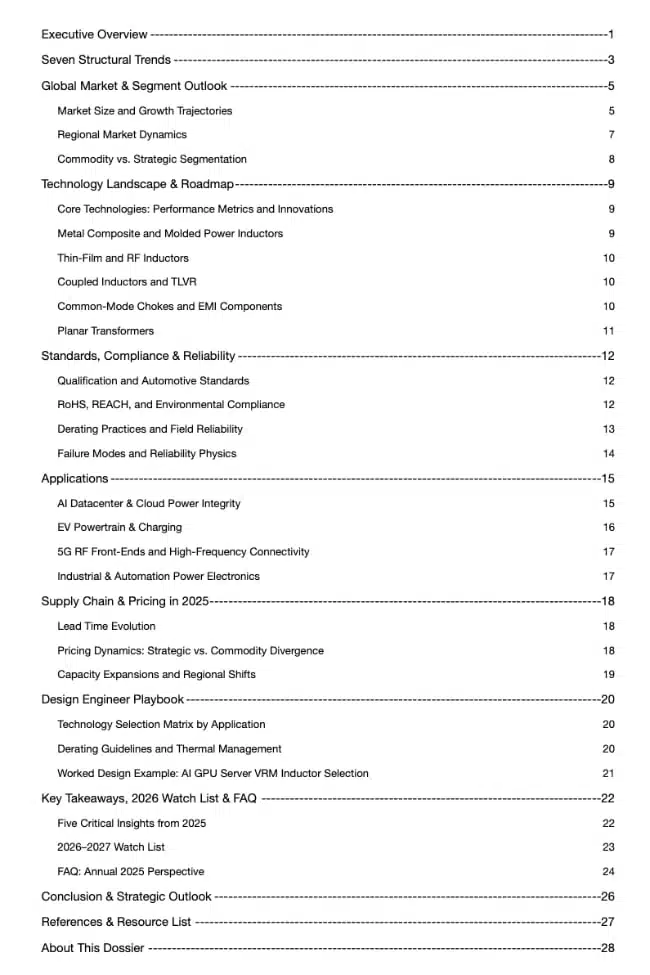
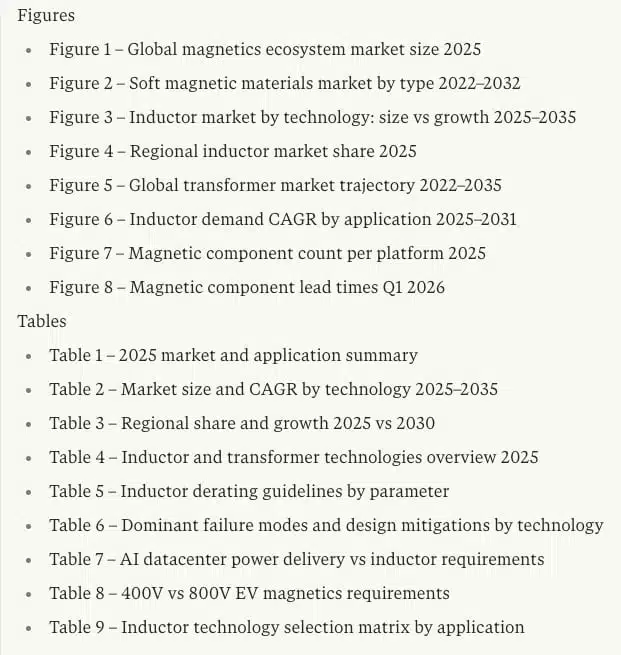
Unlike generic inductor reports that stop at high‑level market sizing, the 2026 Annual Inductor, Transformer & Magnetics Technology Dossier combines:
The result is a compact, high‑density reference that can be read in an afternoon and used all year for strategy, design and sourcing decisions.
© EPCI - Leading Passive Components Educational and Information Site