Click on the Dossier payment button will redirect you to the online payment gateway. After a successful payment, a download link will appear, displaying the PDF report for your download or email transfer. Upon billing details, a PDF invoice will be sent to your email.
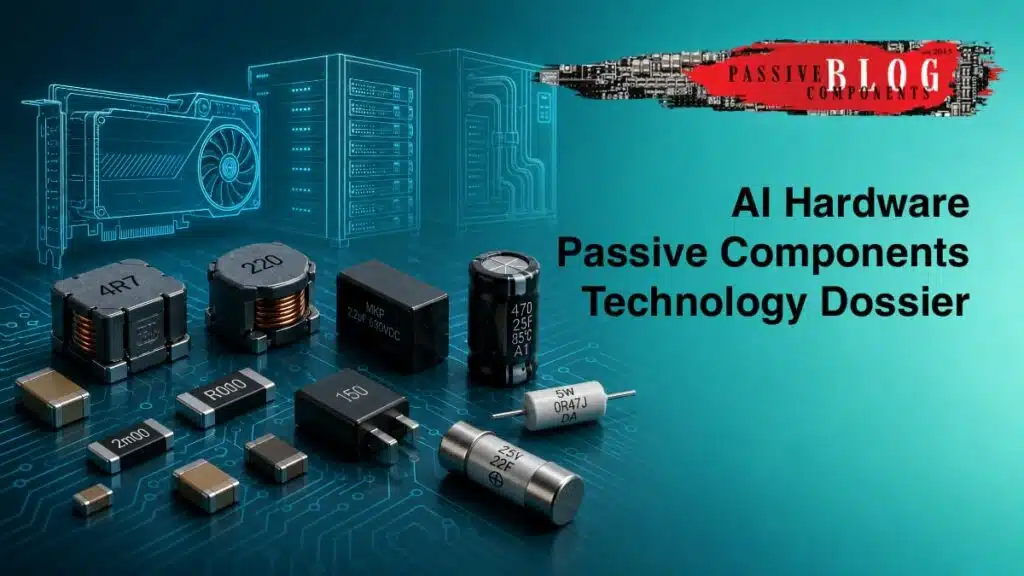
AI Hardware Passive Components Technology Dossier
Passive Components Blog has released the Annual Passive Components for AI Hardware Dossier 06/26, a high‑density, architecture‑driven analysis of how AI hardware design shape and constrain passive electronic components.
From NVIDIA Rubin Ultra NVL576 racks at 600 kW to GB200/GB300 platforms, AI accelerator boards and the emerging Offline‑AI ecosystem of robots, autonomous vehicles and drones, this dossier shows how capacitors, magnetics, resistors, supercapacitors and EMI elements have moved from “background parts” to first‑order limits on power delivery, performance, efficiency and supply risk.
What the dossier covers
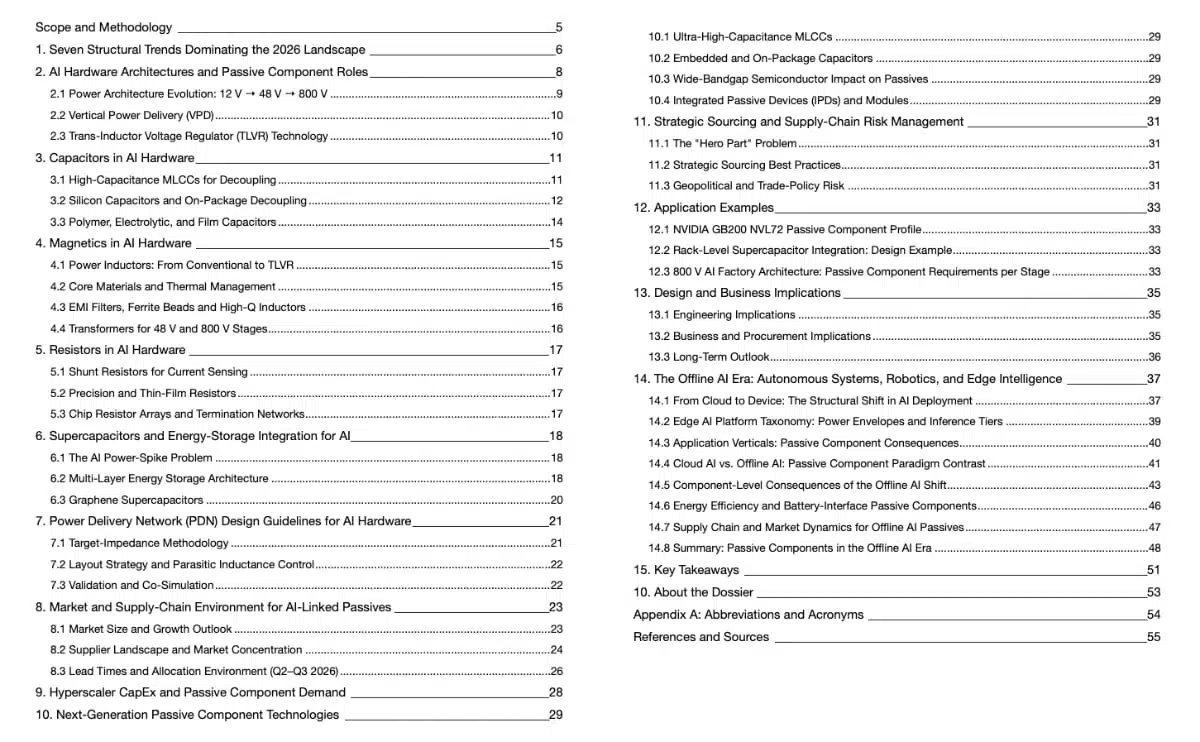
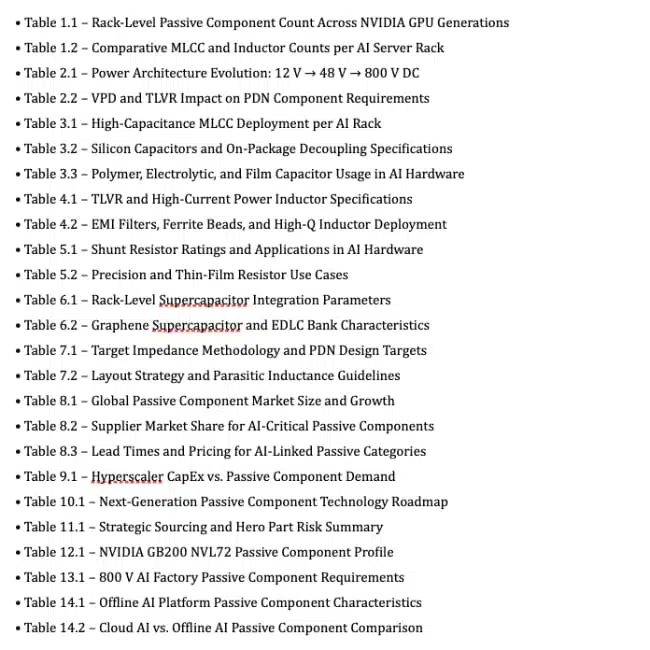
The Passive Components for AI Hardware Dossier 06/26 is a comprehensive annual report focused on AI‑critical passive components across cloud data‑centre and Offline‑AI platforms. It combines hardware‑architecture mapping, component‑technology deep dives, application chapters and design/sourcing guidance into one reference you can use throughout the 2026–2027 design cycle. Structured into fifteen chapters plus abbreviations and references, the dossier covers:
Seven structural trends reshaping AI hardware passives
How the migration from 12 V to 48 V and toward 800 V DC distribution, the adoption of Vertical Power Delivery (VPD) and Trans‑Inductor Voltage Regulator (TLVR) topologies, the explosion in per‑rack MLCC and inductor counts, and the emergence of on‑package silicon capacitors and rack‑level supercapacitor buffers are redefining passive‑component roles and bottlenecks in AI servers.
AI hardware architecture and PDN fundamentals
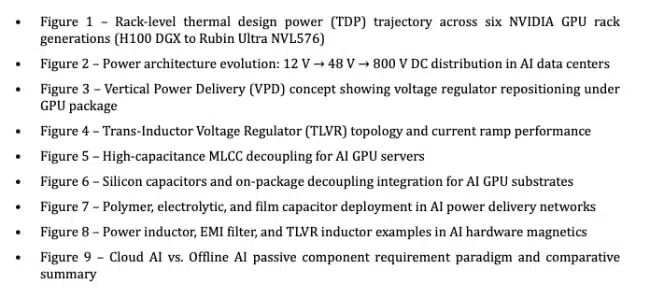
A hardware‑centric view that traces rack‑level thermal design power from H100 DGX to Rubin Ultra NVL576 and maps voltage layers (800 V DC facility, 48 V rack bus, board‑level 12 V, sub‑1.8 V POL rails) to their key passive technologies and critical parameters. The dossier explains how VPD, TLVR and on‑package decoupling change PDN design, decoupling hierarchies and magnetics requirements.
Key passive technologies in AI hardware
Application‑driven chapters for:
- Capacitors: High‑capacitance MLCCs for GPU/HBM decoupling, mid‑ and high‑voltage MLCCs for 48 V and 800 V links, polymer and electrolytic capacitors for bulk energy storage, and film capacitors for DC‑link and snubber roles.
- Silicon capacitors and embedded decoupling: Deep‑trench silicon capacitors (DTCs), embedded ECAP devices and substrate‑integrated passives from Samsung EM, Murata/IPDiA, TSMC iCAP, Empower Semiconductor and others, including competitive landscape and performance metrics.
- Magnetics: TLVR and coupled inductors, VRM and bus inductors, core materials and thermal‑loss modelling, transformers for 48 V and 800 V stages, and EMI‑critical ferrite beads, high‑Q inductors and common‑mode chokes.
- Resistors: Shunt resistors for current sensing at very high currents, precision/ thin‑film resistors for reference paths, and termination networks for high‑speed SerDes and clocking.
- Supercapacitors and rack‑level energy storage: Supercapacitor modules and lithium‑ion capacitors for peak shaving, UPS‑level buffering and AI power‑spike mitigation, including multi‑layer energy‑storage architectures.
Each family is covered in terms of its roles in AI hardware, stress mechanisms, technology options, derating rules and the 2025–2026 shifts in design practice.
PDN design guidelines and checklists for AI hardware
A dedicated chapter provides target‑impedance methodology, decoupling tiering from die‑level ECAPs out to rack‑level supercapacitors, layout and parasitic‑inductance control, and PI/SI/EMC co‑simulation guidance tailored to AI GPU boards and racks. Practical checklists highlight MLCC DC‑bias derating, TLVR inductor core‑loss modelling, shunt resistor temperature behaviour and 800 V compatibility planning.
Market and supply‑chain view for AI‑linked passives
A qualitative 2025–2026 view of AI‑server and Offline‑AI demand, segment growth, supplier concentration and structural supply tightness for MLCCs, TLVR inductors, silicon capacitors, AEC‑Q‑grade passives and rack‑level supercapacitor systems. The dossier discusses lead‑time ranges, price moves and “hero part” risks, and translates them into sourcing strategies, allocation management and supplier‑engagement priorities.
Application examples and Offline‑AI platform impact
Examples show how passives are actually deployed in:
• NVIDIA GB200 NVL72 racks and GB300 evolutions.
• Rack‑level supercapacitor integration for peak‑shaving and energy buffering.
• 800 V “AI factory” architectures, with passive requirements per stage (MVAC → 800 V DC, 800 V bus, 800 V → 48 V resonant conversion, 48 V PDN, GPU/HBM POL).
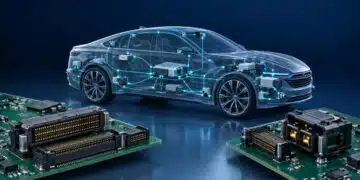
The dossier then explores the Offline‑AI era—autonomous vehicles, robots, drones and other physical‑AI platforms—quantifying projected device volumes and mapping their passive‑component consequences, especially for AEC‑Q200 and industrial‑grade MLCCs, inductors and resistors.