Click on the Dossier payment button will redirect you to the online payment gateway. After a successful payment, a download link will appear, displaying the PDF report for your download or email transfer. Upon billing details, a PDF invoice will be sent to your email.
Automotive Passive Components Technology Annual Dossier
Passive Components Blog has released the Annual Automotive Passive Components Technology Dossier, a 36‑page comprehensive analysis about automotive passive components and how these devices evolved in period from May 2025 to May 2026.
Executive Overview
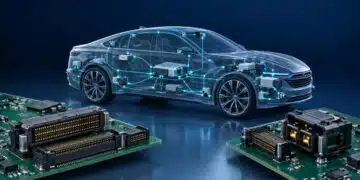
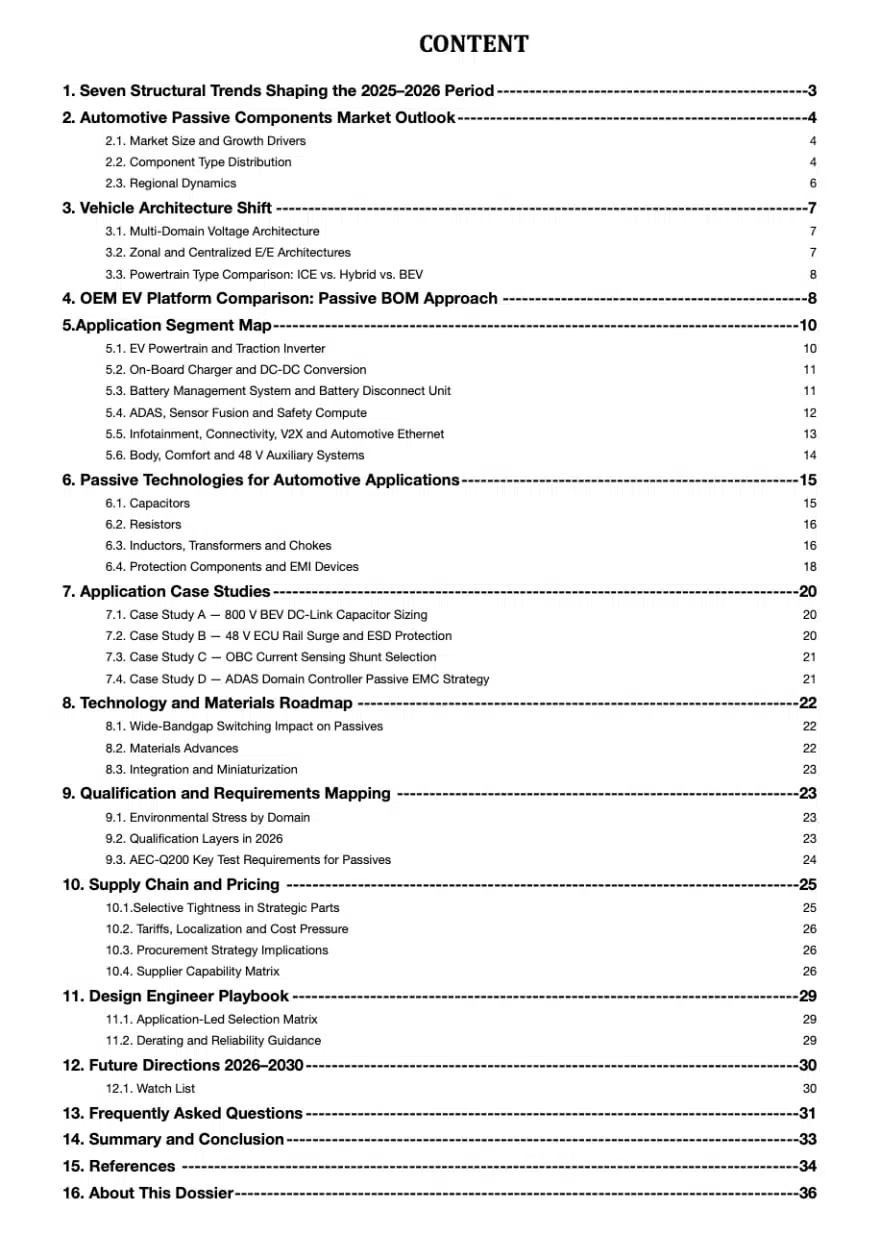
The **Automotive Passive Components Dossier** is a comprehensive annual report focused on the fast-changing role of passive electronic components in automotive applications across the latest 12-month period. It explains how capacitors, resistors, inductors, transformers, EMC filters, and circuit protection devices are evolving from commodity support parts into strategic enablers of electric powertrains, ADAS, zonal electronics, infotainment, connectivity, battery systems, and 48 V architectures.
Unlike component-type dossiers that are organized primarily around capacitor, resistor, or inductor technology families, this dossier is structured by **automotive application segment**. That makes it particularly useful for engineers, sourcing teams, technical marketing, and product managers who need to understand which passive technologies matter most in traction inverters, on-board chargers, DC-DC converters, battery management systems, battery disconnect units, radar and camera modules, vehicle networking, and body electronics.
The report maps the latest automotive passive component trends over the past year, including the continued migration toward 800 V platforms, the impact of SiC and GaN wide-bandgap semiconductors on passive requirements, rising ADAS and domain-controller passive density, the increasing importance of functional safety and qualification, and the divergence between general-purpose passives and high-value automotive-grade segments. It also reviews key component stress factors such as voltage, temperature, vibration, EMI, thermal cycling, low ESL/ESR requirements, current sensing accuracy, and surge / transient robustness.
The dossier combines:
- Market and technology trend analysis for automotive passive components across the latest 12 months.
- Application-focused mapping of passive component requirements by vehicle subsystem.
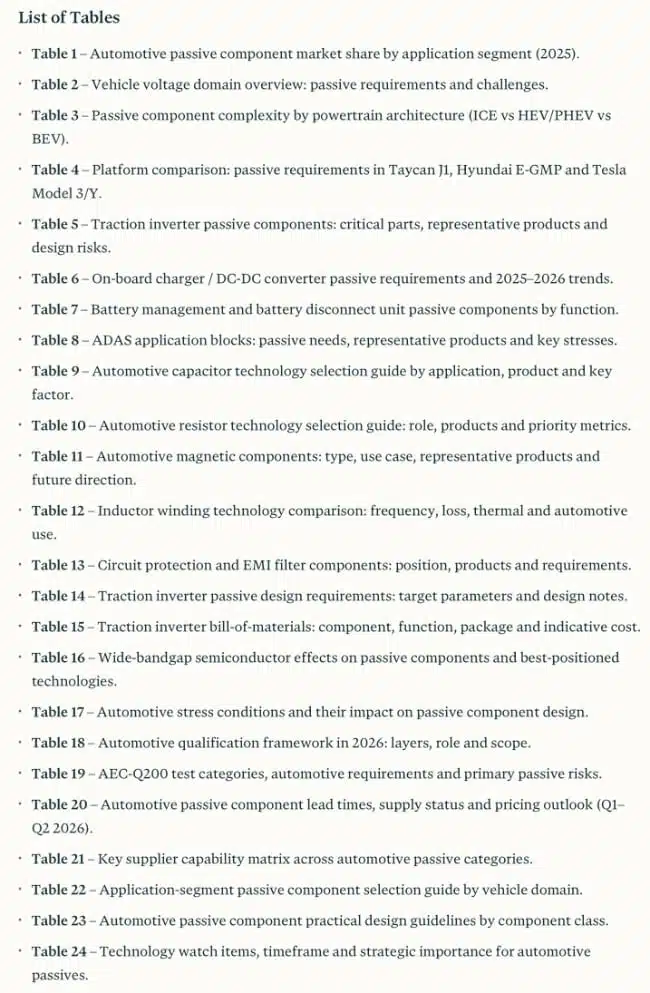
- Comparative tables of best-fit capacitor, resistor, magnetic, EMC, and protection technologies.
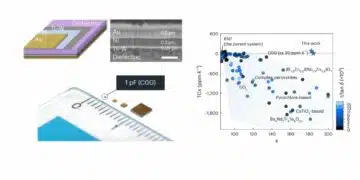
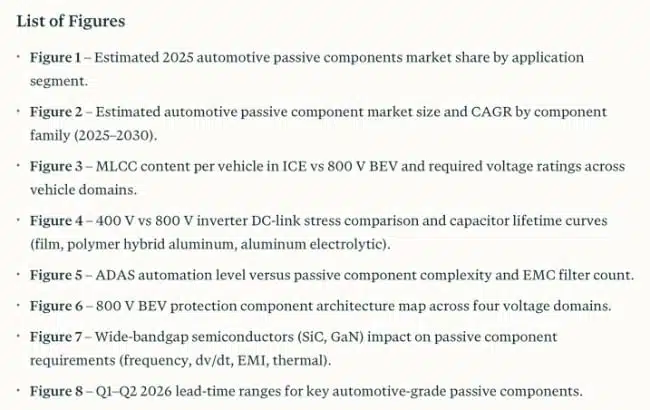
- Figures and visual summaries for EV architecture, ADAS complexity, wide-bandgap impact, supply-chain lead times, and automotive protection structures.
- Guidance on qualification, reliability, and forward-looking technology directions through 2026–2030.
What the dossier covers