













Passive Components Blog
No Result
View All Result
  • Home
  • NewsFilter
    • All
    • Aerospace & Defence
    • Antenna
    • Applications
    • Automotive
    • Capacitors
    • Circuit Protection Devices
    • electro-mechanical news
    • Filters
    • Fuses
    • Inductors
    • Industrial
    • Integrated Passives
    • inter-connect news
    • Market & Supply Chain
    • Market Insights
    • Medical
    • Modelling and Simulation
    • New Materials & Supply
    • New Technologies
    • Non-linear Passives
    • Oscillators
    • Passive Sensors News
    • Resistors
    • RF & Microwave
    • Telecommunication
    • Weekly Digest

    Top 10 Connector Vendors by Product Type

    Bourns Releases High‑Q Air Coil Inductors for RF Aplications

    CMSE 2026 Announces Call for Presentations on High-Reliability Military and Space Electronics

    ESA Call for Papers 6th Space Passive Component Days – SPCD 2026

    Würth Elektronik Offers Halogen‑Free EMC Gaskets for Displays and Housings

    Component Distribution Supply Chain January 2026

    Binder Unveils M8 Flange Solder Connectors for Flexible Cabling

    Power Electronics Tools for Passives and Magnetic Designs

    Modelithics Releases Component Model Library for SIMULIA CST Studio Suite

    Trending Tags

    • Ripple Current
    • RF
    • Leakage Current
    • Tantalum vs Ceramic
    • Snubber
    • Low ESR
    • Feedthrough
    • Derating
    • Dielectric Constant
    • New Products
    • Market Reports
  • VideoFilter
    • All
    • Antenna videos
    • Capacitor videos
    • Circuit Protection Video
    • Filter videos
    • Fuse videos
    • Inductor videos
    • Inter-Connect Video
    • Non-linear passives videos
    • Oscillator videos
    • Passive sensors videos
    • Resistor videos

    One‑Pulse Characterization of Nonlinear Power Inductors

    Thermistor Linearization Challenges

    Coaxial Connectors and How to Connect with PCB

    PCB Manufacturing, Test Methods, Quality and Reliability

    Transformer Behavior – Current Transfer and Hidden Feedback

    Choosing the Right Capacitor: The Importance of Accurate Measurements

    RF Inductors: Selection and Design Challenges for High-Frequency Circuits

    Transformer Safety IEC 61558 Standard

    3-Phase EMI Filter Design, Simulation, Calculation and Test

    Trending Tags

    • Capacitors explained
    • Inductors explained
    • Resistors explained
    • Filters explained
    • Application Video Guidelines
    • EMC
    • New Products
    • Ripple Current
    • Simulation
    • Tantalum vs Ceramic
  • Knowledge Blog
  • DossiersNew
  • Suppliers
    • Who is Who
  • PCNS
    • PCNS 2025
    • PCNS 2023
    • PCNS 2021
    • PCNS 2019
    • PCNS 2017
  • Events
  • Home
  • NewsFilter
    • All
    • Aerospace & Defence
    • Antenna
    • Applications
    • Automotive
    • Capacitors
    • Circuit Protection Devices
    • electro-mechanical news
    • Filters
    • Fuses
    • Inductors
    • Industrial
    • Integrated Passives
    • inter-connect news
    • Market & Supply Chain
    • Market Insights
    • Medical
    • Modelling and Simulation
    • New Materials & Supply
    • New Technologies
    • Non-linear Passives
    • Oscillators
    • Passive Sensors News
    • Resistors
    • RF & Microwave
    • Telecommunication
    • Weekly Digest

    Top 10 Connector Vendors by Product Type

    Bourns Releases High‑Q Air Coil Inductors for RF Aplications

    CMSE 2026 Announces Call for Presentations on High-Reliability Military and Space Electronics

    ESA Call for Papers 6th Space Passive Component Days – SPCD 2026

    Würth Elektronik Offers Halogen‑Free EMC Gaskets for Displays and Housings

    Component Distribution Supply Chain January 2026

    Binder Unveils M8 Flange Solder Connectors for Flexible Cabling

    Power Electronics Tools for Passives and Magnetic Designs

    Modelithics Releases Component Model Library for SIMULIA CST Studio Suite

    Trending Tags

    • Ripple Current
    • RF
    • Leakage Current
    • Tantalum vs Ceramic
    • Snubber
    • Low ESR
    • Feedthrough
    • Derating
    • Dielectric Constant
    • New Products
    • Market Reports
  • VideoFilter
    • All
    • Antenna videos
    • Capacitor videos
    • Circuit Protection Video
    • Filter videos
    • Fuse videos
    • Inductor videos
    • Inter-Connect Video
    • Non-linear passives videos
    • Oscillator videos
    • Passive sensors videos
    • Resistor videos

    One‑Pulse Characterization of Nonlinear Power Inductors

    Thermistor Linearization Challenges

    Coaxial Connectors and How to Connect with PCB

    PCB Manufacturing, Test Methods, Quality and Reliability

    Transformer Behavior – Current Transfer and Hidden Feedback

    Choosing the Right Capacitor: The Importance of Accurate Measurements

    RF Inductors: Selection and Design Challenges for High-Frequency Circuits

    Transformer Safety IEC 61558 Standard

    3-Phase EMI Filter Design, Simulation, Calculation and Test

    Trending Tags

    • Capacitors explained
    • Inductors explained
    • Resistors explained
    • Filters explained
    • Application Video Guidelines
    • EMC
    • New Products
    • Ripple Current
    • Simulation
    • Tantalum vs Ceramic
  • Knowledge Blog
  • DossiersNew
  • Suppliers
    • Who is Who
  • PCNS
    • PCNS 2025
    • PCNS 2023
    • PCNS 2021
    • PCNS 2019
    • PCNS 2017
  • Events
No Result
View All Result
Passive Components Blog
No Result
View All Result

Photoemission spectroscopy XPS how it works and assist in EEE parts analysis

6.6.2019
Reading Time: 5 mins read
A A

Source: Alter Technology article

by Francisco Javier Aparicio Rebollo, Senior materials and Test Engineer at Alter Technology.

RelatedPosts

Top 10 Connector Vendors by Product Type

Bourns Releases High‑Q Air Coil Inductors for RF Aplications

CMSE 2026 Announces Call for Presentations on High-Reliability Military and Space Electronics

X-ray photoemission spectroscopy (XPS) also known as electron spectroscopy for chemical analysis (ESCA) is a surface-sensitive quantitative analysis method to accurately determine the elemental composition of solid materials.

The technique is the most extended tool for the chemical characterization of thin films coatings and surfaces either for industrial applications as well as for research. Amongst others, this is so due to:

  • The non-destructive
  • The broad analysis window that cover all the elements unless H and He.
  • The high sensitivity.
    • For heavy metals detection limit < 0.005 % atomic concertation (ppm in weight).
    • For light organic and inorganic elements detection limit < 1 %.
  • Free of matrix effects which compromise the reliability of other techniques such as EDS, XRF, and FTIR.

Practical Applications

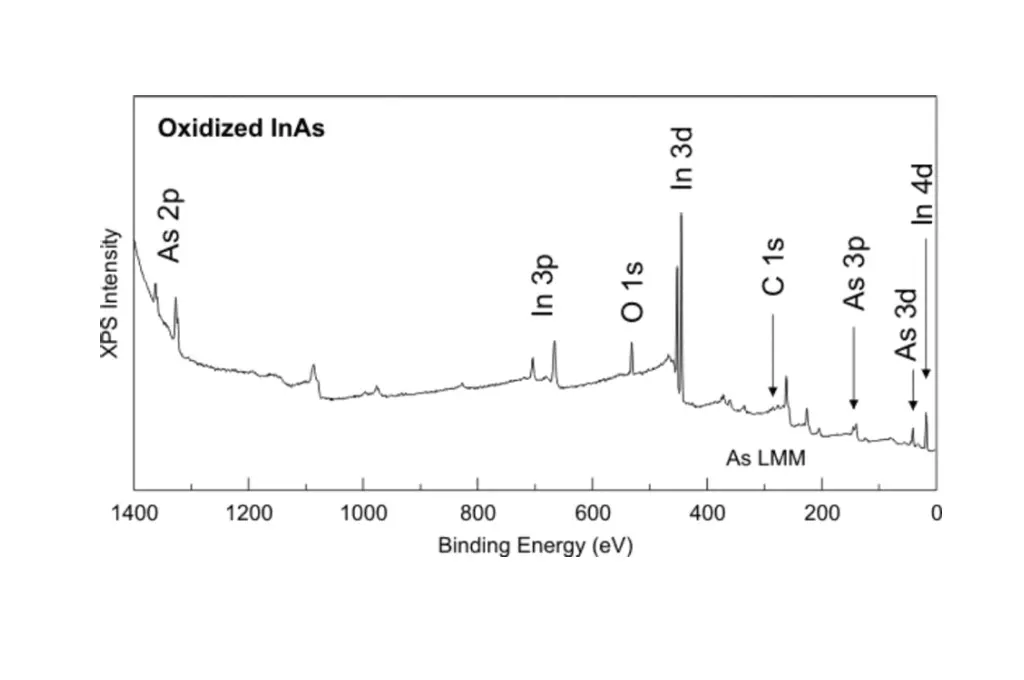
The figure shows a representative example of the XPS survey spectrum of a sample containing both heavy and light elements of interest for technological applications. This illustrates the suitability of the technique for the simultaneous detection of either heavy and light nucleus within the limit Z > 2. Hence, XPS is one of the most reliable approaches for the non-destructive quantification of the atomic concentration in solid coatings.

featured image: example of XPS survey spectrum

Considering the low escape depth of the photoelectrons the inspection thickness of typical XPS instruments is of ≈ 1-3 nm. This makes this technique the most suitable for the thin-film and surface applications and processes. Nonetheless, is not so surface sensitive that the inevitable contamination developed during industrial processes completely hidden the actual sample composition, in contrast to other techniques that require ultra-high cleanliness levels only achievable by preconditioning by sputtering.

Considering the low escape depth of the photoelectrons the inspection thickness of typical XPS instruments is of ≈ 1-3 nm. This makes this technique the most suitable for the thin-film and surface applications and processes. Nonetheless, is not so surface sensitive that the inevitable contamination developed during industrial processes completely hidden the actual sample composition, in contrast to other techniques that require ultra-high cleanliness levels only achievable by preconditioning by sputtering.

XPS analysis is demanded many industrial applications where the surface composition is a critical factor:XPS analysis

  • Photovoltaics.
  • Electronics devices and EEE parts.
  • Packaging systems.
  • Display technology.
  • Magnetic media.
  • Corrosion (oxidation).

How it works

XPS working principle is based upon the photoelectric effect described in the figure.
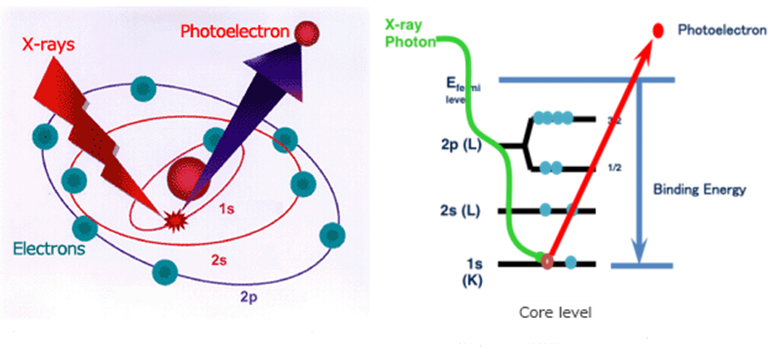
XPS Working principle

When a photon impinges into the sample surface its energy can be absorbed completely by the electronic cloud of the atoms present in the sample. If the energy is high enough, this can cause the sample ionization and the ejection of the so-called photoelectrons with a kinetic energy that according to the Einstein equation [1] is determined by the electron binding energy of the ejected electron and photon energy.

Ekinetic = hν – Ebinding                                                                                        [1]

The binding energy of valence band electrons does not only depend on the elemental composition but also on the material characteristics such as the crystalline phase and others, whereas in the case of internal core electrons the binding energy is characteristics of the atoms source and the electronic level. Thus, according to this principle, XPS makes use of high energy X-ray photons to induce the photoemission of the core electrons who escape with a kinetic energy that is specific to the emitting chemical element.

Additional advantages
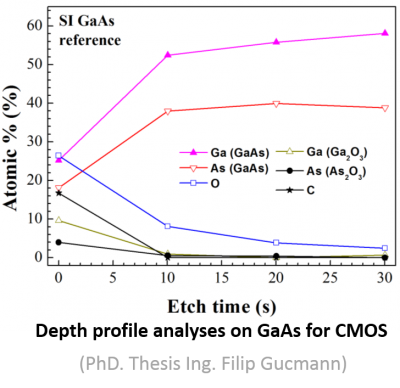
In addition to surface analyses, it is also used for the fine characterization of heterogeneous samples where the composition changes along with the depth. Thus, in combination with sputtering guns, the technique is used to perform depth profiles elemental analyses.

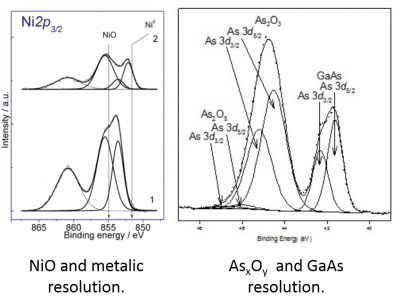
Moreover, the core energy is slightly distorted by the chemical environment what is used in an advantageous way to determine the oxidation estate of the element by fitting procedures. This is illustrated in the next figure, which shows the technique resolve the presence of metallic nickel and (Ni0) and nickel oxide (NiO) and distinguishes between arsenic oxide and gallium arsenide.

Alter Technology compromises 

During the last decade, Alter technology has established a solid collaborating network with reputed research institutions and technological centers. This grant Alter access to different XPS instruments and specifically conceived for different applications: conventional XPS, depth profiles analyses. angle-resolved XPS, UPS, and others.


Related

Recent Posts

Power Electronics Tools for Passives and Magnetic Designs

27.1.2026
60

DC/DC Push‑Pull Converter vs PSFB Design Guide

12.1.2026
145

Energy-Controlled Structural Evolution of Amorphous Ta₂O₅ in Tantalum Anodes

6.1.2026
63

Towards Green and Sustainable Supercapacitors

30.12.2025
63

Mechano-Chemical Model of Sintered Tantalum Capacitor Pellets

29.12.2025
64

One‑Pulse Characterization of Nonlinear Power Inductors

22.12.2025
100

Reliability Improvement in BaTiO3 MLCCs Using Ni–Sn and Ni–In Alloy Electrodes

19.12.2025
109

Mechanical Testing of Tantalum Anodes to Predict Tantalum Capacitor Quality

17.12.2025
56

Thermistor Linearization Challenges

17.12.2025
118

Upcoming Events

Feb 24
16:00 - 17:00 CET

Designing Qi2 Wireless Power Systems: Practical Development and EMC Optimization

Mar 3
16:00 - 17:00 CET

Cybersecurity at the Eleventh Hour – from RED to CRA – Information and Discussion

Mar 21
All day

PSMA Capacitor Workshop 2026

View Calendar

Popular Posts

  • Buck Converter Design and Calculation

    0 shares
    Share 0 Tweet 0
  • Boost Converter Design and Calculation

    0 shares
    Share 0 Tweet 0
  • LLC Resonant Converter Design and Calculation

    0 shares
    Share 0 Tweet 0
  • Flyback Converter Design and Calculation

    0 shares
    Share 0 Tweet 0
  • Ripple Current and its Effects on the Performance of Capacitors

    3 shares
    Share 3 Tweet 0
  • How Metal Prices Are Driving Passive Component Price Hikes

    0 shares
    Share 0 Tweet 0
  • MLCC and Ceramic Capacitors

    0 shares
    Share 0 Tweet 0
  • Dual Active Bridge (DAB) Topology

    0 shares
    Share 0 Tweet 0
  • Degradation of Capacitors and its Failure Mechanisms

    0 shares
    Share 0 Tweet 0
  • What is a Dielectric Constant and DF of Plastic Materials?

    4 shares
    Share 4 Tweet 0

Newsletter Subscription


Passive Components Blog

© EPCI - Leading Passive Components Educational and Information Site

  • Home
  • Privacy Policy
  • EPCI Membership & Advertisement
  • About

No Result
View All Result
  • Home
  • Knowledge Blog
  • PCNS

© EPCI - Leading Passive Components Educational and Information Site

This website uses cookies. By continuing to use this website you are giving consent to cookies being used. Visit our Privacy and Cookie Policy.
Go to mobile version