






Passive Components Blog
No Result
View All Result
  • Home
  • NewsFilter
    • All
    • Aerospace & Defence
    • Antenna
    • Applications
    • Automotive
    • Capacitors
    • Circuit Protection Devices
    • electro-mechanical news
    • Filters
    • Fuses
    • Inductors
    • Industrial
    • Integrated Passives
    • inter-connect news
    • Market & Supply Chain
    • Market Insights
    • Medical
    • Modelling and Simulation
    • New Materials & Supply
    • New Technologies
    • Non-linear Passives
    • Oscillators
    • Passive Sensors News
    • Resistors
    • RF & Microwave
    • Telecommunication
    • Weekly Digest

    KYOCERA AVX Introduces Traction‑Grade DC Link Film Capacitors

    When More Capacitance Hurts Reliability: The Role of the Metallic Skeleton in Tantalum Anodes

    Why Power Inductors Use a Ferrite Core With an Air Gap

    Wk 16 Electronics Supply Chain Digest

    YAGEO Introduces High‑Current Y2/X1 Film Capacitors for Wide-bandgap Power Systems

    Amphenol Explanded Liquid Cooling Connectors for AI, ESS and EV Systems

    Hirose Introduced BGA connector for PCIe Gen6 for AI and Edge Computing

    YAGEO Introduces High Rel MLCCs Beyond MIL-Spec Limits

    Würth Elektronik Expanded Capacity for Validation and Services in Asia

    Trending Tags

    • Ripple Current
    • RF
    • Leakage Current
    • Tantalum vs Ceramic
    • Snubber
    • Low ESR
    • Feedthrough
    • Derating
    • Dielectric Constant
    • New Products
    • Market Reports
  • VideoFilter
    • All
    • Antenna videos
    • Capacitor videos
    • Circuit Protection Video
    • Filter videos
    • Fuse videos
    • Inductor videos
    • Inter-Connect Video
    • Non-linear passives videos
    • Oscillator videos
    • Passive sensors videos
    • Resistor videos

    Why Power Inductors Use a Ferrite Core With an Air Gap

    Transformer-Based Power-Line Harvester Magnetic Design

    Thermal Modeling of Magnetics

    Standard vs Planar LLC transformers Comparison for Battery Chargers

    How Modern Tools Model Magnetic Components for Power Electronics

    Advanced Loss Modeling for Planar Magnetics in the Frenetic Planar Tool

    2026 Power Magnetics Design Trends: Flyback, DAB and Planar

    Enabling Software‑Defined Vehicle Architectures: Automotive Ethernet and Zonal Smart Power

    Calculating Resistance Value of a Flyback RC Snubber 

    Trending Tags

    • Capacitors explained
    • Inductors explained
    • Resistors explained
    • Filters explained
    • Application Video Guidelines
    • EMC
    • New Products
    • Ripple Current
    • Simulation
    • Tantalum vs Ceramic
  • Knowledge Blog
  • DossiersNew
  • Suppliers
    • Who is Who
  • PCNS
    • PCNS 2025
    • PCNS 2023
    • PCNS 2021
    • PCNS 2019
    • PCNS 2017
  • Events
  • Home
  • NewsFilter
    • All
    • Aerospace & Defence
    • Antenna
    • Applications
    • Automotive
    • Capacitors
    • Circuit Protection Devices
    • electro-mechanical news
    • Filters
    • Fuses
    • Inductors
    • Industrial
    • Integrated Passives
    • inter-connect news
    • Market & Supply Chain
    • Market Insights
    • Medical
    • Modelling and Simulation
    • New Materials & Supply
    • New Technologies
    • Non-linear Passives
    • Oscillators
    • Passive Sensors News
    • Resistors
    • RF & Microwave
    • Telecommunication
    • Weekly Digest

    KYOCERA AVX Introduces Traction‑Grade DC Link Film Capacitors

    When More Capacitance Hurts Reliability: The Role of the Metallic Skeleton in Tantalum Anodes

    Why Power Inductors Use a Ferrite Core With an Air Gap

    Wk 16 Electronics Supply Chain Digest

    YAGEO Introduces High‑Current Y2/X1 Film Capacitors for Wide-bandgap Power Systems

    Amphenol Explanded Liquid Cooling Connectors for AI, ESS and EV Systems

    Hirose Introduced BGA connector for PCIe Gen6 for AI and Edge Computing

    YAGEO Introduces High Rel MLCCs Beyond MIL-Spec Limits

    Würth Elektronik Expanded Capacity for Validation and Services in Asia

    Trending Tags

    • Ripple Current
    • RF
    • Leakage Current
    • Tantalum vs Ceramic
    • Snubber
    • Low ESR
    • Feedthrough
    • Derating
    • Dielectric Constant
    • New Products
    • Market Reports
  • VideoFilter
    • All
    • Antenna videos
    • Capacitor videos
    • Circuit Protection Video
    • Filter videos
    • Fuse videos
    • Inductor videos
    • Inter-Connect Video
    • Non-linear passives videos
    • Oscillator videos
    • Passive sensors videos
    • Resistor videos

    Why Power Inductors Use a Ferrite Core With an Air Gap

    Transformer-Based Power-Line Harvester Magnetic Design

    Thermal Modeling of Magnetics

    Standard vs Planar LLC transformers Comparison for Battery Chargers

    How Modern Tools Model Magnetic Components for Power Electronics

    Advanced Loss Modeling for Planar Magnetics in the Frenetic Planar Tool

    2026 Power Magnetics Design Trends: Flyback, DAB and Planar

    Enabling Software‑Defined Vehicle Architectures: Automotive Ethernet and Zonal Smart Power

    Calculating Resistance Value of a Flyback RC Snubber 

    Trending Tags

    • Capacitors explained
    • Inductors explained
    • Resistors explained
    • Filters explained
    • Application Video Guidelines
    • EMC
    • New Products
    • Ripple Current
    • Simulation
    • Tantalum vs Ceramic
  • Knowledge Blog
  • DossiersNew
  • Suppliers
    • Who is Who
  • PCNS
    • PCNS 2025
    • PCNS 2023
    • PCNS 2021
    • PCNS 2019
    • PCNS 2017
  • Events
No Result
View All Result
Passive Components Blog
No Result
View All Result

Influence of Tantalum Capacitor Pellets Size on Stability During Oxide Film Formation

23.2.2026
Reading Time: 6 mins read
A A

This article by Dr. V. Azbel, an Independent consultant on tantalum capacitors investigates influence of the size of sintered tantalum pellets on stability during the tantalum oxide film formation.

This study examines the impact of geometric dimensions on the mechanical properties and stability of sintered porous tantalum pellets during oxide film formation.

RelatedPosts

When More Capacitance Hurts Reliability: The Role of the Metallic Skeleton in Tantalum Anodes

AI-Assisted Structural Diagnostics and Physics-Based Reliability Interpretation of Tantalum Capacitor Anodes

Tantalum Capacitor Anode Manufacturing Quality Management

All technological parameters, including powder grade, pressing density, sintering temperature and time, shrinkage, and oxygen content, were kept constant, with the sole variable being pellet size. The findings indicate that yield strength and heat dissipation, both influenced by neck size, are critical factors in determining stability during formation.

Introduction

Sintered porous tantalum pellets, produced from 20 kCV/g powder with a green density of 5.5 g/cm³ and sintered at 1620°C for 20 minutes, are utilized in the manufacturing of tantalum capacitor anodes. Given identical sintering conditions, shrinkage was uniform across samples.

The morphology of the porous structure significantly affects the pellets’ behavior during oxide film formation. Stress-strain curve characteristics were employed as numerical indicators. Previous research has shown that yield strength, Young’s modulus (k₁), and the hardening coefficient (k₂) are contingent upon pressing and sintering conditions. In this study, all parameters and pellet shapes were consistent, allowing for an exploration of the effects of pellet size on thermal conductivity, internal stresses, and stability during formation.

Experimental

In an experimental study, tantalum powder of uniform grade, with a specific gravity of 20 kCV/g, was used to create pellets under identical processing conditions, including temperature, time, density, shrinkage, and oxygen content.

The pellets were categorized into two sizes: Pellet A, which had a smaller diameter and height, and Pellet B, which was larger in dimensions. After sintering, both pellets were subjected to electrolytic formation at the same voltages using two different electrolytes: 0.01% H₃PO₄ and a mixture of 50% glycol with 0.05% H₃PO₄. These electrolytes differ in conductivity, which affects the electrolysis rate and heat dissipation, with the formation current normalized to mass in amperes per gram.

Processing Conditions: Pellets A and B were processed under identical conditions (temperature, time, density, shrinkage, oxygen content).

Samples: 

  • Pellet A: Smaller diameter and height.
  • Pellet B: Larger dimensions.
Pellet SizePellet APellet B
diameter [mm]3.14.83
height [mm]110

Post-sintering, the pellets underwent electrolytic formation at identical voltages in two electrolytes:

  • 0.01% H₃PO₄
  • 50% glycol + 0.05% H₃PO₄

These electrolytes vary in conductivity, influencing the electrolysis rate and heat dissipation. The formation current was normalized to mass (A/g).

Results

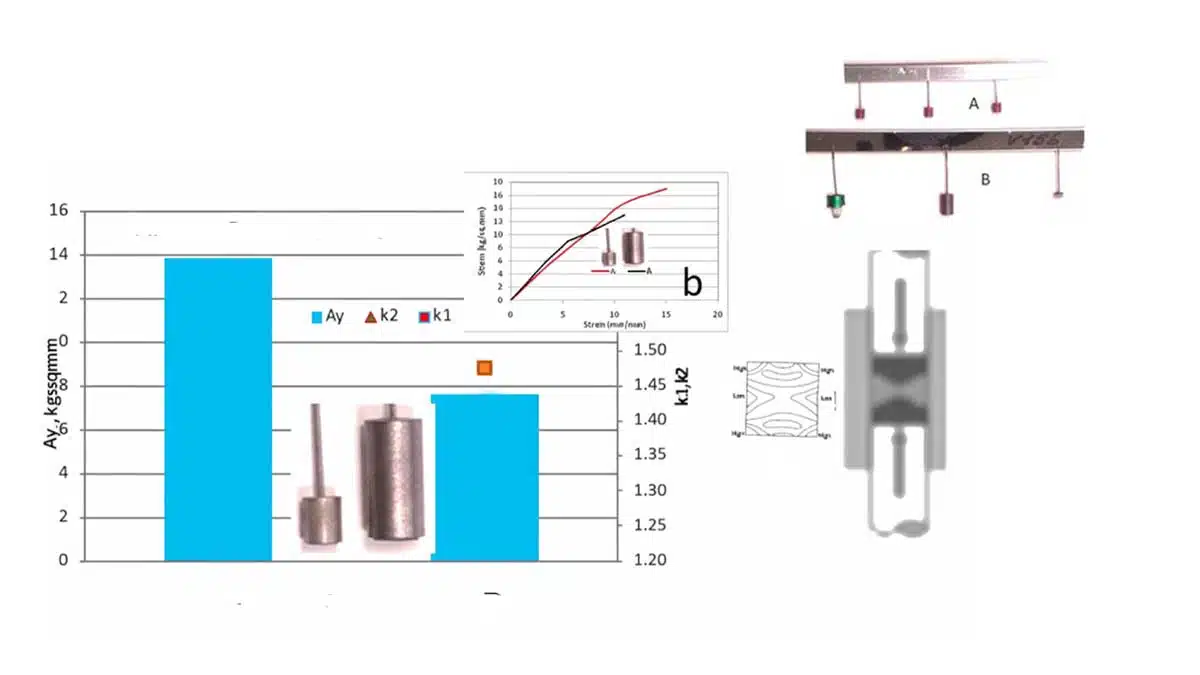
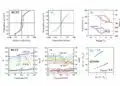
The results, as depicted in Figure 1, include combined data on mechanical parameters, stress-strain diagrams, and stress distribution under compression for both pellets.
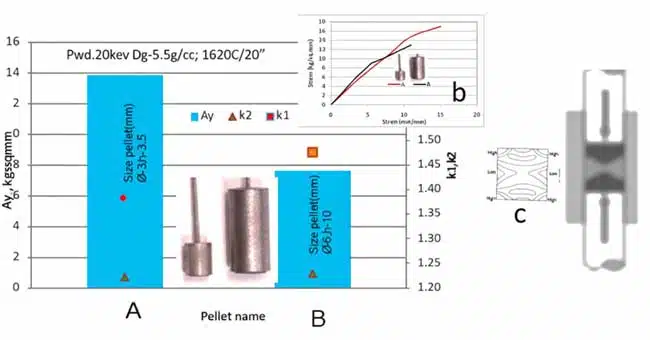
Pellet A demonstrated a yield strength approximately 40% higher than Pellet B, suggesting a larger cross-section of necks in its porous structure and superior heat dissipation. The variation in pellet size led to different stress distributions and density distributions, influencing neck size.

During the formation process, in the 0.01% H₃PO₄ electrolyte, Pellet A maintained its integrity, while Pellet B was destroyed. However, in the low-conductivity electrolyte consisting of 50% glycol and 0.05% H₃PO₄, both pellets underwent formation without destruction. The reduced conductivity in this electrolyte slowed down film growth and heat release, ensuring stability even for pellets with lower yield strength.
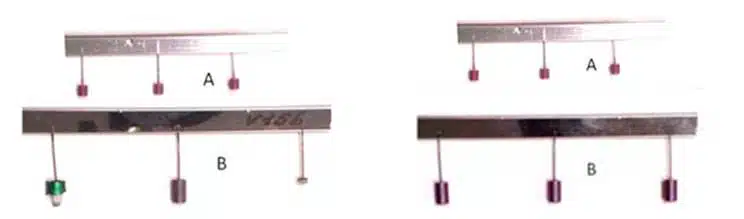
Behavior of pellets A and B during formation in 0.01% H₃PO₄ electrolyte (left) and  in low-conductivity electrolyte 50% glycol + 0.05% H₃PO₄

In summary – behavior during formation:

  • In 0.01% H₃PO₄ Electrolyte: 
    • Pellet A maintains integrity.
    • Pellet B is destroyed.
  • In Low-Conductivity Electrolyte (50% glycol + 0.05% H₃PO₄): 
    • Both pellets undergo formation without destruction.
    • Reduced conductivity slows film growth and heat release, ensuring stability even for pellets with lower yield strength.

Discussion

The discussion highlights several key points:

1. Heat Dissipation and Yield Strength Yield strength is correlated with the cross-sectional size of necks in the porous structure. Higher yield strength, at similar k₂ values, enhances heat dissipation.

2. Role of Pellet Size: Differences in pellet dimensions lead to varied stress distributions and heat dissipation capabilities.

3. Electrolyte and Film Growth Rate**: Lower electrolyte conductivity reduces oxide film growth rate, heat generation, and enhances pellet stability during formation.

4. Indirect Estimation of Stress Distribution: Stress distributions are not directly observable but can be inferred from stress-strain curves.

Conclusion

In conclusion, under identical technological parameters, the behavior of sintered tantalum pellets during formation is solely influenced by their size. Pressing and sintered density are not reliable indicators of the porous structure. Yield strength, correlating with neck size and heat dissipation, is the key factor in stability. For pellets with lower yield strength, reducing the oxide film growth rate using electrolytes of lower conductivity decreases heat generation and prevents destruction.

Appendix

Strain-Stress Curve Parameters for Porous Materials

Yield Stress (Ay): The yield stress of porous materials is related to the ratio of neck size (X) to primary powder particle size (D) by the equation:

Ay = b*A0*(X/D)², where b is an empirical constant, Ay is the yield point of the sintered porous material, and A0 is the yield point of the deformed material.

Young’s Modulus (k1 ~ E): Described by the equation: k1 ~ E = E0 (1-p/pc), where E is the elastic modulus of a porous material, E0 is the modulus of solid material at density pc ~ 1, and p is the porosity-related density.

Hardening Coefficient (k2 ~ P): An exponential coefficient correlating with material defectiveness.

Note: The size D determines BET.

References

Vladimir Azbel: Structural Interpretation of Reliability in Tantalum Capacitor Anodes
Related

Source: Azbel

Recent Posts

KYOCERA AVX Introduces Traction‑Grade DC Link Film Capacitors

21.4.2026
3

When More Capacitance Hurts Reliability: The Role of the Metallic Skeleton in Tantalum Anodes

20.4.2026
16

YAGEO Introduces High‑Current Y2/X1 Film Capacitors for Wide-bandgap Power Systems

17.4.2026
15

YAGEO Introduces High Rel MLCCs Beyond MIL-Spec Limits

16.4.2026
42

Samsung Introduces Ultra-High-Voltage 1500 V MLCCs for xEV Powertrains

16.4.2026
21

YAGEO Q1 2026 Results: AI Servers and Pricing Power Behind a Moderate Q2 Outlook

16.4.2026
61

Samsung Presents MLCC Selection Guide for Humanoids and Robotic Applications

15.4.2026
28

AI-Assisted Structural Diagnostics and Physics-Based Reliability Interpretation of Tantalum Capacitor Anodes

14.4.2026
31

KYOCERA AVX MIL-PRF-32535 BME NP0 MLCCs Approved to the DLA QPD

16.4.2026
29

Upcoming Events

Apr 21
16:00 - 17:00 CEST

Heatsink Solutions: Thermal Management in electronic devices

Apr 22
17:00 - 17:30 CEST

Magnetics in a high frequency GaN era

Apr 22
17:00 - 18:00 CEST

Derating Tantalum, Film, and Ceramic Capacitors

View Calendar

Popular Posts

  • Buck Converter Design and Calculation

    0 shares
    Share 0 Tweet 0
  • Boost Converter Design and Calculation

    0 shares
    Share 0 Tweet 0
  • Flyback Converter Design and Calculation

    0 shares
    Share 0 Tweet 0
  • LLC Resonant Converter Design and Calculation

    0 shares
    Share 0 Tweet 0
  • Dual Active Bridge (DAB) Topology

    0 shares
    Share 0 Tweet 0
  • MLCC and Ceramic Capacitors

    0 shares
    Share 0 Tweet 0
  • Capacitor Charging and Discharging

    0 shares
    Share 0 Tweet 0
  • Ripple Current and its Effects on the Performance of Capacitors

    3 shares
    Share 3 Tweet 0
  • MLCC Case Sizes Standards Explained

    0 shares
    Share 0 Tweet 0
  • Plastic Materials Dielectric Constant and DF

    4 shares
    Share 4 Tweet 0

Newsletter Subscription


Passive Components Blog

© EPCI - Leading Passive Components Educational and Information Site

  • Home
  • Privacy Policy
  • EPCI Membership & Advertisement
  • About

No Result
View All Result
  • Home
  • Knowledge Blog
  • PCNS

© EPCI - Leading Passive Components Educational and Information Site

This website uses cookies. By continuing to use this website you are giving consent to cookies being used. Visit our Privacy and Cookie Policy.
Go to mobile version