




Passive Components Blog
No Result
View All Result
  • Home
  • NewsFilter
    • All
    • Aerospace & Defence
    • Antenna
    • Applications
    • Automotive
    • Capacitors
    • Circuit Protection Devices
    • electro-mechanical news
    • Filters
    • Fuses
    • Inductors
    • Industrial
    • Integrated Passives
    • inter-connect news
    • Market & Supply Chain
    • Market Insights
    • Medical
    • Modelling and Simulation
    • New Materials & Supply
    • New Technologies
    • Non-linear Passives
    • Oscillators
    • Passive Sensors News
    • Resistors
    • RF & Microwave
    • Telecommunication
    • Weekly Digest

    Modelithics Releases COMPLETE v26.1 for Keysight ADS

    April 2026 Interconnect, Passives and Electromechanical Components Market Insights

    SPICE Simulation of Non-Linear Resistors: Vishay’s Thermistor and PPTC Modelling Ecosystem

    KYOCERA AVX Introduces Traction‑Grade DC Link Film Capacitors

    When More Capacitance Hurts Reliability: The Role of the Metallic Skeleton in Tantalum Anodes

    Why Power Inductors Use a Ferrite Core With an Air Gap

    Wk 16 Electronics Supply Chain Digest

    YAGEO Introduces High‑Current Y2/X1 Film Capacitors for Wide-bandgap Power Systems

    Amphenol Explanded Liquid Cooling Connectors for AI, ESS and EV Systems

    Trending Tags

    • Ripple Current
    • RF
    • Leakage Current
    • Tantalum vs Ceramic
    • Snubber
    • Low ESR
    • Feedthrough
    • Derating
    • Dielectric Constant
    • New Products
    • Market Reports
  • VideoFilter
    • All
    • Antenna videos
    • Capacitor videos
    • Circuit Protection Video
    • Filter videos
    • Fuse videos
    • Inductor videos
    • Inter-Connect Video
    • Non-linear passives videos
    • Oscillator videos
    • Passive sensors videos
    • Resistor videos

    Why Power Inductors Use a Ferrite Core With an Air Gap

    Transformer-Based Power-Line Harvester Magnetic Design

    Thermal Modeling of Magnetics

    Standard vs Planar LLC transformers Comparison for Battery Chargers

    How Modern Tools Model Magnetic Components for Power Electronics

    Advanced Loss Modeling for Planar Magnetics in the Frenetic Planar Tool

    2026 Power Magnetics Design Trends: Flyback, DAB and Planar

    Enabling Software‑Defined Vehicle Architectures: Automotive Ethernet and Zonal Smart Power

    Calculating Resistance Value of a Flyback RC Snubber 

    Trending Tags

    • Capacitors explained
    • Inductors explained
    • Resistors explained
    • Filters explained
    • Application Video Guidelines
    • EMC
    • New Products
    • Ripple Current
    • Simulation
    • Tantalum vs Ceramic
  • Knowledge Blog
  • DossiersNew
  • Suppliers
    • Who is Who
  • PCNS
    • PCNS 2025
    • PCNS 2023
    • PCNS 2021
    • PCNS 2019
    • PCNS 2017
  • Events
  • Home
  • NewsFilter
    • All
    • Aerospace & Defence
    • Antenna
    • Applications
    • Automotive
    • Capacitors
    • Circuit Protection Devices
    • electro-mechanical news
    • Filters
    • Fuses
    • Inductors
    • Industrial
    • Integrated Passives
    • inter-connect news
    • Market & Supply Chain
    • Market Insights
    • Medical
    • Modelling and Simulation
    • New Materials & Supply
    • New Technologies
    • Non-linear Passives
    • Oscillators
    • Passive Sensors News
    • Resistors
    • RF & Microwave
    • Telecommunication
    • Weekly Digest

    Modelithics Releases COMPLETE v26.1 for Keysight ADS

    April 2026 Interconnect, Passives and Electromechanical Components Market Insights

    SPICE Simulation of Non-Linear Resistors: Vishay’s Thermistor and PPTC Modelling Ecosystem

    KYOCERA AVX Introduces Traction‑Grade DC Link Film Capacitors

    When More Capacitance Hurts Reliability: The Role of the Metallic Skeleton in Tantalum Anodes

    Why Power Inductors Use a Ferrite Core With an Air Gap

    Wk 16 Electronics Supply Chain Digest

    YAGEO Introduces High‑Current Y2/X1 Film Capacitors for Wide-bandgap Power Systems

    Amphenol Explanded Liquid Cooling Connectors for AI, ESS and EV Systems

    Trending Tags

    • Ripple Current
    • RF
    • Leakage Current
    • Tantalum vs Ceramic
    • Snubber
    • Low ESR
    • Feedthrough
    • Derating
    • Dielectric Constant
    • New Products
    • Market Reports
  • VideoFilter
    • All
    • Antenna videos
    • Capacitor videos
    • Circuit Protection Video
    • Filter videos
    • Fuse videos
    • Inductor videos
    • Inter-Connect Video
    • Non-linear passives videos
    • Oscillator videos
    • Passive sensors videos
    • Resistor videos

    Why Power Inductors Use a Ferrite Core With an Air Gap

    Transformer-Based Power-Line Harvester Magnetic Design

    Thermal Modeling of Magnetics

    Standard vs Planar LLC transformers Comparison for Battery Chargers

    How Modern Tools Model Magnetic Components for Power Electronics

    Advanced Loss Modeling for Planar Magnetics in the Frenetic Planar Tool

    2026 Power Magnetics Design Trends: Flyback, DAB and Planar

    Enabling Software‑Defined Vehicle Architectures: Automotive Ethernet and Zonal Smart Power

    Calculating Resistance Value of a Flyback RC Snubber 

    Trending Tags

    • Capacitors explained
    • Inductors explained
    • Resistors explained
    • Filters explained
    • Application Video Guidelines
    • EMC
    • New Products
    • Ripple Current
    • Simulation
    • Tantalum vs Ceramic
  • Knowledge Blog
  • DossiersNew
  • Suppliers
    • Who is Who
  • PCNS
    • PCNS 2025
    • PCNS 2023
    • PCNS 2021
    • PCNS 2019
    • PCNS 2017
  • Events
No Result
View All Result
Passive Components Blog
No Result
View All Result

Researchers Demonstrated HfO Anti-Ferroelectric Flexible Capacitors

19.8.2025
Reading Time: 4 mins read
A A

Researchers from Xiangtan University, China published article “Mechanically robust flexible HfO₂-Based antiferroelectric energy storage capacitors via ultra-low-temperature deposition” at Materials Science in Semiconductor Processing journal.

Abstract

Flexible antiferroelectric ceramic capacitors based on Hf0.38Zr0.62O2 thin films were fabricated on MICA substrates via a low-temperature atomic layer deposition (ALD) process (100 °C) combined with e-beam evaporation, addressing the critical demand for mechanically robust energy storage in wearable electronics.

RelatedPosts

Modelithics Releases COMPLETE v26.1 for Keysight ADS

April 2026 Interconnect, Passives and Electromechanical Components Market Insights

SPICE Simulation of Non-Linear Resistors: Vishay’s Thermistor and PPTC Modelling Ecosystem

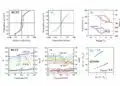
The HZO film with optimized Hf:Zr = 1:2 ratio exhibited a dominant orthorhombic/tetragonal phase mixture, achieving superior antiferroelectricity evidenced by a double hysteresis loop (2Pr = 31.7 μC/cm2 at 4.0 V) and characteristic current peaks.

Remarkably, the devices maintained stable antiferroelectric performance under extreme mechanical bending (radius: 8 mm, 1000 cycles), with minimal degradation in 2Pr (<3 %) and negligible variation in C-V butterfly curves. The capacitors demonstrated high energy storage density (ESD = 38.0 J/cm3) and efficiency (η = 38 %), fatigue endurance exceeding 108 cycles projected 10-year retention (2Pr > 12.33 μC/cm2). This work establishes the synergy of excellent CMOS compatibility, mechanical flexibility, and high reliability of HfO2-based antiferroelectric capacitors for next-generation flexible energy storage systems.

Flexible electronics—spanning wearable health sensors, foldable displays, and implantable devices—are reshaping how we interact with technology. Yet, their advancement is hampered by the lack of energy storage systems that can combine high energy density, mechanical resilience, miniaturization, and safety. Rigid components don’t tolerate repeated bending, while supercapacitors and batteries trade off between power output, energy density, and lifecycle. Moreover, traditional lead-based ferroelectrics, despite their strong polarization properties, suffer from toxicity and brittleness.

This study proposes an alternative: hafnium oxide (HfO₂)-based antiferroelectric (AFE) capacitors fabricated on flexible MICA substrates via an ultra-low-temperature atomic layer deposition (ALD) process at 100 °C. This approach promises high performance, CMOS compatibility, and mechanical robustness—essential for next-generation flexible devices.

Key Points

FeatureDetails
MaterialHf₀.₃₈Zr₀.₆₂O₂ (HZO) thin film
ProcessALD at 100 °C + e-beam evaporation
SubstrateFlexible fluorophlogopite mica
Energy Density38.0 J/cm³
Efficiency38%
Polarization (2Pr)31.7 μC/cm² at 4.0 V
Mechanical Endurance>97% retention after 1000 bends (radius: 8 mm)
Fatigue EnduranceProjected >10⁸ cycles; ~10-year retention
CMOS CompatibleYes, for seamless integration into semiconductor processes

Extended Summary

The paper opens by mapping the limitations of current flexible energy storage technologies. Supercapacitors deliver rapid charge/discharge rates but lack sufficient energy density, whereas flexible batteries offer more energy storage at the expense of power output and cycling stability. Lead-containing perovskite AFEs are further disadvantaged by toxicity and poor mechanical tolerance.

HfO₂-based AFEs, particularly HfₓZr₁₋ₓO₂ (HZO), are presented as an optimal solution: lead-free, scalable to ultra-thin films, and compatible with established CMOS workflows. The composition ratio Hf:Zr = 1:2 encourages a mixed orthorhombic/tetragonal phase structure. This enhances antiferroelectricity through electric-field-induced phase transitions, which are inherently stable even in sub-10 nm films. The key innovation here is lowering ALD deposition temperature from conventional >250 °C to 100 °C, enabling safe fabrication on thermally sensitive flexible substrates like mica without structural damage.

Mechanically, the capacitors are built without buffer or seed layers, simplifying manufacturing. High-resolution TEM imaging shows highly crystalline, well-aligned lattice structures—evidence of phase stability and film quality. Functionally, the devices display strong double hysteresis loops with symmetric current peaks, reflecting robust AFE behavior.

When subjected to mechanical bending (radius 8 mm, 1000 cycles), the capacitors retained >97% of original polarization with negligible changes in capacitance–voltage butterfly curves. Fatigue testing projects stability beyond 10⁸ electrical cycles and over a decade of operational life. The energy storage density of 38.0 J/cm³ and efficiency of 38% place these capacitors in a competitive performance bracket for flexible systems.

This combination of mechanical toughness, electrical performance, and manufacturability signals a major step forward in practical flexible energy storage design.

Conclusion

The study proves that HfO₂-based antiferroelectric capacitors deposited via ultra-low-temperature ALD can achieve the trifecta of high energy density, mechanical flexibility, and long-term durability—all while being fully CMOS process-compatible. By eliminating the need for buffer layers and enabling integration onto flexible substrates, this method offers a scalable pathway for deploying robust energy storage in wearables, implantable electronics, and other next-gen flexible devices.

Read the full paper:

Qin Jiang, Dan Li, Yingfang Zhu, Hao Li, Yujie Wu, Yang Zhan, Qianrun Li, Shaoan Yan,
Mechanically robust flexible HfO2-Based antiferroelectric energy storage capacitors via ultra-low-temperature deposition,
Materials Science in Semiconductor Processing, Volume 200, 2025, 109912,
ISSN 1369-8001,
https://doi.org/10.1016/j.mssp.2025.109912.
(https://www.sciencedirect.com/science/article/pii/S1369800125006493)

Related

Source: Science Direct

Recent Posts

Modelithics Releases COMPLETE v26.1 for Keysight ADS

23.4.2026
11

April 2026 Interconnect, Passives and Electromechanical Components Market Insights

22.4.2026
43

KYOCERA AVX Introduces Traction‑Grade DC Link Film Capacitors

21.4.2026
39

When More Capacitance Hurts Reliability: The Role of the Metallic Skeleton in Tantalum Anodes

20.4.2026
40

YAGEO Introduces High‑Current Y2/X1 Film Capacitors for Wide-bandgap Power Systems

17.4.2026
29

YAGEO Introduces High Rel MLCCs Beyond MIL-Spec Limits

16.4.2026
53

Samsung Introduces Ultra-High-Voltage 1500 V MLCCs for xEV Powertrains

16.4.2026
27

YAGEO Q1 2026 Results: AI Servers and Pricing Power Behind a Moderate Q2 Outlook

16.4.2026
71

Samsung Presents MLCC Selection Guide for Humanoids and Robotic Applications

15.4.2026
44

Upcoming Events

Apr 27
15:00 - 16:00 CEST

Commercial Space Screening Approach for Agile, High-Reliability Payloads

Apr 29
10:00 - 11:00 CDT

SEPIC Design Done Right

Apr 30
10:00 - 11:00 CDT

Programming Embedded Systems

View Calendar

Popular Posts

  • Buck Converter Design and Calculation

    0 shares
    Share 0 Tweet 0
  • Boost Converter Design and Calculation

    0 shares
    Share 0 Tweet 0
  • Flyback Converter Design and Calculation

    0 shares
    Share 0 Tweet 0
  • LLC Resonant Converter Design and Calculation

    0 shares
    Share 0 Tweet 0
  • MLCC and Ceramic Capacitors

    0 shares
    Share 0 Tweet 0
  • Dual Active Bridge (DAB) Topology

    0 shares
    Share 0 Tweet 0
  • Capacitor Charging and Discharging

    0 shares
    Share 0 Tweet 0
  • What Electronics Engineer Needs to Know About Passive Low Pass Filters

    0 shares
    Share 0 Tweet 0
  • Ripple Current and its Effects on the Performance of Capacitors

    3 shares
    Share 3 Tweet 0
  • MLCC Case Sizes Standards Explained

    0 shares
    Share 0 Tweet 0

Newsletter Subscription


Passive Components Blog

© EPCI - Leading Passive Components Educational and Information Site

  • Home
  • Privacy Policy
  • EPCI Membership & Advertisement
  • About

No Result
View All Result
  • Home
  • Knowledge Blog
  • PCNS

© EPCI - Leading Passive Components Educational and Information Site

This website uses cookies. By continuing to use this website you are giving consent to cookies being used. Visit our Privacy and Cookie Policy.
Go to mobile version