

Passive Components Blog
No Result
View All Result
  • Home
  • News
    • All
    • Aerospace & Defence
    • Antenna
    • Applications
    • Automotive
    • Capacitors
    • Circuit Protection Devices
    • electro-mechanical news
    • Filters
    • Fuses
    • Inductors
    • Industrial
    • Integrated Passives
    • inter-connect news
    • Market & Supply Chain
    • Market Insights
    • Medical
    • Modelling and Simulation
    • New Materials & Supply
    • New Technologies
    • Non-linear Passives
    • Oscillators
    • Passive Sensors News
    • Resistors
    • RF & Microwave
    • Telecommunication
    • Weekly Digest
    onsemi solid-state transformer concept for 800 V HVDC AI data center power conversion with SiC modules, DC-link capacitors and high-frequency magnetics

    Solid-State Transformers for 800 V AI Data Centers: Passive Component Design Considerations

    Littelfuse TX00AT314AMA omnipolar TMR magnetic switch sensor in a leaded TO-92-3 through-hole package

    Littelfuse Expands Omnipolar TMR Switch with Leaded TO-92 Package Option

    SCHURTER THT DIP Switches Support Hardware-Level Configuration

    TDK CN series 10 µF 100 V X7R soft-termination multilayer ceramic capacitor in 3225 EIA 1210 package

    TDK Releases 100 V Soft-Termination X7R MLCCs 10 uF in 3225 Package

    Compact inductive rotary position encoder sensor near a motor shaft, representing the Vishay RAIK045I MP encoder category

    Vishay Introduces 16-Bit Inductive Encoder for Motor-Adjacent Position Sensing

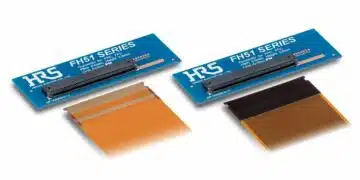
    Hirose FH51 automotive FPC/FFC connector with low-profile receptacle construction and top-and-bottom contact arrangement

    Hirose Automotive FPC/FFC Connector Adds One-Action Mating up to 125°C

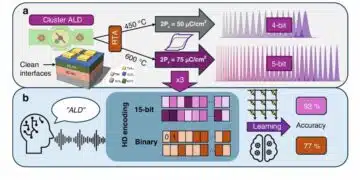
    Overview of fabricated ferroelectric capacitors improving hyperdimensional computing task learning accuracy. a The experimental work reported in this study comprises ferroelectric capacitor (FeCAP) device fabrication, structural and electrical characterization, analog state identification and their reliability study. b The computational part of the work explores the benefits of using characteristics from the fabricated devices in a hyperdimensional computing scheme; source: authors

    High-Precision Hyperdimensional Computing with Multi-Level Ferroelectric HZO Capacitors

    Coilcraft Introduces Automotive Common Mode Chokes Target CISPR 25 Class 5 EMC Compliance

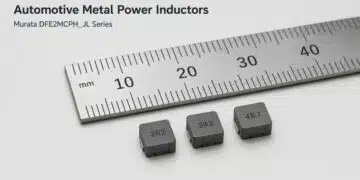
    Murata Expands Automotive Metal Power Inductor Range

    Trending Tags

    • Ripple Current
    • RF
    • Leakage Current
    • Tantalum vs Ceramic
    • Snubber
    • Low ESR
    • Feedthrough
    • Derating
    • Dielectric Constant
    • New Products
    • Market Reports
  • Knowledge Blog
  • Dossiers
    • AI Hardware Dossier
    • Automotive Dossier
    • Industrial Robotics Dossier
    • Power Converter Dossier
    • Capacitor Dossier
    • Resistor Dossier
    • Inductor Dossier
    • Circuit Protection Dossier
  • Suppliers
    • Who is Who
  • PCNS
    • PCNS 2025
    • PCNS 2023
    • PCNS 2021
    • PCNS 2019
    • PCNS 2017
  • Events
  • Home
  • News
    • All
    • Aerospace & Defence
    • Antenna
    • Applications
    • Automotive
    • Capacitors
    • Circuit Protection Devices
    • electro-mechanical news
    • Filters
    • Fuses
    • Inductors
    • Industrial
    • Integrated Passives
    • inter-connect news
    • Market & Supply Chain
    • Market Insights
    • Medical
    • Modelling and Simulation
    • New Materials & Supply
    • New Technologies
    • Non-linear Passives
    • Oscillators
    • Passive Sensors News
    • Resistors
    • RF & Microwave
    • Telecommunication
    • Weekly Digest
    onsemi solid-state transformer concept for 800 V HVDC AI data center power conversion with SiC modules, DC-link capacitors and high-frequency magnetics

    Solid-State Transformers for 800 V AI Data Centers: Passive Component Design Considerations

    Littelfuse TX00AT314AMA omnipolar TMR magnetic switch sensor in a leaded TO-92-3 through-hole package

    Littelfuse Expands Omnipolar TMR Switch with Leaded TO-92 Package Option

    SCHURTER THT DIP Switches Support Hardware-Level Configuration

    TDK CN series 10 µF 100 V X7R soft-termination multilayer ceramic capacitor in 3225 EIA 1210 package

    TDK Releases 100 V Soft-Termination X7R MLCCs 10 uF in 3225 Package

    Compact inductive rotary position encoder sensor near a motor shaft, representing the Vishay RAIK045I MP encoder category

    Vishay Introduces 16-Bit Inductive Encoder for Motor-Adjacent Position Sensing

    Hirose FH51 automotive FPC/FFC connector with low-profile receptacle construction and top-and-bottom contact arrangement

    Hirose Automotive FPC/FFC Connector Adds One-Action Mating up to 125°C

    Overview of fabricated ferroelectric capacitors improving hyperdimensional computing task learning accuracy. a The experimental work reported in this study comprises ferroelectric capacitor (FeCAP) device fabrication, structural and electrical characterization, analog state identification and their reliability study. b The computational part of the work explores the benefits of using characteristics from the fabricated devices in a hyperdimensional computing scheme; source: authors

    High-Precision Hyperdimensional Computing with Multi-Level Ferroelectric HZO Capacitors

    Coilcraft Introduces Automotive Common Mode Chokes Target CISPR 25 Class 5 EMC Compliance

    Murata Expands Automotive Metal Power Inductor Range

    Trending Tags

    • Ripple Current
    • RF
    • Leakage Current
    • Tantalum vs Ceramic
    • Snubber
    • Low ESR
    • Feedthrough
    • Derating
    • Dielectric Constant
    • New Products
    • Market Reports
  • Knowledge Blog
  • Dossiers
    • AI Hardware Dossier
    • Automotive Dossier
    • Industrial Robotics Dossier
    • Power Converter Dossier
    • Capacitor Dossier
    • Resistor Dossier
    • Inductor Dossier
    • Circuit Protection Dossier
  • Suppliers
    • Who is Who
  • PCNS
    • PCNS 2025
    • PCNS 2023
    • PCNS 2021
    • PCNS 2019
    • PCNS 2017
  • Events
No Result
View All Result
Passive Components Blog
No Result
View All Result

Photoemission spectroscopy XPS how it works and assist in EEE parts analysis

6.6.2019
Reading Time: 5 mins read
A A

Source: Alter Technology article

by Francisco Javier Aparicio Rebollo, Senior materials and Test Engineer at Alter Technology.

RelatedPosts

Solid-State Transformers for 800 V AI Data Centers: Passive Component Design Considerations

Littelfuse Expands Omnipolar TMR Switch with Leaded TO-92 Package Option

SCHURTER THT DIP Switches Support Hardware-Level Configuration

X-ray photoemission spectroscopy (XPS) also known as electron spectroscopy for chemical analysis (ESCA) is a surface-sensitive quantitative analysis method to accurately determine the elemental composition of solid materials.

The technique is the most extended tool for the chemical characterization of thin films coatings and surfaces either for industrial applications as well as for research. Amongst others, this is so due to:

  • The non-destructive
  • The broad analysis window that cover all the elements unless H and He.
  • The high sensitivity.
    • For heavy metals detection limit < 0.005 % atomic concertation (ppm in weight).
    • For light organic and inorganic elements detection limit < 1 %.
  • Free of matrix effects which compromise the reliability of other techniques such as EDS, XRF, and FTIR.

Practical Applications

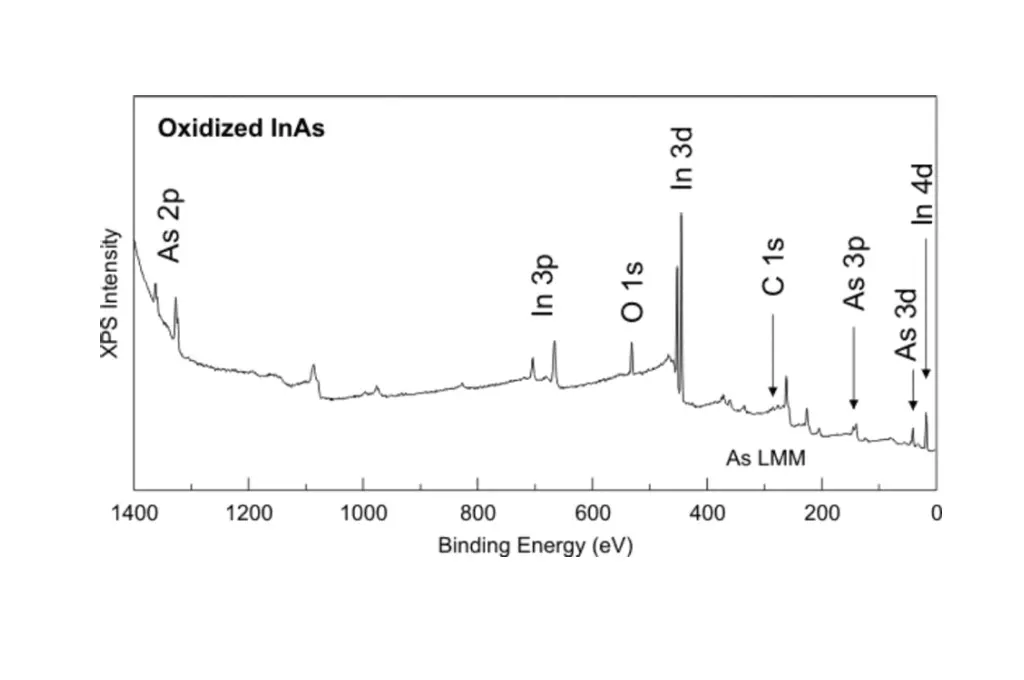
The figure shows a representative example of the XPS survey spectrum of a sample containing both heavy and light elements of interest for technological applications. This illustrates the suitability of the technique for the simultaneous detection of either heavy and light nucleus within the limit Z > 2. Hence, XPS is one of the most reliable approaches for the non-destructive quantification of the atomic concentration in solid coatings.

featured image: example of XPS survey spectrum

Considering the low escape depth of the photoelectrons the inspection thickness of typical XPS instruments is of ≈ 1-3 nm. This makes this technique the most suitable for the thin-film and surface applications and processes. Nonetheless, is not so surface sensitive that the inevitable contamination developed during industrial processes completely hidden the actual sample composition, in contrast to other techniques that require ultra-high cleanliness levels only achievable by preconditioning by sputtering.

Considering the low escape depth of the photoelectrons the inspection thickness of typical XPS instruments is of ≈ 1-3 nm. This makes this technique the most suitable for the thin-film and surface applications and processes. Nonetheless, is not so surface sensitive that the inevitable contamination developed during industrial processes completely hidden the actual sample composition, in contrast to other techniques that require ultra-high cleanliness levels only achievable by preconditioning by sputtering.

XPS analysis is demanded many industrial applications where the surface composition is a critical factor:XPS analysis

  • Photovoltaics.
  • Electronics devices and EEE parts.
  • Packaging systems.
  • Display technology.
  • Magnetic media.
  • Corrosion (oxidation).

How it works

XPS working principle is based upon the photoelectric effect described in the figure.
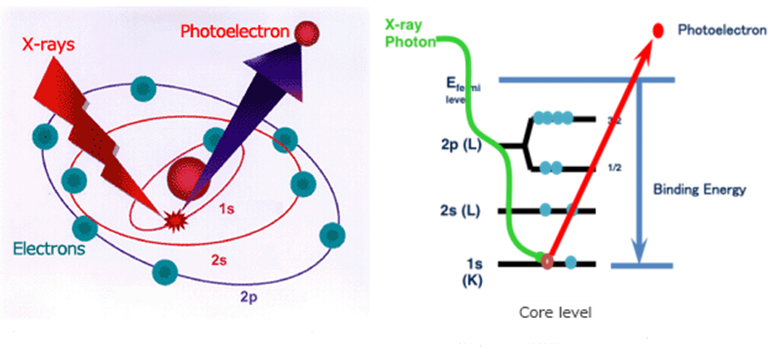
XPS Working principle

When a photon impinges into the sample surface its energy can be absorbed completely by the electronic cloud of the atoms present in the sample. If the energy is high enough, this can cause the sample ionization and the ejection of the so-called photoelectrons with a kinetic energy that according to the Einstein equation [1] is determined by the electron binding energy of the ejected electron and photon energy.

Ekinetic = hν – Ebinding                                                                                        [1]

The binding energy of valence band electrons does not only depend on the elemental composition but also on the material characteristics such as the crystalline phase and others, whereas in the case of internal core electrons the binding energy is characteristics of the atoms source and the electronic level. Thus, according to this principle, XPS makes use of high energy X-ray photons to induce the photoemission of the core electrons who escape with a kinetic energy that is specific to the emitting chemical element.

Additional advantages
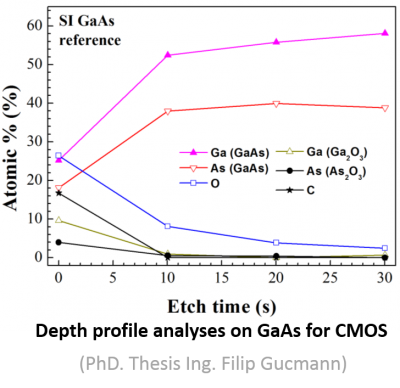
In addition to surface analyses, it is also used for the fine characterization of heterogeneous samples where the composition changes along with the depth. Thus, in combination with sputtering guns, the technique is used to perform depth profiles elemental analyses.

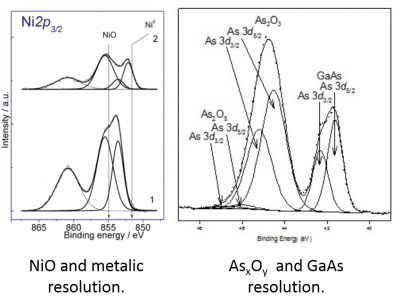
Moreover, the core energy is slightly distorted by the chemical environment what is used in an advantageous way to determine the oxidation estate of the element by fitting procedures. This is illustrated in the next figure, which shows the technique resolve the presence of metallic nickel and (Ni0) and nickel oxide (NiO) and distinguishes between arsenic oxide and gallium arsenide.

Alter Technology compromises 

During the last decade, Alter technology has established a solid collaborating network with reputed research institutions and technological centers. This grant Alter access to different XPS instruments and specifically conceived for different applications: conventional XPS, depth profiles analyses. angle-resolved XPS, UPS, and others.

Related

Recent Posts

Current-Dependent Inductors: Using Non-Linear Inductance in Buck Converters and PFC Stages

24.8.2026
48

Current Sense Transformers: Ferrite vs Nanocrystalline Cores for Accurate Current Measurement

5.8.2026
168

EMC Design Fundamentals: Safe Use of Varistors and Common Mode Chokes in Mains and Data-Line Filters

16.7.2026
319

Square-Wave Harmonics and RMS Currents in Power Converters

14.7.2026
194

Ferrite versus Nanocrystalline Power Inductor Cores: Turns, Gap and Size

9.7.2026
241

From DCL to SSC: Bridging Electrical Symptoms and Structural Indicators in Tantalum Capacitors

7.7.2026
142

Enabling the 800 V AI Server Era: How C0G High-Voltage MLCC Supports Next-Generation Power Architectures

1.7.2026
283

Power Design Simulation Tools for Faster Inductor Selection and Loss Optimization

29.6.2026
96

Using a Virtual Anode Thermal Model to Evaluate Miniaturization Risk in Tantalum Capacitors

24.6.2026
82

Upcoming Events

Sep 10
11:00 - 12:00 CEST

Equipment models and model strategies for Space Missions

Sep 16
17:00 - 18:00 CEST

Designing a 5 kW, 800 V-to-50 V PSFB Converter for Next-Generation Data Centers

Sep 29
16:00 - 17:00 CEST

Cybersecurity 2026

View Calendar

Popular Posts

  • Buck Converter Design and Calculation

    0 shares
    Share 0 Tweet 0
  • LLC Resonant Converter Design and Calculation

    0 shares
    Share 0 Tweet 0
  • Boost Converter Design and Calculation

    0 shares
    Share 0 Tweet 0
  • Flyback Converter Design and Calculation

    0 shares
    Share 0 Tweet 0
  • Earthing Systems and IEC Classification Explained

    0 shares
    Share 0 Tweet 0
  • MLCC and Ceramic Capacitors

    0 shares
    Share 0 Tweet 0
  • Capacitor Charging and Discharging

    0 shares
    Share 0 Tweet 0
  • Resistor Symbols

    0 shares
    Share 0 Tweet 0
  • Audio Capacitors: Choosing Capacitors for Crossover Circuits

    0 shares
    Share 0 Tweet 0
  • Thermistors Basics, NTC and PTC Thermistors

    0 shares
    Share 0 Tweet 0

Newsletter Subscription


Passive Components Blog

© 2015–2026
All rights reserved

  • Home
  • Privacy Policy
  • EPCI Membership & Advertisement
  • About

No Result
View All Result
  • Home
  • Knowledge Blog
  • Dossiers
  • PCNS

© 2015–2026
All rights reserved