






Passive Components Blog
No Result
View All Result
  • Home
  • NewsFilter
    • All
    • Aerospace & Defence
    • Antenna
    • Applications
    • Automotive
    • Capacitors
    • Circuit Protection Devices
    • electro-mechanical news
    • Filters
    • Fuses
    • Inductors
    • Industrial
    • Integrated Passives
    • inter-connect news
    • Market & Supply Chain
    • Market Insights
    • Medical
    • Modelling and Simulation
    • New Materials & Supply
    • New Technologies
    • Non-linear Passives
    • Oscillators
    • Passive Sensors News
    • Resistors
    • RF & Microwave
    • Telecommunication
    • Weekly Digest

    0603 Automotive Chip Varistors as TVS Diode Replacements, TDK Tech Note

    Miniaturization of MLCCs and Electrolytics, KAVX Tech Chat

    Exxelia Offers Custom Naval Transformers and Inductors

    Researchers Demonstrated 32nm Aluminum Vacuum Gap Capacitor

    Conductive Polymer Capacitor Market and Design‑In Guide to 2035

    TDK Releases High Performance 105C DC Link Film Capacitors

    YAGEO Offers Automotive MOVs for EV and AI power

    YAGEO Acquires 100% of Shares of Shibaura Electronics

    Wk 3 Electronics Supply Chain Digest

    Trending Tags

    • Ripple Current
    • RF
    • Leakage Current
    • Tantalum vs Ceramic
    • Snubber
    • Low ESR
    • Feedthrough
    • Derating
    • Dielectric Constant
    • New Products
    • Market Reports
  • VideoFilter
    • All
    • Antenna videos
    • Capacitor videos
    • Circuit Protection Video
    • Filter videos
    • Fuse videos
    • Inductor videos
    • Inter-Connect Video
    • Non-linear passives videos
    • Oscillator videos
    • Passive sensors videos
    • Resistor videos

    One‑Pulse Characterization of Nonlinear Power Inductors

    Thermistor Linearization Challenges

    Coaxial Connectors and How to Connect with PCB

    PCB Manufacturing, Test Methods, Quality and Reliability

    Transformer Behavior – Current Transfer and Hidden Feedback

    Choosing the Right Capacitor: The Importance of Accurate Measurements

    RF Inductors: Selection and Design Challenges for High-Frequency Circuits

    Transformer Safety IEC 61558 Standard

    3-Phase EMI Filter Design, Simulation, Calculation and Test

    Trending Tags

    • Capacitors explained
    • Inductors explained
    • Resistors explained
    • Filters explained
    • Application Video Guidelines
    • EMC
    • New Products
    • Ripple Current
    • Simulation
    • Tantalum vs Ceramic
  • Knowledge Blog
  • Suppliers
    • Who is Who
  • PCNS
    • PCNS 2025
    • PCNS 2023
    • PCNS 2021
    • PCNS 2019
    • PCNS 2017
  • Events
  • Home
  • NewsFilter
    • All
    • Aerospace & Defence
    • Antenna
    • Applications
    • Automotive
    • Capacitors
    • Circuit Protection Devices
    • electro-mechanical news
    • Filters
    • Fuses
    • Inductors
    • Industrial
    • Integrated Passives
    • inter-connect news
    • Market & Supply Chain
    • Market Insights
    • Medical
    • Modelling and Simulation
    • New Materials & Supply
    • New Technologies
    • Non-linear Passives
    • Oscillators
    • Passive Sensors News
    • Resistors
    • RF & Microwave
    • Telecommunication
    • Weekly Digest

    0603 Automotive Chip Varistors as TVS Diode Replacements, TDK Tech Note

    Miniaturization of MLCCs and Electrolytics, KAVX Tech Chat

    Exxelia Offers Custom Naval Transformers and Inductors

    Researchers Demonstrated 32nm Aluminum Vacuum Gap Capacitor

    Conductive Polymer Capacitor Market and Design‑In Guide to 2035

    TDK Releases High Performance 105C DC Link Film Capacitors

    YAGEO Offers Automotive MOVs for EV and AI power

    YAGEO Acquires 100% of Shares of Shibaura Electronics

    Wk 3 Electronics Supply Chain Digest

    Trending Tags

    • Ripple Current
    • RF
    • Leakage Current
    • Tantalum vs Ceramic
    • Snubber
    • Low ESR
    • Feedthrough
    • Derating
    • Dielectric Constant
    • New Products
    • Market Reports
  • VideoFilter
    • All
    • Antenna videos
    • Capacitor videos
    • Circuit Protection Video
    • Filter videos
    • Fuse videos
    • Inductor videos
    • Inter-Connect Video
    • Non-linear passives videos
    • Oscillator videos
    • Passive sensors videos
    • Resistor videos

    One‑Pulse Characterization of Nonlinear Power Inductors

    Thermistor Linearization Challenges

    Coaxial Connectors and How to Connect with PCB

    PCB Manufacturing, Test Methods, Quality and Reliability

    Transformer Behavior – Current Transfer and Hidden Feedback

    Choosing the Right Capacitor: The Importance of Accurate Measurements

    RF Inductors: Selection and Design Challenges for High-Frequency Circuits

    Transformer Safety IEC 61558 Standard

    3-Phase EMI Filter Design, Simulation, Calculation and Test

    Trending Tags

    • Capacitors explained
    • Inductors explained
    • Resistors explained
    • Filters explained
    • Application Video Guidelines
    • EMC
    • New Products
    • Ripple Current
    • Simulation
    • Tantalum vs Ceramic
  • Knowledge Blog
  • Suppliers
    • Who is Who
  • PCNS
    • PCNS 2025
    • PCNS 2023
    • PCNS 2021
    • PCNS 2019
    • PCNS 2017
  • Events
No Result
View All Result
Passive Components Blog
No Result
View All Result

Researchers Developed BaTiO3 based MLCC Material with High Energy Density at High Temperature Range

21.1.2025
Reading Time: 4 mins read
A A

The article from Nature Communications by Chinese Researchers delves into the innovative development of high-entropy engineered BaTiO3-based ceramic capacitors, which have shown remarkable improvements in high-temperature energy storage performance.

Key points

RelatedPosts

0603 Automotive Chip Varistors as TVS Diode Replacements, TDK Tech Note

Miniaturization of MLCCs and Electrolytics, KAVX Tech Chat

Exxelia Offers Custom Naval Transformers and Inductors

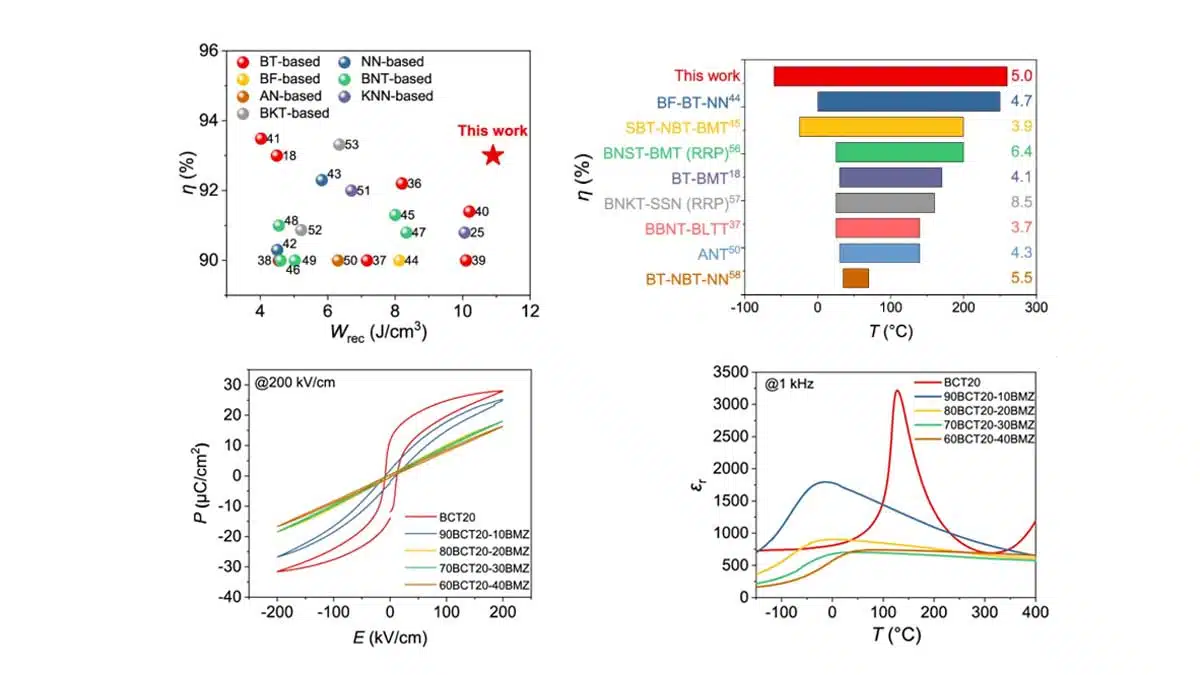
These capacitors achieved a significant recoverable energy density of 10.9 J/cm³ and an impressive energy efficiency of 93% at an applied electric field of 720 kV/cm. Notably, they maintain excellent energy storage capabilities across a wide temperature range of -50 to 260°C, with minimal variation and high cycling reliability up to 10^6 cycles at 450 kV/cm and 200°C. This study underscores the effectiveness of high-entropy engineering in creating high-performance dielectric capacitors for modern electrical applications.

The high-entropy design, characterized by a high configuration entropy and tolerance factor, contributed to the superior energy storage properties, including a high breakdown strength and low leakage current.

High-entropy 70BCT20-30BMZ ceramics exhibit ultrahigh cycling reliability and stable energy storage performance over a wide temperature range. This stability is attributed to the presence of high-dynamic nano polar regions (PNRs) that prevent the formation of large domains, leading to minimal dielectric loss and conductivity. The ceramics also demonstrate excellent high-temperature insulation properties, with a high activation energy for conductivity and a wide temperature range where efficiency exceeds 90%.

High-entropy ceramics, specifically (100-100x)BCT20-100xBMZ (x = 0 ~ 0.4), were synthesized and characterized, with 70BCT20-30BMZ exhibiting excellent energy storage performance at both room temperature and high temperatures.  This is attributed to the high configuration entropy, which induces large lattice distortion and random local fields, resulting in robust thermal and electrical stability.  The dynamic polarization nanoregions (PNRs) in the ceramics, revealed by in-situ characterizations, contribute to their superior high-temperature energy storage performance and cycling reliability.

Abstract

Ceramic capacitors with ultrahigh power density are crucial in modern electrical applications, especially under high-temperature conditions. However, the relatively low energy density limits their application scope and hinders device miniaturization and integration. In this work, we present a high-entropy BaTiO3-based relaxor ceramic with outstanding energy storage properties, achieving a substantial recoverable energy density of 10.9 J/cm3 and a superior energy efficiency of 93% at applied electric field of 720 kV/cm. Of particular importance is that the studied high-entropy composition exhibits excellent energy storage performance across a wide temperature range of −50 to 260 °C, with variation below 9%, additionally, it demonstrates great cycling reliability at 450 kV/cm and 200 °C up to 106cycles. Electrical and in-situ structural characterizations revealed that the high-entropy engineered local structures are highly stable under varying temperature and electric fields, leading to superior energy storage performance. This study provides a good paradigm of the efficacy of the high-entropy engineering for developing high-performance dielectric capacitors.

Summary

(100-100x)BCT20-100xBMZ (x = 0 ~ 0.4) ceramics were synthesized and characterized, with configuration entropy increasing with x. Thoroughly considering Wrecand η, high-entropy composition 70BCT20-30BMZ was selected for in-depth studies. This composition exhibits both a high Wrec of 10.9 J/cm3 and a high η of 93%, along with excellent cycling reliability at room temperature. Of particular importance is that 70BCT20-30BMZ ceramics also showed excellent high-temperature stability with ΔWrec < 9% and Δη < 5% over a broad temperature range of −50 °C to 260 °C, meanwhile exhibiting superior cycling reliability with minimal property degradation after cycling at 450 kV/cm and 200 °C. Electrical and in-situ characterizations revealed the PNRs in the ceramics are highly dynamic under varying temperatures and electric fields, attributed to the high-entropy engineering. This dynamic PNRs underscores the excellent high-temperature energy storage performance and high cycling reliability. This research highlights the significant potential of 70BCT20-30BMZ ceramics for high-temperature capacitors, and demonstrates that high-entropy design is an effective strategy in developing high-performance dielectric materials.

Read the full paper here: Kong, X., Yang, L., Meng, F. et al. High-entropy engineered BaTiO3-based ceramic capacitors with greatly enhanced high-temperature energy storage performance. Nat Commun 16, 885 (2025). https://doi.org/10.1038/s41467-025-56195-0
Related

Source: Nature Communications

Recent Posts

Miniaturization of MLCCs and Electrolytics, KAVX Tech Chat

21.1.2026
7

Researchers Demonstrated 32nm Aluminum Vacuum Gap Capacitor

20.1.2026
17

Conductive Polymer Capacitor Market and Design‑In Guide to 2035

20.1.2026
52

TDK Releases High Performance 105C DC Link Film Capacitors

19.1.2026
39

Vishay Extends Aluminum Capacitors Rating Up to 600 V for DC Links

15.1.2026
32

Würth Elektronik Introduces Product Navigator for Passive Components

14.1.2026
70

Panasonic Passive Components for Reliable Robotic Arms

14.1.2026
81

DC/DC Push‑Pull Converter vs PSFB Design Guide

12.1.2026
88

Rubycon PMLCAP DC‑Link Film Capacitors in Mass Production

9.1.2026
84

Upcoming Events

Jan 21
18:00 - 18:45 CET

To Rogowski or not to Rogowski

Jan 27
16:00 - 17:00 CET

Simplifying Vehicle Development with Automotive Ethernet and Zonal Smart Switch Technologies

Feb 24
16:00 - 17:00 CET

Designing Qi2 Wireless Power Systems: Practical Development and EMC Optimization

View Calendar

Popular Posts

  • Buck Converter Design and Calculation

    0 shares
    Share 0 Tweet 0
  • Boost Converter Design and Calculation

    0 shares
    Share 0 Tweet 0
  • LLC Resonant Converter Design and Calculation

    0 shares
    Share 0 Tweet 0
  • Flyback Converter Design and Calculation

    0 shares
    Share 0 Tweet 0
  • Ripple Current and its Effects on the Performance of Capacitors

    3 shares
    Share 3 Tweet 0
  • How Metal Prices Are Driving Passive Component Price Hikes

    0 shares
    Share 0 Tweet 0
  • MLCC and Ceramic Capacitors

    0 shares
    Share 0 Tweet 0
  • Dual Active Bridge (DAB) Topology

    0 shares
    Share 0 Tweet 0
  • What is a Dielectric Constant and DF of Plastic Materials?

    4 shares
    Share 4 Tweet 0
  • Degradation of Capacitors and its Failure Mechanisms

    0 shares
    Share 0 Tweet 0

Newsletter Subscription


Passive Components Blog

© EPCI - Leading Passive Components Educational and Information Site

  • Home
  • Privacy Policy
  • EPCI Membership & Advertisement
  • About

No Result
View All Result
  • Home
  • Knowledge Blog
  • PCNS

© EPCI - Leading Passive Components Educational and Information Site

This website uses cookies. By continuing to use this website you are giving consent to cookies being used. Visit our Privacy and Cookie Policy.
Go to mobile version