









Passive Components Blog
No Result
View All Result
  • Home
  • NewsFilter
    • All
    • Aerospace & Defence
    • Antenna
    • Applications
    • Automotive
    • Capacitors
    • Circuit Protection Devices
    • electro-mechanical news
    • Filters
    • Fuses
    • Inductors
    • Industrial
    • Integrated Passives
    • inter-connect news
    • Market & Supply Chain
    • Market Insights
    • Medical
    • Modelling and Simulation
    • New Materials & Supply
    • New Technologies
    • Non-linear Passives
    • Oscillators
    • Passive Sensors News
    • Resistors
    • RF & Microwave
    • Telecommunication
    • Weekly Digest

    Murata and Xona Partner on LEO Satellite Navigation for Industrial Applications

    Bourns Offers Custom Magnetics for 3‑Phase Flying Capacitor Inverters

    YAGEO Releases Cost Efficient Pt‑RTD Sensors with Ni wires

    Nvidia Vera Rubin: Why One AI Rack Needs So Many More MLCC Capacitors

    Stackpole Introduces 1400A Busbar Shunt Resistors

    Tecate Unveils High‑temp 105C Supercapacitors for Harsh‑Environment Designs

    Bourns Expands 1000V High‑Power Fuses for Semiconductor and Battery Protection

    Passive Components in 2026: From Invisible Commodity to Design Parameter

    Bourns Introduces High Current Chip Ferrite Beads for Dense Power Rails

    Trending Tags

    • Ripple Current
    • RF
    • Leakage Current
    • Tantalum vs Ceramic
    • Snubber
    • Low ESR
    • Feedthrough
    • Derating
    • Dielectric Constant
    • New Products
    • Market Reports
  • VideoFilter
    • All
    • Antenna videos
    • Capacitor videos
    • Circuit Protection Video
    • Filter videos
    • Fuse videos
    • Inductor videos
    • Inter-Connect Video
    • Non-linear passives videos
    • Oscillator videos
    • Passive sensors videos
    • Resistor videos

    Current Sense Transformer Datasheet and Design‑in Guide

    Designing a USB Type‑C Flyback Planar Transformer with Frenetic’s Planar Tool

    Magnetics Design in High‑Frequency GaN Converters

    Qi2 Wireless Charging: Inductors, Capacitors and EMC Filters

    Two‑capacitor paradox explained for engineers

    Capacitances of Nonlinear MLCCs: What Datasheets Don’t Tell You

    Tapped Inductor Buck Converter Fundamentals

    Planar vs Conventional Transformer: When it Make Sense

    Modeling Fringing Field Losses in Inductors & Transformers

    Trending Tags

    • Capacitors explained
    • Inductors explained
    • Resistors explained
    • Filters explained
    • Application Video Guidelines
    • EMC
    • New Products
    • Ripple Current
    • Simulation
    • Tantalum vs Ceramic
  • Knowledge Blog
  • DossiersNew
  • Suppliers
    • Who is Who
  • PCNS
    • PCNS 2025
    • PCNS 2023
    • PCNS 2021
    • PCNS 2019
    • PCNS 2017
  • Events
  • Home
  • NewsFilter
    • All
    • Aerospace & Defence
    • Antenna
    • Applications
    • Automotive
    • Capacitors
    • Circuit Protection Devices
    • electro-mechanical news
    • Filters
    • Fuses
    • Inductors
    • Industrial
    • Integrated Passives
    • inter-connect news
    • Market & Supply Chain
    • Market Insights
    • Medical
    • Modelling and Simulation
    • New Materials & Supply
    • New Technologies
    • Non-linear Passives
    • Oscillators
    • Passive Sensors News
    • Resistors
    • RF & Microwave
    • Telecommunication
    • Weekly Digest

    Murata and Xona Partner on LEO Satellite Navigation for Industrial Applications

    Bourns Offers Custom Magnetics for 3‑Phase Flying Capacitor Inverters

    YAGEO Releases Cost Efficient Pt‑RTD Sensors with Ni wires

    Nvidia Vera Rubin: Why One AI Rack Needs So Many More MLCC Capacitors

    Stackpole Introduces 1400A Busbar Shunt Resistors

    Tecate Unveils High‑temp 105C Supercapacitors for Harsh‑Environment Designs

    Bourns Expands 1000V High‑Power Fuses for Semiconductor and Battery Protection

    Passive Components in 2026: From Invisible Commodity to Design Parameter

    Bourns Introduces High Current Chip Ferrite Beads for Dense Power Rails

    Trending Tags

    • Ripple Current
    • RF
    • Leakage Current
    • Tantalum vs Ceramic
    • Snubber
    • Low ESR
    • Feedthrough
    • Derating
    • Dielectric Constant
    • New Products
    • Market Reports
  • VideoFilter
    • All
    • Antenna videos
    • Capacitor videos
    • Circuit Protection Video
    • Filter videos
    • Fuse videos
    • Inductor videos
    • Inter-Connect Video
    • Non-linear passives videos
    • Oscillator videos
    • Passive sensors videos
    • Resistor videos

    Current Sense Transformer Datasheet and Design‑in Guide

    Designing a USB Type‑C Flyback Planar Transformer with Frenetic’s Planar Tool

    Magnetics Design in High‑Frequency GaN Converters

    Qi2 Wireless Charging: Inductors, Capacitors and EMC Filters

    Two‑capacitor paradox explained for engineers

    Capacitances of Nonlinear MLCCs: What Datasheets Don’t Tell You

    Tapped Inductor Buck Converter Fundamentals

    Planar vs Conventional Transformer: When it Make Sense

    Modeling Fringing Field Losses in Inductors & Transformers

    Trending Tags

    • Capacitors explained
    • Inductors explained
    • Resistors explained
    • Filters explained
    • Application Video Guidelines
    • EMC
    • New Products
    • Ripple Current
    • Simulation
    • Tantalum vs Ceramic
  • Knowledge Blog
  • DossiersNew
  • Suppliers
    • Who is Who
  • PCNS
    • PCNS 2025
    • PCNS 2023
    • PCNS 2021
    • PCNS 2019
    • PCNS 2017
  • Events
No Result
View All Result
Passive Components Blog
No Result
View All Result

Resonant Capacitors in High-Power Resonant Circuits

1.10.2025
Reading Time: 4 mins read
A A

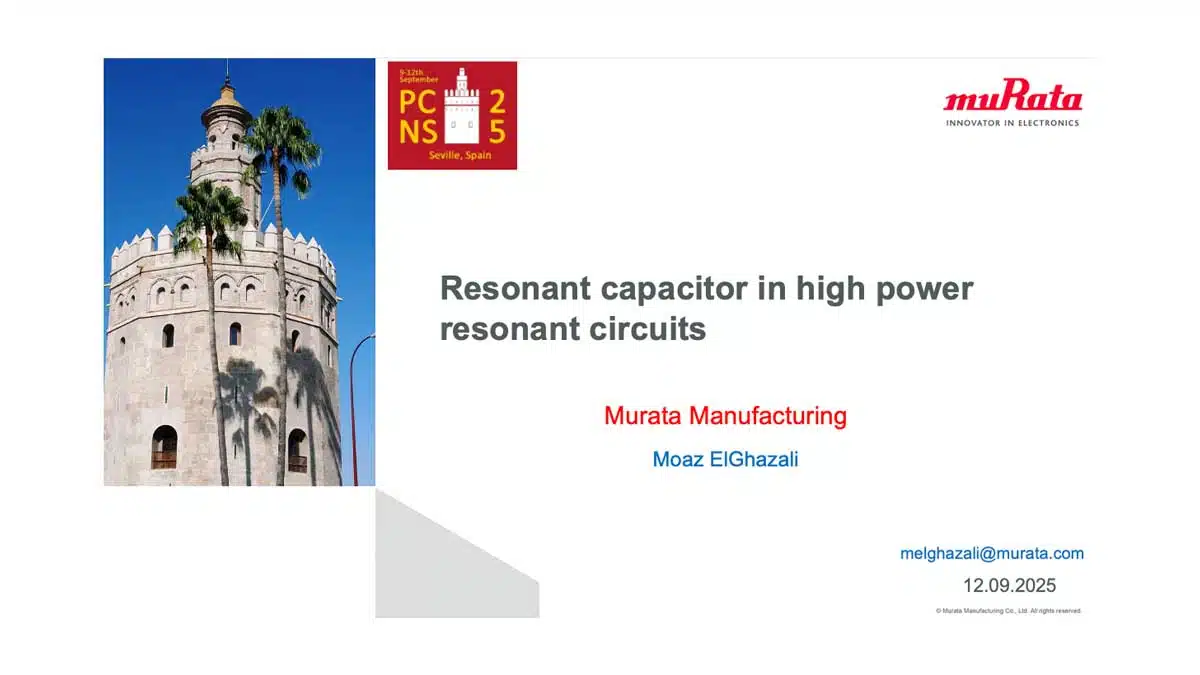
The paper “Resonant Capacitors in High-Power Resonant Circuits” was presented by Moaz ElGhazali, Murata Electronics Europe B.V. Germany, Nürnberg, Germany at the 5th PCNS Passive Components Networking Symposium 9-12th September 2025, Seville, Spain as paper No. 5.4.

Introduction

The paper “Resonant Capacitors in High-Power Resonant Circuits” focuses on the increasing use of multilayer ceramic capacitors (MLCCs) in high-power resonant applications such as automotive onboard chargers (OBCs), server power supplies, and large-scale wireless power transfer (WPT) systems.

RelatedPosts

Murata and Xona Partner on LEO Satellite Navigation for Industrial Applications

Murata Expands Thermistor Production Capacity at Yokaichi Plant

Murata Introduces Crystal and NTC Set for Automotive UWB Timing

It emphasizes how MLCCs ceramic capacitors can replace traditional film capacitors due to their compact size, superior high-frequency performance, low loss, and robust long-term reliability.

Murata Electronics introduces its 630 Vdc and 1000 Vdc MLCC product lines, highlighting their advantages and providing engineers with a selection tool, “Simsurfing,” to simplify capacitor choice and configuration.

Key Points

  • High adoption of resonant circuits in electric vehicles (EVs), plug-in hybrid vehicles (PHVs), and wireless power transfer systems.
  • MLCC advantages over film capacitors include smaller footprint, lower heat generation, and improved thermal and electrical performance.
  • Technical requirements focus on high voltage handling, high-frequency capability, low dielectric loss, and long-term reliability.
  • Murata MLCC lineup supports both standard and metal-terminal packages, with capacitance values up to 54 nF and operating temperatures from −55 to +125°C.
  • Voltage derating and self-heating are critical in selecting and configuring MLCCs to ensure longevity and safe operation.
  • Simsurfing selection tool offers automated recommendations for MLCCs and their optimal series–parallel networks.

Extended Summary

Recent developments in electric vehicles and wireless power transfer have driven the adoption of resonant circuits in power conversion systems to over 90%. LLC and LC topologies improve power efficiency, reduce filter requirements, and allow high-frequency operation. These conditions place stringent demands on resonant capacitors, which must sustain high peak-to-peak voltages, tolerate elevated temperatures, and exhibit low dielectric losses.

MLCCs are positioned as a superior alternative to film capacitors for such scenarios. Their compact form factor allows series–parallel network configurations to achieve high voltage ratings without occupying excessive space. In comparison to film capacitors, MLCCs offer three times smaller footprints, lower ESR and ESL, and better self-heating properties, which enhance efficiency in resonant circuits operating from 60 kHz to 400 kHz.

Technical requirements include stable capacitance above 10 nF, low losses under high-frequency excitation, and the ability to maintain surface temperatures below 125°C throughout a 10-year operational life. Murata addresses these needs with standard chip MLCCs and metal-terminal MLCCs. The latter reduces solder-crack risk in automotive environments and supports capacitance up to 54 nF. Both variants rely on C0G dielectric, which ensures exceptional thermal stability (0 ±30 ppm/°C from 25 to 125°C).

Voltage derating is essential to prevent excessive self-heating. The paper categorizes operating frequencies into three ranges, each with specific derating behavior: below 10 kHz where rated voltage governs, 10–100 kHz where continuous thermal rise limits operation, and above 100 kHz where initial heating constrains voltage application. Detailed derating charts guide engineers in applying optimal series–parallel configurations for reliable long-term service.

Murata’s “Simsurfing” web tool significantly eases the selection process by allowing engineers to input frequency, voltage, temperature, and required capacitance. It then suggests suitable MLCC products and network arrangements, ensuring both performance and durability in demanding resonant applications.

Conclusion

MLCCs are highly suitable for modern high-power resonant circuits due to their compact size, low loss, superior thermal properties, and long-term reliability. By following proper series–parallel configurations and adhering to voltage derating guidelines, engineers can confidently replace film capacitors with MLCCs. Murata’s comprehensive MLCC lineup, combined with the “Simsurfing” selection tool, offers a streamlined approach to optimize resonant circuit design and enhance system efficiency.


5_4_Murata_Resonant Capacitors_MoazDownload

Related

Source: PCNS

Recent Posts

Bourns Offers Custom Magnetics for 3‑Phase Flying Capacitor Inverters

3.6.2026
16

YAGEO Releases Cost Efficient Pt‑RTD Sensors with Ni wires

3.6.2026
6

Nvidia Vera Rubin: Why One AI Rack Needs So Many More MLCC Capacitors

2.6.2026
59

Stackpole Introduces 1400A Busbar Shunt Resistors

2.6.2026
11

Tecate Unveils High‑temp 105C Supercapacitors for Harsh‑Environment Designs

2.6.2026
14

Bourns Expands 1000V High‑Power Fuses for Semiconductor and Battery Protection

2.6.2026
8

Passive Components in 2026: From Invisible Commodity to Design Parameter

2.6.2026
21

Bourns Introduces High Current Chip Ferrite Beads for Dense Power Rails

1.6.2026
14

Vishay Releases High‑Current Radial Inductors up to 209 A

29.5.2026
27

Upcoming Events

Jun 16
16:00 - 17:00 CEST

EMC with EMC – EMC‑compliant design with electromechanical connectors

View Calendar

Popular Posts

  • Buck Converter Design and Calculation

    0 shares
    Share 0 Tweet 0
  • Boost Converter Design and Calculation

    0 shares
    Share 0 Tweet 0
  • MLCC and Ceramic Capacitors

    0 shares
    Share 0 Tweet 0
  • Flyback Converter Design and Calculation

    0 shares
    Share 0 Tweet 0
  • LLC Resonant Converter Design and Calculation

    0 shares
    Share 0 Tweet 0
  • What Electronics Engineer Needs to Know About Passive Low Pass Filters

    0 shares
    Share 0 Tweet 0
  • Capacitor Charging and Discharging

    0 shares
    Share 0 Tweet 0
  • Dual Active Bridge (DAB) Topology

    0 shares
    Share 0 Tweet 0
  • SEPIC Converter Design and Calculation

    0 shares
    Share 0 Tweet 0
  • Ripple Current and its Effects on the Performance of Capacitors

    3 shares
    Share 3 Tweet 0

Newsletter Subscription


Passive Components Blog

© EPCI - Leading Passive Components Educational and Information Site

  • Home
  • Privacy Policy
  • EPCI Membership & Advertisement
  • About

No Result
View All Result
  • Home
  • Knowledge Blog
  • Dossiers
  • PCNS

© EPCI - Leading Passive Components Educational and Information Site

This website uses cookies. By continuing to use this website you are giving consent to cookies being used. Visit our Privacy and Cookie Policy.
Go to mobile version