








Passive Components Blog
No Result
View All Result
  • Home
  • NewsFilter
    • All
    • Aerospace & Defence
    • Antenna
    • Applications
    • Automotive
    • Capacitors
    • Circuit Protection Devices
    • electro-mechanical news
    • Filters
    • Fuses
    • Inductors
    • Industrial
    • Integrated Passives
    • inter-connect news
    • Market & Supply Chain
    • Market Insights
    • Medical
    • Modelling and Simulation
    • New Materials & Supply
    • New Technologies
    • Non-linear Passives
    • Oscillators
    • Passive Sensors News
    • Resistors
    • RF & Microwave
    • Telecommunication
    • Weekly Digest

    Modeling Planar Magnetics Temperature: Practical Guidelines for Power Electronics Engineers

    YAGEO Releases Ferrite Shielded Power Inductors for High‑Density Designs

    Samsung Presents MLCC Selection Guide for Humanoids and Robotic Applications

    AI-Assisted Structural Diagnostics and Physics-Based Reliability Interpretation of Tantalum Capacitor Anodes

    YAGEO Introduces EMI Suppression High‑Current 3‑phase Common Mode Chokes

    KYOCERA AVX MIL-PRF-32535 BME NP0 MLCCs Approved to the DLA QPD

    ECIA March 2026 Industry Pulse Points to Best Sales Climate in Five Years

    Vishay Releases 2-Way Wilkinson Divider / Combiner for 15–20 GHz RF Front Ends

    Wk 15 Electronics Supply Chain Digest

    Trending Tags

    • Ripple Current
    • RF
    • Leakage Current
    • Tantalum vs Ceramic
    • Snubber
    • Low ESR
    • Feedthrough
    • Derating
    • Dielectric Constant
    • New Products
    • Market Reports
  • VideoFilter
    • All
    • Antenna videos
    • Capacitor videos
    • Circuit Protection Video
    • Filter videos
    • Fuse videos
    • Inductor videos
    • Inter-Connect Video
    • Non-linear passives videos
    • Oscillator videos
    • Passive sensors videos
    • Resistor videos

    Transformer-Based Power-Line Harvester Magnetic Design

    Thermal Modeling of Magnetics

    Standard vs Planar LLC transformers Comparison for Battery Chargers

    How Modern Tools Model Magnetic Components for Power Electronics

    Advanced Loss Modeling for Planar Magnetics in the Frenetic Planar Tool

    2026 Power Magnetics Design Trends: Flyback, DAB and Planar

    Enabling Software‑Defined Vehicle Architectures: Automotive Ethernet and Zonal Smart Power

    Calculating Resistance Value of a Flyback RC Snubber 

    One‑Pulse Characterization of Nonlinear Power Inductors

    Trending Tags

    • Capacitors explained
    • Inductors explained
    • Resistors explained
    • Filters explained
    • Application Video Guidelines
    • EMC
    • New Products
    • Ripple Current
    • Simulation
    • Tantalum vs Ceramic
  • Knowledge Blog
  • DossiersNew
  • Suppliers
    • Who is Who
  • PCNS
    • PCNS 2025
    • PCNS 2023
    • PCNS 2021
    • PCNS 2019
    • PCNS 2017
  • Events
  • Home
  • NewsFilter
    • All
    • Aerospace & Defence
    • Antenna
    • Applications
    • Automotive
    • Capacitors
    • Circuit Protection Devices
    • electro-mechanical news
    • Filters
    • Fuses
    • Inductors
    • Industrial
    • Integrated Passives
    • inter-connect news
    • Market & Supply Chain
    • Market Insights
    • Medical
    • Modelling and Simulation
    • New Materials & Supply
    • New Technologies
    • Non-linear Passives
    • Oscillators
    • Passive Sensors News
    • Resistors
    • RF & Microwave
    • Telecommunication
    • Weekly Digest

    Modeling Planar Magnetics Temperature: Practical Guidelines for Power Electronics Engineers

    YAGEO Releases Ferrite Shielded Power Inductors for High‑Density Designs

    Samsung Presents MLCC Selection Guide for Humanoids and Robotic Applications

    AI-Assisted Structural Diagnostics and Physics-Based Reliability Interpretation of Tantalum Capacitor Anodes

    YAGEO Introduces EMI Suppression High‑Current 3‑phase Common Mode Chokes

    KYOCERA AVX MIL-PRF-32535 BME NP0 MLCCs Approved to the DLA QPD

    ECIA March 2026 Industry Pulse Points to Best Sales Climate in Five Years

    Vishay Releases 2-Way Wilkinson Divider / Combiner for 15–20 GHz RF Front Ends

    Wk 15 Electronics Supply Chain Digest

    Trending Tags

    • Ripple Current
    • RF
    • Leakage Current
    • Tantalum vs Ceramic
    • Snubber
    • Low ESR
    • Feedthrough
    • Derating
    • Dielectric Constant
    • New Products
    • Market Reports
  • VideoFilter
    • All
    • Antenna videos
    • Capacitor videos
    • Circuit Protection Video
    • Filter videos
    • Fuse videos
    • Inductor videos
    • Inter-Connect Video
    • Non-linear passives videos
    • Oscillator videos
    • Passive sensors videos
    • Resistor videos

    Transformer-Based Power-Line Harvester Magnetic Design

    Thermal Modeling of Magnetics

    Standard vs Planar LLC transformers Comparison for Battery Chargers

    How Modern Tools Model Magnetic Components for Power Electronics

    Advanced Loss Modeling for Planar Magnetics in the Frenetic Planar Tool

    2026 Power Magnetics Design Trends: Flyback, DAB and Planar

    Enabling Software‑Defined Vehicle Architectures: Automotive Ethernet and Zonal Smart Power

    Calculating Resistance Value of a Flyback RC Snubber 

    One‑Pulse Characterization of Nonlinear Power Inductors

    Trending Tags

    • Capacitors explained
    • Inductors explained
    • Resistors explained
    • Filters explained
    • Application Video Guidelines
    • EMC
    • New Products
    • Ripple Current
    • Simulation
    • Tantalum vs Ceramic
  • Knowledge Blog
  • DossiersNew
  • Suppliers
    • Who is Who
  • PCNS
    • PCNS 2025
    • PCNS 2023
    • PCNS 2021
    • PCNS 2019
    • PCNS 2017
  • Events
No Result
View All Result
Passive Components Blog
No Result
View All Result

Skeleton Supercapacitors Power New IndyCar Hybrid Racing

29.7.2024
Reading Time: 3 mins read
A A

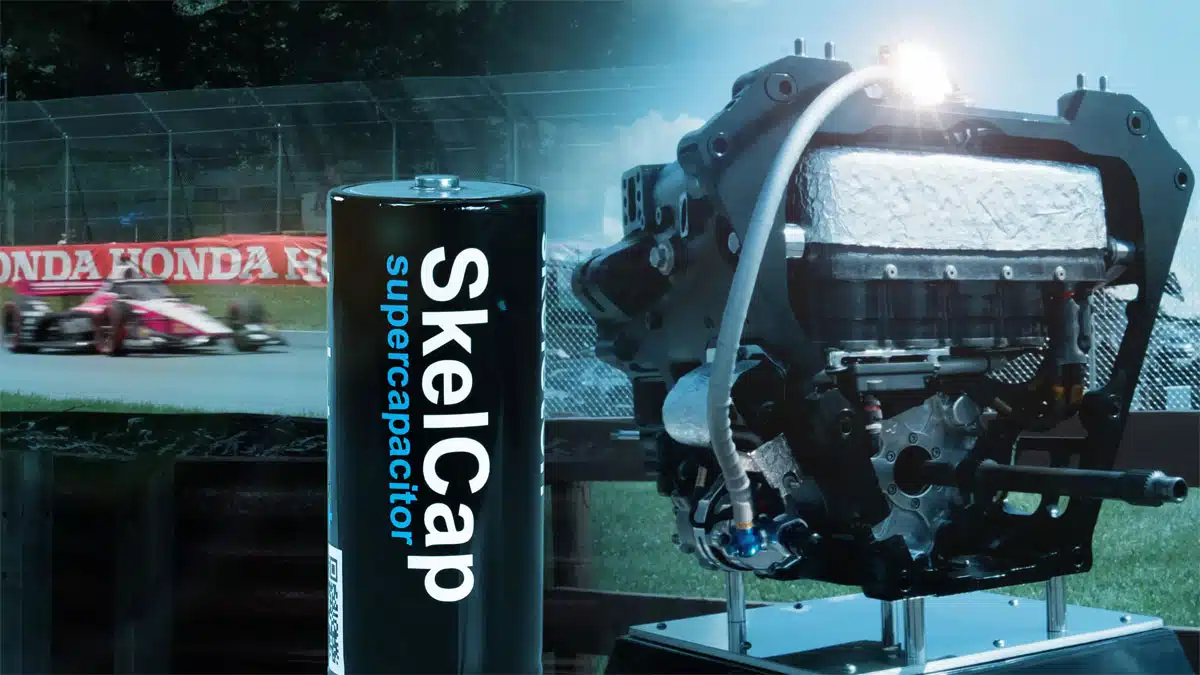
Skeleton’s cutting-edge supercapacitors are now integrated into the NTT IndyCar Series innovative Energy Recovery System (ERS). All racecars are equipped with this new hybrid system, which made its competition debut at the Honda Indy 200 at Mid-Ohio on July 7th, 2024.

Skeleton Technologies has designed and manufactured the high-performance supercapacitors commissioned by Honda Racing Corporation USA (HRC US) as the new Energy Storage System (ESS), a component of the overall ERS, which also incorporates a Motor Generator Unit. HRC US helped manage this collaborative effort among industry leaders enabling IndyCar participants to embrace hybrid racing technologies. 

RelatedPosts

Skeleton Technologies Expands in U.S. to Power AI Data Centers

Skeleton Opens €220M Supercapacitor Leipzig Factory

Skeleton Opens SuperBattery Factory in Finland 

David Arsenault, Senior Vice-President of Business Development at Skeleton Technologies, says: “We are excited to collaborate with Honda Racing Corporation USA and play a pivotal role in this ground-breaking development in the NTT IndyCar Series. Motorsports are more than just about speed, precision and a thrilling spectacle. They set a standard for technological innovation in the automotive industry. This collaboration with HRC US and other industry leaders highlights our commitment to advancing energy storage technology and pushing the boundaries of performance in motorsports. We now look forward to continuing our partnership with HRC USA and contributing to the evolution of hybrid racing technology.”

This new technology opens a new era of NTT IndyCar Series electrified hybrid racing, promising enhanced efficiency and power. By leveraging cutting-edge supercapacitor technology, the ERS optimizes energy capture and deployment, providing a substantial performance boost while maintaining the integrity and footprint of the traditional powertrain. 

David Salters, President of Honda Racing Corporation USA explains: “We have had a superb collaboration with Skeleton. Using Skeleton’s advanced supercapacitor technology, we have been able to test out something novel and unique, which is what racing is for. We are also particularly glad we executed this project in a short time. There are many other promising technologies that Skeleton is working on, so we are looking forward to continuing this collaboration and innovate further together.”

The Energy Storage System is composed of 20 supercapacitors developed and supplied by Skeleton Technologies. These supercapacitors were specifically chosen for their unparalleled ability to capture and deploy energy rapidly, which is crucial in high-speed racing environments. The ESS can fully charge and discharge in approximately 4.5 seconds, providing drivers with an additional 60 horsepower to enhance their performance on the track. This rapid energy transfer capability not only improves the vehicle’s acceleration and power during critical moments but also contributes to more consistent and sustainable performance throughout the race. 

The ESS developed by HRC US is one of the major components of the energy recovery system, alongside the Motor Generator Unit, produced by EMPEL in collaboration with Chevrolet and Ilmor, the DC/DC converter, produced by BrightLoop, and the voltage control device. These components work together with the existing engine control unit provided by McLaren Applied, ensuring optimal performance and reliability. 

The innovative design of the ERS captures energy typically lost during braking, storing it efficiently within the supercapacitors. This stored energy is then available for drivers to deploy manually, providing a powerful boost during crucial moments such as overtaking.

Additionally, the system’s ability to start or restart the car autonomously without external assistance not only reduces race interruptions but also minimizes the risks associated with trackside assistance. This feature helped prevent a caution in the closing stages of the Honda Indy 200 at Mid-Ohio when a driver was able to fire up his car again with the hybrid – instead of the previous set-up of waiting for the safety team to arrive, which in turn would require a caution. This episode underscores the dual benefits of the ERS: enhanced competitive performance and improved safety standards in high-stakes racing environments.


Related

Source: Skeleton Technologies

Recent Posts

YAGEO Releases Ferrite Shielded Power Inductors for High‑Density Designs

15.4.2026
4

Samsung Presents MLCC Selection Guide for Humanoids and Robotic Applications

15.4.2026
4

AI-Assisted Structural Diagnostics and Physics-Based Reliability Interpretation of Tantalum Capacitor Anodes

14.4.2026
13

KYOCERA AVX MIL-PRF-32535 BME NP0 MLCCs Approved to the DLA QPD

14.4.2026
15

ECIA March 2026 Industry Pulse Points to Best Sales Climate in Five Years

13.4.2026
27

Coilcraft Unveils Molded Power Inductors for High‑Current VRMs

8.4.2026
39

Murata Automotive MLCCs Push Capacitance Limits for ADAS and Power Lines

8.4.2026
40

TDK and Nippon Chemical Launch Joint Venture for MLCC Materials

7.4.2026
42

March 2026 Interconnect, Passives and Electromechanical Components Market Insights

2.4.2026
95

Upcoming Events

Apr 21
16:00 - 17:00 CEST

Heatsink Solutions: Thermal Management in electronic devices

Apr 29
10:00 - 11:00 CDT

SEPIC Design Done Right

May 5
16:00 - 17:00 CEST

Understanding and Selecting Capacitors – Fundamentals, Technologies and Latest Trends

View Calendar

Popular Posts

  • Buck Converter Design and Calculation

    0 shares
    Share 0 Tweet 0
  • Boost Converter Design and Calculation

    0 shares
    Share 0 Tweet 0
  • Flyback Converter Design and Calculation

    0 shares
    Share 0 Tweet 0
  • LLC Resonant Converter Design and Calculation

    0 shares
    Share 0 Tweet 0
  • MLCC and Ceramic Capacitors

    0 shares
    Share 0 Tweet 0
  • Dual Active Bridge (DAB) Topology

    0 shares
    Share 0 Tweet 0
  • Capacitor Charging and Discharging

    0 shares
    Share 0 Tweet 0
  • Plastic Materials Dielectric Constant and DF

    4 shares
    Share 4 Tweet 0
  • MLCC Case Sizes Standards Explained

    0 shares
    Share 0 Tweet 0
  • Ripple Current and its Effects on the Performance of Capacitors

    3 shares
    Share 3 Tweet 0

Newsletter Subscription


Passive Components Blog

© EPCI - Leading Passive Components Educational and Information Site

  • Home
  • Privacy Policy
  • EPCI Membership & Advertisement
  • About

No Result
View All Result
  • Home
  • Knowledge Blog
  • PCNS

© EPCI - Leading Passive Components Educational and Information Site

This website uses cookies. By continuing to use this website you are giving consent to cookies being used. Visit our Privacy and Cookie Policy.
Go to mobile version