
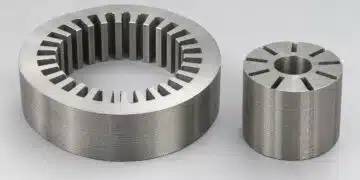



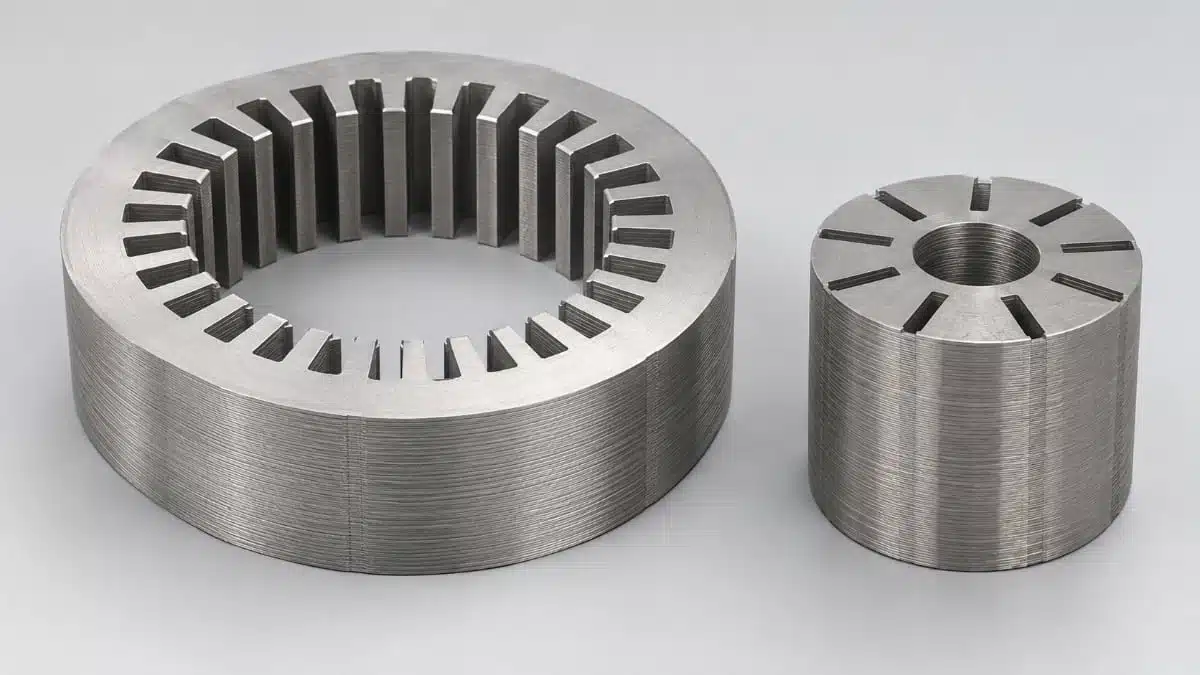
VACUUMSCHMELZE has introduced VACODUR Max, a cobalt-iron soft magnetic alloy for rotor and stator laminations in electric motors and generators.
It combines a saturation polarization of 2.35 T with heat-treatment-adjustable yield strength from 150 to 370 MPa. Stator and rotor laminations can be stamped from the same strip, then annealed separately to obtain different magnetic and mechanical properties.
Key features and benefits
- Saturation polarization of 2.35 T in both stator and rotor grades.
- Final-annealed yield strength of 150 MPa for the stator grade and 370 MPa for the rotor grade.
- Strip thicknesses from 0.05 to 0.2 mm and widths from 120 to 320 mm.
- Supply forms including strip, stamped parts, laminations and laminated assemblies.
- Separate stator and rotor heat treatments, allowing a shared strip material to serve different requirements within the same machine.
Technical highlights
Magnetic properties and mechanical strength
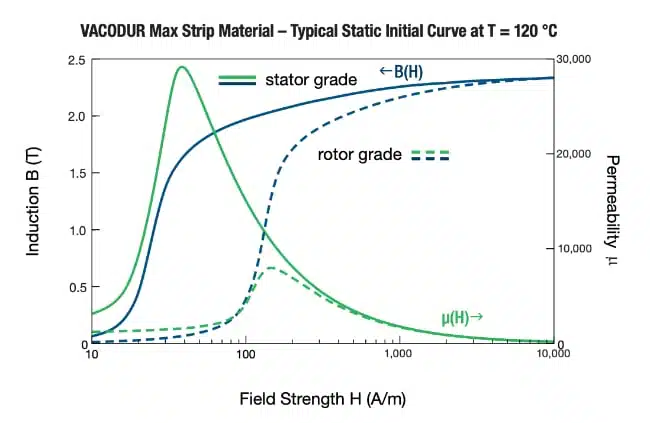
VACODUR Max belongs to the cobalt-iron family of soft magnetic materials. Its stator and rotor grades share the same saturation polarization, but their permeability, coercivity and mechanical properties differ after final annealing.
The following are typical values for 0.1 mm strip. Magnetic properties apply at 20 °C.
| Parameter | Stator grade | Rotor grade |
|---|---|---|
| Saturation polarization | 2.35 T | 2.35 T |
| Induction at 40 kA/m | 2.40 T | 2.40 T |
| Coercivity | 35 A/m | 110 A/m |
| Maximum permeability | 22,000 | 7,000 |
| Yield strength after final annealing | 150 MPa | 370 MPa |
| Tensile strength after final annealing | 350 MPa | 700 MPa |
| Elongation after final annealing | 4% | 8% |
| Young’s modulus after final annealing | 200 GPa | 250 GPa |
The stator grade combines lower coercivity with higher maximum permeability. The rotor grade provides higher yield and tensile strength, with increased coercivity and reduced permeability. Selection therefore involves a magnetic–mechanical trade-off rather than a change in saturation polarization.
Electrical resistivity is 0.31 µΩm at 20 °C. Thermal conductivity is 42 W/(m·K) at 25 °C, and material density is 8.14 g/cm³.
Iron loss depends on grade and operating point
The heat-treatment choice also changes specific iron loss. For 0.1 mm strip at 20 °C, the stator grade has lower loss than the rotor grade at each operating point below.
| Flux density | Frequency | Stator grade | Rotor grade |
|---|---|---|---|
| 1.5 T | 50 Hz | 1.2 W/kg | 3.3 W/kg |
| 1.5 T | 400 Hz | 13 W/kg | 31 W/kg |
| 1.5 T | 1,000 Hz | 44 W/kg | 91 W/kg |
| 2.0 T | 50 Hz | 1.8 W/kg | 5.8 W/kg |
| 2.0 T | 400 Hz | 21 W/kg | 52 W/kg |
| 2.0 T | 1,000 Hz | 75 W/kg | 152 W/kg |
These values make frequency and flux density central selection parameters. At 2.0 T and 1,000 Hz, for example, the rotor grade combines its 370 MPa yield strength with a specific iron loss of 152 W/kg, compared with 75 W/kg for the stator grade.
Temperature and strip thickness also matter. At 1.5 T and 1,000 Hz, the stator grade’s typical loss is 44 W/kg for 0.1 mm strip and 60 W/kg for 0.15 mm strip at 20 °C. At 120 °C, the corresponding values are 41 and 56 W/kg. Loss calculations should therefore use the selected thickness, grade and temperature together.
Final heat treatment
Different annealing schedules establish the stator and rotor conditions.
| Process parameter | Stator grade | Rotor grade |
|---|---|---|
| Atmosphere | Hydrogen | Hydrogen |
| Annealing temperature | 880 °C | 735 °C |
| Annealing time | 6 h | 3 h |
| Cooling rate | 150 ± 50 K/h | 150 ± 50 K/h |
The annealing schedule is part of the material selection, not a separate manufacturing detail. The same starting strip can produce laminations with different strength, permeability and loss characteristics.
Typical applications and application fit
VACODUR Max targets rotors and stators in high-speed electric motors and generators.
For stators, the 2.35 T saturation polarization, maximum permeability of 22,000 and coercivity of 35 A/m provide the principal magnetic selection parameters. Specific iron loss at the intended flux density and frequency governs the associated thermal assessment.
For rotors, the final-annealed yield strength of 370 MPa and tensile strength of 700 MPa support mechanically demanding rotating structures. The accompanying magnetic properties remain part of the design: saturation polarization stays at 2.35 T, while maximum permeability is 7,000 and coercivity is 110 A/m.
A shared-strip manufacturing route allows stator and rotor laminations to be stamped together before separate heat treatments. This approach links material utilisation to the required final condition of each part.
Design-in notes for engineers
- Select the final-annealed grade alongside the electromagnetic and mechanical design. Cold-rolled and final-annealed properties represent different material conditions.
- Use loss values for the intended strip thickness, flux density, frequency and temperature when establishing the thermal budget.
- Include the hydrogen anneal, holding time and cooling rate in the manufacturing process definition.
- Define the required supply form—strip, stamped laminations or laminated assembly—before fixing the production route.
- Validate final selection under the actual operating conditions before production release.
Further reading
- Magnetic Fields in Inductors: Ampère’s Law, Flux Density, and Magnetic Materials
- Nanocrystalline Soft Magnetic Metal Core Materials Explained
Source
This article is based on the VACUUMSCHMELZE product announcement and official product documentation. Engineers should refer to the current manufacturer datasheet for final design and qualification.
References
- VACODUR Max, VACUUMSCHMELZE, September 2026.
- 49% Cobalt-Iron Alloys, VACUUMSCHMELZE.
- Trinity of Power, VACUUMSCHMELZE, November 2025.