
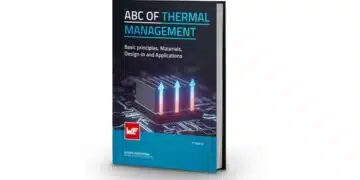





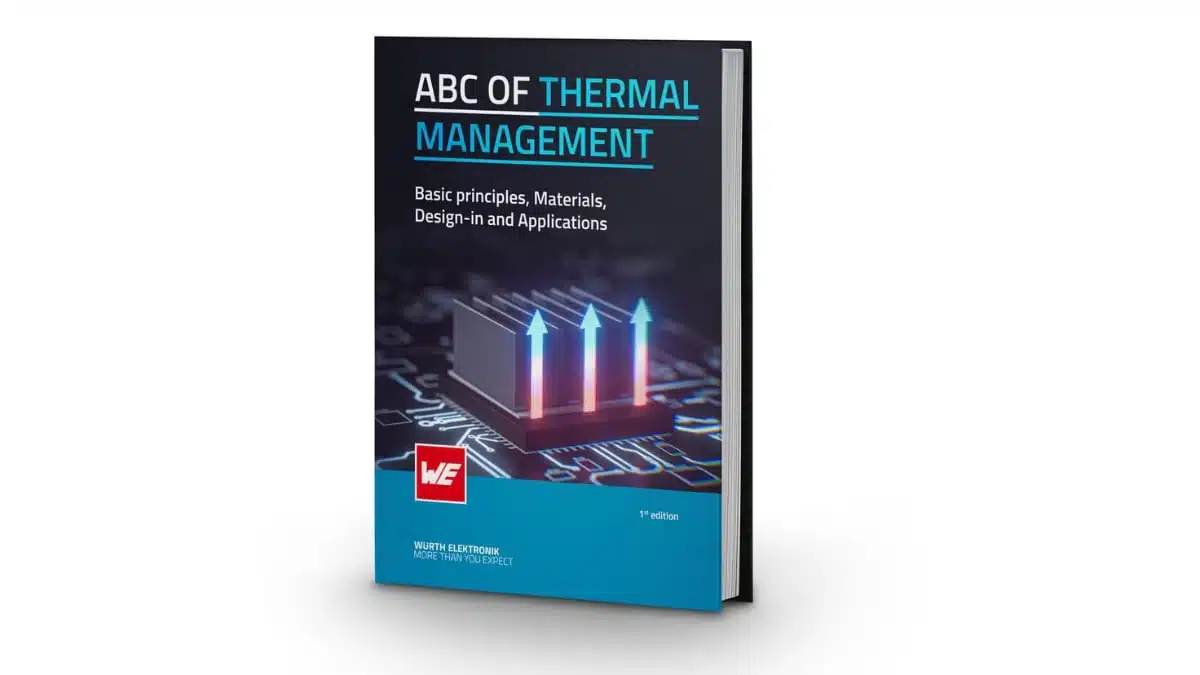
Würth Elektronik has published “ABC of Thermal Management,” an English-language textbook that helps engineers translate thermal requirements into practical electronics design decisions.
Introduced at electronica 2026, the Würth Elektronik book connects heat-transfer fundamentals with PCB layout, enclosure design, thermal-interface materials and cooling-system selection.
Written by Dr. José F. Toledo Alarcón and Sebastián Mirasol-Menacho, the guide follows the development process from initial feasibility checks to prototype validation. Its central message is that preventing hotspots requires a complete thermal strategy—not simply adding a larger heat sink after a design starts overheating.
From Thermal Budget to Validated Hardware
The textbook presents a structured workflow that begins with operating conditions and the available thermal budget. It then moves through circuit-board and enclosure design, simulation, datasheet interpretation, cooling-material selection and experimental verification.
Topics highlighted by Würth Elektronik include:
- Defining boundary conditions and thermal requirements.
- Understanding heat-transfer mechanisms and thermal models.
- Incorporating thermal considerations into PCB layout and enclosure design.
- Selecting, installing and handling heat-conduction materials and heat sinks.
- Assessing interface quality, compression, geometry and long-term reliability.
- Validating prototypes and correlating measurements with simulation models.
Practical examples illustrate how these activities fit into different stages of an electronics development project.
Why the Complete Cooling Path Matters
The engineering value of this approach lies in treating thermal performance as a system property. Heat must travel from its source through the component package, PCB or mounting interface, and onward to the surrounding environment. Improving one part of that path does not necessarily resolve a restriction elsewhere.
For example, a heat sink cannot deliver its intended performance if poor mechanical contact leaves an insulating air gap at the component interface. Likewise, a thermal model may underestimate operating temperature if its airflow or mounting assumptions do not reflect the finished assembly.
A useful starting point is the relationship between dissipated power, thermal resistance and temperature rise: at steady state, a higher thermal resistance produces a larger temperature rise for the same power loss. The Passive Components Blog guide to heat-sink design and thermal-interface material selection explains how this relationship supports cooling-system design.
The textbook’s emphasis on correlating measurements with models is therefore particularly relevant: simulation provides a design framework, while hardware testing checks whether the assumed cooling path exists in practice.
Thermal Interfaces Are a Design Variable
Würth Elektronik places particular emphasis on the selection and installation of thermal-interface materials. Interface quality, compression and geometry influence how effectively heat crosses the boundary between a component and its cooling structure.
For engineers, this means evaluating the assembled interface rather than relying on a material’s thermal-conductivity figure alone. Gap thickness, contact conditions and installation repeatability can all affect the resulting thermal resistance.
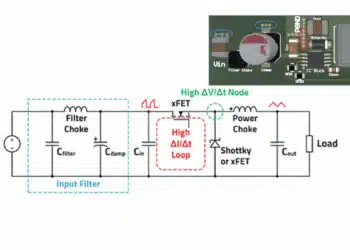
Thermal decisions can also interact with electrical performance. In switched-mode power supplies, the interface between a switching device and a heat sink may introduce parasitic capacitance and contribute to common-mode noise. Thermal and EMC requirements should therefore be considered together where the cooling structure forms part of that coupling path.
Authors Combine Academic and Design-In Experience
Dr. José F. Toledo Alarcón is a professor at the Universitat Politècnica de València in Spain. Co-author Sebastián Mirasol-Menacho works at Würth Elektronik as a product manager for thermal-interface materials.
According to the manufacturer, the authors draw on practical experience to connect thermal theory with material selection, installation and application-level design decisions.
In his introduction, Alexander Gerfer, CTO of the Würth Elektronik eiSos Group, highlights a recurring development challenge: heat conduction, convection and radiation are often addressed only once a design is already running too hot. The book instead encourages engineers to consider the interaction between components, their environment and the cooling path from the outset.
Relevance for Passive-Component Designs
Although the textbook addresses electronic systems broadly, its system-level approach also matters for passive components. Capacitors, for example, generate internal heat under AC and ripple-current loading, and their operating temperature depends on both electrical losses and the available cooling path.
For designers of power converters and other densely populated assemblies, the practical implication is to assess cooling around the complete power stage rather than concentrating exclusively on semiconductor temperatures. Component placement, PCB heat flow and cooling arrangements must work together.
Availability and Publication Details
“ABC of Thermal Management” is published in English and can be ordered through Würth Elektronik’s website. The manufacturer’s announcement lists a price of €19.90.
- Authors: Dr. José F. Toledo Alarcón and Sebastián Mirasol-Menacho.
- Print ISBN: 978-3-89929-480-4.
- E-book ISBN: 978-3-89929-481-1.
- Announcement date: 11 November 2026.
Further reading
- Correlation between Calculation & Practice PCB Heat Dissipation
- Improving SMPS Performance with Thermal Interface Material
- Capacitors Cooling Explained
Source
This article is based on Würth Elektronik’s manufacturer press release, “Understanding hotspots and how to avoid them,” published on 11 November 2026. Additional engineering context draws on Passive Components Blog articles covering heat-sink selection, thermal interfaces, prototype validation and capacitor cooling.
References
- Würth Elektronik press release: Understanding hotspots and how to avoid them.[we-online]
- Würth Elektronik: ABC of Thermal Management book overview and ordering
- Heatsink Design and TIM Selection for Reliable Electronics.
- Improving SMPS Performance with Thermal Interface Material.
- Capacitors Cooling Explained.