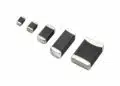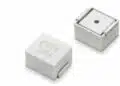




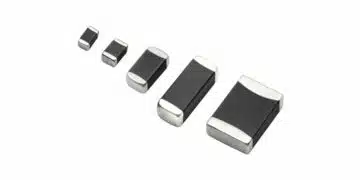


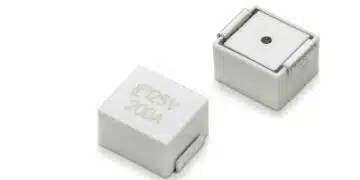







The KH-AT Series from YAGEO Group is a family of automotive‑grade metal oxide varistors (MOVs) targeting surge and overvoltage protection in demanding AC and DC power stages.
Designed for AEC‑Q200 environments and reflow‑solderable assembly, these through‑hole components aim to simplify protection design in EV chargers, AI server power shelves, industrial power modules and infrastructure systems.
Key features and benefits
The YAGEO KH-AT Series is positioned as an automotive‑grade, through‑hole MOV varistor platform with emphasis on long‑term reliability in harsh thermal and humidity conditions.
Key characteristics include:
- Automotive‑grade construction with silicone coating to improve resistance against high temperature, humidity and mechanical stress.
- Qualification to AEC‑Q200 Rev. E, including 1,000 thermal cycles from –40 °C to +125 °C, 1,000 h biased humidity at 85 °C / 85% RH, and 1,000 h operational life at 125 °C maximum operating temperature.
- Storage capability specified from –40 °C up to +150 °C for robust logistics and long‑term stocking.
- Global safety and performance certifications, including UL, CSA and TÜV, supporting use in worldwide platforms.
From a practical standpoint, this combination of coating, qualification and certifications means the same MOV family can be used across multiple automotive and industrial projects, reducing risk of field failures and simplifying approval work with OEMs and safety agencies.
Typical applications
The KH-AT Series targets high‑energy power stages where line transients, lightning surges and grid disturbances must be handled without compromising uptime.
Typical use cases include:
- EV on‑board chargers (OBC) in the 3.3 kW to 22 kW range, providing AC input protection for integrated chargers and AC/DC converter front ends.
- EV powertrain and motor control units, where surge robustness is required on supply lines and auxiliary power rails in harsh automotive environments.
- AI server and rack power supplies, including large GPU‑based systems such as GB200‑class platforms, where MOVs protect AC input and intermediate stages in power shelves and battery backup units.
- Industrial power supplies and power modules, including drives and factory automation equipment connected to noisy mains.
- Renewable energy and charging infrastructure, such as EV charging stations and solar inverters, where lightning‑induced surges and grid events are common.
- Smart grid and telecom base stations, protecting AC and DC feeds in outdoor or semi‑outdoor installations.
In many of these systems, the KH-AT MOV is placed directly across AC lines or between line and protective earth, often combined with additional protective elements (such as TVS, PPTC or GDT) to form a coordinated surge protection scheme.
Technical highlights
Electrical ratings and sizes
The KH-AT MOV family covers a broad electrical and mechanical range for different power levels and surge classes.
- Disc diameters: 7 mm, 10 mm, 14 mm and 20 mm, enabling scalable surge capability from compact input filters to high‑energy mains interfaces.
- AC operating voltage range: 130 Vac to 750 Vac, targeting common mains and high‑voltage industrial lines.
- DC operating voltage range: 170 Vdc to 990 Vdc, suitable for DC buses and intermediate circuits within the specified range.
- Varistor voltage range: approximately 200 V to 1200 V at 1 mA according to the manufacturer datasheet.
Larger disc sizes generally provide higher surge current and energy absorption at the cost of footprint and height, allowing the engineer to select the smallest package that meets surge and lifetime requirements.
Surge capability
For surge current handling (8/20 µs waveform), the KH-AT Series offers:
- 7 mm: up to 1,750 A.
- 10 mm: up to 3,500 A.
- 14 mm: up to 6,000 A.
- 20 mm: up to 10,000 A.
These ratings reflect single‑pulse surge capability; engineers should refer to the detailed product brief and datasheet for repetitive surge guidance and derating curves. In practice, larger devices at higher surge ratings are appropriate for locations close to the grid entry or long cable runs where surge levels are highest.
Environmental robustness and soldering
The series is designed to maintain stable electrical performance under extended environmental and soldering stress:
- Environmental endurance: 1,000 thermal cycles (–40 °C to +125 °C), 1,000 h biased humidity at 85 °C / 85% RH, and 1,000 h operational life at 125 °C.
- Storage rating up to +150 °C, supporting high‑temperature storage conditions in automotive and industrial logistics.
- Reflow soldering: capable of withstanding up to three reflow soldering cycles, enabling use in SMT‑dominant assemblies without dedicated wave‑soldering passes.
Reflow‑capable THT MOVs are particularly attractive in mixed‑technology PCBs: they allow designers to avoid a separate wave process, reduce handling steps and maintain more uniform soldering profiles across the board.
Availability and part numbers
The press release highlights the KH-AT Series as part of YAGEO Group’s circuit protection components (CPC) portfolio, with multiple voltage and disc‑size variants and custom lead forming options.
Key commercial notes:
- Package options: 07 mm, 10 mm, 14 mm and 20 mm disc diameters, all in through‑hole format with silicone coating.
- Lead forms: standard and custom lead forming to suit different creepage requirements and PCB layouts, according to manufacturer documentation.
- Certification set: AEC‑Q200, UL1449, CSA and TÜV recognition for relevant types and voltage classes.
Precise ordering codes, detailed varistor voltage bins, energy ratings and mechanical drawings are provided in the KH-AT Series product brief and associated datasheets and should be consulted for final part selection.
Design‑in notes for engineers
Selection guidelines
When designing in the KH-AT MOVs, several engineering trade‑offs should be considered:
- Operating voltage: choose the varistor voltage and maximum continuous operating voltage (AC or DC) with sufficient margin over nominal mains or DC bus, while keeping clamping voltage compatible with the withstand capability of downstream components.
- Surge requirements: estimate the expected surge environment (lightning category, installation class, cable length, location in protection hierarchy) and select disc size accordingly; 14 mm and 20 mm devices are typically used for higher‑energy, mains‑side positions.
- Energy and repetition: check surge energy ratings and derating curves in the datasheet for repetitive surge scenarios, such as frequent switching transients or exposed outdoor equipment.
Because the KH-AT Series is AEC‑Q200 qualified, it can be attractive for automotive as well as industrial platforms seeking automotive‑style robustness and test regimes.
Layout and manufacturing considerations
The reflow‑capable construction provides manufacturing flexibility, but proper layout remains important:
- PCB landing: ensure sufficient creepage and clearance distances around MOV pads, especially at higher voltage ratings; consider slots or isolation areas where needed.
- Thermal aspects: avoid placing MOVs directly adjacent to long‑term hot spots; while rated for high temperature operation, minimizing continuous thermal stress improves lifetime margin.
- Mechanical stress: observe recommended lead forming guidelines and avoid excessive bending or board flex that could crack the disc or coating.
In reflow processes, engineers should verify that the chosen solder profile respects maximum temperature and time limits defined in the manufacturer’s product brief to avoid degrading insulation resistance or changing varistor characteristics.
Coordination with other protection elements
The press release positions the KH-AT Series as part of YAGEO Group’s broader protection ecosystem including MOVs, TVSs, PPTCs and GDTs. In practical designs this often translates to:
- Using a KH-AT MOV as the primary energy absorber at the mains entry.
- Adding GDTs for high‑energy, high‑voltage surge diversion in telecom or long‑line applications.
- Using TVS diodes for fast clamping of residual transients on low‑voltage DC rails or data lines.
- Incorporating PPTCs for resettable overcurrent protection in conjunction with MOV‑based surge suppression.
Coordinated design of these elements allows controlled clamping levels and shared energy dissipation, improving both protection effectiveness and component lifetime.
Source
This article is based on information provided in a YAGEO Group press release introducing the KH-AT Series automotive‑grade MOVs, complemented by the official product brief and related resource links from the same source.