



Passive Components Blog
No Result
View All Result
  • Home
  • NewsFilter
    • All
    • Aerospace & Defence
    • Antenna
    • Applications
    • Automotive
    • Capacitors
    • Circuit Protection Devices
    • electro-mechanical news
    • Filters
    • Fuses
    • Inductors
    • Industrial
    • Integrated Passives
    • inter-connect news
    • Market & Supply Chain
    • Market Insights
    • Medical
    • Modelling and Simulation
    • New Materials & Supply
    • New Technologies
    • Non-linear Passives
    • Oscillators
    • Passive Sensors News
    • Resistors
    • RF & Microwave
    • Telecommunication
    • Weekly Digest

    Würth Elektronik Updates REDEXPERT DC‑DC Converter Designer

    Stackpole Unveils High-Temperature Automotive Thick Film Chip Resistors for Harsh Environments

    Molex Presents MiniMix Hybrid Power and Signal Connectors for Compact Humanoid Joints

    Bourns Releases Custom SiC AFE/PFC Power Inductor for High‑Voltage Designs

    Littelfuse Releases Toggle Safety Covers for Reliable Control Panels

    Bourns Expanded Blend‑Balance Guitar Potentiometers Resistance Range

    TDK Extends Vibration‑Resistant Axial Aluminum Capacitors for Compact DC‑links

    YAGEO Releases SMD 0402 Pt Temperature Sensors for Space‑Constrained Designs

    Bourns Introduces Automotive Wide Terminal Metal Foil Current Sense Resistors for High‑Reliability Designs

    Trending Tags

    • Ripple Current
    • RF
    • Leakage Current
    • Tantalum vs Ceramic
    • Snubber
    • Low ESR
    • Feedthrough
    • Derating
    • Dielectric Constant
    • New Products
    • Market Reports
  • VideoFilter
    • All
    • Antenna videos
    • Capacitor videos
    • Circuit Protection Video
    • Filter videos
    • Fuse videos
    • Inductor videos
    • Inter-Connect Video
    • Non-linear passives videos
    • Oscillator videos
    • Passive sensors videos
    • Resistor videos

    Current Sense Transformers: Ferrite vs Nanocrystalline Cores for Accurate Current Measurement

    EMC Design Fundamentals: Safe Use of Varistors and Common Mode Chokes in Mains and Data-Line Filters

    Ferrite versus Nanocrystalline Power Inductor Cores: Turns, Gap and Size

    KYOCERA AVX Presents Antenna Integrator Studio Tutorial for Antenna Placement and RF Design

    Power Design Simulation Tools for Faster Inductor Selection and Loss Optimization

    EMC‑Compliant PCB and Connector Design Guidelines

    Why Isolated DC/DC Power Supplies Fail Late, Würth Elektronik Podcast

    Designing 800 V DC EMC Filters: Calculation, Simulation and Measurement

    Current Sense Transformer Datasheet and Design‑in Guide

    Trending Tags

    • Capacitors explained
    • Inductors explained
    • Resistors explained
    • Filters explained
    • Application Video Guidelines
    • EMC
    • New Products
    • Ripple Current
    • Simulation
    • Tantalum vs Ceramic
  • Knowledge Blog
  • Dossiers
    • AI Hardware Dossier
    • Power Converter Dossier
    • Automotive Dossier
    • Capacitor Dossier
    • Resistor Dossier
    • Inductor Dossier
    • Circuit Protection Dossier
  • Suppliers
    • Who is Who
  • PCNS
    • PCNS 2025
    • PCNS 2023
    • PCNS 2021
    • PCNS 2019
    • PCNS 2017
  • Events
  • Home
  • NewsFilter
    • All
    • Aerospace & Defence
    • Antenna
    • Applications
    • Automotive
    • Capacitors
    • Circuit Protection Devices
    • electro-mechanical news
    • Filters
    • Fuses
    • Inductors
    • Industrial
    • Integrated Passives
    • inter-connect news
    • Market & Supply Chain
    • Market Insights
    • Medical
    • Modelling and Simulation
    • New Materials & Supply
    • New Technologies
    • Non-linear Passives
    • Oscillators
    • Passive Sensors News
    • Resistors
    • RF & Microwave
    • Telecommunication
    • Weekly Digest

    Würth Elektronik Updates REDEXPERT DC‑DC Converter Designer

    Stackpole Unveils High-Temperature Automotive Thick Film Chip Resistors for Harsh Environments

    Molex Presents MiniMix Hybrid Power and Signal Connectors for Compact Humanoid Joints

    Bourns Releases Custom SiC AFE/PFC Power Inductor for High‑Voltage Designs

    Littelfuse Releases Toggle Safety Covers for Reliable Control Panels

    Bourns Expanded Blend‑Balance Guitar Potentiometers Resistance Range

    TDK Extends Vibration‑Resistant Axial Aluminum Capacitors for Compact DC‑links

    YAGEO Releases SMD 0402 Pt Temperature Sensors for Space‑Constrained Designs

    Bourns Introduces Automotive Wide Terminal Metal Foil Current Sense Resistors for High‑Reliability Designs

    Trending Tags

    • Ripple Current
    • RF
    • Leakage Current
    • Tantalum vs Ceramic
    • Snubber
    • Low ESR
    • Feedthrough
    • Derating
    • Dielectric Constant
    • New Products
    • Market Reports
  • VideoFilter
    • All
    • Antenna videos
    • Capacitor videos
    • Circuit Protection Video
    • Filter videos
    • Fuse videos
    • Inductor videos
    • Inter-Connect Video
    • Non-linear passives videos
    • Oscillator videos
    • Passive sensors videos
    • Resistor videos

    Current Sense Transformers: Ferrite vs Nanocrystalline Cores for Accurate Current Measurement

    EMC Design Fundamentals: Safe Use of Varistors and Common Mode Chokes in Mains and Data-Line Filters

    Ferrite versus Nanocrystalline Power Inductor Cores: Turns, Gap and Size

    KYOCERA AVX Presents Antenna Integrator Studio Tutorial for Antenna Placement and RF Design

    Power Design Simulation Tools for Faster Inductor Selection and Loss Optimization

    EMC‑Compliant PCB and Connector Design Guidelines

    Why Isolated DC/DC Power Supplies Fail Late, Würth Elektronik Podcast

    Designing 800 V DC EMC Filters: Calculation, Simulation and Measurement

    Current Sense Transformer Datasheet and Design‑in Guide

    Trending Tags

    • Capacitors explained
    • Inductors explained
    • Resistors explained
    • Filters explained
    • Application Video Guidelines
    • EMC
    • New Products
    • Ripple Current
    • Simulation
    • Tantalum vs Ceramic
  • Knowledge Blog
  • Dossiers
    • AI Hardware Dossier
    • Power Converter Dossier
    • Automotive Dossier
    • Capacitor Dossier
    • Resistor Dossier
    • Inductor Dossier
    • Circuit Protection Dossier
  • Suppliers
    • Who is Who
  • PCNS
    • PCNS 2025
    • PCNS 2023
    • PCNS 2021
    • PCNS 2019
    • PCNS 2017
  • Events
No Result
View All Result
Passive Components Blog
No Result
View All Result

Empower Extends Embedded Silicon Capacitors for AI

6.3.2026
Reading Time: 6 mins read
A A

Empower Semiconductor has introduced a new family of embedded silicon capacitors (ECAPs) aimed at solving power integrity challenges directly at the AI and high‑performance computing (HPC) processor package level.

By integrating high‑density capacitance into the processor substrate, these silicon capacitor devices address the limits of traditional board‑level decoupling in systems with extreme current transients and tight voltage margins.

RelatedPosts

Empower Releases High-Density Embedded Silicon Capacitors

Empower’s Low ESL 1pH Silicon Capacitor Meets Tight AI Chip Requirements

Empower E-CAP Silicon Capacitors vs MLCC

Key features and benefits

The new ECAP portfolio currently includes three embedded silicon capacitors optimized for package‑level integration in AI and HPC SoCs:

  • EC2005P: 9.34 µF nominal capacitance in a 2 mm × 2 mm package
  • EC2025P: 18.68 µF nominal capacitance in a 4 mm × 2 mm package
  • EC2006P: 36.8 µF nominal capacitance in a 4 mm × 4 mm package

From a power integrity perspective, the key characteristics of these ECAP devices are:

  • Ultralow equivalent series inductance (ESL) to minimize voltage droop during fast load steps.
  • Ultralow equivalent series resistance (ESR) to reduce resistive loss and improve damping of supply rail resonances.
  • Wide‑bandwidth ultralow impedance profile to support high di/dt current transients across a broad frequency range.

In practice, low ESL enables the capacitor to remain effective at very high edge rates, where conventional discrete MLCCs on the PCB can be limited by mounting inductance. Low ESR and a flat impedance characteristic help designers maintain tight DC and dynamic voltage regulation at the point of load, even as AI accelerators draw rapidly varying currents.

Each ECAP device is mechanically and dimensionally engineered for substrate embedding rather than simple surface mounting. This includes package thickness, tolerance control and planarity tuned for integration into advanced processor substrates and interposers, which is critical to avoid reliability issues in high‑density chiplet and 2.5D/3D packages.

Typical applications

The EC2005P, EC2025P and EC2006P are intended for use directly under or adjacent to AI‑class processors and high‑end SoCs, where very tight power integrity budgets drive the need for embedded decoupling. Typical use cases include:

  • Core and cache rail decoupling for large AI accelerators (GPU, custom AI ASIC, NPU) operating at high current densities.
  • High‑speed digital core rails in HPC CPUs and data‑center class SoCs.
  • Multi‑rail power delivery in chiplet‑based architectures where vertical power delivery is used to minimize PDN loop inductance.
  • Advanced networking and switch ASICs with similar fast transient behavior to AI accelerators.

In these environments, board‑level decoupling alone often cannot provide the required combination of low inductance and high capacitance directly at the die. Embedding ECAPs into the substrate shortens the electrical distance between the silicon and the decoupling network, reducing parasitics and improving the effectiveness of the overall power delivery network.

Technical highlights

The ECAP concept combines silicon‑based capacitor structures with packaging optimized for embedding rather than discrete PCB assembly. For PDN design, the most relevant technical highlights are:

  • Capacitance density: tens of microfarads in a few square millimeters, enabling substantial decoupling capacitance very close to the die.
  • Embedded form factor: 2 mm × 2 mm up to 4 mm × 4 mm footprints designed to fit within substrate keep‑out and routing constraints.
  • Ultralow ESL and ESR: supports wideband decoupling and reduces the need for large “capacitor farms” of discrete MLCCs around the package.
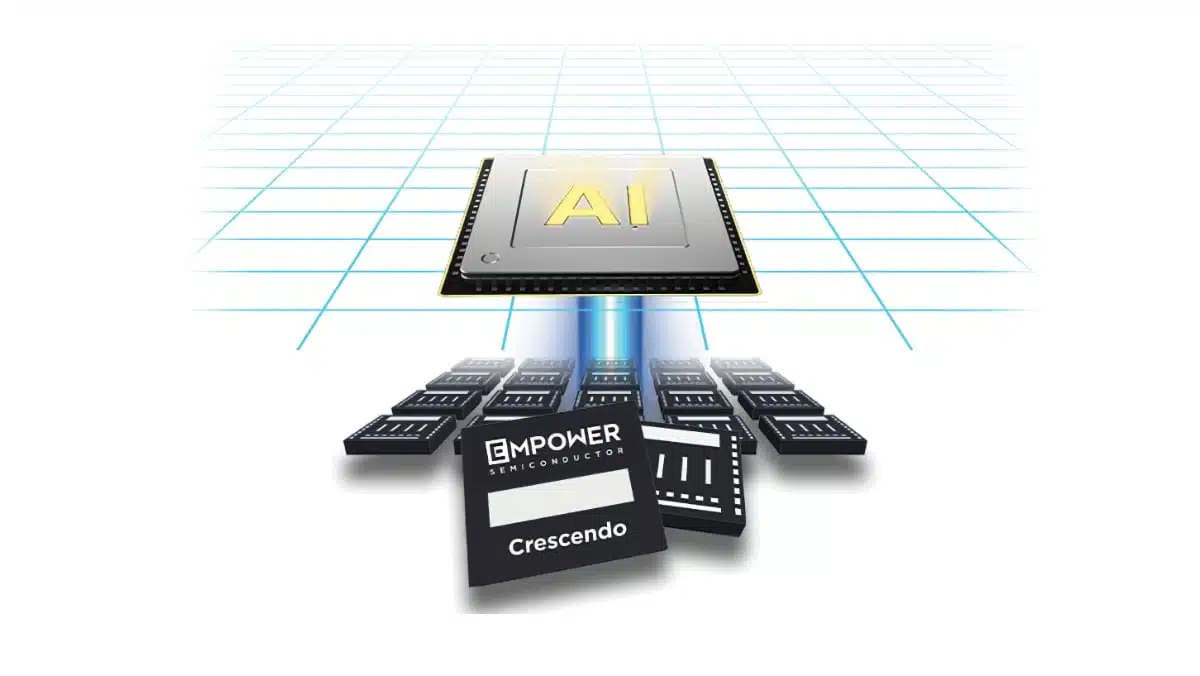
  • Power integrity focus: the impedance characteristics are tuned to complement vertical power delivery architectures such as Empower’s Crescendo platform.

For design engineers, this means these capacitors can be treated as part of the on‑package PDN rather than as standard PCB components. They are especially valuable for suppressing mid‑ to high‑frequency impedance peaks that arise from the interaction of on‑die decoupling, package parasitics and PCB‑mounted capacitors.

Where exact electrical limits (voltage rating, detailed frequency response, reliability data) are required for qualification and simulation, these should be taken from the manufacturer datasheet and characterization reports according to the target processor and substrate technology.

Design‑in notes for engineers

When considering ECAPs for a next‑generation AI or HPC design, engineers should focus on how the embedded capacitors fit into the overall PDN strategy rather than treating them as a simple replacement for PCB‑mounted MLCCs:

  • Plan for substrate integration early: ECAP footprints and keep‑out areas must be coordinated with substrate layout, via fields and chiplet placement. Late‑stage changes are difficult once the package stack‑up is fixed.
  • Co‑simulate the PDN: include ECAP models alongside on‑die capacitance, package parasitics, vertical power delivery elements and board‑level decoupling. This helps determine the optimal mix and placement for meeting impedance targets.
  • Match device size to rail requirements: higher‑capacitance EC2006P devices may be allocated to the most demanding core rails, while EC2005P or EC2025P devices can be used on auxiliary or moderately loaded rails where area is constrained.
  • Consider thermal and mechanical aspects: embedded components must withstand the same reflow, underfill and thermal cycling environment as the processor package. Use the manufacturer’s guidance on maximum operating conditions and stack‑up compatibility.
  • Coordinate with voltage regulator architecture: when using vertical power delivery platforms such as Empower’s Crescendo, the ECAP placement and values can be tuned to minimize PDN loop inductance and optimize transient response from the integrated voltage regulators to the die.

For purchasing and sourcing teams, it is important to recognize that ECAPs are not drop‑in alternatives to standard SMD capacitors. They are typically qualified as part of a specific package design and processor program. Long‑term supply agreements, lifecycle expectations and second‑source strategies should therefore be aligned with the AI/HPC platform roadmap.

Source

This article is based on information provided by Empower Semiconductor in their official press release announcing the EC2005P, EC2025P and EC2006P embedded silicon capacitors for AI and HPC applications, complemented by general power integrity design considerations that apply to on‑package decoupling solutions.


References

  1. Empower introduces high-density embedded silicon capacitors to advance next-generation AI and HPC performance
  2. Empower Semiconductor – Corporate brochure (October 2025, ECAP portfolio overview)
  3. Empower Semiconductor – Official website

Related

Recent Posts

Würth Elektronik Updates REDEXPERT DC‑DC Converter Designer

6.8.2026
26

TDK Extends Vibration‑Resistant Axial Aluminum Capacitors for Compact DC‑links

4.8.2026
31

YAGEO Extends Automotive Tantalum Polymer Capacitors for AI and ADAS Controllers

31.7.2026
106

Knowles Introduces PP Film Capacitors for High‑Stress Power Electronics

30.7.2026
61

AI Data Centers Push Aluminium Capacitor Prices Higher

30.7.2026
166

Samsung Introduces Ultra‑compact, High‑Capacitance MLCCs for AI Edge and Wearable designs

29.7.2026
77

Knowles Presents Pulse Power Capacitors for Demanding MedTech, Industrial and Defense Applications

29.7.2026
54

YAGEO Extends its Supercapacitor Series Line-Up

28.7.2026
101

June 2026: AI Demand Pushes Japanese and Korean MLCC Makers to Five‑Year Shipment High

28.7.2026
184

Upcoming Events

Sep 10
11:00 - 12:00 CEST

Equipment models and model strategies for Space Missions

Sep 29
16:00 - 17:00 CEST

Cybersecurity 2026

Nov 24
16:00 - 17:00 CET

Component selection with the WE REDEXPERT® DC-DC Converter Designer Tool

View Calendar

Popular Posts

  • Buck Converter Design and Calculation

    0 shares
    Share 0 Tweet 0
  • Boost Converter Design and Calculation

    0 shares
    Share 0 Tweet 0
  • LLC Resonant Converter Design and Calculation

    0 shares
    Share 0 Tweet 0
  • Flyback Converter Design and Calculation

    0 shares
    Share 0 Tweet 0
  • YAGEO Announces July 2026 Capacitor Price Increase

    0 shares
    Share 0 Tweet 0
  • MLCC and Ceramic Capacitors

    0 shares
    Share 0 Tweet 0
  • MLCCs in the Age of AI: Q2 2026 Market Tightness

    0 shares
    Share 0 Tweet 0
  • Earthing Systems and IEC Classification Explained

    0 shares
    Share 0 Tweet 0
  • Dual Active Bridge (DAB) Topology

    0 shares
    Share 0 Tweet 0
  • Ripple Current and its Effects on the Performance of Capacitors

    3 shares
    Share 3 Tweet 0

Newsletter Subscription


Passive Components Blog

© EPCI - Leading Passive Components Educational and Information Site

  • Home
  • Privacy Policy
  • EPCI Membership & Advertisement
  • About

No Result
View All Result
  • Home
  • Knowledge Blog
  • Dossiers
  • PCNS

© EPCI - Leading Passive Components Educational and Information Site