





Passive Components Blog
No Result
View All Result
  • Home
  • NewsFilter
    • All
    • Aerospace & Defence
    • Antenna
    • Applications
    • Automotive
    • Capacitors
    • Circuit Protection Devices
    • electro-mechanical news
    • Filters
    • Fuses
    • Inductors
    • Industrial
    • Integrated Passives
    • inter-connect news
    • Market & Supply Chain
    • Market Insights
    • Medical
    • Modelling and Simulation
    • New Materials & Supply
    • New Technologies
    • Non-linear Passives
    • Oscillators
    • Passive Sensors News
    • Resistors
    • RF & Microwave
    • Telecommunication
    • Weekly Digest

    Binder Hybrid Connector Simplifies One Cable Automation

    Tapped Inductor Buck Converter Fundamentals

    TAIYO YUDEN Releases Mini Metal Power Inductors

    Molecular Memristor Shows Record 145 kH Emergent Inductance

    Planar vs Conventional Transformer: When it Make Sense

    Researchers Propose Next‑Gen Compact Memory Using Ultra-thin Ferroelectric Capacitors

    Nichicon ADN Automotive Hybrid Aluminum Capacitors Now Available in EMEA

    Wk 19 Electronics Supply Chain Digest

    Electrocaloric Multilayer Capacitors: Towards Quiet, Solid‑State Cooling Around Room Temperature

    Trending Tags

    • Ripple Current
    • RF
    • Leakage Current
    • Tantalum vs Ceramic
    • Snubber
    • Low ESR
    • Feedthrough
    • Derating
    • Dielectric Constant
    • New Products
    • Market Reports
  • VideoFilter
    • All
    • Antenna videos
    • Capacitor videos
    • Circuit Protection Video
    • Filter videos
    • Fuse videos
    • Inductor videos
    • Inter-Connect Video
    • Non-linear passives videos
    • Oscillator videos
    • Passive sensors videos
    • Resistor videos

    Tapped Inductor Buck Converter Fundamentals

    Planar vs Conventional Transformer: When it Make Sense

    Modeling Fringing Field Losses in Inductors & Transformers

    Why Power Inductors Use a Ferrite Core With an Air Gap

    Transformer-Based Power-Line Harvester Magnetic Design

    Thermal Modeling of Magnetics

    Standard vs Planar LLC transformers Comparison for Battery Chargers

    How Modern Tools Model Magnetic Components for Power Electronics

    Advanced Loss Modeling for Planar Magnetics in the Frenetic Planar Tool

    Trending Tags

    • Capacitors explained
    • Inductors explained
    • Resistors explained
    • Filters explained
    • Application Video Guidelines
    • EMC
    • New Products
    • Ripple Current
    • Simulation
    • Tantalum vs Ceramic
  • Knowledge Blog
  • DossiersNew
  • Suppliers
    • Who is Who
  • PCNS
    • PCNS 2025
    • PCNS 2023
    • PCNS 2021
    • PCNS 2019
    • PCNS 2017
  • Events
  • Home
  • NewsFilter
    • All
    • Aerospace & Defence
    • Antenna
    • Applications
    • Automotive
    • Capacitors
    • Circuit Protection Devices
    • electro-mechanical news
    • Filters
    • Fuses
    • Inductors
    • Industrial
    • Integrated Passives
    • inter-connect news
    • Market & Supply Chain
    • Market Insights
    • Medical
    • Modelling and Simulation
    • New Materials & Supply
    • New Technologies
    • Non-linear Passives
    • Oscillators
    • Passive Sensors News
    • Resistors
    • RF & Microwave
    • Telecommunication
    • Weekly Digest

    Binder Hybrid Connector Simplifies One Cable Automation

    Tapped Inductor Buck Converter Fundamentals

    TAIYO YUDEN Releases Mini Metal Power Inductors

    Molecular Memristor Shows Record 145 kH Emergent Inductance

    Planar vs Conventional Transformer: When it Make Sense

    Researchers Propose Next‑Gen Compact Memory Using Ultra-thin Ferroelectric Capacitors

    Nichicon ADN Automotive Hybrid Aluminum Capacitors Now Available in EMEA

    Wk 19 Electronics Supply Chain Digest

    Electrocaloric Multilayer Capacitors: Towards Quiet, Solid‑State Cooling Around Room Temperature

    Trending Tags

    • Ripple Current
    • RF
    • Leakage Current
    • Tantalum vs Ceramic
    • Snubber
    • Low ESR
    • Feedthrough
    • Derating
    • Dielectric Constant
    • New Products
    • Market Reports
  • VideoFilter
    • All
    • Antenna videos
    • Capacitor videos
    • Circuit Protection Video
    • Filter videos
    • Fuse videos
    • Inductor videos
    • Inter-Connect Video
    • Non-linear passives videos
    • Oscillator videos
    • Passive sensors videos
    • Resistor videos

    Tapped Inductor Buck Converter Fundamentals

    Planar vs Conventional Transformer: When it Make Sense

    Modeling Fringing Field Losses in Inductors & Transformers

    Why Power Inductors Use a Ferrite Core With an Air Gap

    Transformer-Based Power-Line Harvester Magnetic Design

    Thermal Modeling of Magnetics

    Standard vs Planar LLC transformers Comparison for Battery Chargers

    How Modern Tools Model Magnetic Components for Power Electronics

    Advanced Loss Modeling for Planar Magnetics in the Frenetic Planar Tool

    Trending Tags

    • Capacitors explained
    • Inductors explained
    • Resistors explained
    • Filters explained
    • Application Video Guidelines
    • EMC
    • New Products
    • Ripple Current
    • Simulation
    • Tantalum vs Ceramic
  • Knowledge Blog
  • DossiersNew
  • Suppliers
    • Who is Who
  • PCNS
    • PCNS 2025
    • PCNS 2023
    • PCNS 2021
    • PCNS 2019
    • PCNS 2017
  • Events
No Result
View All Result
Passive Components Blog
No Result
View All Result

ECIA February 2026 Industry Pulse Signals Strong Component Growth

6.3.2026
Reading Time: 3 mins read
A A

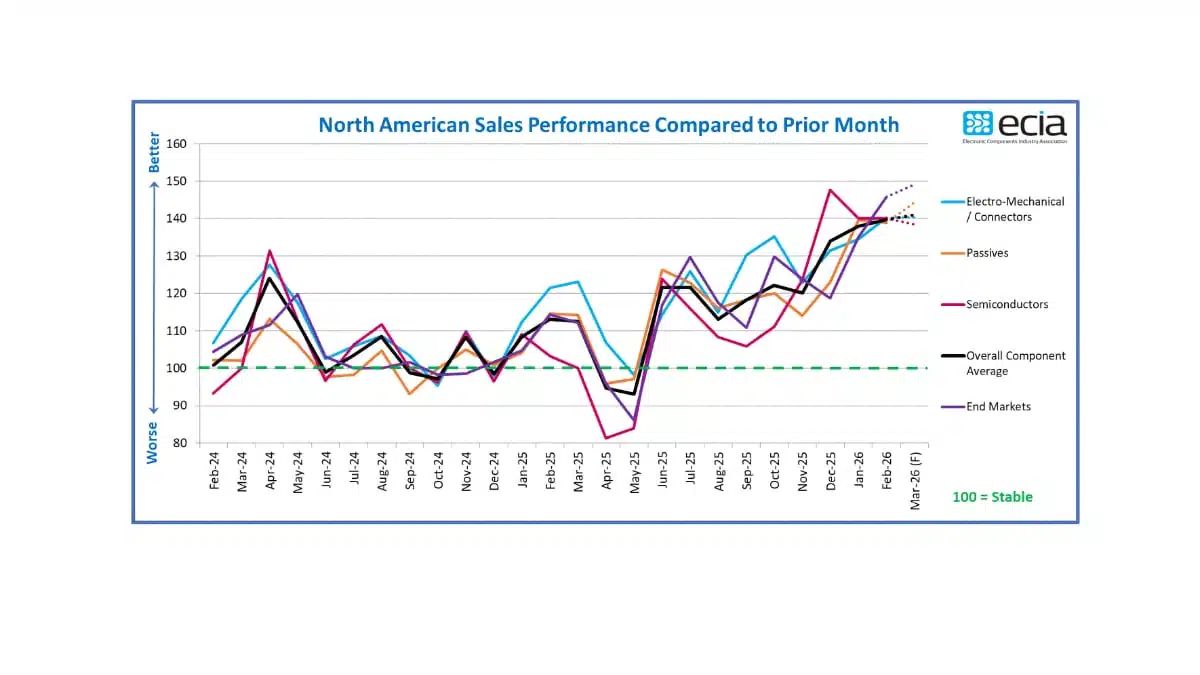
ECIA’s latest Industry Pulse survey for February 2026 confirms that sales optimism continues to climb across every major sector of the electronic components market.

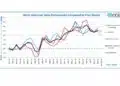
Average sales sentiment reached 139.7 in February, up from 138.0 in January, marking the ninth consecutive month of strong positive sentiment and the fifth month in a row with robust results across all subcategories.

RelatedPosts

ECIA March 2026 Industry Pulse Points to Best Sales Climate in Five Years

ECIA January 2026 Reports Strong Sales Confidence

October 2025 ECIA US Components Sales Sentiment Remains Strong but Weakens in November

Strong Sales Sentiment Across Components and Channels

The survey highlights a solidly positive environment in all major component categories, including semiconductors, electro-mechanical/connectors, and passive components. A score of 100 represents the break-even line between negative and positive sentiment, and all categories remain well above this threshold.

Looking ahead, respondents project further improvement, with the March 2026 overall sentiment index expected to reach 141.1. After a steep drop in confidence triggered by global tariff shocks in 2025, the market has recovered strongly since June, and industry participants now expect 2026 to maintain a healthy sales climate, barring any major unforeseen “Black Swan” disruptions.

Q1 and Q2 2026 Outlook: Broad Growth, Minimal Negativity

Quarterly survey results for Q1 and Q2 2026 support a sustained growth narrative through at least the first half of the year. In Q1, 71% of respondents report positive sales growth, rising slightly to 72% for Q2.

Negative expectations are now the exception rather than the rule, with only 2% of participants in Q1 and 4% in Q2 anticipating declining sales. Remarkably, no respondents in the semiconductor segment report expectations of negative growth in either Q1 or Q2, underscoring the sector’s current strength.

Distributors Lead in Optimism, But All Channels Positive

Sentiment varies by channel, but all remain clearly positive. Distributors report the strongest confidence levels for both February and March, with an overall average around 160 on the sentiment index.

Manufacturers and manufacturer representatives are more conservative, but still firmly optimistic, posting index scores between 119 and 130 for the same period. Despite the gap between channels, all three groups—distributors, manufacturers, and reps—report positive sentiment in every product subcategory in both February and March.

End-Market Trends: Industrial and Aerospace Lead, Consumer Also Strong

The overall end-market index rose to nearly 146 in February, its highest reading since May 2021, and is expected to climb further to 149.2 in March. This broad-based strength spans all end markets covered in the survey.

Avionics, military, space, and industrial segments continue to post the highest sentiment scores, reflecting sustained investment in mission-critical and infrastructure-related applications. Even at the lower end of the spectrum, markets such as consumer electronics and mobile phones still deliver index readings above 122, indicating healthy demand and far from any contraction signal.

Lead Times: Easing in Semiconductors, Persistent Concerns in Advanced Memory

Lead time dynamics remain a critical operational indicator for the industry. In February, pressure eased notably in semiconductors, as the share of respondents reporting increasing lead times dropped from 52% to 39%.

For electro-mechanical and passive components, lead times were generally stable between January and March, with very few reports of improvement. Only 2% of respondents cited decreasing lead times for electro-mechanical components, and 5% for semiconductors. A significant supply–demand imbalance in advanced memory ICs continues to be one of the most pressing risks, as constrained availability in this segment could stall sales in other parts of the components market and has become a key focus area for supply chain management heading into 2026.

Source

This article is based on information from the Electronic Components Industry Association (ECIA) Industry Pulse and Electronic Component Sales Trends (ECST) survey summary for February and Q1 2026, authored by ECIA Chief Analyst Dale Ford.
References

  1. ECIA Industry Pulse February 2026 Outlook Article (PDF)

Related

Recent Posts

Binder Hybrid Connector Simplifies One Cable Automation

13.5.2026
3

Planar vs Conventional Transformer: When it Make Sense

11.5.2026
35

Nichicon ADN Automotive Hybrid Aluminum Capacitors Now Available in EMEA

11.5.2026
22

European Components Distribution Shows Strong Q1 2026 Growth Amid Geopolitical Uncertainty

7.5.2026
70

Stackpole Expanded its AlN Thick Film Chip Resistors

6.5.2026
22

Würth Elektronik Introduces Compact Flat-wire SMT Power Inductors for Automotive

5.5.2026
49

KYOCERA AVX Extends MLV Varistors for 48V Automotive Protection

5.5.2026
26

YAGEO Introduces C0G Flexible Termination Automotive MLCCs

30.4.2026
41

SCHURTER Releases SMT Micro Switch for Compact HMIs

30.4.2026
14

Upcoming Events

May 13
17:00 - 17:30 CEST

Winding Loss Modeling for Toroidal Magnetics – Including Gapped Cores

May 19
16:00 - 17:00 CEST

Designing Qi2 Wireless Power Systems: Practical Development and EMC Optimization

Jun 2
16:00 - 17:00 CEST

Calculation, Simulation and Measurement of 800V EMC Filters

View Calendar

Popular Posts

  • Buck Converter Design and Calculation

    0 shares
    Share 0 Tweet 0
  • Boost Converter Design and Calculation

    0 shares
    Share 0 Tweet 0
  • Flyback Converter Design and Calculation

    0 shares
    Share 0 Tweet 0
  • LLC Resonant Converter Design and Calculation

    0 shares
    Share 0 Tweet 0
  • MLCC and Ceramic Capacitors

    0 shares
    Share 0 Tweet 0
  • Dual Active Bridge (DAB) Topology

    0 shares
    Share 0 Tweet 0
  • What Electronics Engineer Needs to Know About Passive Low Pass Filters

    0 shares
    Share 0 Tweet 0
  • Capacitor Charging and Discharging

    0 shares
    Share 0 Tweet 0
  • Ripple Current and its Effects on the Performance of Capacitors

    3 shares
    Share 3 Tweet 0
  • MLCC Case Sizes Standards Explained

    0 shares
    Share 0 Tweet 0

Newsletter Subscription


Passive Components Blog

© EPCI - Leading Passive Components Educational and Information Site

  • Home
  • Privacy Policy
  • EPCI Membership & Advertisement
  • About

No Result
View All Result
  • Home
  • Knowledge Blog
  • PCNS

© EPCI - Leading Passive Components Educational and Information Site

This website uses cookies. By continuing to use this website you are giving consent to cookies being used. Visit our Privacy and Cookie Policy.
Go to mobile version