















Passive Components Blog
No Result
View All Result
  • Home
  • NewsFilter
    • All
    • Aerospace & Defence
    • Antenna
    • Applications
    • Automotive
    • Capacitors
    • Circuit Protection Devices
    • electro-mechanical news
    • Filters
    • Fuses
    • Inductors
    • Industrial
    • Integrated Passives
    • inter-connect news
    • Market & Supply Chain
    • Market Insights
    • Medical
    • Modelling and Simulation
    • New Materials & Supply
    • New Technologies
    • Non-linear Passives
    • Oscillators
    • Passive Sensors News
    • Resistors
    • RF & Microwave
    • Telecommunication
    • Weekly Digest

    Nanocrystalline Cores for Low‑Loss MHz Chip Inductors

    Exxelia Miniaturized 400 MHz Inverted‑F Antenna

    Würth Elektronik Unveils High-Current Automotive Power Inductor

    Transformer-Based Power-Line Harvester Magnetic Design

    Tantalum Capacitor Anode Manufacturing Quality Management

    Middle East Conflict: The Potential Impact to Passive Components

    Wk 12 Electronics Supply Chain Digest

    Designing a 2 kW LLC Transformer with Integrated Resonant Inductor

    Inductor Technology Dossier

    Trending Tags

    • Ripple Current
    • RF
    • Leakage Current
    • Tantalum vs Ceramic
    • Snubber
    • Low ESR
    • Feedthrough
    • Derating
    • Dielectric Constant
    • New Products
    • Market Reports
  • VideoFilter
    • All
    • Antenna videos
    • Capacitor videos
    • Circuit Protection Video
    • Filter videos
    • Fuse videos
    • Inductor videos
    • Inter-Connect Video
    • Non-linear passives videos
    • Oscillator videos
    • Passive sensors videos
    • Resistor videos

    Transformer-Based Power-Line Harvester Magnetic Design

    Thermal Modeling of Magnetics

    Standard vs Planar LLC transformers Comparison for Battery Chargers

    How Modern Tools Model Magnetic Components for Power Electronics

    Advanced Loss Modeling for Planar Magnetics in the Frenetic Planar Tool

    2026 Power Magnetics Design Trends: Flyback, DAB and Planar

    Enabling Software‑Defined Vehicle Architectures: Automotive Ethernet and Zonal Smart Power

    Calculating Resistance Value of a Flyback RC Snubber 

    One‑Pulse Characterization of Nonlinear Power Inductors

    Trending Tags

    • Capacitors explained
    • Inductors explained
    • Resistors explained
    • Filters explained
    • Application Video Guidelines
    • EMC
    • New Products
    • Ripple Current
    • Simulation
    • Tantalum vs Ceramic
  • Knowledge Blog
  • DossiersNew
  • Suppliers
    • Who is Who
  • PCNS
    • PCNS 2025
    • PCNS 2023
    • PCNS 2021
    • PCNS 2019
    • PCNS 2017
  • Events
  • Home
  • NewsFilter
    • All
    • Aerospace & Defence
    • Antenna
    • Applications
    • Automotive
    • Capacitors
    • Circuit Protection Devices
    • electro-mechanical news
    • Filters
    • Fuses
    • Inductors
    • Industrial
    • Integrated Passives
    • inter-connect news
    • Market & Supply Chain
    • Market Insights
    • Medical
    • Modelling and Simulation
    • New Materials & Supply
    • New Technologies
    • Non-linear Passives
    • Oscillators
    • Passive Sensors News
    • Resistors
    • RF & Microwave
    • Telecommunication
    • Weekly Digest

    Nanocrystalline Cores for Low‑Loss MHz Chip Inductors

    Exxelia Miniaturized 400 MHz Inverted‑F Antenna

    Würth Elektronik Unveils High-Current Automotive Power Inductor

    Transformer-Based Power-Line Harvester Magnetic Design

    Tantalum Capacitor Anode Manufacturing Quality Management

    Middle East Conflict: The Potential Impact to Passive Components

    Wk 12 Electronics Supply Chain Digest

    Designing a 2 kW LLC Transformer with Integrated Resonant Inductor

    Inductor Technology Dossier

    Trending Tags

    • Ripple Current
    • RF
    • Leakage Current
    • Tantalum vs Ceramic
    • Snubber
    • Low ESR
    • Feedthrough
    • Derating
    • Dielectric Constant
    • New Products
    • Market Reports
  • VideoFilter
    • All
    • Antenna videos
    • Capacitor videos
    • Circuit Protection Video
    • Filter videos
    • Fuse videos
    • Inductor videos
    • Inter-Connect Video
    • Non-linear passives videos
    • Oscillator videos
    • Passive sensors videos
    • Resistor videos

    Transformer-Based Power-Line Harvester Magnetic Design

    Thermal Modeling of Magnetics

    Standard vs Planar LLC transformers Comparison for Battery Chargers

    How Modern Tools Model Magnetic Components for Power Electronics

    Advanced Loss Modeling for Planar Magnetics in the Frenetic Planar Tool

    2026 Power Magnetics Design Trends: Flyback, DAB and Planar

    Enabling Software‑Defined Vehicle Architectures: Automotive Ethernet and Zonal Smart Power

    Calculating Resistance Value of a Flyback RC Snubber 

    One‑Pulse Characterization of Nonlinear Power Inductors

    Trending Tags

    • Capacitors explained
    • Inductors explained
    • Resistors explained
    • Filters explained
    • Application Video Guidelines
    • EMC
    • New Products
    • Ripple Current
    • Simulation
    • Tantalum vs Ceramic
  • Knowledge Blog
  • DossiersNew
  • Suppliers
    • Who is Who
  • PCNS
    • PCNS 2025
    • PCNS 2023
    • PCNS 2021
    • PCNS 2019
    • PCNS 2017
  • Events
No Result
View All Result
Passive Components Blog
No Result
View All Result

How to Optimize Magnetizing Inductance for ZVS Zero Volt Switching

9.11.2023
Reading Time: 5 mins read
A A

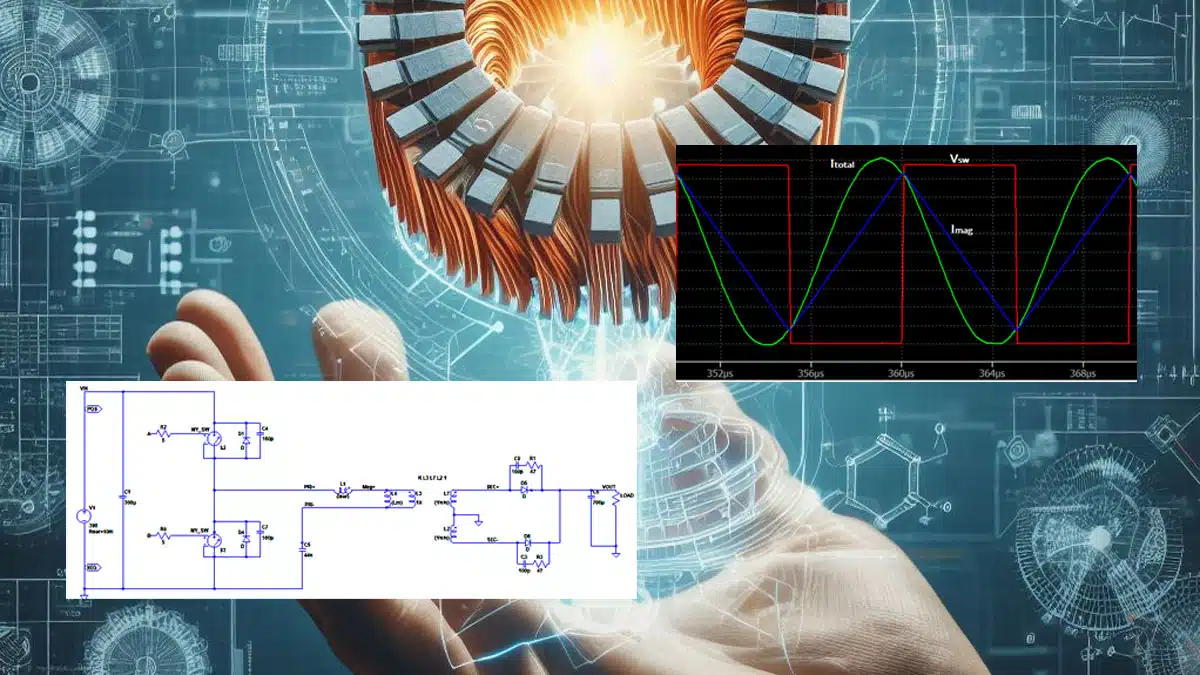
This article based on Sotiris Zorbas, Power Εlectronics Εngineer Frenetic newsletter discusses optimisation of magnetic inductance for ZVS zero volt switching.

Our mission today is to understand how an LLC Converter achieves ZVS on the primary side.

RelatedPosts

Designing a 2 kW LLC Transformer with Integrated Resonant Inductor

Thermal Modeling of Magnetics

Standard vs Planar LLC transformers Comparison for Battery Chargers

The zero-voltage switching in an LLC Converter is directly linked to the magnetizing inductance of the Transformer and the output parasitic capacitance Coss of the mosfets that form the full/half driving bridge.

Let’s start from an LTspice schematic as you can see in Figure 1.

I have used a simple trick for the Transformer model: I kept the series and magnetizing inductances separate and used an ideal Transformer utilizing high inductance perfectly coupled inductors.

That way, I could monitor the magnetizing current going through Lm (L4) and that going to L3, thus the load eventually. L7, L2 secondaries are sized at 1H/n^2, where n is the turns ratio.
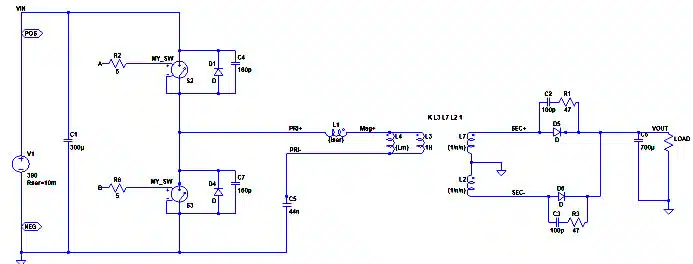
Figure 1. An LLC Converter

What else is important in that schematic?

Switches S2, S3 are working like on/off switches using the Rds_on of the selected mosfet each time. The important part is putting a couple of capacitors in parallel with these to model the output parasitic capacitance. That parameter can be found in the respective datasheets of the selected device. However, there is a trap here!

Is the output capacitance calculated based on time, or energy?

The output capacitance changes dynamically in mosfets when switching, ranging from a few picofarads to a few nanofarads, as the voltage on the drain-source pins drops from a high to a low potential. The manufacturer has constructed an artificial effective capacitor that either gives the same stored energy value or the same charging time.

Looking at Figure 2 helps to better understand what I’ve just described.
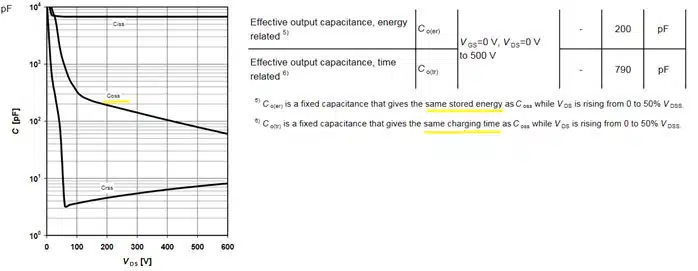
Figure 2.  IPW90R120C3 power mosfet Coss values

An example design – case study.

I have used the worked example in SLUA923 reference below, to help the reader. The specs are listed in Table 1.

The first thing when looking to achieve ZVS is to realize the working mechanism that causes the parasitic capacitances to be discharged. Without getting into many details, the resonant current in an LLC circulates through the LLC network and the power switches, causing ZVS of the latter. Part of the current is flowing through the magnetizing inductance Lm and part “flows” to the load through the ideal Transformer.

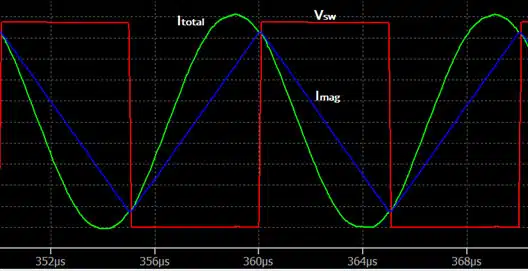
In Figure 3, the total current through the LLC tank marked as Itotal is L1’s current. Imag as the name suggests is Lm current. The difference of these currents flows into the ideal Transformer. Right at the switching transitions the Itotal equals Imag , and we can assume that this is practically constant during the transitions.
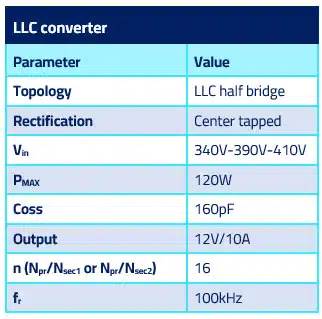
Table 1. Example LLC Converter/Transformer specs 
Figure 3. Switching currents and bridge node voltage

The rate of voltage rise dv/dt of the switching transition depends on the total capacitance to be charged/discharged (2*Coss_tr) and the actual peak current level, as shown in the figure 3. above. The usual 50-100ns of rise/fall times in 400V systems yields good results overall.
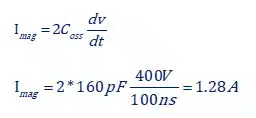
The magnetizing current swings triangularly from a maximum positive to a maximum negative value in T/2 as seen in Figure 3. At the moment of switching to get the 1.28A we just calculated, the current need to swing from -1.28A to +1.28A thus a ΔΙ=2Imag is the current swing.

Using the basic formula for an inductor:
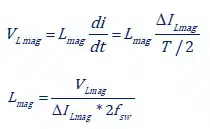
The voltage at the magnetizing Inductor is approximately half of the switching voltage because of the DC bias removal action of the resonant capacitor. So, in the end:
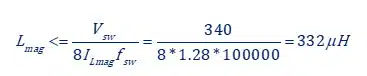
o achieve 100ns of switching time (0-100% of the voltage) we should select the magnetizing inductance below 332μH. Checking out LTspice in Figure 4 we can verify the correctness of the previous steps.
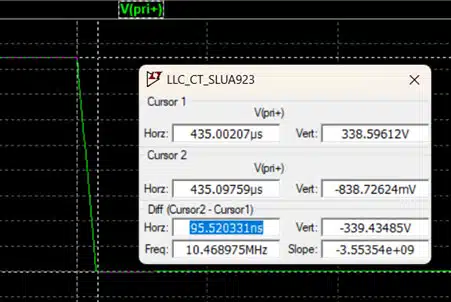
Figure 4. Switching time at ~95ns close to the 100ns target

Conclusion

Proper selection of the magnetizing inductance ensures ZVS conditions over an extensive input voltage range. Of course, lowering the magnetizing inductance comes with the price tag. Reduced efficiency number at light loads (especially) is observed because of the increase in resonant current.

Related

Source: Frenetic

Recent Posts

Nanocrystalline Cores for Low‑Loss MHz Chip Inductors

25.3.2026
5

Würth Elektronik Unveils High-Current Automotive Power Inductor

24.3.2026
13

Transformer-Based Power-Line Harvester Magnetic Design

24.3.2026
6

Tantalum Capacitor Anode Manufacturing Quality Management

23.3.2026
16

Middle East Conflict: The Potential Impact to Passive Components

23.3.2026
73

Designing a 2 kW LLC Transformer with Integrated Resonant Inductor

20.3.2026
48

Inductor Technology Dossier

19.3.2026
46

Coilcraft Releases TLVR Inductors for High Density VRMs and PoL Converters

19.3.2026
40
Schematic illustration of the electric double layer of porous carbon electrodes at elevated potentials in a a conventional electrolyte and b a weakly solvating electrolyte; source: authors

Researchers Presented Lignin-based Electrolyte for 4V Supercapacitors with Low Self‑Discharge

19.3.2026
25

Upcoming Events

Apr 21
16:00 - 17:00 CEST

Heatsink Solutions: Thermal Management in electronic devices

May 5
16:00 - 17:00 CEST

Understanding and Selecting Capacitors – Fundamentals, Technologies and Latest Trends

May 19
16:00 - 17:00 CEST

Designing Qi2 Wireless Power Systems: Practical Development and EMC Optimization

View Calendar

Popular Posts

  • Buck Converter Design and Calculation

    0 shares
    Share 0 Tweet 0
  • Boost Converter Design and Calculation

    0 shares
    Share 0 Tweet 0
  • Flyback Converter Design and Calculation

    0 shares
    Share 0 Tweet 0
  • LLC Resonant Converter Design and Calculation

    0 shares
    Share 0 Tweet 0
  • MLCC and Ceramic Capacitors

    0 shares
    Share 0 Tweet 0
  • Dual Active Bridge (DAB) Topology

    0 shares
    Share 0 Tweet 0
  • MLCC Manufacturers Consider Price Increase as AI Demand Outpaces Supply

    0 shares
    Share 0 Tweet 0
  • Ripple Current and its Effects on the Performance of Capacitors

    3 shares
    Share 3 Tweet 0
  • MLCC Case Sizes Standards Explained

    0 shares
    Share 0 Tweet 0
  • What is a Dielectric Constant and DF of Plastic Materials?

    4 shares
    Share 4 Tweet 0

Newsletter Subscription


Passive Components Blog

© EPCI - Leading Passive Components Educational and Information Site

  • Home
  • Privacy Policy
  • EPCI Membership & Advertisement
  • About

No Result
View All Result
  • Home
  • Knowledge Blog
  • PCNS

© EPCI - Leading Passive Components Educational and Information Site

This website uses cookies. By continuing to use this website you are giving consent to cookies being used. Visit our Privacy and Cookie Policy.
Go to mobile version