








Passive Components Blog
No Result
View All Result
  • Home
  • NewsFilter
    • All
    • Aerospace & Defence
    • Antenna
    • Applications
    • Automotive
    • Capacitors
    • Circuit Protection Devices
    • electro-mechanical news
    • Filters
    • Fuses
    • Inductors
    • Industrial
    • Integrated Passives
    • inter-connect news
    • Market & Supply Chain
    • Market Insights
    • Medical
    • Modelling and Simulation
    • New Materials & Supply
    • New Technologies
    • Non-linear Passives
    • Oscillators
    • Passive Sensors News
    • Resistors
    • RF & Microwave
    • Telecommunication
    • Weekly Digest

    YAGEO Introduces High Rel MLCCs Beyond MIL-Spec Limits

    Würth Elektronik Expanded Capacity for Validation and Services in Asia

    Samsung Introduces Ultra-High-Voltage 1500 V MLCCs for xEV Powertrains

    YAGEO Q1 2026 Results: AI Servers and Pricing Power Behind a Moderate Q2 Outlook

    TDK Introduces High‑Voltage Common‑Mode Chokes for Compact 1250 V DC Converters

    Vishay Extends Power Inductors for DC/DC with 1212 Compact Case

    Modeling Planar Magnetics Temperature: Practical Guidelines for Power Electronics Engineers

    YAGEO Releases Ferrite Shielded Power Inductors for High‑Density Designs

    Samsung Presents MLCC Selection Guide for Humanoids and Robotic Applications

    Trending Tags

    • Ripple Current
    • RF
    • Leakage Current
    • Tantalum vs Ceramic
    • Snubber
    • Low ESR
    • Feedthrough
    • Derating
    • Dielectric Constant
    • New Products
    • Market Reports
  • VideoFilter
    • All
    • Antenna videos
    • Capacitor videos
    • Circuit Protection Video
    • Filter videos
    • Fuse videos
    • Inductor videos
    • Inter-Connect Video
    • Non-linear passives videos
    • Oscillator videos
    • Passive sensors videos
    • Resistor videos

    Transformer-Based Power-Line Harvester Magnetic Design

    Thermal Modeling of Magnetics

    Standard vs Planar LLC transformers Comparison for Battery Chargers

    How Modern Tools Model Magnetic Components for Power Electronics

    Advanced Loss Modeling for Planar Magnetics in the Frenetic Planar Tool

    2026 Power Magnetics Design Trends: Flyback, DAB and Planar

    Enabling Software‑Defined Vehicle Architectures: Automotive Ethernet and Zonal Smart Power

    Calculating Resistance Value of a Flyback RC Snubber 

    One‑Pulse Characterization of Nonlinear Power Inductors

    Trending Tags

    • Capacitors explained
    • Inductors explained
    • Resistors explained
    • Filters explained
    • Application Video Guidelines
    • EMC
    • New Products
    • Ripple Current
    • Simulation
    • Tantalum vs Ceramic
  • Knowledge Blog
  • DossiersNew
  • Suppliers
    • Who is Who
  • PCNS
    • PCNS 2025
    • PCNS 2023
    • PCNS 2021
    • PCNS 2019
    • PCNS 2017
  • Events
  • Home
  • NewsFilter
    • All
    • Aerospace & Defence
    • Antenna
    • Applications
    • Automotive
    • Capacitors
    • Circuit Protection Devices
    • electro-mechanical news
    • Filters
    • Fuses
    • Inductors
    • Industrial
    • Integrated Passives
    • inter-connect news
    • Market & Supply Chain
    • Market Insights
    • Medical
    • Modelling and Simulation
    • New Materials & Supply
    • New Technologies
    • Non-linear Passives
    • Oscillators
    • Passive Sensors News
    • Resistors
    • RF & Microwave
    • Telecommunication
    • Weekly Digest

    YAGEO Introduces High Rel MLCCs Beyond MIL-Spec Limits

    Würth Elektronik Expanded Capacity for Validation and Services in Asia

    Samsung Introduces Ultra-High-Voltage 1500 V MLCCs for xEV Powertrains

    YAGEO Q1 2026 Results: AI Servers and Pricing Power Behind a Moderate Q2 Outlook

    TDK Introduces High‑Voltage Common‑Mode Chokes for Compact 1250 V DC Converters

    Vishay Extends Power Inductors for DC/DC with 1212 Compact Case

    Modeling Planar Magnetics Temperature: Practical Guidelines for Power Electronics Engineers

    YAGEO Releases Ferrite Shielded Power Inductors for High‑Density Designs

    Samsung Presents MLCC Selection Guide for Humanoids and Robotic Applications

    Trending Tags

    • Ripple Current
    • RF
    • Leakage Current
    • Tantalum vs Ceramic
    • Snubber
    • Low ESR
    • Feedthrough
    • Derating
    • Dielectric Constant
    • New Products
    • Market Reports
  • VideoFilter
    • All
    • Antenna videos
    • Capacitor videos
    • Circuit Protection Video
    • Filter videos
    • Fuse videos
    • Inductor videos
    • Inter-Connect Video
    • Non-linear passives videos
    • Oscillator videos
    • Passive sensors videos
    • Resistor videos

    Transformer-Based Power-Line Harvester Magnetic Design

    Thermal Modeling of Magnetics

    Standard vs Planar LLC transformers Comparison for Battery Chargers

    How Modern Tools Model Magnetic Components for Power Electronics

    Advanced Loss Modeling for Planar Magnetics in the Frenetic Planar Tool

    2026 Power Magnetics Design Trends: Flyback, DAB and Planar

    Enabling Software‑Defined Vehicle Architectures: Automotive Ethernet and Zonal Smart Power

    Calculating Resistance Value of a Flyback RC Snubber 

    One‑Pulse Characterization of Nonlinear Power Inductors

    Trending Tags

    • Capacitors explained
    • Inductors explained
    • Resistors explained
    • Filters explained
    • Application Video Guidelines
    • EMC
    • New Products
    • Ripple Current
    • Simulation
    • Tantalum vs Ceramic
  • Knowledge Blog
  • DossiersNew
  • Suppliers
    • Who is Who
  • PCNS
    • PCNS 2025
    • PCNS 2023
    • PCNS 2021
    • PCNS 2019
    • PCNS 2017
  • Events
No Result
View All Result
Passive Components Blog
No Result
View All Result

Hybrid Energy Storage System for Nanosatellite Applications

1.5.2025
Reading Time: 5 mins read
A A

This paper Hybrid Energy Storage Based on Supercapacitors and Conventional Batteries System for Nanosatellite Applications was presented by Faiza Arezki, Algerian Space Agency, Oran, Algeria during the 5th Space Passive Component Days (SPCD), an International Symposium held from October 15th to 18th, 2024, at ESA/ESTEC in Noordwijk, the Netherlands. Published under permission from ESA SPCD organizers.

Introduction:

RelatedPosts

ESA SPCD 26 Call for Papers Extended to 30th March

High-Density PCB Assemblies For Space Applications

Solid State Polymer Multilayer Capacitors For High Temperature Application

Nanosatellites have emerged as critical assets in space technology due to their cost-effectiveness, flexibility, and capacity to support various applications such as scientific research, commercial usage, and military missions.

However, one of the significant challenges faced by nanosatellites is the development of reliable and efficient energy storage systems.

Traditional systems, relying heavily on batteries, face limitations when dealing with high-power demands, particularly during peak load operations. This article explores the integration of Hybrid Energy Storage Systems (HESS) that combine supercapacitors with conventional batteries to enhance nanosatellite performance.

Key Points:

  1. Challenges with Conventional Energy Storage: Batteries alone face degradation issues under high current demands.
  2. Role of Supercapacitors: Supercapacitors offer high power density, fast charge/discharge cycles, and longevity.
  3. Hybrid Energy Storage System (HESS): Combines the benefits of both batteries and supercapacitors, improving lifecycle, efficiency, and reliability.
  4. Modeling and Experimental Validation: The study includes simulations and experimental setups to validate the HESS performance.

Extended Summary:

The article begins by identifying the growing importance of nanosatellites in modern space missions. Despite their small size, these satellites are tasked with high-power operations, which traditional battery systems struggle to support effectively. Batteries experience reduced lifecycle and efficiency when subjected to high current loads, primarily due to limitations in their discharge capabilities.
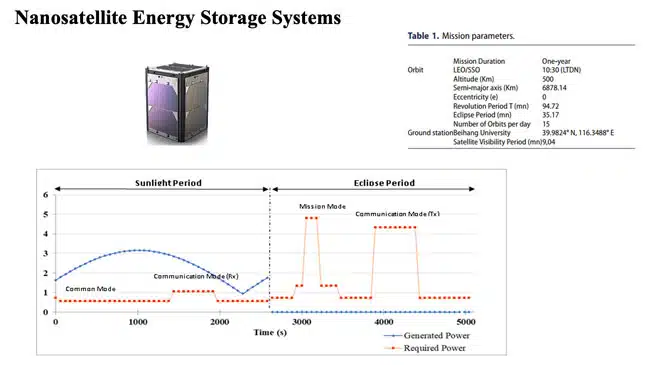
To address this, the study investigates the integration of supercapacitors into nanosatellite energy systems. Supercapacitors are advantageous because they can deliver high power bursts, have a long cycle life, and operate efficiently across a wide temperature range. The European Space Agency has shown long-standing interest in supercapacitor applications, initiating studies to explore their potential in space environments.

The article delves into the modeling and simulation of supercapacitor behavior, essential for predicting performance in real-world scenarios. A two-branch equivalent circuit model is introduced to represent the dynamic behavior of supercapacitors more accurately, capturing both immediate and prolonged charge/discharge responses. Parameters for the model are identified through controlled laboratory experiments using a 2.7V, 100F supercapacitor.

Further, the study proposes a hybrid energy storage architecture, illustrating its components, including solar cells, lithium-ion batteries, and supercapacitors managed via a Power Management Unit (PMU). The system’s performance is analyzed using MATLAB/Simulink to simulate different operational modes and energy demands typical of nanosatellite missions.

Experimental results validate the model, demonstrating that HESS reduces the depth of discharge for batteries, thereby extending their lifespan. The inclusion of supercapacitors efficiently handles peak power demands, reducing the stress on batteries and ensuring stable power supply during critical mission phases.
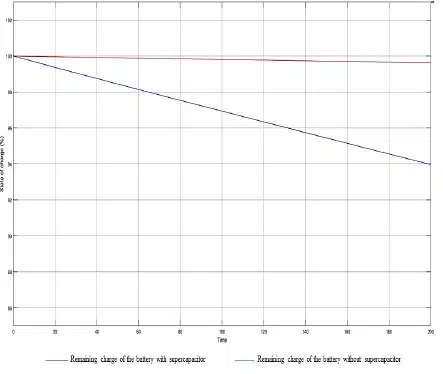
Comparison between state of charge of the battery with and without the supercapacitor

Remaining capacity of battery extended up to 6.4% and 18% depending on the load scenarios. Furthermore, it is
observed that battery DOD is reduced from 50% to 36% as the supercapacitor supplies the peak load demand.

Conclusion:

The paper concludes that integrating Hybrid Energy Storage Systems in nanosatellites significantly enhances power reliability and efficiency.

By combining the high energy density of batteries with the high power density of supercapacitors, HESS addresses the limitations of traditional energy storage systems. Experimental results confirm improved performance, making HESS a promising solution for future nanosatellite missions, particularly those requiring frequent high-power operations.

Read the full paper:

ORAL_Day 2_20_Algerian Space Agency_Hybrid Energy Storage SupercapacitorsDownload

Related

Source: ESA SPCD

Recent Posts

YAGEO Introduces High Rel MLCCs Beyond MIL-Spec Limits

16.4.2026
6

Samsung Introduces Ultra-High-Voltage 1500 V MLCCs for xEV Powertrains

16.4.2026
3

YAGEO Q1 2026 Results: AI Servers and Pricing Power Behind a Moderate Q2 Outlook

16.4.2026
15

Samsung Presents MLCC Selection Guide for Humanoids and Robotic Applications

15.4.2026
13

AI-Assisted Structural Diagnostics and Physics-Based Reliability Interpretation of Tantalum Capacitor Anodes

14.4.2026
16

KYOCERA AVX MIL-PRF-32535 BME NP0 MLCCs Approved to the DLA QPD

16.4.2026
20

ECIA March 2026 Industry Pulse Points to Best Sales Climate in Five Years

13.4.2026
31

Exxelia Releases Updated Microwave Materials and Frequency Tuning Catalogues

8.4.2026
18

Murata Automotive MLCCs Push Capacitance Limits for ADAS and Power Lines

16.4.2026
41

Upcoming Events

Apr 21
16:00 - 17:00 CEST

Heatsink Solutions: Thermal Management in electronic devices

Apr 22
17:00 - 17:30 CEST

Magnetics in a high frequency GaN era

Apr 22
17:00 - 18:00 CEST

Derating Tantalum, Film, and Ceramic Capacitors

View Calendar

Popular Posts

  • Buck Converter Design and Calculation

    0 shares
    Share 0 Tweet 0
  • Boost Converter Design and Calculation

    0 shares
    Share 0 Tweet 0
  • Flyback Converter Design and Calculation

    0 shares
    Share 0 Tweet 0
  • LLC Resonant Converter Design and Calculation

    0 shares
    Share 0 Tweet 0
  • MLCC and Ceramic Capacitors

    0 shares
    Share 0 Tweet 0
  • Dual Active Bridge (DAB) Topology

    0 shares
    Share 0 Tweet 0
  • Capacitor Charging and Discharging

    0 shares
    Share 0 Tweet 0
  • Plastic Materials Dielectric Constant and DF

    4 shares
    Share 4 Tweet 0
  • MLCC Case Sizes Standards Explained

    0 shares
    Share 0 Tweet 0
  • Ripple Current and its Effects on the Performance of Capacitors

    3 shares
    Share 3 Tweet 0

Newsletter Subscription


Passive Components Blog

© EPCI - Leading Passive Components Educational and Information Site

  • Home
  • Privacy Policy
  • EPCI Membership & Advertisement
  • About

No Result
View All Result
  • Home
  • Knowledge Blog
  • PCNS

© EPCI - Leading Passive Components Educational and Information Site

This website uses cookies. By continuing to use this website you are giving consent to cookies being used. Visit our Privacy and Cookie Policy.
Go to mobile version