
















Passive Components Blog
No Result
View All Result
  • Home
  • NewsFilter
    • All
    • Aerospace & Defence
    • Antenna
    • Applications
    • Automotive
    • Capacitors
    • Circuit Protection Devices
    • electro-mechanical news
    • Filters
    • Fuses
    • Inductors
    • Industrial
    • Integrated Passives
    • inter-connect news
    • Market & Supply Chain
    • Market Insights
    • Medical
    • Modelling and Simulation
    • New Materials & Supply
    • New Technologies
    • Non-linear Passives
    • Oscillators
    • Passive Sensors News
    • Resistors
    • RF & Microwave
    • Telecommunication
    • Weekly Digest

    2026 Power Magnetics Design Trends: Flyback, DAB and Planar

    Vishay Releases Sulfur‑Resistant Chip Resistors

    Würth Elektronik Introduces Lead-Free SMT Spacers

    Schurter Releases EKO HV Fuses up to 1000 VDC, 1100 A

    Empower Releases High-Density Embedded Silicon Capacitors

    TDK Unveils 125C Compact DC Link Film Capacitors

    SCHURTER Releases Coin Cell Supercapacitors for Backup Power

    Skeleton Technologies Expands in U.S. to Power AI Data Centers

    TDK Releases Stackable µPOL 25A Power Modules

    Trending Tags

    • Ripple Current
    • RF
    • Leakage Current
    • Tantalum vs Ceramic
    • Snubber
    • Low ESR
    • Feedthrough
    • Derating
    • Dielectric Constant
    • New Products
    • Market Reports
  • VideoFilter
    • All
    • Antenna videos
    • Capacitor videos
    • Circuit Protection Video
    • Filter videos
    • Fuse videos
    • Inductor videos
    • Inter-Connect Video
    • Non-linear passives videos
    • Oscillator videos
    • Passive sensors videos
    • Resistor videos

    2026 Power Magnetics Design Trends: Flyback, DAB and Planar

    Enabling Software‑Defined Vehicle Architectures: Automotive Ethernet and Zonal Smart Power

    Calculating Resistance Value of a Flyback RC Snubber 

    One‑Pulse Characterization of Nonlinear Power Inductors

    Thermistor Linearization Challenges

    Coaxial Connectors and How to Connect with PCB

    PCB Manufacturing, Test Methods, Quality and Reliability

    Transformer Behavior – Current Transfer and Hidden Feedback

    Choosing the Right Capacitor: The Importance of Accurate Measurements

    Trending Tags

    • Capacitors explained
    • Inductors explained
    • Resistors explained
    • Filters explained
    • Application Video Guidelines
    • EMC
    • New Products
    • Ripple Current
    • Simulation
    • Tantalum vs Ceramic
  • Knowledge Blog
  • DossiersNew
  • Suppliers
    • Who is Who
  • PCNS
    • PCNS 2025
    • PCNS 2023
    • PCNS 2021
    • PCNS 2019
    • PCNS 2017
  • Events
  • Home
  • NewsFilter
    • All
    • Aerospace & Defence
    • Antenna
    • Applications
    • Automotive
    • Capacitors
    • Circuit Protection Devices
    • electro-mechanical news
    • Filters
    • Fuses
    • Inductors
    • Industrial
    • Integrated Passives
    • inter-connect news
    • Market & Supply Chain
    • Market Insights
    • Medical
    • Modelling and Simulation
    • New Materials & Supply
    • New Technologies
    • Non-linear Passives
    • Oscillators
    • Passive Sensors News
    • Resistors
    • RF & Microwave
    • Telecommunication
    • Weekly Digest

    2026 Power Magnetics Design Trends: Flyback, DAB and Planar

    Vishay Releases Sulfur‑Resistant Chip Resistors

    Würth Elektronik Introduces Lead-Free SMT Spacers

    Schurter Releases EKO HV Fuses up to 1000 VDC, 1100 A

    Empower Releases High-Density Embedded Silicon Capacitors

    TDK Unveils 125C Compact DC Link Film Capacitors

    SCHURTER Releases Coin Cell Supercapacitors for Backup Power

    Skeleton Technologies Expands in U.S. to Power AI Data Centers

    TDK Releases Stackable µPOL 25A Power Modules

    Trending Tags

    • Ripple Current
    • RF
    • Leakage Current
    • Tantalum vs Ceramic
    • Snubber
    • Low ESR
    • Feedthrough
    • Derating
    • Dielectric Constant
    • New Products
    • Market Reports
  • VideoFilter
    • All
    • Antenna videos
    • Capacitor videos
    • Circuit Protection Video
    • Filter videos
    • Fuse videos
    • Inductor videos
    • Inter-Connect Video
    • Non-linear passives videos
    • Oscillator videos
    • Passive sensors videos
    • Resistor videos

    2026 Power Magnetics Design Trends: Flyback, DAB and Planar

    Enabling Software‑Defined Vehicle Architectures: Automotive Ethernet and Zonal Smart Power

    Calculating Resistance Value of a Flyback RC Snubber 

    One‑Pulse Characterization of Nonlinear Power Inductors

    Thermistor Linearization Challenges

    Coaxial Connectors and How to Connect with PCB

    PCB Manufacturing, Test Methods, Quality and Reliability

    Transformer Behavior – Current Transfer and Hidden Feedback

    Choosing the Right Capacitor: The Importance of Accurate Measurements

    Trending Tags

    • Capacitors explained
    • Inductors explained
    • Resistors explained
    • Filters explained
    • Application Video Guidelines
    • EMC
    • New Products
    • Ripple Current
    • Simulation
    • Tantalum vs Ceramic
  • Knowledge Blog
  • DossiersNew
  • Suppliers
    • Who is Who
  • PCNS
    • PCNS 2025
    • PCNS 2023
    • PCNS 2021
    • PCNS 2019
    • PCNS 2017
  • Events
No Result
View All Result
Passive Components Blog
No Result
View All Result

Indian Institute of Technology Fabricates Wearable Supercapacitor

20.5.2019
Reading Time: 3 mins read
A A

Source: The Hindu news

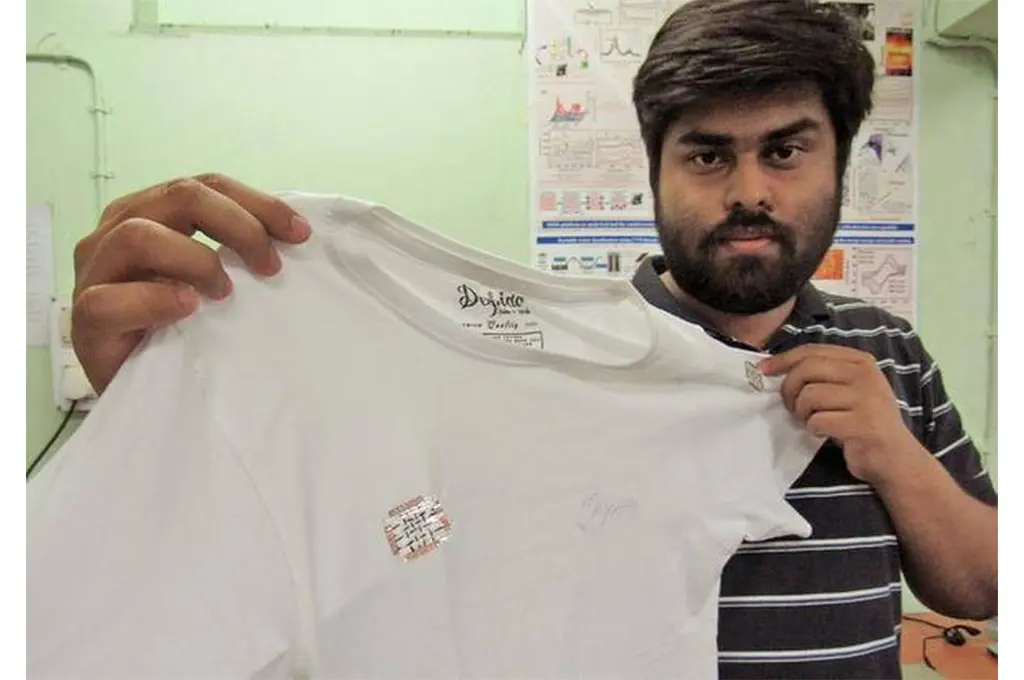
Researchers at the Indian Institute of Technology (IIT) Bombay have fabricated a wearable supercapacitor that can store and deliver large amount of electrical energy, exceeding other similar devices. The wearable energy storage device can be stitched on to any fabric and can deliver power ranging from microwatt to milliwatt. The energy stored in the device can power GPS location-based transmitters or a 1.8 volt LED.

RelatedPosts

2026 Power Magnetics Design Trends: Flyback, DAB and Planar

Vishay Releases Sulfur‑Resistant Chip Resistors

Würth Elektronik Introduces Lead-Free SMT Spacers

“The idea is when the supercapacitor is integrated with a piezoelectric energy generator then it will become completely self-sustaining. And when stitched to the fabric, the supercapacitor can be used for powering GPS location-based devices or a LED lamp or even charge small electronic devices,” says Prof. Chandramouli Subramaniam. He is from the institute’s Department of Chemistry and the lead author of a paper published in the journal ACS Applied Materials & Interfaces.

Novel electrode
The electrode of the supercapacitor was fabricated by uniformly coating cotton yarn with carbon nanotubes (CNTs). The coating is done by dipping the yarn into carbon nanotube ink, where the CNTs are dispersed in water using a surfactant (detergent).

The coating converts the electrical insulating yarn into a metallic conductor thereby behaving like an electrode. “The yarns coated with carbon nanotubes exhibited a finite electrical conductivity,” says Prof. Subramaniam.

As the supercapacitor is targeting wearable and portable electronics, liquid electrolytes are out of the reckoning. So the researchers prepared a solid electrolyte film just 150 micrometre thick by mixing poly vinyl alcohol and potassium hydroxide in appropriate proportions.

“We stitched the solid electrolyte with CNT-coated yarn both vertically and horizontally. Capacitors were formed wherever the CNT wires criss-crossed each other and sandwiched the electrolyte,” Prof. Subramaniam says. “By increasing the number of stitches, and therefore, the number of capacitors, the amount of energy stored can be increased.” A 1×1 sqcm electrolyte will have at least a few hundred capacitors.

The researchers laminated the electrolyte film containing CNT wire electrodes to protect it. The laminated capacitors retained flexibility and sturdiness without compromising on performance and power.

The ions in a solid matrix are typically trapped and hinder energy storage capabilities. To overcome this, the polymer matrix was controllably hydrated with water vapour to enhance the mobility of the ions. Similarly, to increase the interaction between the CNT wire and electrolyte, the wires were treated with acid. Acid treatment improved the interface between the CNT wire and the electrolyte. “The combination of mobile ions in the electrolyte and better interface between the wire and the electrolyte increases the capacity to store electrical energy,” he says.

Application
“Energy stored in just nine capacitors can power a LED of 1.8 volts,” says Mihir Kumar Jha from the Department of Chemistry at IIT Bombay and the first author of the paper. “Depending on the application, we can increase the number of capacitors made in a small area and integrate to increase the total amount of energy stored in the system.”

High performance
The laminated supercapacitor demonstrated unchanged performance even when subjected to extreme and harsh mechanical testing — striking repeatedly with a hammer, complete flexing, bending and rolling, and washing in a laundry machine in the presence of hot water, detergents and high spinning action. “This is possibly the first demonstration of a wearable device that can withstand rigorous washing conditions,” says Jha. Moreover, being lightweight, it does not hinder user movement in any way.

featured image: We can increase the number of capacitors made in a small area and increase the total amount of energy stored, says Mihir Kumar Jha.  Image Source: IIT Bombay

Related

Recent Posts

Empower Releases High-Density Embedded Silicon Capacitors

11.2.2026
31

TDK Unveils 125C Compact DC Link Film Capacitors

11.2.2026
20

SCHURTER Releases Coin Cell Supercapacitors for Backup Power

10.2.2026
17

Skeleton Technologies Expands in U.S. to Power AI Data Centers

9.2.2026
22

TDK Releases Stackable µPOL 25A Power Modules

9.2.2026
21

Smoltek CNF-MIM Capacitors Hit 1,000x Lower Leakage

6.2.2026
21

Murata Opens New Ceramic Capacitor Manufacturing and R&D Center in Japan

5.2.2026
85

Murata Publishes Power Delivery Guide for AI Servers

4.2.2026
114

Mechanical Drift Indicator of Tantalum Capacitor Anodes Degradation under Reverse Bias

3.2.2026
44

Upcoming Events

Feb 24
16:00 - 17:00 CET

Designing Qi2 Wireless Power Systems: Practical Development and EMC Optimization

Mar 3
16:00 - 17:00 CET

Cybersecurity at the Eleventh Hour – from RED to CRA – Information and Discussion

Mar 21
All day

PSMA Capacitor Workshop 2026

View Calendar

Popular Posts

  • Buck Converter Design and Calculation

    0 shares
    Share 0 Tweet 0
  • Boost Converter Design and Calculation

    0 shares
    Share 0 Tweet 0
  • LLC Resonant Converter Design and Calculation

    0 shares
    Share 0 Tweet 0
  • Flyback Converter Design and Calculation

    0 shares
    Share 0 Tweet 0
  • Ripple Current and its Effects on the Performance of Capacitors

    3 shares
    Share 3 Tweet 0
  • Dual Active Bridge (DAB) Topology

    0 shares
    Share 0 Tweet 0
  • MLCC and Ceramic Capacitors

    0 shares
    Share 0 Tweet 0
  • What is a Dielectric Constant and DF of Plastic Materials?

    4 shares
    Share 4 Tweet 0
  • MLCC Case Sizes Standards Explained

    0 shares
    Share 0 Tweet 0
  • Degradation of Capacitors and its Failure Mechanisms

    0 shares
    Share 0 Tweet 0

Newsletter Subscription


Passive Components Blog

© EPCI - Leading Passive Components Educational and Information Site

  • Home
  • Privacy Policy
  • EPCI Membership & Advertisement
  • About

No Result
View All Result
  • Home
  • Knowledge Blog
  • PCNS

© EPCI - Leading Passive Components Educational and Information Site

This website uses cookies. By continuing to use this website you are giving consent to cookies being used. Visit our Privacy and Cookie Policy.
Go to mobile version