





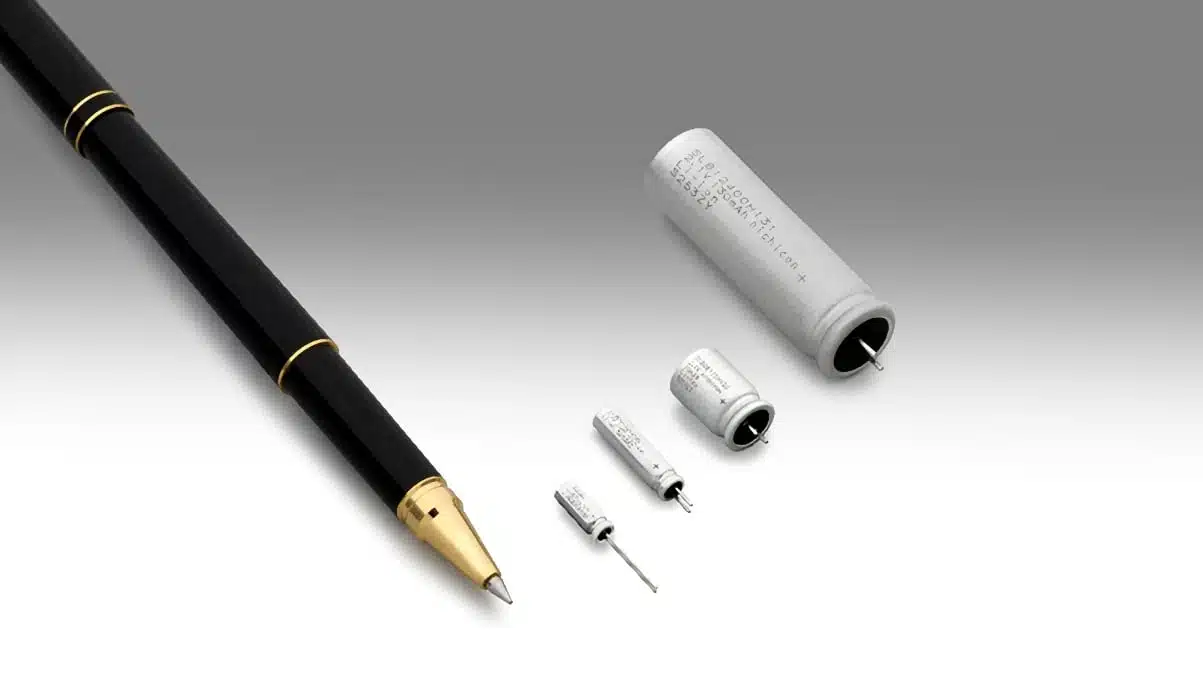
Nichicon has expanded its SLB series of small lithium titanate (LTO) rechargeable batteries with a new high‑temperature variant rated for continuous operation from −30 °C to 80 °C.
This positions the Nichicon SLB series as a serious alternative to supercapacitors and electrolytic capacitor‑based backup schemes in IoT, industrial and outdoor applications where long life, fast charge/discharge and wide temperature range are critical.
Key features and benefits
- Wide operating temperature range −30 °C to 80 °C
This enables use in outdoor infrastructure, industrial sensors and communication nodes exposed to both winter cold and elevated ambient or enclosure temperatures in summer or near power electronics. - Long cycle life at elevated temperature
According to Nichicon’s testing at 80 °C with 20C charge/discharge and full (100%) depth of discharge, the 10 mAh SLB sample retains around 80% of its initial capacity after about 19 000 cycles. This is a key differentiator versus conventional Li‑ion coin cells and many supercapacitors, whose lifetime usually derates significantly at high temperature. - Fast charge/discharge capability (up to 20C)
Maximum charge/discharge currents range from 16 mA for the smallest 0.8 mAh cell up to 2.6 A for the 130 mAh type, supporting energy buffering for pulsed loads such as radio transmissions, sensor bursts or actuator events. - Four capacity/size options for design flexibility
The SLB high‑temperature lineup covers 0.8, 2, 10 and 130 mAh nominal capacities in cylindrical packages from 3.3 × 9 mm up to 12.5 × 40 mm, allowing designers to trade board space and runtime against peak current and maintenance intervals. - Improved thermal robustness through materials optimization
Nichicon reports that the high‑temperature performance has been achieved by analyzing heat‑induced degradation mechanisms and optimizing both electrode foil and electrolyte formulation. - Reduced maintenance for “fit‑and‑forget” nodes
The combination of long cycle life, high safety and broad temperature capability supports maintenance‑free or low‑maintenance designs, which is attractive in distributed IoT or industrial deployments where battery replacement is costly.
LTO cells versus supercapacitors and electrolytic capacitors
From a power architecture perspective, Nichicon’s high-temperature SLB lithium titanate cells compete with supercapacitors and aluminum hybrid capacitors used for backup, pulse support, and energy buffering. The key difference is that the SLB devices combine rechargeable battery behavior with wide-temperature operation, while hybrid capacitors remain optimized mainly for low-ESR filtering and short-duration energy support.
Energy‑storage options for IoT backup (qualitative comparison)
| Parameter / aspect | High-temp LTO SLB | Supercapacitors | Aluminum hybrid capacitors |
|---|---|---|---|
| Main role | Rechargeable backup / energy storage | Short-term energy buffer / hold-up | Low-ESR bulk filtering / pulse smoothing |
| Nominal voltage behavior | Battery-like, relatively flat discharge | Voltage drops linearly with discharge | Capacitor behavior, voltage-dependent stored energy |
| Energy density | Higher than capacitor technologies | Moderate | Low |
| Pulse current capability | High, up to 20C per Nichicon data | Very high | Very High |
| Self-discharge | Lower than supercapacitors | Relatively high | Low |
| High-temperature suitability | Designed for up to 80 °C | Varies strongly by series | Strong option in 125 °C-rated power designs |
| Best fit | IoT backup, intermittent recharge, maintenance reduction | Short hold-up, peak assist | DC/DC output filtering, automotive/industrial rails |
| Assembly / soldering | Leaded cell, not suitable for direct SMD reflow or wave soldering; mount via leads or holders, insert after soldering | Many SMD types support reflow; check series‑specific limits | Standard SMD/TH parts; full reflow/wave profiles available from vendors |
In practice, LTO SLB devices can replace supercapacitors or large capacitor banks where slightly higher system complexity is acceptable in exchange for broader temperature capability, better energy density and lower self‑discharge. Supercapacitors and capacitors remain more suitable as pure power buffers or for extremely high peak currents over very short durations.
Typical applications
Nichicon positions the SLB series mainly for small, rechargeable power sources in communication and IoT equipment. The high‑temperature model extends that usage into harsher environments where conventional rechargeable coin cells struggle.
Typical application areas include:
- Wireless sensor nodes and data loggers in outdoor or semi‑protected environments.
- Industrial sensors, condition‑monitoring nodes and predictive maintenance systems mounted on machinery or in cabinets with elevated ambient temperatures.
- Smart meters, smart building nodes and infrastructure monitoring, where access for maintenance is limited and long life is essential.
- Backup and buffer power for communication modules that need short bursts of relatively high current for radio transmission.
- Small actuators or latches that require reliable energy delivery in a wide temperature range (for example, valve control or door locks).
In many of these use cases, designers currently rely on supercapacitors or large electrolytic capacitors to cover current peaks on top of a primary cell; the SLB high‑temperature devices provide an alternative where full rechargeability and long cycle life are key requirements.
Technical highlights
Line‑up and mechanical data
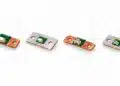
Nichicon’s high‑temperature SLB extension consists of four cylindrical cell types:
- SLB03090HR80 – 0.8 mAh nominal capacity, 3.3 mm diameter × 9 mm height, 0.2 g mass.
- SLB04150H020 – 2 mAh nominal capacity, 4 mm diameter × 15 mm height, 0.5 g mass.
- SLB08115H100 – 10 mAh nominal capacity, 8 mm diameter × 11.5 mm height, 1.3 g mass.
- SLB12400H131 – 130 mAh nominal capacity, 12.5 mm diameter × 40 mm height, 9.2 g mass.
All four share the same nominal cell voltage of 2.1 V and operate over a recommended voltage window from 1.5 V (discharge cut‑off) to 2.5 V (maximum charging voltage). The operating temperature range for the high‑temperature model is specified from −30 °C up to 80 °C.
Electrical characteristics
Key electrical parameters include:
- Nominal voltage: 2.1 V per cell.
- Maximum charging voltage: 2.5 V.
- Discharge cut‑off: 1.5 V.
- Maximum charge/discharge current (20C):
- 16 mA for the 0.8 mAh type.
- 20 mA for the 2 mAh type.
- 200 mA for the 10 mAh type.
- 2 600 mA for the 130 mAh type.
The 20C rating indicates that the cell can be charged or discharged at up to twenty times its nominal capacity in amperes. For example, the 10 mAh device can deliver 200 mA pulses, which is sufficient to cover typical radio modem bursts or other short‑term load peaks if the average load is much smaller.
High‑temperature cycling performance
Nichicon reports test results for a 10 mAh sample cycled at 80 °C with 20C charge/discharge and 100% depth of discharge, where the capacity remained at 80% of the initial value after approximately 19 000 cycles. This demonstrates that the optimized electrode foil and electrolyte can withstand high‑temperature stress better than standard Li‑ion chemistries in similar form factors, and it is a key argument when comparing against supercapacitors or hybrid capacitor solutions in similar roles.
Design‑in notes for engineers
When considering the SLB high‑temperature LTO cells as an alternative or complement to capacitor‑based solutions, the following points can help guide component selection and circuit design:
- Think of SLB as a rechargeable “energy reservoir” rather than a simple decoupling element
Unlike electrolytic, the SLB cells require proper charge management within the 1.5–2.5 V window and should be treated as a secondary battery in the power tree. - Dimension capacity according to energy, not just current peaks
Estimate the energy requirement per operation cycle (for example, sensor measurement + radio burst) and ensure sufficient capacity reserve for ageing, temperature effects and self‑discharge. - Observe mounting and soldering constraints
SLB cells are leaded batteries and are not intended for direct SMD reflow or wave soldering; in automated assemblies, solder only the PCB pads or holders first and insert the SLB cells after the main soldering process. - Mind series configuration and balancing
A single SLB cell has a nominal voltage of 2.1 V, so stepping up to higher system voltages normally requires DC‑DC conversion rather than simple series stacking. If multiple cells are used in series, appropriate balancing and monitoring are needed. - Compare against supercapacitors using life at real operating temperature
For applications around 70–80 °C, compare lifetime estimates of supercapacitors and electrolytic capacitors at that temperature with Nichicon’s high‑temperature cycle data for SLB to decide which technology meets your maintenance interval targets. - Consider mixed architectures
In some power architectures, a small SLB LTO cell can provide energy storage and long‑term backup, while high‑frequency decoupling and very short transient current peaks are still handled by MLCCs or film capacitors close to the load. - Check mechanical integration and mounting
The cylindrical form factor and relatively small diameters allow vertical mounting, but board real estate and height restrictions must be considered, especially in ultra‑low‑profile designs where thin prismatic cells or flat supercapacitors may still have advantages. - Thermal environment and enclosure design
Even though the SLB high‑temperature variants are rated to 80 °C, enclosure design should still avoid hot spots and provide reasonable thermal paths to keep both the cells and other components within their preferred ranges.
Source
This article is based on information provided by Nichicon Corporation in its press release on the expansion of the SLB series with a high‑temperature model, complemented by general engineering context on energy storage component selection. For exact and up‑to‑date ratings and recommended operating conditions, always refer to the official manufacturer datasheet.