










Passive Components Blog
No Result
View All Result
  • Home
  • NewsFilter
    • All
    • Aerospace & Defence
    • Antenna
    • Applications
    • Automotive
    • Capacitors
    • Circuit Protection Devices
    • electro-mechanical news
    • Filters
    • Fuses
    • Inductors
    • Industrial
    • Integrated Passives
    • inter-connect news
    • Market & Supply Chain
    • Market Insights
    • Medical
    • Modelling and Simulation
    • New Materials & Supply
    • New Technologies
    • Non-linear Passives
    • Oscillators
    • Passive Sensors News
    • Resistors
    • RF & Microwave
    • Telecommunication
    • Weekly Digest

    YAGEO Introduces C0G Flexible Termination Automotive MLCCs

    SCHURTER Releases SMT Micro Switch for Compact HMIs

    binder Releases Tool‑Tightenable M12 Connectors for Improved Reliability

    Vishay Introduced Thin Film Submount Platform for Optical and RF Modules

    Murata Introduces Crystal and NTC Set for Automotive UWB Timing

    Kyocera Developed Multilayer Ceramic Core Substrate for AI Packages

    Modeling Fringing Field Losses in Inductors & Transformers

    YMIN Introduces Polymer Tantalum Capacitors for AI Server SSDs

    Littelfuse Expands High-Voltage TVS Diodes

    Trending Tags

    • Ripple Current
    • RF
    • Leakage Current
    • Tantalum vs Ceramic
    • Snubber
    • Low ESR
    • Feedthrough
    • Derating
    • Dielectric Constant
    • New Products
    • Market Reports
  • VideoFilter
    • All
    • Antenna videos
    • Capacitor videos
    • Circuit Protection Video
    • Filter videos
    • Fuse videos
    • Inductor videos
    • Inter-Connect Video
    • Non-linear passives videos
    • Oscillator videos
    • Passive sensors videos
    • Resistor videos

    Modeling Fringing Field Losses in Inductors & Transformers

    Why Power Inductors Use a Ferrite Core With an Air Gap

    Transformer-Based Power-Line Harvester Magnetic Design

    Thermal Modeling of Magnetics

    Standard vs Planar LLC transformers Comparison for Battery Chargers

    How Modern Tools Model Magnetic Components for Power Electronics

    Advanced Loss Modeling for Planar Magnetics in the Frenetic Planar Tool

    2026 Power Magnetics Design Trends: Flyback, DAB and Planar

    Enabling Software‑Defined Vehicle Architectures: Automotive Ethernet and Zonal Smart Power

    Trending Tags

    • Capacitors explained
    • Inductors explained
    • Resistors explained
    • Filters explained
    • Application Video Guidelines
    • EMC
    • New Products
    • Ripple Current
    • Simulation
    • Tantalum vs Ceramic
  • Knowledge Blog
  • DossiersNew
  • Suppliers
    • Who is Who
  • PCNS
    • PCNS 2025
    • PCNS 2023
    • PCNS 2021
    • PCNS 2019
    • PCNS 2017
  • Events
  • Home
  • NewsFilter
    • All
    • Aerospace & Defence
    • Antenna
    • Applications
    • Automotive
    • Capacitors
    • Circuit Protection Devices
    • electro-mechanical news
    • Filters
    • Fuses
    • Inductors
    • Industrial
    • Integrated Passives
    • inter-connect news
    • Market & Supply Chain
    • Market Insights
    • Medical
    • Modelling and Simulation
    • New Materials & Supply
    • New Technologies
    • Non-linear Passives
    • Oscillators
    • Passive Sensors News
    • Resistors
    • RF & Microwave
    • Telecommunication
    • Weekly Digest

    YAGEO Introduces C0G Flexible Termination Automotive MLCCs

    SCHURTER Releases SMT Micro Switch for Compact HMIs

    binder Releases Tool‑Tightenable M12 Connectors for Improved Reliability

    Vishay Introduced Thin Film Submount Platform for Optical and RF Modules

    Murata Introduces Crystal and NTC Set for Automotive UWB Timing

    Kyocera Developed Multilayer Ceramic Core Substrate for AI Packages

    Modeling Fringing Field Losses in Inductors & Transformers

    YMIN Introduces Polymer Tantalum Capacitors for AI Server SSDs

    Littelfuse Expands High-Voltage TVS Diodes

    Trending Tags

    • Ripple Current
    • RF
    • Leakage Current
    • Tantalum vs Ceramic
    • Snubber
    • Low ESR
    • Feedthrough
    • Derating
    • Dielectric Constant
    • New Products
    • Market Reports
  • VideoFilter
    • All
    • Antenna videos
    • Capacitor videos
    • Circuit Protection Video
    • Filter videos
    • Fuse videos
    • Inductor videos
    • Inter-Connect Video
    • Non-linear passives videos
    • Oscillator videos
    • Passive sensors videos
    • Resistor videos

    Modeling Fringing Field Losses in Inductors & Transformers

    Why Power Inductors Use a Ferrite Core With an Air Gap

    Transformer-Based Power-Line Harvester Magnetic Design

    Thermal Modeling of Magnetics

    Standard vs Planar LLC transformers Comparison for Battery Chargers

    How Modern Tools Model Magnetic Components for Power Electronics

    Advanced Loss Modeling for Planar Magnetics in the Frenetic Planar Tool

    2026 Power Magnetics Design Trends: Flyback, DAB and Planar

    Enabling Software‑Defined Vehicle Architectures: Automotive Ethernet and Zonal Smart Power

    Trending Tags

    • Capacitors explained
    • Inductors explained
    • Resistors explained
    • Filters explained
    • Application Video Guidelines
    • EMC
    • New Products
    • Ripple Current
    • Simulation
    • Tantalum vs Ceramic
  • Knowledge Blog
  • DossiersNew
  • Suppliers
    • Who is Who
  • PCNS
    • PCNS 2025
    • PCNS 2023
    • PCNS 2021
    • PCNS 2019
    • PCNS 2017
  • Events
No Result
View All Result
Passive Components Blog
No Result
View All Result

January 2026 Interconnect, Passives and Electromechanical Components Market Insights

22.1.2026
Reading Time: 5 mins read
A A

Edgewater researchers report that January 26 AI strength continues; Cyclical markets improving bolstering outlooks in early 2026.

This January 2026 collection of news summaries, survey results, and channel market insights, covers Interconnect, Passives, and Electromechanical Components from Edgewater Research. 

RelatedPosts

YAGEO Introduces C0G Flexible Termination Automotive MLCCs

SCHURTER Releases SMT Micro Switch for Compact HMIs

binder Releases Tool‑Tightenable M12 Connectors for Improved Reliability

What’s Changed/What’s New?

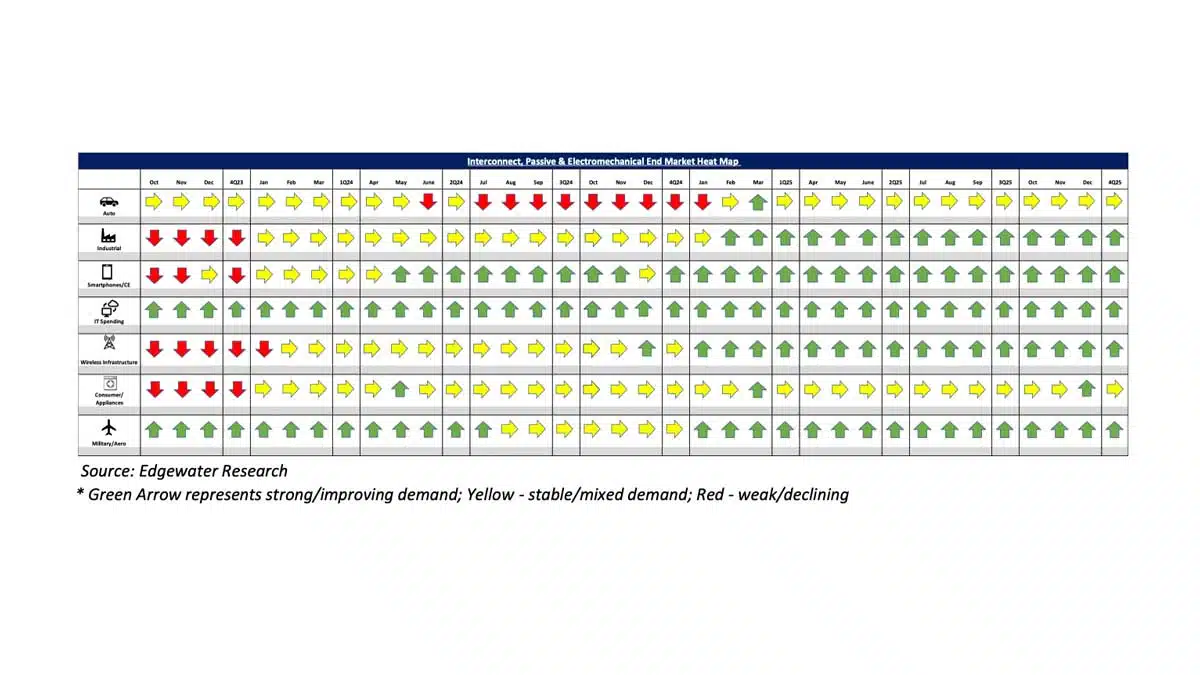
Aggregate demand is improving, with the fourth quarter ending ahead of expectations. This is primarily driven by the strength of the AI, Mil/Aero, and industrial sectors, while the auto sector remains relatively stable.

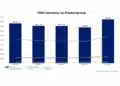
Bookings have been increasing since October and November, with B2B bookings reaching approximately 1.1 times the previous quarter. This has helped extend the backlog coverage and supported a strong first-quarter setup.

The outlook for 2026 is firming up. Some IP&E suppliers are pushing for an average price increase across distribution and direct channels, which is tied to the inflation of metals costs.

The demand forecast for AI continues to rise, with the connector industry projected to see a demand increase of approximately 2 times in the next year, with some projections suggesting a doubling again in the following year.

Top 3 Channel Comments:

  1. Demand trends have improved since October, and the sentiment from customers and distributors at CES was positive. We have seen a healthy concern from buyers regarding supply assurance, which is a positive sign for suppliers. While buyers are concerned about inflation and component price increases, they seem willing to pay. We are forecasting double-digit growth in sales for 2026.
  2. Interconnect B2B improved to approximately 1.1 times in the fourth quarter compared to approximately 1.0 times in the previous quarter. This improvement was driven by the strength of bookings, which continued into early January. Our backlog coverage for the first half of 2026 has significantly improved over the past three to four months, and our focus has shifted to filling in the second half of the orderbook. We are optimistic and forecasting sales growth of 10-12% in 2026, including the impact of AI.
  3. Nvidia and hyperscalers are aiming to flatten the scale-out network from a three-tier structure to a two-tier structure while expanding the scale-up domain.

This shift is expected to begin with VR and extend into Kyber.

Other Key Takeaways:

  • Demand improvement appears to be at least partly driven by increased customer focus on supply assurance, given the signs of broader tightening across electronic components. This includes an uptick in IP&E lead times and metal inflation impacting pricing.
  • TPU CY26 forecasts are up again to approximately 68–69K racks compared to around 60K in the previous year and less than 40K in CY25. The TPU connector TAM is projected to increase by over 90% in CY26.
  • CY26 Nvidia GB connector TAM is projected to be around 60K racks, with an upside potential of approximately 80K. VR volumes are expected to be incremental, with shipments beginning in the third quarter of 2026.
  • CY26 Trainium connector TAM is estimated to increase by over 55% year-over-year in terms of rack volume growth, with moderate content uplift linked to the backplane.
  • Copper is expected to continue to be a key component in AI NT/MT, particularly in scale-up applications. The active copper/CPC is likely to remain viable until the 448G/lane era.
  • The transition to optics is unlikely to be a significant hurdle in the next three years. The CPO volume adoption is expected to potentially occur in 2027 for scale-out applications, while scale-up is likely to occur in 2028 and beyond.
  • Auto demand is expected to remain stable after the fourth quarter, with the first-quarter outlook being seasonal. The CY26 production outlook is still relatively flat, with risks from tariffs, the USMCA agreement, and memory issues.
  • CY26 Auto connector sales are likely to increase due to the MSD support and pricing.
  • Industrial demand is expected to improve moderately, with better visibility. The CY26 demand is projected to increase due to the MSD support. Mil/Aero demand is projected to increase due to the HSD/LDD support.
  • Capacitor demand is expected to strengthen due to the AI market, with lead times stretching and factory utilization already high. Resistor and inductor demand is also expected to increase, with lead times remaining stable and supply generally available. Passive B2B demand is expected to strengthen to approximately 1.2 times on average.

Conclusion:

Early 2026 IP&E indicators remain encouraging, following a strengthening in fundamentals towards the end of 2025. Similar to previous months, AI continues to be the primary growth driver for the industry. However, feedback from December and early January suggests that the recovery is gradually broadening across other end markets. B2B ratios have improved heading into 2026 (typically exceeding 1.1x in our work), alongside

Firm backlogs and pricing discipline collectively support a more constructive near-term outlook. Notably, the buyer’s tone appears to be shifting, with procurement behavior moving towards supply sufficiency and securing allocation. This should further reinforce fundamentals. We are also beginning to witness genuine improvement in select industrial pockets (beyond pure restocking), although a significant portion of feedback still characterizes auto and industrial consumption as stable. Overall, data points appear supportive of a more durable recovery trajectory in 2026, although we would like to see broader confirmation in underlying consumption trends.

Full report available from: Dennis Reed, Sr. Research Analyst, Edgewater Research

Related

Source: Edgewater Research

Recent Posts

DigiKey Adds 31k New In‑Stock Parts in Q1 2026

29.4.2026
7

April 2026 Interconnect, Passives and Electromechanical Components Market Insights

22.4.2026
76

Würth Elektronik Expanded Capacity for Validation and Services in Asia

16.4.2026
17

YAGEO Q1 2026 Results: AI Servers and Pricing Power Behind a Moderate Q2 Outlook

16.4.2026
90

ECIA March 2026 Industry Pulse Points to Best Sales Climate in Five Years

13.4.2026
58

TDK and Nippon Chemical Launch Joint Venture for MLCC Materials

7.4.2026
56

March 2026 Interconnect, Passives and Electromechanical Components Market Insights

2.4.2026
117

Molex Completes Acquisition of Smiths Interconnect, Expanding Portfolio of High-Reliability Connectivity Solutions

1.4.2026
16

APEC 2026 Power Electronics Trends and Implications for Passive Components

1.4.2026
141

Upcoming Events

May 5
16:00 - 17:00 CEST

Understanding and Selecting Capacitors – Fundamentals, Technologies and Latest Trends

May 7
17:00 - 18:00 CEST

From Grid to Motion: How Industrial Electrification is Redefining Power System Design

May 12
8:00 - 15:00 CEST

ESCC Space Splice connectors

View Calendar

Popular Posts

  • Buck Converter Design and Calculation

    0 shares
    Share 0 Tweet 0
  • Boost Converter Design and Calculation

    0 shares
    Share 0 Tweet 0
  • Flyback Converter Design and Calculation

    0 shares
    Share 0 Tweet 0
  • LLC Resonant Converter Design and Calculation

    0 shares
    Share 0 Tweet 0
  • MLCC and Ceramic Capacitors

    0 shares
    Share 0 Tweet 0
  • Dual Active Bridge (DAB) Topology

    0 shares
    Share 0 Tweet 0
  • What Electronics Engineer Needs to Know About Passive Low Pass Filters

    0 shares
    Share 0 Tweet 0
  • Capacitor Charging and Discharging

    0 shares
    Share 0 Tweet 0
  • MLCC Case Sizes Standards Explained

    0 shares
    Share 0 Tweet 0
  • Ripple Current and its Effects on the Performance of Capacitors

    3 shares
    Share 3 Tweet 0

Newsletter Subscription


Passive Components Blog

© EPCI - Leading Passive Components Educational and Information Site

  • Home
  • Privacy Policy
  • EPCI Membership & Advertisement
  • About

No Result
View All Result
  • Home
  • Knowledge Blog
  • PCNS

© EPCI - Leading Passive Components Educational and Information Site

This website uses cookies. By continuing to use this website you are giving consent to cookies being used. Visit our Privacy and Cookie Policy.
Go to mobile version