







Passive Components Blog
No Result
View All Result
  • Home
  • NewsFilter
    • All
    • Aerospace & Defence
    • Antenna
    • Applications
    • Automotive
    • Capacitors
    • Circuit Protection Devices
    • electro-mechanical news
    • Filters
    • Fuses
    • Inductors
    • Industrial
    • Integrated Passives
    • inter-connect news
    • Market & Supply Chain
    • Market Insights
    • Medical
    • Modelling and Simulation
    • New Materials & Supply
    • New Technologies
    • Non-linear Passives
    • Oscillators
    • Passive Sensors News
    • Resistors
    • RF & Microwave
    • Telecommunication
    • Weekly Digest

    Nichicon Extends Rechargeable Batteries Temperature to Rival Supercapacitors

    Two‑capacitor paradox explained for engineers

    YAGEO Releases Compact RJ45 Connector for Multi‑Gigabit Ethernet

    Circuit Protection Technology Annual Dossier

    ESA SPCD 26 Registration Open

    Capacitances of Nonlinear MLCCs: What Datasheets Don’t Tell You

    Stackpole Releases Automotive Wide‑Termination Resistors

    How a Digital Structural Twin Can Predict Tantalum Capacitor Reliability

    SCHURTER Buys Biaodi to Boost High-Voltage Protection Portfolio

    Trending Tags

    • Ripple Current
    • RF
    • Leakage Current
    • Tantalum vs Ceramic
    • Snubber
    • Low ESR
    • Feedthrough
    • Derating
    • Dielectric Constant
    • New Products
    • Market Reports
  • VideoFilter
    • All
    • Antenna videos
    • Capacitor videos
    • Circuit Protection Video
    • Filter videos
    • Fuse videos
    • Inductor videos
    • Inter-Connect Video
    • Non-linear passives videos
    • Oscillator videos
    • Passive sensors videos
    • Resistor videos

    Two‑capacitor paradox explained for engineers

    Capacitances of Nonlinear MLCCs: What Datasheets Don’t Tell You

    Tapped Inductor Buck Converter Fundamentals

    Planar vs Conventional Transformer: When it Make Sense

    Modeling Fringing Field Losses in Inductors & Transformers

    Why Power Inductors Use a Ferrite Core With an Air Gap

    Transformer-Based Power-Line Harvester Magnetic Design

    Thermal Modeling of Magnetics

    Standard vs Planar LLC transformers Comparison for Battery Chargers

    Trending Tags

    • Capacitors explained
    • Inductors explained
    • Resistors explained
    • Filters explained
    • Application Video Guidelines
    • EMC
    • New Products
    • Ripple Current
    • Simulation
    • Tantalum vs Ceramic
  • Knowledge Blog
  • DossiersNew
  • Suppliers
    • Who is Who
  • PCNS
    • PCNS 2025
    • PCNS 2023
    • PCNS 2021
    • PCNS 2019
    • PCNS 2017
  • Events
  • Home
  • NewsFilter
    • All
    • Aerospace & Defence
    • Antenna
    • Applications
    • Automotive
    • Capacitors
    • Circuit Protection Devices
    • electro-mechanical news
    • Filters
    • Fuses
    • Inductors
    • Industrial
    • Integrated Passives
    • inter-connect news
    • Market & Supply Chain
    • Market Insights
    • Medical
    • Modelling and Simulation
    • New Materials & Supply
    • New Technologies
    • Non-linear Passives
    • Oscillators
    • Passive Sensors News
    • Resistors
    • RF & Microwave
    • Telecommunication
    • Weekly Digest

    Nichicon Extends Rechargeable Batteries Temperature to Rival Supercapacitors

    Two‑capacitor paradox explained for engineers

    YAGEO Releases Compact RJ45 Connector for Multi‑Gigabit Ethernet

    Circuit Protection Technology Annual Dossier

    ESA SPCD 26 Registration Open

    Capacitances of Nonlinear MLCCs: What Datasheets Don’t Tell You

    Stackpole Releases Automotive Wide‑Termination Resistors

    How a Digital Structural Twin Can Predict Tantalum Capacitor Reliability

    SCHURTER Buys Biaodi to Boost High-Voltage Protection Portfolio

    Trending Tags

    • Ripple Current
    • RF
    • Leakage Current
    • Tantalum vs Ceramic
    • Snubber
    • Low ESR
    • Feedthrough
    • Derating
    • Dielectric Constant
    • New Products
    • Market Reports
  • VideoFilter
    • All
    • Antenna videos
    • Capacitor videos
    • Circuit Protection Video
    • Filter videos
    • Fuse videos
    • Inductor videos
    • Inter-Connect Video
    • Non-linear passives videos
    • Oscillator videos
    • Passive sensors videos
    • Resistor videos

    Two‑capacitor paradox explained for engineers

    Capacitances of Nonlinear MLCCs: What Datasheets Don’t Tell You

    Tapped Inductor Buck Converter Fundamentals

    Planar vs Conventional Transformer: When it Make Sense

    Modeling Fringing Field Losses in Inductors & Transformers

    Why Power Inductors Use a Ferrite Core With an Air Gap

    Transformer-Based Power-Line Harvester Magnetic Design

    Thermal Modeling of Magnetics

    Standard vs Planar LLC transformers Comparison for Battery Chargers

    Trending Tags

    • Capacitors explained
    • Inductors explained
    • Resistors explained
    • Filters explained
    • Application Video Guidelines
    • EMC
    • New Products
    • Ripple Current
    • Simulation
    • Tantalum vs Ceramic
  • Knowledge Blog
  • DossiersNew
  • Suppliers
    • Who is Who
  • PCNS
    • PCNS 2025
    • PCNS 2023
    • PCNS 2021
    • PCNS 2019
    • PCNS 2017
  • Events
No Result
View All Result
Passive Components Blog
No Result
View All Result

Littelfuse Expands High-Voltage TVS Diodes

29.4.2026
Reading Time: 4 mins read
A A

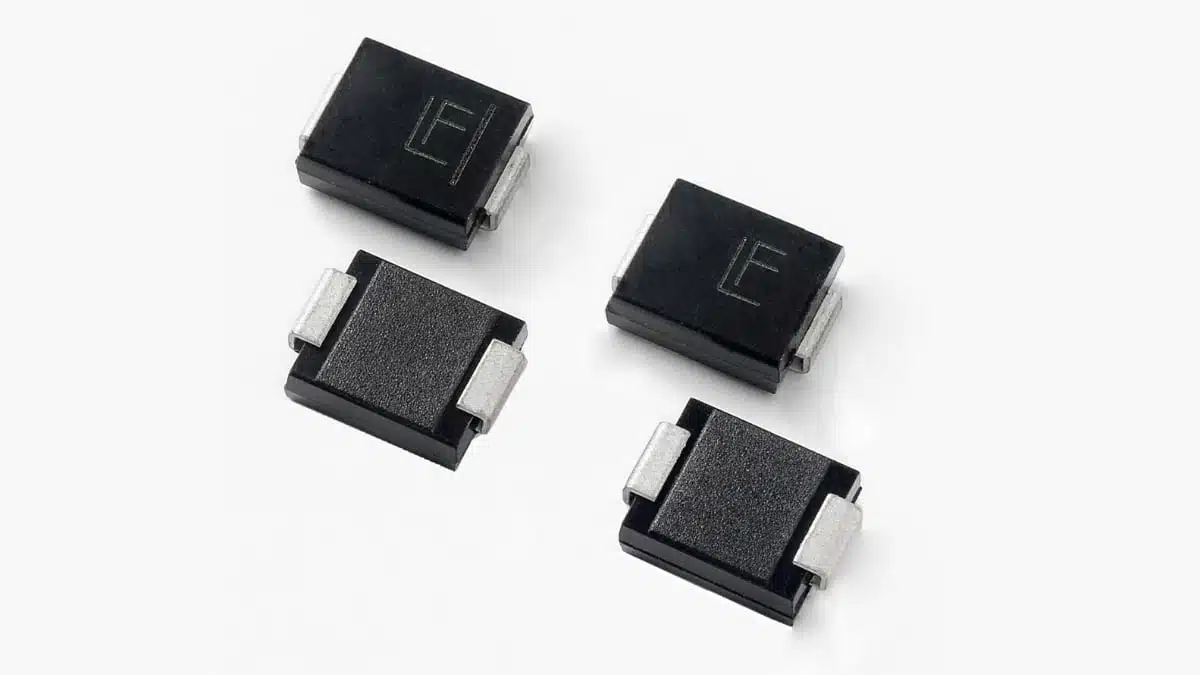
Littelfuse has expanded its TP Series with high-voltage TPSMC TPSMD and TP5.0SMDJ transient voltage suppression (TVS) diodes designed for automotive power electronics.

These Littelfuse AEC-Q101 qualified over-voltage protection devices offer standoff voltages up to 400 V and high peak pulse power ratings enabling single-device protection for GaN/SiC MOSFETs and IGBTs against load dumps and inductive switching transients. They help engineers simplify designs reduce BOM costs and improve efficiency in electrified vehicle systems.

RelatedPosts

Littelfuse Presents Ultra-Miniature Half-Pitch SMT DIP Switches

Littelfuse NANO2 415 SMD Fuse Wins 2025 Product of the Year

Littelfuse Unveils Ultra-Low-Power TMR Magnetic Switches

Key Features and Benefits

  • High standoff voltages from 180 V to 540 V allow single-device clamping in high-voltage rails eliminating the need for series-connected lower-voltage TVS diodes.
  • Peak pulse power ratings of 1500 W (TPSMC) 3000 W (TPSMD) and 5000 W (TP5.0SMDJ) at 10/1000 μs waveform handle severe automotive transients like load dumps.
  • Peak surge current up to 300 A supports protection in high-energy events while fast response time (<1 ps) ensures effective clamping before sensitive power semiconductors are damaged.
  • DO-214AB (SMC) surface-mount package optimizes PCB space with low profile and built-in strain relief for reliable assembly.
  • AEC-Q101 qualified PPAP capable and IEC-61000-4-2 ESD compliant up to 30 kV providing automotive-grade reliability.
  • Low incremental surge resistance and typical reverse leakage <1 μA above 13 V minimize conduction losses in normal operation.
  • Glass passivated junction and 260°C/10s soldering guarantee enhance thermal performance and manufacturing robustness.

Technical Highlights

These TVS diodes feature unidirectional and bidirectional configurations to suit various circuit needs. The table below summarizes key series specifications:

SeriesStandoff Voltage RangePeak Pulse Power (10/1000 μs)Package
TPSMC300-540 V1500 WDO-214AB
TPSMD180-400 V3000 WDO-214AB
TP5.0SMDJUp to high voltages5000 WSMC

Exact part numbers voltages and clamping voltages are detailed in manufacturer datasheets. Peak surge current and power ratings indicate the device’s ability to absorb energy from transients without failure typically shorting in overstress for fail-safe operation.

Typical Applications

In battery disconnect units (BDUs) these diodes protect high-voltage DC rails from inductive spikes during switching. High-voltage HVAC compressors and PTC heaters benefit from their surge handling in power stages where GaN/SiC MOSFETs or IGBTs face load dumps exceeding 100 V. They also suit high-voltage DC distribution in electrified vehicles reducing protection complexity compared to multi-device arrays.

Design-in Notes for Engineers

  • Select based on standoff voltage slightly above normal operating voltage (e.g. ≥400 V for 400 V rails) to avoid leakage while ensuring clamping below power device ratings.
  • Place close to protected semiconductors with adequate copper pad area (e.g. 8×8 mm per terminal) for thermal dissipation during surges.
  • Use bidirectional parts for AC lines or floating rails; verify AEC-Q101 for PPAP in automotive production.
  • Combine with fuses or current limiters for coordinated protection; simulate transients using 10/1000 μs waveform for validation.
  • Lower peak power devices enable cost-optimized power semiconductors reducing overall conduction losses.

Source

This article is based on the official Littelfuse press release announcing the TPSMC TPSMD and TP5.0SMDJ high-voltage TVS diode series along with product page details.


  1. Littelfuse Press Release
  2. TPSMC Product Page
  3. TPSMD Product Page
  4. TP5.0SMDJ Product Page

Related

Recent Posts

Circuit Protection Technology Annual Dossier

15.5.2026
32

SCHURTER Buys Biaodi to Boost High-Voltage Protection Portfolio

14.5.2026
52

KYOCERA AVX Extends MLV Varistors for 48V Automotive Protection

5.5.2026
40

SPICE Simulation of Non-Linear Resistors: Vishay’s Thermistor and PPTC Modelling Ecosystem

22.4.2026
90

TDK Extends Compact ThermoFuse Varistors up to 50 kA

5.3.2026
27

Bourns Extends PPTC Resettable High‑Power, High‑Voltage Protection Fuses

2.3.2026
30

Bourns Unveils High Volt GDT for High‑Energy Surge Protection

23.2.2026
26

Würth Elektronik Component Data Live in Accuris

19.2.2026
29

TDK Releases High Temp 175C Automotive NTC thermistors

17.2.2026
44

Upcoming Events

May 19
16:00 - 17:00 CEST

Designing Qi2 Wireless Power Systems: Practical Development and EMC Optimization

Jun 2
16:00 - 17:00 CEST

Calculation, Simulation and Measurement of 800V EMC Filters

Jun 16
16:00 - 17:00 CEST

EMC with EMC – EMC‑compliant design with electromechanical connectors

View Calendar

Popular Posts

  • Buck Converter Design and Calculation

    0 shares
    Share 0 Tweet 0
  • Boost Converter Design and Calculation

    0 shares
    Share 0 Tweet 0
  • Flyback Converter Design and Calculation

    0 shares
    Share 0 Tweet 0
  • LLC Resonant Converter Design and Calculation

    0 shares
    Share 0 Tweet 0
  • MLCC and Ceramic Capacitors

    0 shares
    Share 0 Tweet 0
  • Capacitor Charging and Discharging

    0 shares
    Share 0 Tweet 0
  • What Electronics Engineer Needs to Know About Passive Low Pass Filters

    0 shares
    Share 0 Tweet 0
  • Dual Active Bridge (DAB) Topology

    0 shares
    Share 0 Tweet 0
  • Ripple Current and its Effects on the Performance of Capacitors

    3 shares
    Share 3 Tweet 0
  • MLCC Case Sizes Standards Explained

    0 shares
    Share 0 Tweet 0

Newsletter Subscription


Passive Components Blog

© EPCI - Leading Passive Components Educational and Information Site

  • Home
  • Privacy Policy
  • EPCI Membership & Advertisement
  • About

No Result
View All Result
  • Home
  • Knowledge Blog
  • PCNS

© EPCI - Leading Passive Components Educational and Information Site

This website uses cookies. By continuing to use this website you are giving consent to cookies being used. Visit our Privacy and Cookie Policy.
Go to mobile version