







Passive Components Blog
No Result
View All Result
  • Home
  • NewsFilter
    • All
    • Aerospace & Defence
    • Antenna
    • Applications
    • Automotive
    • Capacitors
    • Circuit Protection Devices
    • electro-mechanical news
    • Filters
    • Fuses
    • Inductors
    • Industrial
    • Integrated Passives
    • inter-connect news
    • Market & Supply Chain
    • Market Insights
    • Medical
    • Modelling and Simulation
    • New Materials & Supply
    • New Technologies
    • Non-linear Passives
    • Oscillators
    • Passive Sensors News
    • Resistors
    • RF & Microwave
    • Telecommunication
    • Weekly Digest

    Designing a 2 kW LLC Transformer with Integrated Resonant Inductor

    Middle East Conflict: The Potential Impact to Passive Components

    Inductor Technology Dossier

    Coilcraft Releases TLVR Inductors for High Density VRMs and PoL Converters

    Rutheniums Critical Role in Passive Component Supply Chains

    Bourns Expands its Modular Contacts for Power-Dense Systems

    Murata to Decouple China Rare Earth Supply in 3 Years

    Samtec AcceleRate Slim ARC6 Cable Assemblies with New Signaling Options

    Hirose Electric to Establish Automotive Connector Plant in India

    Trending Tags

    • Ripple Current
    • RF
    • Leakage Current
    • Tantalum vs Ceramic
    • Snubber
    • Low ESR
    • Feedthrough
    • Derating
    • Dielectric Constant
    • New Products
    • Market Reports
  • VideoFilter
    • All
    • Antenna videos
    • Capacitor videos
    • Circuit Protection Video
    • Filter videos
    • Fuse videos
    • Inductor videos
    • Inter-Connect Video
    • Non-linear passives videos
    • Oscillator videos
    • Passive sensors videos
    • Resistor videos

    Thermal Modeling of Magnetics

    Standard vs Planar LLC transformers Comparison for Battery Chargers

    How Modern Tools Model Magnetic Components for Power Electronics

    Advanced Loss Modeling for Planar Magnetics in the Frenetic Planar Tool

    2026 Power Magnetics Design Trends: Flyback, DAB and Planar

    Enabling Software‑Defined Vehicle Architectures: Automotive Ethernet and Zonal Smart Power

    Calculating Resistance Value of a Flyback RC Snubber 

    One‑Pulse Characterization of Nonlinear Power Inductors

    Thermistor Linearization Challenges

    Trending Tags

    • Capacitors explained
    • Inductors explained
    • Resistors explained
    • Filters explained
    • Application Video Guidelines
    • EMC
    • New Products
    • Ripple Current
    • Simulation
    • Tantalum vs Ceramic
  • Knowledge Blog
  • DossiersNew
  • Suppliers
    • Who is Who
  • PCNS
    • PCNS 2025
    • PCNS 2023
    • PCNS 2021
    • PCNS 2019
    • PCNS 2017
  • Events
  • Home
  • NewsFilter
    • All
    • Aerospace & Defence
    • Antenna
    • Applications
    • Automotive
    • Capacitors
    • Circuit Protection Devices
    • electro-mechanical news
    • Filters
    • Fuses
    • Inductors
    • Industrial
    • Integrated Passives
    • inter-connect news
    • Market & Supply Chain
    • Market Insights
    • Medical
    • Modelling and Simulation
    • New Materials & Supply
    • New Technologies
    • Non-linear Passives
    • Oscillators
    • Passive Sensors News
    • Resistors
    • RF & Microwave
    • Telecommunication
    • Weekly Digest

    Designing a 2 kW LLC Transformer with Integrated Resonant Inductor

    Middle East Conflict: The Potential Impact to Passive Components

    Inductor Technology Dossier

    Coilcraft Releases TLVR Inductors for High Density VRMs and PoL Converters

    Rutheniums Critical Role in Passive Component Supply Chains

    Bourns Expands its Modular Contacts for Power-Dense Systems

    Murata to Decouple China Rare Earth Supply in 3 Years

    Samtec AcceleRate Slim ARC6 Cable Assemblies with New Signaling Options

    Hirose Electric to Establish Automotive Connector Plant in India

    Trending Tags

    • Ripple Current
    • RF
    • Leakage Current
    • Tantalum vs Ceramic
    • Snubber
    • Low ESR
    • Feedthrough
    • Derating
    • Dielectric Constant
    • New Products
    • Market Reports
  • VideoFilter
    • All
    • Antenna videos
    • Capacitor videos
    • Circuit Protection Video
    • Filter videos
    • Fuse videos
    • Inductor videos
    • Inter-Connect Video
    • Non-linear passives videos
    • Oscillator videos
    • Passive sensors videos
    • Resistor videos

    Thermal Modeling of Magnetics

    Standard vs Planar LLC transformers Comparison for Battery Chargers

    How Modern Tools Model Magnetic Components for Power Electronics

    Advanced Loss Modeling for Planar Magnetics in the Frenetic Planar Tool

    2026 Power Magnetics Design Trends: Flyback, DAB and Planar

    Enabling Software‑Defined Vehicle Architectures: Automotive Ethernet and Zonal Smart Power

    Calculating Resistance Value of a Flyback RC Snubber 

    One‑Pulse Characterization of Nonlinear Power Inductors

    Thermistor Linearization Challenges

    Trending Tags

    • Capacitors explained
    • Inductors explained
    • Resistors explained
    • Filters explained
    • Application Video Guidelines
    • EMC
    • New Products
    • Ripple Current
    • Simulation
    • Tantalum vs Ceramic
  • Knowledge Blog
  • DossiersNew
  • Suppliers
    • Who is Who
  • PCNS
    • PCNS 2025
    • PCNS 2023
    • PCNS 2021
    • PCNS 2019
    • PCNS 2017
  • Events
No Result
View All Result
Passive Components Blog
No Result
View All Result

Negative Capacitor Enable Higher Voltage Systems

3.10.2022
Reading Time: 4 mins read
A A

by DOE/Argonne National Laboratory, original written by Jared Sagoff. Researchers have created a permanent static ‘negative capacitor,’ a device believed to have been in violation of physical laws until about a decade ago. Newly devised static negative capacitor could improve computing and yield more energy-efficient computers.

With a little physics ingenuity, scientists have designed a way to redistribute electricity on a small scale, potentially opening new avenues of research into more energy-efficient computing.

RelatedPosts

Designing a 2 kW LLC Transformer with Integrated Resonant Inductor

Middle East Conflict: The Potential Impact to Passive Components

Inductor Technology Dossier

In a new study, researchers at the U.S. Department of Energy’s (DOE) Argonne National Laboratory, together with collaborators in France and Russia, have created a permanent static “negative capacitor,” a device thought to have been in violation of physical laws until about a decade ago.

“The objective is to be able to get electricity where it is needed while using as little as possible in a controlled static regime.” — Argonne materials scientist Valerii Vinokur

While previously proposed designs for negative capacitors worked on a temporary, transient basis, the new Argonne-developed negative capacitor concept works as a steady-state, reversible device.

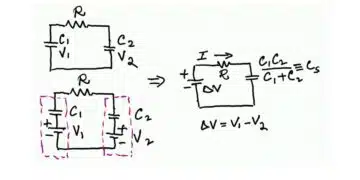
The researchers found that by pairing a negative capacitor in series with a positive capacitor, they could locally increase the voltage on the positive capacitor to a point higher than the total system voltage. In this way, they could distribute electricity to regions of a circuit requiring higher voltage while operating the entire circuit at lower voltage.

“The objective is to get electricity where it is needed while using as little as possible in a controlled, static regime,” said Argonne materials scientist Valerii Vinokur, the corresponding author of the study.

In traditional capacitors, the electric voltage of the capacitor is proportional to their stored electrical charge — increasing the amount of stored charge increases the voltage. In negative capacitors, the opposite happens — increasing the amount of charge decreases the voltage. Because the negative capacitor is a part of the larger circuit, this does not violate conservation of energy.

“One way you can think about it is like having a refrigerator,” said University of Picardie (France) scientist Igor Lukyanchuk, the first author of the paper. “Inside the refrigerator, of course, it is much colder than the outside environment, but that is because we are heating up the rest of the environment by expending energy to cool the refrigerator.”

A prime component of the negative capacitor put forward by Vinokur and his colleagues involves a filling made of a ferroelectric material, which is similar to a magnet except that it has an internal electric polarization, rather than a magnetic orientation.

“In a ferroelectric nanoparticle, on one surface you will have a positive charge, and at the other surface you will have negative charges,” Vinokur said. “This creates electric fields that try to depolarize the material.”

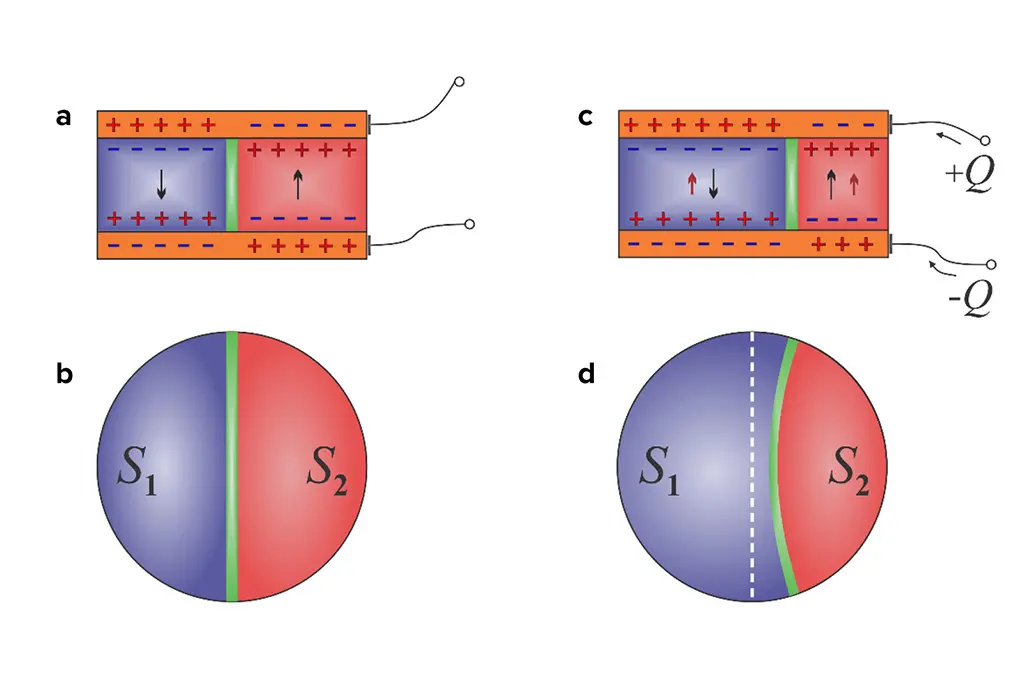
By splitting a nanoparticle into two equal ferroelectric domains of opposite polarization, separated by a boundary called a domain wall, Vinokur and his colleagues were able to minimize the effect of the total depolarizing electric field. Then, by adding charge to one of the ferroelectric domains, the researchers shifted the position of the domain wall between them.

Because of the cylindrical nature of the nanoparticle, the domain wall began to shrink, causing it to displace beyond the new electric equilibrium point. “Essentially, you can think of the domain wall like a fully extended spring,” said Lukyanchuk. “When the domain wall displaces to one side because of the charge imbalance, the spring relaxes, and the released elastic energy propels it further than expected. This effect creates the static negative capacitance.”

An article based on the study, “Harnessing ferroelectric domains for negative capacitance,” appeared in the February 26 online edition of Communications Physics. Authors of the study also include Anaïs Sené of the University of Picardie, and Yuri Tikhonov and Anna Razumnaya of the Southern Federal University (Russia).

The research at Argonne was funded by the DOE’s Office of Science. Research at the collaborating institutions was funded by the European Commission’s HORIZON 2020 initiative.

Journal Reference:

I. Luk’yanchuk, Y. Tikhonov, A. Sené, A. Razumnaya, V. M. Vinokur. Harnessing ferroelectric domains for negative capacitance. Communications Physics, 2019; 2 (1) DOI: 10.1038/s42005-019-0121-0

featured image: shows the movement of the domain wall (a-c and b-d) in a capacitor when a charge is added to one side (c). The resulting redistribution of the domain wall causes a negative capacitive effect. Credit: Argonne National Laboratory


Related

Source: Science Daily News

Recent Posts

Designing a 2 kW LLC Transformer with Integrated Resonant Inductor

20.3.2026
8

Middle East Conflict: The Potential Impact to Passive Components

20.3.2026
11

Inductor Technology Dossier

19.3.2026
27

Coilcraft Releases TLVR Inductors for High Density VRMs and PoL Converters

19.3.2026
23

Bourns Expands its Modular Contacts for Power-Dense Systems

19.3.2026
6

Murata to Decouple China Rare Earth Supply in 3 Years

19.3.2026
95

Samtec AcceleRate Slim ARC6 Cable Assemblies with New Signaling Options

19.3.2026
7
Schematic illustration of the electric double layer of porous carbon electrodes at elevated potentials in a a conventional electrolyte and b a weakly solvating electrolyte; source: authors

Researchers Presented Lignin-based Electrolyte for 4V Supercapacitors with Low Self‑Discharge

19.3.2026
7

Samsung Outlines Growth Roadmap at its 52nd General Shareholders Meeting

19.3.2026
14

Upcoming Events

Mar 21
All day

PSMA Capacitor Workshop 2026

Mar 24
9:00 - 10:00 CET

Power protection in the digital age – eFuse and hot-swap strategies for modern data center design

Apr 21
16:00 - 17:00 CEST

Heatsink Solutions: Thermal Management in electronic devices

View Calendar

Popular Posts

  • Buck Converter Design and Calculation

    0 shares
    Share 0 Tweet 0
  • Boost Converter Design and Calculation

    0 shares
    Share 0 Tweet 0
  • Flyback Converter Design and Calculation

    0 shares
    Share 0 Tweet 0
  • LLC Resonant Converter Design and Calculation

    0 shares
    Share 0 Tweet 0
  • MLCC Manufacturers Consider Price Increase as AI Demand Outpaces Supply

    0 shares
    Share 0 Tweet 0
  • MLCC and Ceramic Capacitors

    0 shares
    Share 0 Tweet 0
  • Dual Active Bridge (DAB) Topology

    0 shares
    Share 0 Tweet 0
  • Ripple Current and its Effects on the Performance of Capacitors

    3 shares
    Share 3 Tweet 0
  • MLCC Case Sizes Standards Explained

    0 shares
    Share 0 Tweet 0
  • What is a Dielectric Constant and DF of Plastic Materials?

    4 shares
    Share 4 Tweet 0

Newsletter Subscription


Passive Components Blog

© EPCI - Leading Passive Components Educational and Information Site

  • Home
  • Privacy Policy
  • EPCI Membership & Advertisement
  • About

No Result
View All Result
  • Home
  • Knowledge Blog
  • PCNS

© EPCI - Leading Passive Components Educational and Information Site

This website uses cookies. By continuing to use this website you are giving consent to cookies being used. Visit our Privacy and Cookie Policy.
Go to mobile version