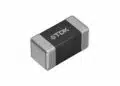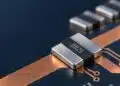


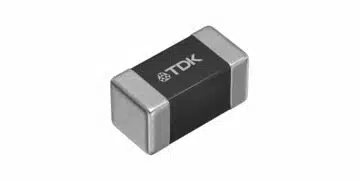



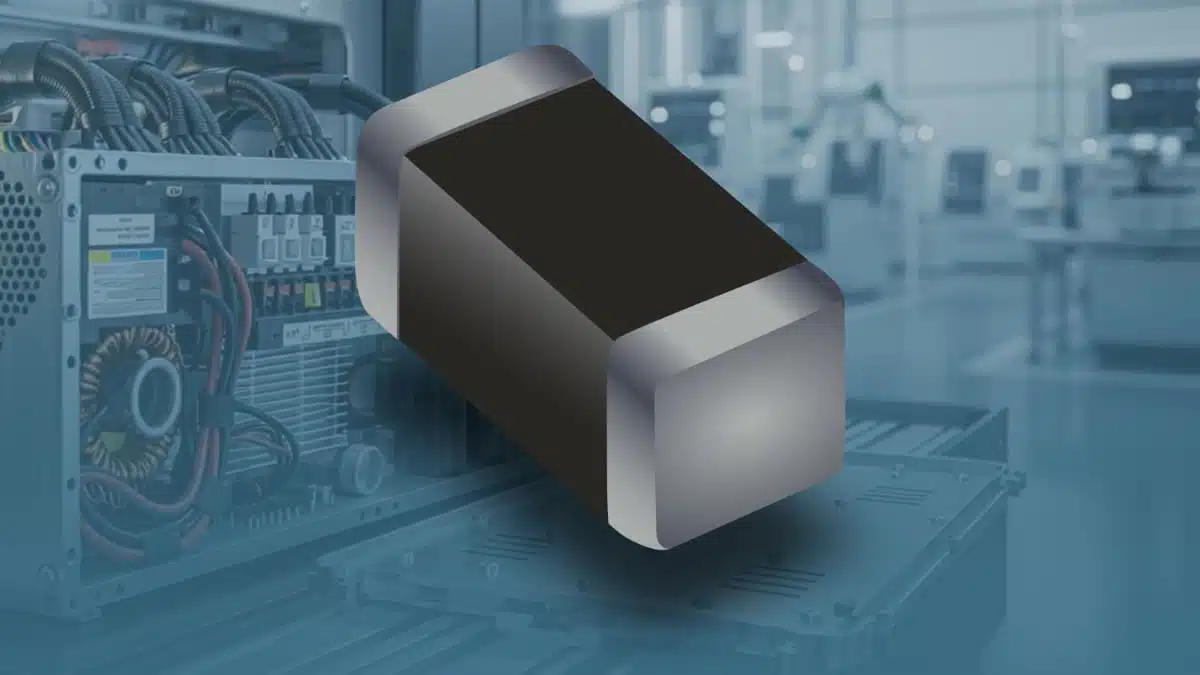
Bourns has introduced the MH3261‑T Series high current chip ferrite beads, a 1206 (3216 metric) SMD family aimed at EMI suppression on space‑constrained, high‑current power rails.
The combination of low DC resistance, impedance options from tens to one thousand ohms, and current ratings up to double‑digit ampere levels makes these ferrite beads relevant for modern high‑density power stages where both efficiency and EMC margins are tight.
Key features and benefits
- Compact 1206 footprint for dense layouts
The MH3261‑T devices use a 3.2 × 1.6 × 1.1 mm package, allowing designers to place EMI suppression directly in crowded power distribution areas without major routing or placement compromises. - High rated current capability
The series covers rated current values from 2 A up to 11 A, depending on impedance option, making it suitable from low‑power supply rails up to higher current distribution paths in compact power systems. - Low DC resistance for reduced losses
DC resistance values start as low as 2.5 mΩ, with upper values depending on the chosen impedance code. This helps minimize I²R losses and self‑heating, which is critical in tightly packed boards with limited airflow. - Wide impedance range for targeted EMI tuning
Impedance values span from 30 Ω up to 1000 Ω at 100 MHz with ±25% tolerance, supporting both broadband noise attenuation and more targeted suppression around switching and harmonic frequencies. - Wide operating temperature range
The operating range from −55 °C to +125 °C, including self‑heating at rated current, makes the series suitable for industrial and many automotive‑adjacent environments where ambient and load‑related temperature excursions are significant. - RoHS compliant and halogen free
The MH3261‑T devices are specified as compliant with RoHS Directive 2015/863 and are classified as halogen free according to Bourns internal ppm limits for bromine and chlorine content.
Typical applications
Ferrite beads in this class are primarily used as “clean‑up” components on power rails, where they attenuate high‑frequency noise while leaving the DC level and low‑frequency behavior largely unaffected.
- EMI suppression on DC power rails feeding digital ICs, processors, FPGAs or RF transceivers in compact embedded systems
- Noise filtering on power lines in high‑density DC‑DC converter modules and POL regulators on server and telecom boards
- Suppression of high‑frequency switching noise in point‑of‑load converters located near sensitive analog front ends or clock generators
- Local filtering in power distribution paths of industrial control units, PLC I/O modules, motor control boards and sensor interfaces
- High‑density consumer and IoT boards where multiple switching converters share restricted PCB area and common supply planes
In many designs, a ferrite bead from this series will be combined with one or more ceramic capacitors to form a simple but effective single‑stage LC or π‑type filter for differential‑mode noise on the supply line.
Technical highlights
The following table summarizes the key high‑level ratings of the MH3261‑T Series according to Bourns:
MH3261‑T Series main parameters
| Parameter | Value / Range |
|---|---|
| Package size | 3.2 × 1.6 × 1.1 mm (1206) |
| Impedance at 100 MHz | 30 Ω – 1000 Ω (±25%) |
| DC resistance (max.) | 0.0025 Ω – 0.075 Ω |
| Rated current (max.) | 2 A – 11 A |
| Operating temperature range | −55 °C to +125 °C |
The impedance specification at 100 MHz is a common reference point for EMI components and gives a good indication of how strongly the bead will attenuate noise around that frequency. In practice, designers should refer to the manufacturer impedance versus frequency curves to check behavior at their converter switching frequency and its harmonics.
The wide range of impedance and current combinations across the MH3261‑T options enables use in different roles, for example:
- Lower impedance, higher current types for main power distribution rails where voltage drop must be minimized
- Higher impedance, lower current types for secondary supplies and local power domains feeding single ICs or small groups of loads
The series is specified over a wide temperature range including self‑heating at rated current, which is important when placing these beads close to hot power components like MOSFETs, controllers or rectifiers.
Design‑in notes for engineers
When designing with high current ferrite beads in dense power layouts, selection should consider not only the catalog ratings but also the actual operating conditions, including worst‑case load and ambient environment.
- Clarify the design objective
Decide whether the bead is mainly intended for broadband noise suppression or for targeting a narrower frequency range around the converter switching frequency and its first few harmonics. - Check impedance versus frequency curves
Use the impedance graphs in the MH3261‑T datasheet to confirm that the chosen part maintains sufficient impedance across the relevant noise spectrum, and avoid choosing solely on the 100 MHz value. - Validate DC bias and thermal performance
At high currents the bead will self‑heat; verify that the chosen part remains within the −55 °C to +125 °C rating and that temperature rise at maximum load is acceptable in your thermal environment. - Account for voltage drop and efficiency
Multiply DC resistance by the maximum continuous current to estimate voltage drop and I²R losses. Low DCR types in this series help maintain efficiency, but the effect can still be significant on low‑voltage rails. - Combine with appropriate capacitors
For effective EMI suppression, place low‑ESR MLCCs close to the bead on the load side and, if necessary, the source side. Layout should minimize loop area and return‑path inductance. - Consider derating in harsh environments
In applications with elevated ambient temperatures, continuous high current or strong transient loading, consider derating the current relative to the catalog maximum for additional reliability margin. - Layout and placement practices
Place the bead as close as practical to the noise source or to the entry point of the sensitive circuit block, and keep associated traces short and wide to reduce parasitic inductance and resistance.
For procurement and lifecycle management, it is useful to confirm status and recommended replacements for specific impedance codes using Bourns product notifications and featured product bulletins, as these document active support and any reactivations within the broader MH family.
Source
This article is based on information provided in the official Bourns press release for the MH3261‑T Series High Current Chip Ferrite Beads and on the corresponding product documentation available on the Bourns website, complemented by publicly available distributor datasheet copies for context.