




Passive Components Blog
No Result
View All Result
  • Home
  • NewsFilter
    • All
    • Aerospace & Defence
    • Antenna
    • Applications
    • Automotive
    • Capacitors
    • Circuit Protection Devices
    • electro-mechanical news
    • Filters
    • Fuses
    • Inductors
    • Industrial
    • Integrated Passives
    • inter-connect news
    • Market & Supply Chain
    • Market Insights
    • Medical
    • Modelling and Simulation
    • New Materials & Supply
    • New Technologies
    • Non-linear Passives
    • Oscillators
    • Passive Sensors News
    • Resistors
    • RF & Microwave
    • Telecommunication
    • Weekly Digest

    YAGEO Introduces High‑Current Y2/X1 Film Capacitors for Wide-bandgap Power Systems

    Amphenol Explanded Liquid Cooling Connectors for AI, ESS and EV Systems

    Hirose Introduced BGA connector for PCIe Gen6 for AI and Edge Computing

    YAGEO Introduces High Rel MLCCs Beyond MIL-Spec Limits

    Würth Elektronik Expanded Capacity for Validation and Services in Asia

    Samsung Introduces Ultra-High-Voltage 1500 V MLCCs for xEV Powertrains

    YAGEO Q1 2026 Results: AI Servers and Pricing Power Behind a Moderate Q2 Outlook

    TDK Introduces High‑Voltage Common‑Mode Chokes for Compact 1250 V DC Converters

    Vishay Extends Power Inductors for DC/DC with 1212 Compact Case

    Trending Tags

    • Ripple Current
    • RF
    • Leakage Current
    • Tantalum vs Ceramic
    • Snubber
    • Low ESR
    • Feedthrough
    • Derating
    • Dielectric Constant
    • New Products
    • Market Reports
  • VideoFilter
    • All
    • Antenna videos
    • Capacitor videos
    • Circuit Protection Video
    • Filter videos
    • Fuse videos
    • Inductor videos
    • Inter-Connect Video
    • Non-linear passives videos
    • Oscillator videos
    • Passive sensors videos
    • Resistor videos

    Transformer-Based Power-Line Harvester Magnetic Design

    Thermal Modeling of Magnetics

    Standard vs Planar LLC transformers Comparison for Battery Chargers

    How Modern Tools Model Magnetic Components for Power Electronics

    Advanced Loss Modeling for Planar Magnetics in the Frenetic Planar Tool

    2026 Power Magnetics Design Trends: Flyback, DAB and Planar

    Enabling Software‑Defined Vehicle Architectures: Automotive Ethernet and Zonal Smart Power

    Calculating Resistance Value of a Flyback RC Snubber 

    One‑Pulse Characterization of Nonlinear Power Inductors

    Trending Tags

    • Capacitors explained
    • Inductors explained
    • Resistors explained
    • Filters explained
    • Application Video Guidelines
    • EMC
    • New Products
    • Ripple Current
    • Simulation
    • Tantalum vs Ceramic
  • Knowledge Blog
  • DossiersNew
  • Suppliers
    • Who is Who
  • PCNS
    • PCNS 2025
    • PCNS 2023
    • PCNS 2021
    • PCNS 2019
    • PCNS 2017
  • Events
  • Home
  • NewsFilter
    • All
    • Aerospace & Defence
    • Antenna
    • Applications
    • Automotive
    • Capacitors
    • Circuit Protection Devices
    • electro-mechanical news
    • Filters
    • Fuses
    • Inductors
    • Industrial
    • Integrated Passives
    • inter-connect news
    • Market & Supply Chain
    • Market Insights
    • Medical
    • Modelling and Simulation
    • New Materials & Supply
    • New Technologies
    • Non-linear Passives
    • Oscillators
    • Passive Sensors News
    • Resistors
    • RF & Microwave
    • Telecommunication
    • Weekly Digest

    YAGEO Introduces High‑Current Y2/X1 Film Capacitors for Wide-bandgap Power Systems

    Amphenol Explanded Liquid Cooling Connectors for AI, ESS and EV Systems

    Hirose Introduced BGA connector for PCIe Gen6 for AI and Edge Computing

    YAGEO Introduces High Rel MLCCs Beyond MIL-Spec Limits

    Würth Elektronik Expanded Capacity for Validation and Services in Asia

    Samsung Introduces Ultra-High-Voltage 1500 V MLCCs for xEV Powertrains

    YAGEO Q1 2026 Results: AI Servers and Pricing Power Behind a Moderate Q2 Outlook

    TDK Introduces High‑Voltage Common‑Mode Chokes for Compact 1250 V DC Converters

    Vishay Extends Power Inductors for DC/DC with 1212 Compact Case

    Trending Tags

    • Ripple Current
    • RF
    • Leakage Current
    • Tantalum vs Ceramic
    • Snubber
    • Low ESR
    • Feedthrough
    • Derating
    • Dielectric Constant
    • New Products
    • Market Reports
  • VideoFilter
    • All
    • Antenna videos
    • Capacitor videos
    • Circuit Protection Video
    • Filter videos
    • Fuse videos
    • Inductor videos
    • Inter-Connect Video
    • Non-linear passives videos
    • Oscillator videos
    • Passive sensors videos
    • Resistor videos

    Transformer-Based Power-Line Harvester Magnetic Design

    Thermal Modeling of Magnetics

    Standard vs Planar LLC transformers Comparison for Battery Chargers

    How Modern Tools Model Magnetic Components for Power Electronics

    Advanced Loss Modeling for Planar Magnetics in the Frenetic Planar Tool

    2026 Power Magnetics Design Trends: Flyback, DAB and Planar

    Enabling Software‑Defined Vehicle Architectures: Automotive Ethernet and Zonal Smart Power

    Calculating Resistance Value of a Flyback RC Snubber 

    One‑Pulse Characterization of Nonlinear Power Inductors

    Trending Tags

    • Capacitors explained
    • Inductors explained
    • Resistors explained
    • Filters explained
    • Application Video Guidelines
    • EMC
    • New Products
    • Ripple Current
    • Simulation
    • Tantalum vs Ceramic
  • Knowledge Blog
  • DossiersNew
  • Suppliers
    • Who is Who
  • PCNS
    • PCNS 2025
    • PCNS 2023
    • PCNS 2021
    • PCNS 2019
    • PCNS 2017
  • Events
No Result
View All Result
Passive Components Blog
No Result
View All Result

Off-the-Shelf vs Customized Inductor Solutions

18.12.2023
Reading Time: 4 mins read
A A

This article is based on blog written by Pablo Blázquez, Frenetic power electronics engineer that compares inductor and transformer solutions for Buck-Boost Converter and discusses benefits of Off-the-Shelf vs Customized solutions.

As technology continues to advance, demands for compact and efficient Power Converters are on the rise.

RelatedPosts

Modeling Planar Magnetics Temperature: Practical Guidelines for Power Electronics Engineers

LLC Transformer: Designing a 2 kW LLC Transformer with Integrated Resonant Inductor

Thermal Modeling of Magnetics

Magnetics, such as Inductors and Transformers, are the ones that help achieve this goal by significantly contributing to the miniaturization of Converters.

In Power Converters, Inductors are commonly used to smooth out the current, reduce ripple, and store energy that can be released when needed.

Transformers are instrumental in changing voltage levels, stepping up or stepping down as required.

Buck-Boost Converter Off-the-Shelf vs. Customized Solutions

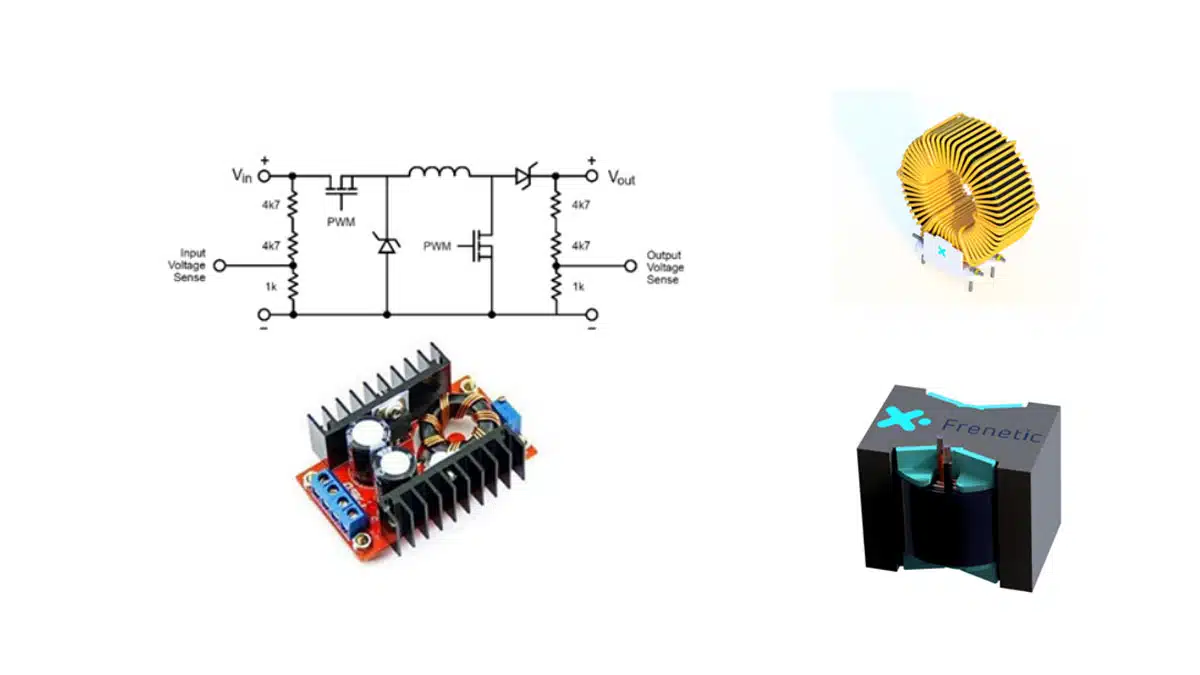
To show the impact of Magnetics on size reduction, let’s take into consideration the Buck-Boost Converter. This topology is widely used for voltage regulation, capable of both stepping up and stepping down the input voltage.

Many engineers opt for off-the-shelf Magnetics components due to their convenience and availability. However, when it comes to achieving the smallest possible size for a Converter, these components might fall short.

  1. Size: off-the-shelf components are designed to meet general requirements, resulting in compromises. The physical dimensions of these components may not perfectly align with the space constraints of a specific application.
  2. Time: acquiring off-the-shelf components is quick, but integrating them into a design might take additional time. Modifications to the circuitry to accommodate these components could be necessary.
  3. Cost: off-the-shelf components are cost-effective in terms of initial investment, but they might not be the most economical choice in the long run if they lead to suboptimal performance or if additional modifications are needed.

For projects where size is a critical factor, investing in customized solutions for Magnetic components could be a game-changer.

  1. Size: tailoring Inductors and Transformers to the exact specifications of the application allows for a more efficient use of space. This can result in a significant reduction in the overall size of the Converter.
  2. Time: while designing and manufacturing custom Magnetics may take a bit longer, the time invested is often justified by the improved performance and size reduction achieved.
  3. Cost: customization may involve higher upfront costs, but the long-term benefits, such as improved efficiency and reduced footprint, can make it a cost-effective choice over the converter’s lifecycle.

Buck-Boost Converter Case Study

Let’s consider now a practical scenario involving a Buck-Boost Converter for a portable electronic device. First, let’s imagine an Off-the-Shelf scenario, where engineers choose off-the-shelf Inductors and Transformers for the Buck-Boost Converter. While these components meet the basic requirements, the Converter’s size is larger than desired due to the compromise on form factor.

Then we move to a Customized Solution scenario. In this case, engineers decide to invest in custom Inductors and Transformers precisely tailored to the specifications of the application. The result is a Buck-Boost Converter that not only meets all performance criteria, but is also significantly smaller in size.

Let’s explore now on the comparative data. For Off-the-Shelf components:

  • Size: 100mm x 80mm x 20mm
  • Efficiency: 90%
  • Cost: $10 per unit
  • Design and Integration Time: 2 weeks

While, for the customized solution:

  • Size: 60mm x 40mm x 15mm
  • Efficiency: 95%
  • Cost: $15 per unit
  • Design and Integration Time: 4 weeks

Conclusion

While off-the-shelf Magnetics components provide a quick and cost-effective solution, they might not be the optimal choice when size is a critical factor. Customized Inductors and Transformers, despite requiring more time and upfront investment, offer a tailored approach that can significantly reduce the overall size of the Converter while improving performance.

As technology continues to advance, the importance of Magnetics in Power Electronics cannot be overstated. The choice between off-the-shelf and customized solutions ultimately depends on the specific requirements of the application, with an eye on achieving the perfect balance between size, efficiency, and cost.


Related

Source: Frenetic

Recent Posts

TDK Introduces High‑Voltage Common‑Mode Chokes for Compact 1250 V DC Converters

16.4.2026
16

Vishay Extends Power Inductors for DC/DC with 1212 Compact Case

16.4.2026
11

Modeling Planar Magnetics Temperature: Practical Guidelines for Power Electronics Engineers

15.4.2026
16

YAGEO Releases Ferrite Shielded Power Inductors for High‑Density Designs

15.4.2026
12

AI-Assisted Structural Diagnostics and Physics-Based Reliability Interpretation of Tantalum Capacitor Anodes

14.4.2026
25

YAGEO Introduces EMI Suppression High‑Current 3‑phase Common Mode Chokes

14.4.2026
29

ECIA March 2026 Industry Pulse Points to Best Sales Climate in Five Years

13.4.2026
34

Coilcraft Unveils Molded Power Inductors for High‑Current VRMs

8.4.2026
39

Bourns Releases Compact High Current Shielded Power Inductors

2.4.2026
29

Upcoming Events

Apr 21
16:00 - 17:00 CEST

Heatsink Solutions: Thermal Management in electronic devices

Apr 22
17:00 - 17:30 CEST

Magnetics in a high frequency GaN era

Apr 22
17:00 - 18:00 CEST

Derating Tantalum, Film, and Ceramic Capacitors

View Calendar

Popular Posts

  • Buck Converter Design and Calculation

    0 shares
    Share 0 Tweet 0
  • Boost Converter Design and Calculation

    0 shares
    Share 0 Tweet 0
  • Flyback Converter Design and Calculation

    0 shares
    Share 0 Tweet 0
  • LLC Resonant Converter Design and Calculation

    0 shares
    Share 0 Tweet 0
  • Dual Active Bridge (DAB) Topology

    0 shares
    Share 0 Tweet 0
  • MLCC and Ceramic Capacitors

    0 shares
    Share 0 Tweet 0
  • Capacitor Charging and Discharging

    0 shares
    Share 0 Tweet 0
  • MLCC Case Sizes Standards Explained

    0 shares
    Share 0 Tweet 0
  • Plastic Materials Dielectric Constant and DF

    4 shares
    Share 4 Tweet 0
  • Ripple Current and its Effects on the Performance of Capacitors

    3 shares
    Share 3 Tweet 0

Newsletter Subscription


Passive Components Blog

© EPCI - Leading Passive Components Educational and Information Site

  • Home
  • Privacy Policy
  • EPCI Membership & Advertisement
  • About

No Result
View All Result
  • Home
  • Knowledge Blog
  • PCNS

© EPCI - Leading Passive Components Educational and Information Site

This website uses cookies. By continuing to use this website you are giving consent to cookies being used. Visit our Privacy and Cookie Policy.
Go to mobile version