











Passive Components Blog
No Result
View All Result
  • Home
  • NewsFilter
    • All
    • Aerospace & Defence
    • Antenna
    • Applications
    • Automotive
    • Capacitors
    • Circuit Protection Devices
    • electro-mechanical news
    • Filters
    • Fuses
    • Inductors
    • Industrial
    • Integrated Passives
    • inter-connect news
    • Market & Supply Chain
    • Market Insights
    • Medical
    • Modelling and Simulation
    • New Materials & Supply
    • New Technologies
    • Non-linear Passives
    • Oscillators
    • Passive Sensors News
    • Resistors
    • RF & Microwave
    • Telecommunication
    • Weekly Digest

    Top 10 Connector Vendors by Product Type

    Bourns Releases High‑Q Air Coil Inductors for RF Aplications

    CMSE 2026 Announces Call for Presentations on High-Reliability Military and Space Electronics

    ESA Call for Papers 6th Space Passive Component Days – SPCD 2026

    Würth Elektronik Offers Halogen‑Free EMC Gaskets for Displays and Housings

    Component Distribution Supply Chain January 2026

    Binder Unveils M8 Flange Solder Connectors for Flexible Cabling

    Power Electronics Tools for Passives and Magnetic Designs

    Modelithics Releases Component Model Library for SIMULIA CST Studio Suite

    Trending Tags

    • Ripple Current
    • RF
    • Leakage Current
    • Tantalum vs Ceramic
    • Snubber
    • Low ESR
    • Feedthrough
    • Derating
    • Dielectric Constant
    • New Products
    • Market Reports
  • VideoFilter
    • All
    • Antenna videos
    • Capacitor videos
    • Circuit Protection Video
    • Filter videos
    • Fuse videos
    • Inductor videos
    • Inter-Connect Video
    • Non-linear passives videos
    • Oscillator videos
    • Passive sensors videos
    • Resistor videos

    One‑Pulse Characterization of Nonlinear Power Inductors

    Thermistor Linearization Challenges

    Coaxial Connectors and How to Connect with PCB

    PCB Manufacturing, Test Methods, Quality and Reliability

    Transformer Behavior – Current Transfer and Hidden Feedback

    Choosing the Right Capacitor: The Importance of Accurate Measurements

    RF Inductors: Selection and Design Challenges for High-Frequency Circuits

    Transformer Safety IEC 61558 Standard

    3-Phase EMI Filter Design, Simulation, Calculation and Test

    Trending Tags

    • Capacitors explained
    • Inductors explained
    • Resistors explained
    • Filters explained
    • Application Video Guidelines
    • EMC
    • New Products
    • Ripple Current
    • Simulation
    • Tantalum vs Ceramic
  • Knowledge Blog
  • DossiersNew
  • Suppliers
    • Who is Who
  • PCNS
    • PCNS 2025
    • PCNS 2023
    • PCNS 2021
    • PCNS 2019
    • PCNS 2017
  • Events
  • Home
  • NewsFilter
    • All
    • Aerospace & Defence
    • Antenna
    • Applications
    • Automotive
    • Capacitors
    • Circuit Protection Devices
    • electro-mechanical news
    • Filters
    • Fuses
    • Inductors
    • Industrial
    • Integrated Passives
    • inter-connect news
    • Market & Supply Chain
    • Market Insights
    • Medical
    • Modelling and Simulation
    • New Materials & Supply
    • New Technologies
    • Non-linear Passives
    • Oscillators
    • Passive Sensors News
    • Resistors
    • RF & Microwave
    • Telecommunication
    • Weekly Digest

    Top 10 Connector Vendors by Product Type

    Bourns Releases High‑Q Air Coil Inductors for RF Aplications

    CMSE 2026 Announces Call for Presentations on High-Reliability Military and Space Electronics

    ESA Call for Papers 6th Space Passive Component Days – SPCD 2026

    Würth Elektronik Offers Halogen‑Free EMC Gaskets for Displays and Housings

    Component Distribution Supply Chain January 2026

    Binder Unveils M8 Flange Solder Connectors for Flexible Cabling

    Power Electronics Tools for Passives and Magnetic Designs

    Modelithics Releases Component Model Library for SIMULIA CST Studio Suite

    Trending Tags

    • Ripple Current
    • RF
    • Leakage Current
    • Tantalum vs Ceramic
    • Snubber
    • Low ESR
    • Feedthrough
    • Derating
    • Dielectric Constant
    • New Products
    • Market Reports
  • VideoFilter
    • All
    • Antenna videos
    • Capacitor videos
    • Circuit Protection Video
    • Filter videos
    • Fuse videos
    • Inductor videos
    • Inter-Connect Video
    • Non-linear passives videos
    • Oscillator videos
    • Passive sensors videos
    • Resistor videos

    One‑Pulse Characterization of Nonlinear Power Inductors

    Thermistor Linearization Challenges

    Coaxial Connectors and How to Connect with PCB

    PCB Manufacturing, Test Methods, Quality and Reliability

    Transformer Behavior – Current Transfer and Hidden Feedback

    Choosing the Right Capacitor: The Importance of Accurate Measurements

    RF Inductors: Selection and Design Challenges for High-Frequency Circuits

    Transformer Safety IEC 61558 Standard

    3-Phase EMI Filter Design, Simulation, Calculation and Test

    Trending Tags

    • Capacitors explained
    • Inductors explained
    • Resistors explained
    • Filters explained
    • Application Video Guidelines
    • EMC
    • New Products
    • Ripple Current
    • Simulation
    • Tantalum vs Ceramic
  • Knowledge Blog
  • DossiersNew
  • Suppliers
    • Who is Who
  • PCNS
    • PCNS 2025
    • PCNS 2023
    • PCNS 2021
    • PCNS 2019
    • PCNS 2017
  • Events
No Result
View All Result
Passive Components Blog
No Result
View All Result

Panasonic Releases High Energy Varistors for Protecting Automotive ECUs

28.3.2022
Reading Time: 4 mins read
A A

Panasonic releases high energy varistors for protecting automotive ECUs from load dump surges. The new varistors achieve the industry’s highest level of heat resistance of 150℃.

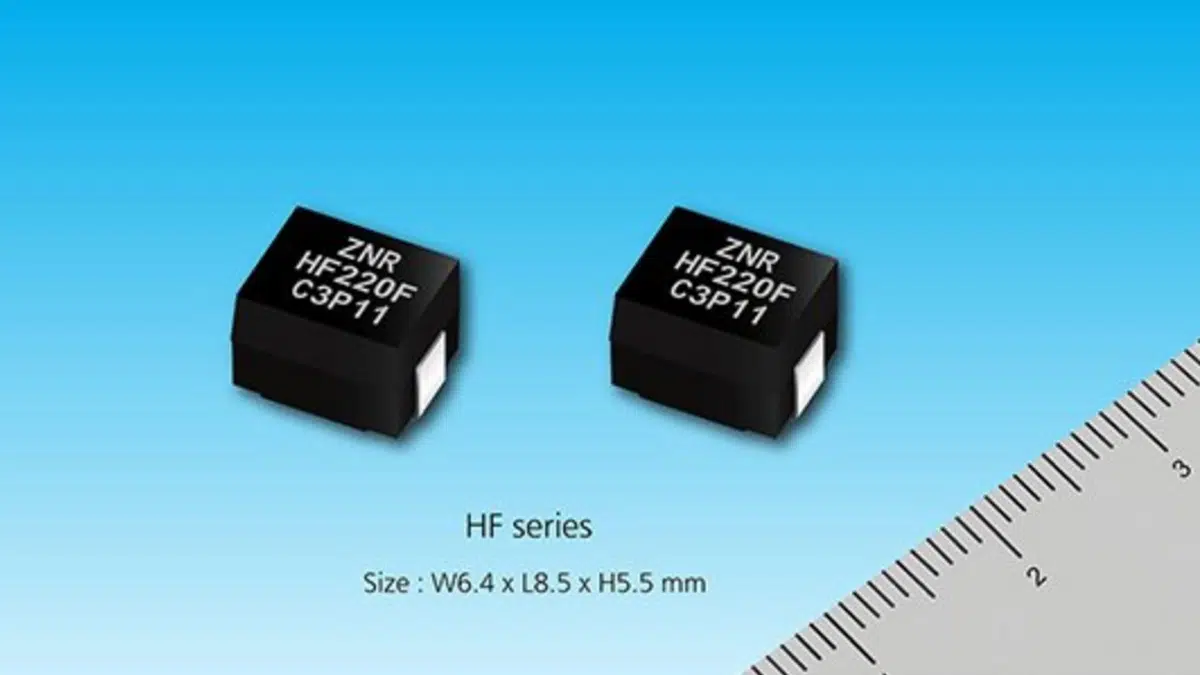
Panasonic Corporation announced that its Industry Company has commercialized ZNR[1] high energy varistors[2], which protect ECUs (electronic control units) from load dump surges[3] of automobiles. The mass production will start in March 2022.

RelatedPosts

Conductive Polymer Capacitor Market and Design‑In Guide to 2035

Panasonic Passive Components for Reliable Robotic Arms

Panasonic Releases Compact Tactile Switch with 3N Operation Force and 500K Cycles Life

The rise in environmental and safety awareness has led to progress in the digitization and electrification of automobiles including motorcycles, increasing the number of ECUs mounted. More ECUs are mounted in the vicinity of heat generating parts such as engines, increasing the demand for heat resistance of protective devices against load dump surges.

Panasonic successfully developed and commercialized the world’s first ZnO varistor (zinc oxide varistor) in 1968. By utilizing the varistor technology it developed over the years since, the company has commercialized ZNR high energy varistors suitable for a wider range of automotive applications, as part of its efforts to improve the heat resistance of varistors for load dump surge protection.

Panasonic’s new ZNR® high energy varistors have the following features:

  1. Their unique structure achieves both bending strength and the industry’s highest level of heat resistance temperature of 150℃.
  2. Excellent product characteristics (resistance performance against load dump surges, clamping voltage[4]) protect automotive ECUs from surges.
  3. The reduced size and weight save space and lower environmental load.

Recommended applications:

Load dump surge protection for automotive ECUs, etc.
(ECUs for lighting, engine control, and electronic meters, as well as USB chargers, etc.)

Product features:

1. Their unique structure achieves both bending strength and the industry’s highest level of heat resistance temperature of 150℃.

With an increase in the number of ECUs mounted in the vicinity of heat generating parts such as engines, automotive applications now require varistors with a higher heat resistance. However, as single components, conventional varistors are susceptible to rapid heat stress due to temperature changes although their resin mold structure makes them resistant to the deflection stress of the board. This necessitated the restriction of their operating temperature range to -40℃ to 125℃. By applying its material and structure design technologies accumulated through the development of various high heat-resistance devices, Panasonic has significantly reduced stress due to temperature changes, achieving the industry’s highest operating temperature range of -55℃ to 150℃ (Panasonic’s previous product: -40℃ to 125℃).

2. Excellent product characteristics (resistance performance against load dump surges, clamping voltage) protect automotive ECUs from surges.

The newly developed varistors provide excellent protection performance for automotive ECUs against surges due to their resistance performance against load dump surges that complies with the international standard ISO16750-2 and JASO D 001-94 Type A A-1[5] related to automotive load dump surges, as well as by achieving the industry’s lowest* clamping voltage of 35 Vmax.

  • * As ZnO varistor products (as of March 25, 2022, Panasonic data)

3. The reduced size and weight save space and lower environmental load.

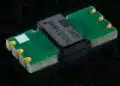
The newly developed varistors are compact with dimensions of 6.4 mm (W) × 8.0 mm (L) × 5.5 mm (H), enabling the reduction of the mounting area and weight to a half or less compared to Zener diodes[6] with equivalent performance, thereby contributing to the reduction of the amount of environmentally hazardous substances used.

Basic specifications:
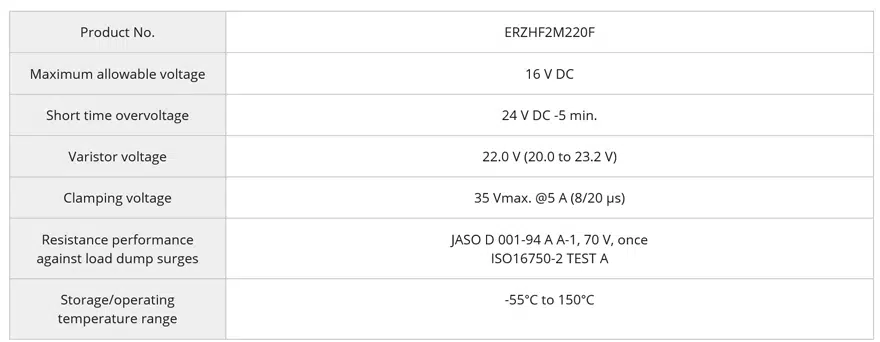
Term Descriptions:

[1] ZNR. ZNR, which is a registered trademark of Panasonic Corporation, refers to a voltage-dependent ceramic resistor (varistor) that is mainly made of zinc oxide and changes its resistance value depending on the applied voltage. ZNR won the One Step on Electro-Technology electrical technology award (The Institute of Electrical Engineers of Japan) in 2018.

[2] Varistor. Varistor, whose name originates from variable resistor, refers to a non-linear resistance element. The world’s first ZnO varistor (zinc oxide varistor), which Panasonic successfully developed and commercialized in 1968, revolutionized overvoltage protection technology against lightning surges, etc., contributing to the development of an advanced-information and energy society.

[3] Load dump surge. A surge generated when the battery connection is lost while an automotive engine is in operation and the alternator is charging the battery.

[4] Clamping voltage. Clamping voltage refers to the voltage suppressed by the varistor when a surge voltage is applied. A standard impulse current waveform (8/20 μs) is applied to determine the voltage across the varistor terminals.

[5] JASO D 001-94 Type A A-1. A 12-V system transient voltage test specified in the General Rules of Environmental Testing Methods for Automotive Electronic Equipment stipulated by the Society of Automotive Engineers of Japan, Inc. Abolished in March 2010.

[6]Zener diode. A semiconductor element that is a type of diode. Also referred to as a constant voltage diode. Zener diodes are also used for surge and noise protection.

Related

Source: Panasonic

Recent Posts

Binder Unveils M8 Flange Solder Connectors for Flexible Cabling

28.1.2026
13

Stackpole Releases AlN High‑Power Thick Film Chip Resistors

26.1.2026
17

Samsung Q4 2025 Results: MLCC focus for AI, Server and Automotive

26.1.2026
51

Capacitor Technology Dossier

26.1.2026
70

ROHM Extends 2012 Shunt Resistors Power Rating up to 1.25 W

23.1.2026
23

Passive Components in Quantum Computing

22.1.2026
122

0603 Automotive Chip Varistors as TVS Diode Replacements, TDK Tech Note

21.1.2026
29

Conductive Polymer Capacitor Market and Design‑In Guide to 2035

20.1.2026
140

TDK Releases High Performance 105C DC Link Film Capacitors

19.1.2026
64

Upcoming Events

Feb 24
16:00 - 17:00 CET

Designing Qi2 Wireless Power Systems: Practical Development and EMC Optimization

Mar 3
16:00 - 17:00 CET

Cybersecurity at the Eleventh Hour – from RED to CRA – Information and Discussion

Mar 21
All day

PSMA Capacitor Workshop 2026

View Calendar

Popular Posts

  • Buck Converter Design and Calculation

    0 shares
    Share 0 Tweet 0
  • Boost Converter Design and Calculation

    0 shares
    Share 0 Tweet 0
  • LLC Resonant Converter Design and Calculation

    0 shares
    Share 0 Tweet 0
  • Flyback Converter Design and Calculation

    0 shares
    Share 0 Tweet 0
  • Ripple Current and its Effects on the Performance of Capacitors

    3 shares
    Share 3 Tweet 0
  • How Metal Prices Are Driving Passive Component Price Hikes

    0 shares
    Share 0 Tweet 0
  • MLCC and Ceramic Capacitors

    0 shares
    Share 0 Tweet 0
  • Dual Active Bridge (DAB) Topology

    0 shares
    Share 0 Tweet 0
  • Degradation of Capacitors and its Failure Mechanisms

    0 shares
    Share 0 Tweet 0
  • What is a Dielectric Constant and DF of Plastic Materials?

    4 shares
    Share 4 Tweet 0

Newsletter Subscription


Passive Components Blog

© EPCI - Leading Passive Components Educational and Information Site

  • Home
  • Privacy Policy
  • EPCI Membership & Advertisement
  • About

No Result
View All Result
  • Home
  • Knowledge Blog
  • PCNS

© EPCI - Leading Passive Components Educational and Information Site

This website uses cookies. By continuing to use this website you are giving consent to cookies being used. Visit our Privacy and Cookie Policy.
Go to mobile version