














Passive Components Blog
No Result
View All Result
  • Home
  • NewsFilter
    • All
    • Aerospace & Defence
    • Antenna
    • Applications
    • Automotive
    • Capacitors
    • Circuit Protection Devices
    • electro-mechanical news
    • Filters
    • Fuses
    • Inductors
    • Industrial
    • Integrated Passives
    • inter-connect news
    • Market & Supply Chain
    • Market Insights
    • Medical
    • Modelling and Simulation
    • New Materials & Supply
    • New Technologies
    • Non-linear Passives
    • Oscillators
    • Passive Sensors News
    • Resistors
    • RF & Microwave
    • Telecommunication
    • Weekly Digest

    Mechanical Testing of Tantalum Anodes to Predict Tantalum Capacitor Quality

    Thermistor Linearization Challenges

    Coaxial Connectors and How to Connect with PCB

    SCHURTER APO Pyrofuse Brings Active Safety for High-Voltage Systems

    Coilcraft Releases Worlds Smallest 0402 Ferrite-Core Wirewound Chip Inductor

    Panasonic Releases Compact Tactile Switch with 3N Operation Force and 500K Cycles Life

    Modelithics Unveils Qorvo GaN Library v25.5.9

    Jianghai Offers Custom Bottom Cooled Screw Aluminum Capacitors

    PCB Manufacturing, Test Methods, Quality and Reliability

    Trending Tags

    • Ripple Current
    • RF
    • Leakage Current
    • Tantalum vs Ceramic
    • Snubber
    • Low ESR
    • Feedthrough
    • Derating
    • Dielectric Constant
    • New Products
    • Market Reports
  • VideoFilter
    • All
    • Antenna videos
    • Capacitor videos
    • Circuit Protection Video
    • Filter videos
    • Fuse videos
    • Inductor videos
    • Inter-Connect Video
    • Non-linear passives videos
    • Oscillator videos
    • Passive sensors videos
    • Resistor videos

    Thermistor Linearization Challenges

    Coaxial Connectors and How to Connect with PCB

    PCB Manufacturing, Test Methods, Quality and Reliability

    Transformer Behavior – Current Transfer and Hidden Feedback

    Choosing the Right Capacitor: The Importance of Accurate Measurements

    RF Inductors: Selection and Design Challenges for High-Frequency Circuits

    Transformer Safety IEC 61558 Standard

    3-Phase EMI Filter Design, Simulation, Calculation and Test

    Transformer Design Optimization for Power Electronics Applications

    Trending Tags

    • Capacitors explained
    • Inductors explained
    • Resistors explained
    • Filters explained
    • Application Video Guidelines
    • EMC
    • New Products
    • Ripple Current
    • Simulation
    • Tantalum vs Ceramic
  • Knowledge Blog
  • Suppliers
    • Who is Who
  • PCNS
    • PCNS 2025
    • PCNS 2023
    • PCNS 2021
    • PCNS 2019
    • PCNS 2017
  • Events
  • Home
  • NewsFilter
    • All
    • Aerospace & Defence
    • Antenna
    • Applications
    • Automotive
    • Capacitors
    • Circuit Protection Devices
    • electro-mechanical news
    • Filters
    • Fuses
    • Inductors
    • Industrial
    • Integrated Passives
    • inter-connect news
    • Market & Supply Chain
    • Market Insights
    • Medical
    • Modelling and Simulation
    • New Materials & Supply
    • New Technologies
    • Non-linear Passives
    • Oscillators
    • Passive Sensors News
    • Resistors
    • RF & Microwave
    • Telecommunication
    • Weekly Digest

    Mechanical Testing of Tantalum Anodes to Predict Tantalum Capacitor Quality

    Thermistor Linearization Challenges

    Coaxial Connectors and How to Connect with PCB

    SCHURTER APO Pyrofuse Brings Active Safety for High-Voltage Systems

    Coilcraft Releases Worlds Smallest 0402 Ferrite-Core Wirewound Chip Inductor

    Panasonic Releases Compact Tactile Switch with 3N Operation Force and 500K Cycles Life

    Modelithics Unveils Qorvo GaN Library v25.5.9

    Jianghai Offers Custom Bottom Cooled Screw Aluminum Capacitors

    PCB Manufacturing, Test Methods, Quality and Reliability

    Trending Tags

    • Ripple Current
    • RF
    • Leakage Current
    • Tantalum vs Ceramic
    • Snubber
    • Low ESR
    • Feedthrough
    • Derating
    • Dielectric Constant
    • New Products
    • Market Reports
  • VideoFilter
    • All
    • Antenna videos
    • Capacitor videos
    • Circuit Protection Video
    • Filter videos
    • Fuse videos
    • Inductor videos
    • Inter-Connect Video
    • Non-linear passives videos
    • Oscillator videos
    • Passive sensors videos
    • Resistor videos

    Thermistor Linearization Challenges

    Coaxial Connectors and How to Connect with PCB

    PCB Manufacturing, Test Methods, Quality and Reliability

    Transformer Behavior – Current Transfer and Hidden Feedback

    Choosing the Right Capacitor: The Importance of Accurate Measurements

    RF Inductors: Selection and Design Challenges for High-Frequency Circuits

    Transformer Safety IEC 61558 Standard

    3-Phase EMI Filter Design, Simulation, Calculation and Test

    Transformer Design Optimization for Power Electronics Applications

    Trending Tags

    • Capacitors explained
    • Inductors explained
    • Resistors explained
    • Filters explained
    • Application Video Guidelines
    • EMC
    • New Products
    • Ripple Current
    • Simulation
    • Tantalum vs Ceramic
  • Knowledge Blog
  • Suppliers
    • Who is Who
  • PCNS
    • PCNS 2025
    • PCNS 2023
    • PCNS 2021
    • PCNS 2019
    • PCNS 2017
  • Events
No Result
View All Result
Passive Components Blog
No Result
View All Result

Polysulfate Film Capacitors Pose to Extend Temperature and Energy Density of Film Capacitors

22.2.2023
Reading Time: 4 mins read
A A
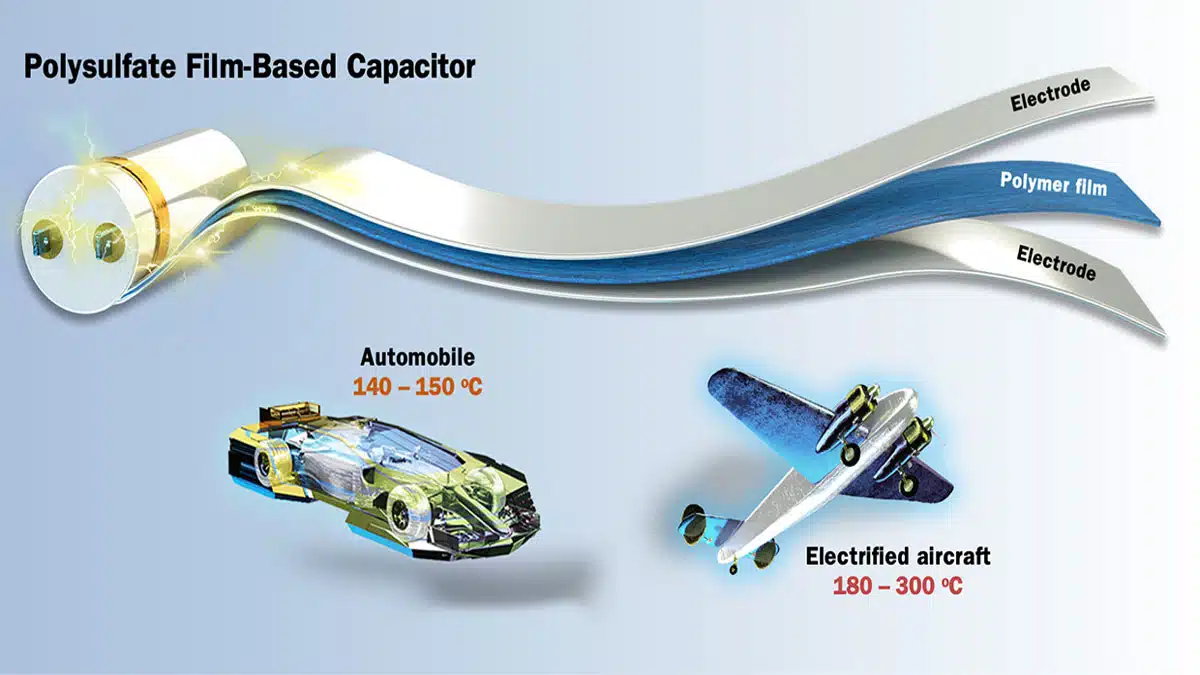
Polysulfates with excellent thermal properties are casted into flexible free-standing films. High-temperature, high-voltage capacitors based on such films show state-of-the-art energy storage properties at 150 degrees Celsius. Such power capacitors are promising for improving the energy efficiency and reliability of integrated power systems in demanding applications such as electrified transportation. (Credit: Yi Liu and He (Henry) Li/Berkeley Lab)

Polysulfates with excellent thermal properties are casted into flexible free-standing films. High-temperature, high-voltage capacitors based on such films show state-of-the-art energy storage properties at 150 degrees Celsius. Such power capacitors are promising for improving the energy efficiency and reliability of integrated power systems in demanding applications such as electrified transportation. (Credit: Yi Liu and He (Henry) Li/Berkeley Lab)

Researchers at the Department of Energy’s Lawrence Berkeley National Laboratory (Berkeley Lab) and Scripps Research have now developed a new polymer-based polysulfate dielectric material ready for film capacitors that efficiently handles record amounts of energy while withstanding extreme temperatures and electric fields.

As reported in article Polysulfates Could Boost Energy Density and Temperature Range of Film Capacitors, the scientists published study on January 18, 2023 in Joule magazine found that the new polysulfates can be used to make polymer film capacitors that store and discharge high density of electrical energy while tolerating heat and electric fields beyond the limits of existing polymer film capacitors.

RelatedPosts

Mechanical Testing of Tantalum Anodes to Predict Tantalum Capacitor Quality

Thermistor Linearization Challenges

Coaxial Connectors and How to Connect with PCB

The device is composed of materials synthesized via a next-generation version of the chemical reaction for which three scientists won the 2022 Nobel Prize in Chemistry.

Polymer film capacitors are electrical components that store and release energy within an electric field using a thin plastic layer as the insulating layer. They make up 50% of the global high voltage capacitor market and offer advantages including light weight, low cost, mechanical flexibility, and robust cyclability. But state-of-the-art polymer film capacitors decrease dramatically in performance with increasing temperature and voltages. Developing new materials with improved tolerance for heat and electric fields is paramount; and creating polymers with near-perfect chemistry offers a way to do so.

“Our work adds a new class of electrically robust polymers to the table. It opens many possibilities to the exploration of more robust, high performing materials,” said Yi Liu, a chemist at Berkeley Lab and senior author on the Joule study reporting the work. Liu is the Facility Director of Organic and Macromolecular Synthesis at the Molecular Foundry, a DOE Office of Science user facility at Berkeley Lab.

In addition to remaining stable when subjected to high temperatures, a capacitor needs to be a strong “dielectric” material, meaning that it remains a strong insulator when subjected to high voltages. However, few known materials systems exist that deliver both thermal stability and dielectric strength. This scarcity is due to a lack of reliable and convenient synthesis methods, as well as a lack of fundamental understanding of the relationship between polymer structure and properties. “Improving the thermal stability of existing films while retaining their electrical insulating strength is an ongoing materials challenge,” said Liu.

A long-term collaboration between researchers at the Molecular Foundry and Scripps Research Institute has now met that challenge. They used a simple and quick chemical reaction developed in 2014 that swaps out fluorine atoms in compounds that contain sulfur-fluoride bonds, to yield long polymer chains of sulfate molecules called polysulfates. This Sulfur-Fluoride Exchange (SuFEx) reaction is a next-generation version of the click chemistry reaction pioneered by K. Barry Sharpless, a chemist at Scripps Research and two-time Nobel laureate in Chemistry, along with Peng Wu, also a chemist at Scripps Research. The near-perfect yet easy-to-run reactions join separate molecular entities through strong chemical bonds that form between different reactive groups. Liu’s team had originally used a variety of thermal analysis tools to examine the basic thermal and mechanical properties of these new materials.

As part of a Berkeley Lab program to synthesize and identify novel materials that could be useful in energy storage, Liu and his colleagues now find that, surprisingly, the polysulfates have outstanding dielectric properties, especially at high electric fields and temperatures. “Several commercial and lab-generated polymers are known for their dielectric properties, but polysulfates had never been considered. The marriage between polysulfates and dielectrics is one of the novelties here,” said He Li, a postdoctoral researcher in the Molecular Foundry and in Berkeley Lab’s Materials Sciences Division, and lead author of the study.

Inspired by the excellent baseline dielectric properties offered by polysulfates, the researchers deposited extremely thin layers of aluminum oxide (Al2O3) onto thin films of the material to engineer capacitor devices with enhanced energy storage performance. They discovered that the fabricated capacitors exhibited excellent mechanical flexibility, withstood electric fields of more than 750 million volts per meter, and performed efficiently at temperatures up to 150 degrees Celsius. In comparison, today’s benchmark commercial polymer capacitors only function reliably at temperatures lower than 120 degrees Celsius. Above that temperature, they can only withstand electric fields smaller than 500 million volts per meter, and the energy efficiency severely drops by over half.

The work opens new possibilities for exploring robust, high performing materials for energy storage. “We have provided deep insight into the underlying mechanisms that contribute to the material’s excellent performance,” said Wu.

The polymer strikes a balance of electrical, thermal, and mechanical properties, likely due to the sulfate linkages introduced by the click chemistry reaction. Because modular chemistry accommodates extraordinary structural diversity and scalability, the same route could offer a viable path to new polymers with higher performance that meet even more demanding operational conditions.

The polysulfates are strong contenders to become new state-of-the-art polymer dielectrics. Once researchers overcome barriers in large-scale manufacturing processes for thin film materials, the devices could greatly improve the energy efficiency of integrated power systems in electric vehicles and enhance their operational reliability.

“Who could have imagined that a wispy sulfate polymer film could fend off lightning and fire, two of the most destructive forces in the universe?!” said Sharpless.

“We’re continuously pushing the envelope of thermal and electrical properties, and accelerating the lab-to-market transition,” Liu added.

The technology is now available for licensing by contacting [email protected].

The work received funding from the Department of Energy’s Office of Science, the National Science Foundation, and the National Institute of Health. The work was carried out at the Molecular Foundry.
Related

Source: Berkeley Lab

Recent Posts

Mechanical Testing of Tantalum Anodes to Predict Tantalum Capacitor Quality

17.12.2025
4

Jianghai Offers Custom Bottom Cooled Screw Aluminum Capacitors

17.12.2025
20

TDK Unveils Vibration-Resistant Hybrid Polymer Aluminum Capacitors

15.12.2025
16

Vishay Releases Automotive Glass Protected 0402 NTC Thermistor

11.12.2025
14

Samsungs Low ESL MLCCs to Power Next-Generation ADAS SoCs

10.12.2025
26

YAGEO Launches Hybrid Polymer Radial Capacitor for High-Reliability Automotive and Power Applications

10.12.2025
29

Industry Smallest Dual-Pole Reed Relay Wins Elektra Awards 2025

10.12.2025
16

Digital Twin of a Tantalum Capacitor Anode: From Powder to Formation

8.12.2025
59

Bourns Introduces High Voltage Gas Discharge Tube

8.12.2025
18

Upcoming Events

Dec 15
December 15 @ 13:00 - December 18 @ 15:15 EST

Pre Cap Visual Inspection per Mil-Std-883 (TM 2017)

Dec 19
12:00 - 14:00 EST

External Visual Inspection per MIL-STD-883 TM 2009

Jan 27
16:00 - 17:00 CET

Simplifying Vehicle Development with Automotive Ethernet and Zonal Smart Switch Technologies

View Calendar

Popular Posts

  • Buck Converter Design and Calculation

    0 shares
    Share 0 Tweet 0
  • Boost Converter Design and Calculation

    0 shares
    Share 0 Tweet 0
  • LLC Resonant Converter Design and Calculation

    0 shares
    Share 0 Tweet 0
  • Flyback Converter Design and Calculation

    0 shares
    Share 0 Tweet 0
  • What Electronics Engineer Needs to Know About Passive Low Pass Filters

    0 shares
    Share 0 Tweet 0
  • Dual Active Bridge (DAB) Topology

    0 shares
    Share 0 Tweet 0
  • Ripple Current and its Effects on the Performance of Capacitors

    3 shares
    Share 3 Tweet 0
  • MLCC and Ceramic Capacitors

    0 shares
    Share 0 Tweet 0
  • What is a Dielectric Constant and DF of Plastic Materials?

    4 shares
    Share 4 Tweet 0
  • SEPIC Converter Design and Calculation

    0 shares
    Share 0 Tweet 0

Newsletter Subscription


Passive Components Blog

© EPCI - Leading Passive Components Educational and Information Site

  • Home
  • Privacy Policy
  • EPCI Membership & Advertisement
  • About

No Result
View All Result
  • Home
  • Knowledge Blog
  • PCNS

© EPCI - Leading Passive Components Educational and Information Site

This website uses cookies. By continuing to use this website you are giving consent to cookies being used. Visit our Privacy and Cookie Policy.
Go to mobile version