








Passive Components Blog
No Result
View All Result
  • Home
  • NewsFilter
    • All
    • Aerospace & Defence
    • Antenna
    • Applications
    • Automotive
    • Capacitors
    • Circuit Protection Devices
    • electro-mechanical news
    • Filters
    • Fuses
    • Inductors
    • Industrial
    • Integrated Passives
    • inter-connect news
    • Market & Supply Chain
    • Market Insights
    • Medical
    • Modelling and Simulation
    • New Materials & Supply
    • New Technologies
    • Non-linear Passives
    • Oscillators
    • Passive Sensors News
    • Resistors
    • RF & Microwave
    • Telecommunication
    • Weekly Digest

    Binder Extends NCC Circular Connectors for Harsh Environments

    Standard vs Planar LLC transformers Comparison for Battery Chargers

    Würth Elektronik and Grinn Launch Edge AI Cooperation

    Bourns Expanded Semi-Shielded Low Profile Automotive Power Inductor

    Peak Nano to Develop Fusion Grade High Energy Film Capacitors

    Murata New Vibration Sensor Targets High‑Frequency Predictive Maintenance

    Kyocera Releases 30fs Jitter Differential Clock Oscillator

    Panasonic Expands Automotive PP Film Capacitors Voltage Range

    Panasonic Extends Automotive Power Inductor Line

    Trending Tags

    • Ripple Current
    • RF
    • Leakage Current
    • Tantalum vs Ceramic
    • Snubber
    • Low ESR
    • Feedthrough
    • Derating
    • Dielectric Constant
    • New Products
    • Market Reports
  • VideoFilter
    • All
    • Antenna videos
    • Capacitor videos
    • Circuit Protection Video
    • Filter videos
    • Fuse videos
    • Inductor videos
    • Inter-Connect Video
    • Non-linear passives videos
    • Oscillator videos
    • Passive sensors videos
    • Resistor videos

    Standard vs Planar LLC transformers Comparison for Battery Chargers

    How Modern Tools Model Magnetic Components for Power Electronics

    Advanced Loss Modeling for Planar Magnetics in the Frenetic Planar Tool

    2026 Power Magnetics Design Trends: Flyback, DAB and Planar

    Enabling Software‑Defined Vehicle Architectures: Automotive Ethernet and Zonal Smart Power

    Calculating Resistance Value of a Flyback RC Snubber 

    One‑Pulse Characterization of Nonlinear Power Inductors

    Thermistor Linearization Challenges

    Coaxial Connectors and How to Connect with PCB

    Trending Tags

    • Capacitors explained
    • Inductors explained
    • Resistors explained
    • Filters explained
    • Application Video Guidelines
    • EMC
    • New Products
    • Ripple Current
    • Simulation
    • Tantalum vs Ceramic
  • Knowledge Blog
  • DossiersNew
  • Suppliers
    • Who is Who
  • PCNS
    • PCNS 2025
    • PCNS 2023
    • PCNS 2021
    • PCNS 2019
    • PCNS 2017
  • Events
  • Home
  • NewsFilter
    • All
    • Aerospace & Defence
    • Antenna
    • Applications
    • Automotive
    • Capacitors
    • Circuit Protection Devices
    • electro-mechanical news
    • Filters
    • Fuses
    • Inductors
    • Industrial
    • Integrated Passives
    • inter-connect news
    • Market & Supply Chain
    • Market Insights
    • Medical
    • Modelling and Simulation
    • New Materials & Supply
    • New Technologies
    • Non-linear Passives
    • Oscillators
    • Passive Sensors News
    • Resistors
    • RF & Microwave
    • Telecommunication
    • Weekly Digest

    Binder Extends NCC Circular Connectors for Harsh Environments

    Standard vs Planar LLC transformers Comparison for Battery Chargers

    Würth Elektronik and Grinn Launch Edge AI Cooperation

    Bourns Expanded Semi-Shielded Low Profile Automotive Power Inductor

    Peak Nano to Develop Fusion Grade High Energy Film Capacitors

    Murata New Vibration Sensor Targets High‑Frequency Predictive Maintenance

    Kyocera Releases 30fs Jitter Differential Clock Oscillator

    Panasonic Expands Automotive PP Film Capacitors Voltage Range

    Panasonic Extends Automotive Power Inductor Line

    Trending Tags

    • Ripple Current
    • RF
    • Leakage Current
    • Tantalum vs Ceramic
    • Snubber
    • Low ESR
    • Feedthrough
    • Derating
    • Dielectric Constant
    • New Products
    • Market Reports
  • VideoFilter
    • All
    • Antenna videos
    • Capacitor videos
    • Circuit Protection Video
    • Filter videos
    • Fuse videos
    • Inductor videos
    • Inter-Connect Video
    • Non-linear passives videos
    • Oscillator videos
    • Passive sensors videos
    • Resistor videos

    Standard vs Planar LLC transformers Comparison for Battery Chargers

    How Modern Tools Model Magnetic Components for Power Electronics

    Advanced Loss Modeling for Planar Magnetics in the Frenetic Planar Tool

    2026 Power Magnetics Design Trends: Flyback, DAB and Planar

    Enabling Software‑Defined Vehicle Architectures: Automotive Ethernet and Zonal Smart Power

    Calculating Resistance Value of a Flyback RC Snubber 

    One‑Pulse Characterization of Nonlinear Power Inductors

    Thermistor Linearization Challenges

    Coaxial Connectors and How to Connect with PCB

    Trending Tags

    • Capacitors explained
    • Inductors explained
    • Resistors explained
    • Filters explained
    • Application Video Guidelines
    • EMC
    • New Products
    • Ripple Current
    • Simulation
    • Tantalum vs Ceramic
  • Knowledge Blog
  • DossiersNew
  • Suppliers
    • Who is Who
  • PCNS
    • PCNS 2025
    • PCNS 2023
    • PCNS 2021
    • PCNS 2019
    • PCNS 2017
  • Events
No Result
View All Result
Passive Components Blog
No Result
View All Result

Researchers Developed Ti/Si/C Composite for High-Performance Zinc-ion Hybrid Supercapacitor

20.7.2023
Reading Time: 4 mins read
A A

Researchers from West Pomeranian University of Technology in Szczecin, Poland published paper “Core/shell structured Ti/Si/C composite for high-performance zinc-ion hybrid supercapacitor” in Journal of Alloys and Compounds.

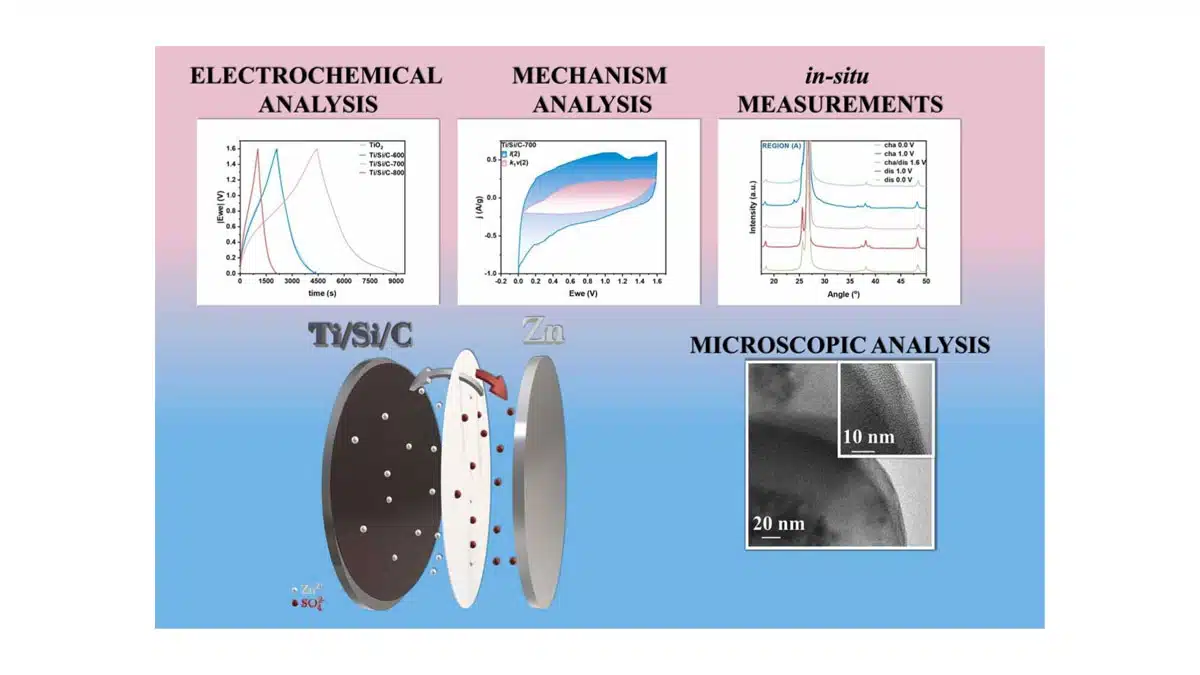
In this study, novel nanocomposites with a core/shell structure based on titania/silica/carbon nanoparticles (Ti/Si/C) were fabricated using a solvothermal method and subsequent carbonization. The resulting material showed superior activity in a hybrid energy storage system using a zinc-ion supercapacitor as a model device. The TiO2 nanoparticles served as the core of the composite, providing a high surface area for electrochemical reactions, enhancing electrical conductivity.

RelatedPosts

Binder Extends NCC Circular Connectors for Harsh Environments

Standard vs Planar LLC transformers Comparison for Battery Chargers

Würth Elektronik and Grinn Launch Edge AI Cooperation

Abstract

Zinc-ion capacitors (ZnIC) have focused great attention due to high intrinsic safety and their advantages in terms of environmental protection and price. However, the increase in energy and power densities still remains a challenge.

Therefore, this study aims to design and fabricate novel low-cost and environmentally-friendly nanocomposite based on titania/silica/carbon used as cathode in ZnIC. The fabrication procedure involves the functionalization of TiO2 nanoparticles with APTES and glucose, followed by a hydrothermal reaction and carbonization at 600, 700, and 800 °C (Ti/Si/C-Tx, where Tx is the temperature of carbonization) to result in carbon-coated titania/silica with a core/shell architecture. In-situ Raman and X-Ray Diffractometry (XRD) analyses were conducted to elucidate the electrochemical behaviour of the material during charge-discharge cycles.

The nanocomposites were electrochemically tested using cyclic voltammetry (CV), galvanostatic cycling with potential limitation (GCPL), and potentio electrochemical impedance spectroscopy (PEIS). The designed nanocomposite showed improved performance in terms of specific capacity, power, and energy densities with values of 295 F/g, 160 W/kg, and 210 Wh/kg, respectively.

Ti/Si/C-700 also demonstrated a high stability retention of 85% after 10′000 cycles, indicating its potential for use in energy storage devices. Despite these promising results, further research is required to improve capacity retention at increased current densities. The key implication of this study is the potential for the development of low-cost and high-performance energy storage devices for various applications, contributing to the growth of renewable energy sources.

Introduction

Currently, one of the most promising energy storage technology, which can fill the gap between supercapacitors and batteries, is based on an electrochemical device called Zinc-ion supercapacitors (ZnIC). The mechanism includes simultaneous adsorption-desorption of ions on one electrode and zinc-ion covering/fracturing on the second Zn electrode.

Here, the storage mechanism is based on porous carbon storage via the double-layer capacitance, due to the Faradaic behaviour of the Zn electrode that exhibits flat charge/discharge plateaus. Theoretically, a porous carbon with a specific surface area (SSA) in the range between 1000 and 3000 m2/g can reach a capacitance of 300–500 F/g. In practice, they reach only 100–250 F/g.

Nonetheless, there are still challenges with ZnIC, and their primary drawback is the specific capacity and kinetic imbalance between the electrodes due to the different energy storage mechanisms of capacitor-type and battery-type electrodes. To overcome this obstacle we designed a fabrication of a new carbon/titania/silica-based composite, which served as a promising cathode in ZnIC.

Our approach induces an increase in the electrochemically available active surface areas (through porous carbon) and induces pseudocapacitance due to the presence of SiO2 and TiO2. To the best of our knowledge, this particular approach has never been studied before but the potential of silica and titania-based compounds in supercapacitors has been addressed.

Here, we address the issues using a facile fabrication route of a three-component molecular hybrid composed of a core/shell structure based on TiO2 nanoparticles coated by silica and graphitic shell (Ti/Si/C). The designed material was tested in ZnIC using carbon-based EDLC as positive electrodes and zinc foil as negative electrodes in ZnSO4·7 H2O electrolyte.

The encapsulation of TiO2/SiO2 in carbon spheres provided room to gather the charge near the TiO2 particles (surface storage), and modification with Si species improved device capacity. The approach allowed for overcoming the limitation of low performance observed in TiO2-based electrodes for energy storage. The method involves the synthesis of ultrasmall particles from a semiconductor core.

These particles are prevented from agglomerating through silica and carbon coatings. This design induces more active sites during the energy storage process. Furthermore, this strategy resulted in a composite fabrication with remarkable electrochemical properties, such as a high capacity of 295 F/g (at 0.1 A/g). This is one of the highest in the current state of the art.

Furthermore, the analysis of EDLC and pseudocapacitance contributions revealed a cooperative effect between diffusion-controlled and surface capacitance-controlled mechanisms, with surface capacitance being the dominant mechanism. In addition, the electrochemical behaviour of the material was further elucidated through in-situ Raman and XRD analyses during the charge-discharge process.

The results shed light on the underlying electrochemical behaviour of the material behind its improved performance. Thus, the material can deliver energy at a huge speed, with the possibility to repeat the cycles of charging and delivering energy for at least thousands of repetitions. The facile synthesis route, outstanding electrochemical performance, and in-situ analysis make this work highly significant for the development of high-performance energy storage materials.

Read more in reference: https://doi.org/10.1016/j.jallcom.2023.171259
Related

Recent Posts

Peak Nano to Develop Fusion Grade High Energy Film Capacitors

11.3.2026
24

Panasonic Expands Automotive PP Film Capacitors Voltage Range

9.3.2026
22

February 2026 Interconnect, Passives and Electromechanical Components Market Insights

9.3.2026
50

Empower Extends Embedded Silicon Capacitors for AI

6.3.2026
42

AI Servers Demand is Driving Tantalum Capacitor Price Hikes

5.3.2026
112

DMASS Reports Europe Components Up 9.8% in Q4 2025

3.3.2026
23

Mastering Galvanic Isolation in Power Electronics: Methods, Standards, and Implementation

2.3.2026
68

VINATech Targets AI Data Center Supercapacitor Boom

26.2.2026
73

TDK Introduces 350V Safety Film Capacitors for Compact EMI Suppression

26.2.2026
43

Upcoming Events

Mar 19
13:00 - 14:00 CDT

Smart Consideration of Inductor Thermal Performance

Mar 21
All day

PSMA Capacitor Workshop 2026

Apr 21
16:00 - 17:00 CEST

Heatsink Solutions: Thermal Management in electronic devices

View Calendar

Popular Posts

  • Buck Converter Design and Calculation

    0 shares
    Share 0 Tweet 0
  • Boost Converter Design and Calculation

    0 shares
    Share 0 Tweet 0
  • Flyback Converter Design and Calculation

    0 shares
    Share 0 Tweet 0
  • LLC Resonant Converter Design and Calculation

    0 shares
    Share 0 Tweet 0
  • MLCC Manufacturers Consider Price Increase as AI Demand Outpaces Supply

    0 shares
    Share 0 Tweet 0
  • Dual Active Bridge (DAB) Topology

    0 shares
    Share 0 Tweet 0
  • Ripple Current and its Effects on the Performance of Capacitors

    3 shares
    Share 3 Tweet 0
  • MLCC and Ceramic Capacitors

    0 shares
    Share 0 Tweet 0
  • MLCC Case Sizes Standards Explained

    0 shares
    Share 0 Tweet 0
  • What is a Dielectric Constant and DF of Plastic Materials?

    4 shares
    Share 4 Tweet 0

Newsletter Subscription


Passive Components Blog

© EPCI - Leading Passive Components Educational and Information Site

  • Home
  • Privacy Policy
  • EPCI Membership & Advertisement
  • About

No Result
View All Result
  • Home
  • Knowledge Blog
  • PCNS

© EPCI - Leading Passive Components Educational and Information Site

This website uses cookies. By continuing to use this website you are giving consent to cookies being used. Visit our Privacy and Cookie Policy.
Go to mobile version