





Passive Components Blog
No Result
View All Result
  • Home
  • NewsFilter
    • All
    • Aerospace & Defence
    • Antenna
    • Applications
    • Automotive
    • Capacitors
    • Circuit Protection Devices
    • electro-mechanical news
    • Filters
    • Fuses
    • Inductors
    • Industrial
    • Integrated Passives
    • inter-connect news
    • Market & Supply Chain
    • Market Insights
    • Medical
    • Modelling and Simulation
    • New Materials & Supply
    • New Technologies
    • Non-linear Passives
    • Oscillators
    • Passive Sensors News
    • Resistors
    • RF & Microwave
    • Telecommunication
    • Weekly Digest

    Vishay Releases Compact 0806 Low‑DCR Power Inductor

    Murata Opens New Ceramic Capacitor Manufacturing and R&D Center in Japan

    Murata Publishes Power Delivery Guide for AI Servers

    Selecting Current Sense Transformers with Würth Elektronik REDEXPERT

    Mechanical Drift Indicator of Tantalum Capacitor Anodes Degradation under Reverse Bias

    Enabling Software‑Defined Vehicle Architectures: Automotive Ethernet and Zonal Smart Power

    Calculating Resistance Value of a Flyback RC Snubber 

    Wk 5 Electronics Supply Chain Digest

    Top 10 Connector Vendors by Product Type

    Trending Tags

    • Ripple Current
    • RF
    • Leakage Current
    • Tantalum vs Ceramic
    • Snubber
    • Low ESR
    • Feedthrough
    • Derating
    • Dielectric Constant
    • New Products
    • Market Reports
  • VideoFilter
    • All
    • Antenna videos
    • Capacitor videos
    • Circuit Protection Video
    • Filter videos
    • Fuse videos
    • Inductor videos
    • Inter-Connect Video
    • Non-linear passives videos
    • Oscillator videos
    • Passive sensors videos
    • Resistor videos

    Enabling Software‑Defined Vehicle Architectures: Automotive Ethernet and Zonal Smart Power

    Calculating Resistance Value of a Flyback RC Snubber 

    One‑Pulse Characterization of Nonlinear Power Inductors

    Thermistor Linearization Challenges

    Coaxial Connectors and How to Connect with PCB

    PCB Manufacturing, Test Methods, Quality and Reliability

    Transformer Behavior – Current Transfer and Hidden Feedback

    Choosing the Right Capacitor: The Importance of Accurate Measurements

    RF Inductors: Selection and Design Challenges for High-Frequency Circuits

    Trending Tags

    • Capacitors explained
    • Inductors explained
    • Resistors explained
    • Filters explained
    • Application Video Guidelines
    • EMC
    • New Products
    • Ripple Current
    • Simulation
    • Tantalum vs Ceramic
  • Knowledge Blog
  • DossiersNew
  • Suppliers
    • Who is Who
  • PCNS
    • PCNS 2025
    • PCNS 2023
    • PCNS 2021
    • PCNS 2019
    • PCNS 2017
  • Events
  • Home
  • NewsFilter
    • All
    • Aerospace & Defence
    • Antenna
    • Applications
    • Automotive
    • Capacitors
    • Circuit Protection Devices
    • electro-mechanical news
    • Filters
    • Fuses
    • Inductors
    • Industrial
    • Integrated Passives
    • inter-connect news
    • Market & Supply Chain
    • Market Insights
    • Medical
    • Modelling and Simulation
    • New Materials & Supply
    • New Technologies
    • Non-linear Passives
    • Oscillators
    • Passive Sensors News
    • Resistors
    • RF & Microwave
    • Telecommunication
    • Weekly Digest

    Vishay Releases Compact 0806 Low‑DCR Power Inductor

    Murata Opens New Ceramic Capacitor Manufacturing and R&D Center in Japan

    Murata Publishes Power Delivery Guide for AI Servers

    Selecting Current Sense Transformers with Würth Elektronik REDEXPERT

    Mechanical Drift Indicator of Tantalum Capacitor Anodes Degradation under Reverse Bias

    Enabling Software‑Defined Vehicle Architectures: Automotive Ethernet and Zonal Smart Power

    Calculating Resistance Value of a Flyback RC Snubber 

    Wk 5 Electronics Supply Chain Digest

    Top 10 Connector Vendors by Product Type

    Trending Tags

    • Ripple Current
    • RF
    • Leakage Current
    • Tantalum vs Ceramic
    • Snubber
    • Low ESR
    • Feedthrough
    • Derating
    • Dielectric Constant
    • New Products
    • Market Reports
  • VideoFilter
    • All
    • Antenna videos
    • Capacitor videos
    • Circuit Protection Video
    • Filter videos
    • Fuse videos
    • Inductor videos
    • Inter-Connect Video
    • Non-linear passives videos
    • Oscillator videos
    • Passive sensors videos
    • Resistor videos

    Enabling Software‑Defined Vehicle Architectures: Automotive Ethernet and Zonal Smart Power

    Calculating Resistance Value of a Flyback RC Snubber 

    One‑Pulse Characterization of Nonlinear Power Inductors

    Thermistor Linearization Challenges

    Coaxial Connectors and How to Connect with PCB

    PCB Manufacturing, Test Methods, Quality and Reliability

    Transformer Behavior – Current Transfer and Hidden Feedback

    Choosing the Right Capacitor: The Importance of Accurate Measurements

    RF Inductors: Selection and Design Challenges for High-Frequency Circuits

    Trending Tags

    • Capacitors explained
    • Inductors explained
    • Resistors explained
    • Filters explained
    • Application Video Guidelines
    • EMC
    • New Products
    • Ripple Current
    • Simulation
    • Tantalum vs Ceramic
  • Knowledge Blog
  • DossiersNew
  • Suppliers
    • Who is Who
  • PCNS
    • PCNS 2025
    • PCNS 2023
    • PCNS 2021
    • PCNS 2019
    • PCNS 2017
  • Events
No Result
View All Result
Passive Components Blog
No Result
View All Result

Samsung Electro-Mechanics Releases Worlds First 10uF 10V X7T 0603 Automotive MLCC

12.12.2024
Reading Time: 3 mins read
A A

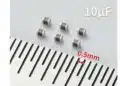
Samsung Electro-Mechanics is releasing CL10Z106MP96PN# MLCC capacitors, which implement a capacitance of 10uF at a rated voltage of 10V in a 0603 inch (1.6×0.8mm) size and X7T specifications (temperature range: -55 to 125C) ideal for automotive ADAS ECU applications.

This World’s first MLCC capacitor in its size and features is now in mass production. Samples are now available upon request.

RelatedPosts

Samsung Q4 2025 Results: MLCC focus for AI, Server and Automotive

Samsung Unveils World First CLLC Resonant 1kV 33nF C0G MLCC in 1210 Size

Samsung MLCC Replacing Aluminum Polymer Capacitors in AI Systems

As the trend toward high integration, high density, and miniaturization of ADAS Radar, LiDAR, HPC, IVI communication (WiFi/BT/5G/NAD) modules and SiP modules continues to spread, the demand for miniaturization of multilayer ceramic capacitors (MLCCs) has also been increasing.

This new product maintains the same capacitance and rated voltage as the existing 0805 inch (2.0×1.25mm) product, while reducing the size to 0603 inch (1.6×0.8mm). In doing so, it simultaneously meets the requirements for miniaturization, high capacitance design, high-temperature (125℃) stability, and voltage reliability for the given application.

Samsung Electro-Mechanics has strategically expanded its product coverage to include the 0603 inch (1.6×0.8mm) size, rated at 10V and 10μF, by leveraging proprietary advancements in the miniaturization of ceramic and electrode materials, coupled with ultra-precise stacking technology.

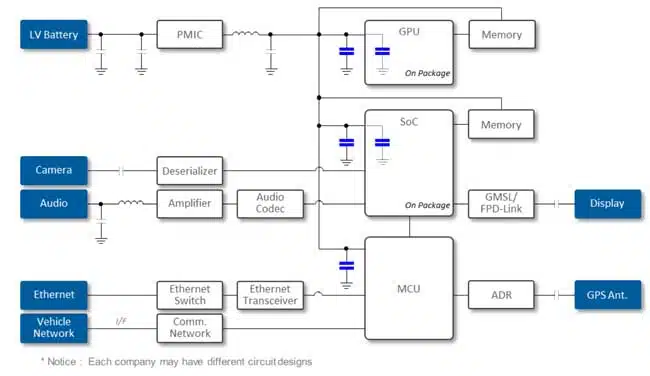
Application Example: ADAS (Advanced Driver Assistance System) ECU

The ongoing advancements in the performance of SoC/GPU semiconductor ICs utilized in ADAS ECUs have resulted in escalating demands for (ultra) high-capacitance and high-temperature products. Concurrently, the necessity for miniaturization has intensified to address the constraints posed by limited mounting space around ICs.  The Samsung Electro-Mechanics X7* high-capacitance MLCCs, suitable for this application, ensure exceptional reliability even under high-temperature conditions.

Furthermore, we are committed to the continuous expansion and supply of our MLCC lineup, including sizes smaller than 0603 inch, to meet the diverse needs of our customers.
MLCC Trend : High Capacitance, High Temperature

  • Miniaturization

High Reliability

 → Recommendation : X7* PN Series 

Size(inch/mm)Rated Voltage[Vdc]TCCCapacitancePart Number MPStatusSampleAvailability
0402/100510X7S2.2㎌CL05Y225KP66PN#NEWAvailable
0603/160810X7T10㎌CL10Z106MP96PN#NEWAvailable
0805/201210X7R10㎌CL21B106KPY6PN#In MPAvailable
1206/321610X7R22㎌CL31B226KPK6PN#In MPAvailable
1210/322510X7S47㎌CL32Y476KPVVPN#In MP​Available

Related

Source: Samsung Electro-Mechanics

Recent Posts

Murata Opens New Ceramic Capacitor Manufacturing and R&D Center in Japan

5.2.2026
5

Murata Publishes Power Delivery Guide for AI Servers

4.2.2026
31

Mechanical Drift Indicator of Tantalum Capacitor Anodes Degradation under Reverse Bias

3.2.2026
18

Enabling Software‑Defined Vehicle Architectures: Automotive Ethernet and Zonal Smart Power

2.2.2026
19

CMSE 2026 Announces Call for Presentations on High-Reliability Military and Space Electronics

28.1.2026
47

ESA Call for Papers 6th Space Passive Component Days – SPCD 2026

28.1.2026
42

Samsung Q4 2025 Results: MLCC focus for AI, Server and Automotive

26.1.2026
102

Capacitor Technology Dossier

26.1.2026
140

ROHM Extends 2012 Shunt Resistors Power Rating up to 1.25 W

23.1.2026
30

Upcoming Events

Feb 24
16:00 - 17:00 CET

Designing Qi2 Wireless Power Systems: Practical Development and EMC Optimization

Mar 3
16:00 - 17:00 CET

Cybersecurity at the Eleventh Hour – from RED to CRA – Information and Discussion

Mar 21
All day

PSMA Capacitor Workshop 2026

View Calendar

Popular Posts

  • Buck Converter Design and Calculation

    0 shares
    Share 0 Tweet 0
  • Boost Converter Design and Calculation

    0 shares
    Share 0 Tweet 0
  • LLC Resonant Converter Design and Calculation

    0 shares
    Share 0 Tweet 0
  • Flyback Converter Design and Calculation

    0 shares
    Share 0 Tweet 0
  • Ripple Current and its Effects on the Performance of Capacitors

    3 shares
    Share 3 Tweet 0
  • How Metal Prices Are Driving Passive Component Price Hikes

    0 shares
    Share 0 Tweet 0
  • MLCC and Ceramic Capacitors

    0 shares
    Share 0 Tweet 0
  • Dual Active Bridge (DAB) Topology

    0 shares
    Share 0 Tweet 0
  • What is a Dielectric Constant and DF of Plastic Materials?

    4 shares
    Share 4 Tweet 0
  • Degradation of Capacitors and its Failure Mechanisms

    0 shares
    Share 0 Tweet 0

Newsletter Subscription


Passive Components Blog

© EPCI - Leading Passive Components Educational and Information Site

  • Home
  • Privacy Policy
  • EPCI Membership & Advertisement
  • About

No Result
View All Result
  • Home
  • Knowledge Blog
  • PCNS

© EPCI - Leading Passive Components Educational and Information Site

This website uses cookies. By continuing to use this website you are giving consent to cookies being used. Visit our Privacy and Cookie Policy.
Go to mobile version