




Passive Components Blog
No Result
View All Result
  • Home
  • NewsFilter
    • All
    • Aerospace & Defence
    • Antenna
    • Applications
    • Automotive
    • Capacitors
    • Circuit Protection Devices
    • electro-mechanical news
    • Filters
    • Fuses
    • Inductors
    • Industrial
    • Integrated Passives
    • inter-connect news
    • Market & Supply Chain
    • Market Insights
    • Medical
    • Modelling and Simulation
    • New Materials & Supply
    • New Technologies
    • Non-linear Passives
    • Oscillators
    • Passive Sensors News
    • Resistors
    • RF & Microwave
    • Telecommunication
    • Weekly Digest

    Samsung Introduced Low ESL 3-Terminal Reverse-Geometry MLCCs for High-Performance ADAS

    Würth Elektronik Presents New Bidirectional Digital Isolators

    Using Stress–Strain Curves to Diagnose Tantalum Powders for Capacitors

    Coilcraft Introduces SMT Current Sense Transformers for High‑Performance Power Electronics

    Samsung Launches Ultra-Compact 008004 High Q MLCC for Next-Generation RF Applications

    Nichicon Extends Rechargeable Batteries Temperature to Rival Supercapacitors

    Two‑capacitor paradox explained for engineers

    YAGEO Releases Compact RJ45 Connector for Multi‑Gigabit Ethernet

    Circuit Protection Technology Annual Dossier

    Trending Tags

    • Ripple Current
    • RF
    • Leakage Current
    • Tantalum vs Ceramic
    • Snubber
    • Low ESR
    • Feedthrough
    • Derating
    • Dielectric Constant
    • New Products
    • Market Reports
  • VideoFilter
    • All
    • Antenna videos
    • Capacitor videos
    • Circuit Protection Video
    • Filter videos
    • Fuse videos
    • Inductor videos
    • Inter-Connect Video
    • Non-linear passives videos
    • Oscillator videos
    • Passive sensors videos
    • Resistor videos

    Two‑capacitor paradox explained for engineers

    Capacitances of Nonlinear MLCCs: What Datasheets Don’t Tell You

    Tapped Inductor Buck Converter Fundamentals

    Planar vs Conventional Transformer: When it Make Sense

    Modeling Fringing Field Losses in Inductors & Transformers

    Why Power Inductors Use a Ferrite Core With an Air Gap

    Transformer-Based Power-Line Harvester Magnetic Design

    Thermal Modeling of Magnetics

    Standard vs Planar LLC transformers Comparison for Battery Chargers

    Trending Tags

    • Capacitors explained
    • Inductors explained
    • Resistors explained
    • Filters explained
    • Application Video Guidelines
    • EMC
    • New Products
    • Ripple Current
    • Simulation
    • Tantalum vs Ceramic
  • Knowledge Blog
  • DossiersNew
  • Suppliers
    • Who is Who
  • PCNS
    • PCNS 2025
    • PCNS 2023
    • PCNS 2021
    • PCNS 2019
    • PCNS 2017
  • Events
  • Home
  • NewsFilter
    • All
    • Aerospace & Defence
    • Antenna
    • Applications
    • Automotive
    • Capacitors
    • Circuit Protection Devices
    • electro-mechanical news
    • Filters
    • Fuses
    • Inductors
    • Industrial
    • Integrated Passives
    • inter-connect news
    • Market & Supply Chain
    • Market Insights
    • Medical
    • Modelling and Simulation
    • New Materials & Supply
    • New Technologies
    • Non-linear Passives
    • Oscillators
    • Passive Sensors News
    • Resistors
    • RF & Microwave
    • Telecommunication
    • Weekly Digest

    Samsung Introduced Low ESL 3-Terminal Reverse-Geometry MLCCs for High-Performance ADAS

    Würth Elektronik Presents New Bidirectional Digital Isolators

    Using Stress–Strain Curves to Diagnose Tantalum Powders for Capacitors

    Coilcraft Introduces SMT Current Sense Transformers for High‑Performance Power Electronics

    Samsung Launches Ultra-Compact 008004 High Q MLCC for Next-Generation RF Applications

    Nichicon Extends Rechargeable Batteries Temperature to Rival Supercapacitors

    Two‑capacitor paradox explained for engineers

    YAGEO Releases Compact RJ45 Connector for Multi‑Gigabit Ethernet

    Circuit Protection Technology Annual Dossier

    Trending Tags

    • Ripple Current
    • RF
    • Leakage Current
    • Tantalum vs Ceramic
    • Snubber
    • Low ESR
    • Feedthrough
    • Derating
    • Dielectric Constant
    • New Products
    • Market Reports
  • VideoFilter
    • All
    • Antenna videos
    • Capacitor videos
    • Circuit Protection Video
    • Filter videos
    • Fuse videos
    • Inductor videos
    • Inter-Connect Video
    • Non-linear passives videos
    • Oscillator videos
    • Passive sensors videos
    • Resistor videos

    Two‑capacitor paradox explained for engineers

    Capacitances of Nonlinear MLCCs: What Datasheets Don’t Tell You

    Tapped Inductor Buck Converter Fundamentals

    Planar vs Conventional Transformer: When it Make Sense

    Modeling Fringing Field Losses in Inductors & Transformers

    Why Power Inductors Use a Ferrite Core With an Air Gap

    Transformer-Based Power-Line Harvester Magnetic Design

    Thermal Modeling of Magnetics

    Standard vs Planar LLC transformers Comparison for Battery Chargers

    Trending Tags

    • Capacitors explained
    • Inductors explained
    • Resistors explained
    • Filters explained
    • Application Video Guidelines
    • EMC
    • New Products
    • Ripple Current
    • Simulation
    • Tantalum vs Ceramic
  • Knowledge Blog
  • DossiersNew
  • Suppliers
    • Who is Who
  • PCNS
    • PCNS 2025
    • PCNS 2023
    • PCNS 2021
    • PCNS 2019
    • PCNS 2017
  • Events
No Result
View All Result
Passive Components Blog
No Result
View All Result

Samsung Electro-Mechanics Unveils Ultra-High-Capacitance MLCCs for AI Servers

26.9.2025
Reading Time: 3 mins read
A A

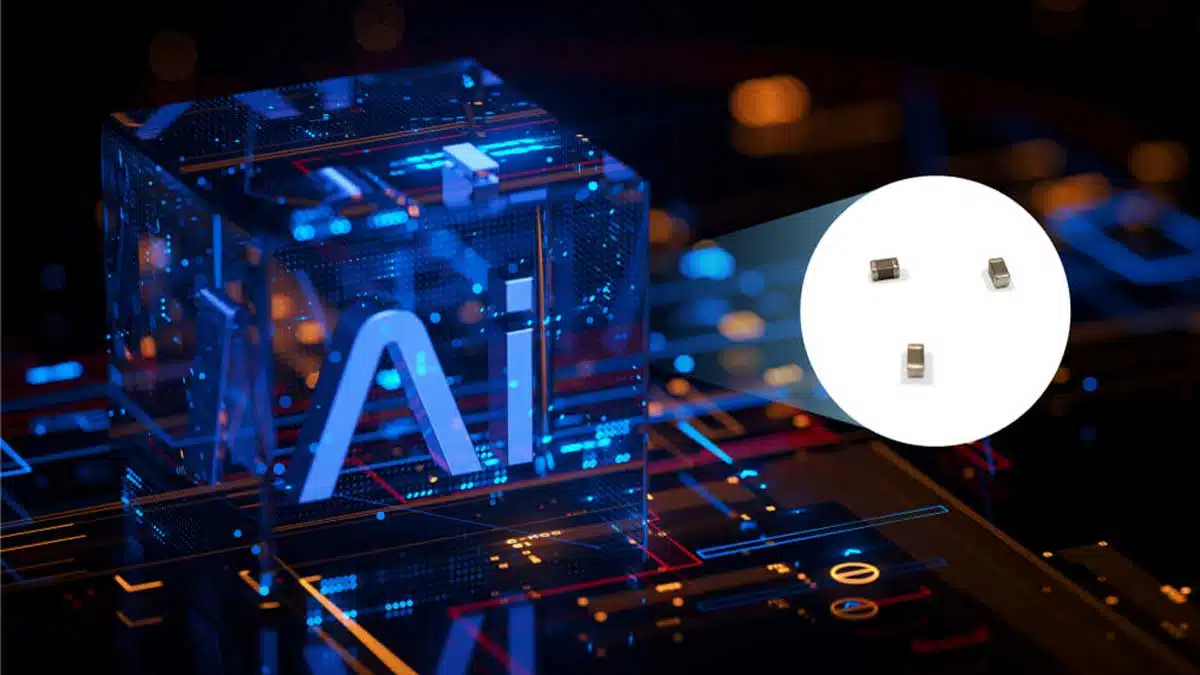
Samsung Electro-Mechanics is proud to announce the launch of its latest ultra-high-capacitance MLCCs ceramic capacitors CL31X227MRKNNW# (1206 inch, 220 µF, 4Vdc, X6S) and CL32X337MSVN4S# (1210 inch, 330 µF, 2.5 Vdc, X6S), designed to meet the demanding requirements of AI servers and data centers.

These advanced components are essential for high-performance computing and high-speed communications, crucial for processing and analyzing vast amounts of data.

RelatedPosts

Samsung Introduced Low ESL 3-Terminal Reverse-Geometry MLCCs for High-Performance ADAS

Samsung Launches Ultra-Compact 008004 High Q MLCC for Next-Generation RF Applications

Samsung Introduces Ultra-High-Voltage 1500 V MLCCs for xEV Powertrains

AI servers and data centers require high-performance computing and high-speed communications in order to process and analyze large volumes of data. Under these circumstances, numerous high-performance ICs (CPU, GPU, ASIC, etc.) are applied.

This leads to heat dissipation, which causes large current transients during intensive computation. Ultra-high-capacitance MLCCs are suitable as decoupling capacitors for high-frequency noises and responding to peak current demands.

The new MLCCs, including the CL31X227MRKNNW# (1206 inch, 220 µF, 4Vdc, X6S) and CL32X337MSVN4S# (1210 inch, 330 µF, 2.5 Vdc, X6S), are specifically engineered to decouple high-frequency noises and efficiently respond to peak current demands during intensive computation. This innovation is vital for managing heat dissipation and large current transients in AI server applications.

Application of High-Temperature / Ultra-High-Capacitance MLCCs, CPO Switch (Co-Packaged Optics Switch)
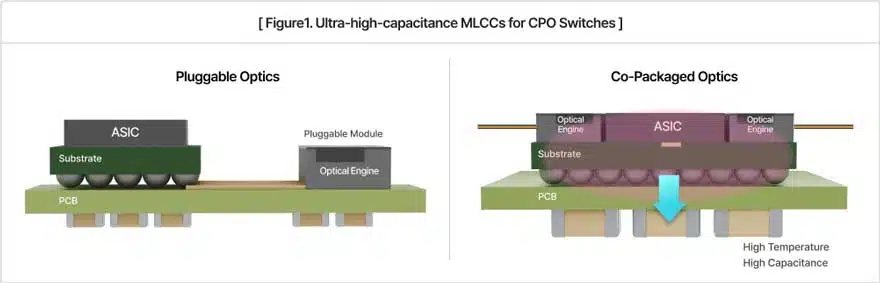
In addition to their application in AI servers, these ultra-high-capacitance MLCCs are also suitable for use in Co-Packaged Optics (CPO) Switches. CPO Switches, which integrate optical components and network switch chips into a single package, enable ultra-high-speed data transmission in data centers and high-performance computing environments.

The increased temperature and power consumption from optical engines necessitate the use of ultra-high-capacitance, high-temperature MLCCs of X7 or higher. Samsung Electro-Mechanics recommends the CL32X337MSVN4S#, CL31X227MRKNNW#, CL32Z227MSVN4S#, and CL31Z107MRKN4N# for these applications.

Application Proposal: Thickness-Constrained PCIe Card / OAM Socket, 220 µF Ultra-High-Capacitance MLCCs​

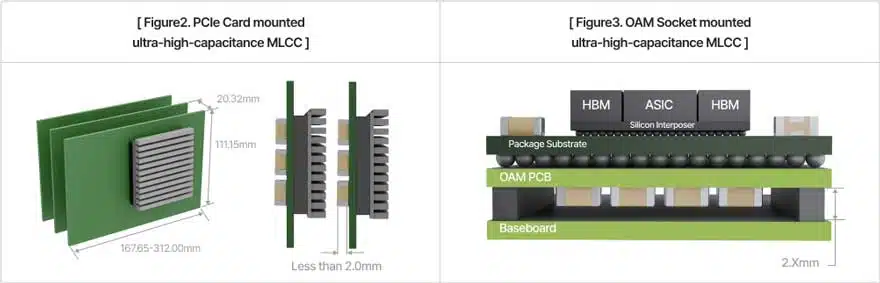
A PCIe Card (Peripheral Component Interconnect Express Card) supports high-speed data transfer for the fast transmission of large-volumes of data. Graphics cards, storage devices, network adapters, AI accelerators and other components require high-power and high-speed data handling. To ensure power stability, multiple high-capacitance MLCCs are demanded.​

When multiple PCIe cards are installed within an AI server (refer to Figure 2), space constraints and thermal considerations make thickness-limited ultra-high-capacitance MLCCs desirable. We propose ultra-high-capacitance MLCCs (thickness ≤ 2.0mm), such as CL31X227MRKNNW# and CL31A227MQKNNW#.​

OAM Socket (Open-Compute-Project Accelerator Module Socket) is an interface designed for high-performance modules including GPUs for AI/ML workloads or custom ASICs. Using a custom ASIC in an Accelerator Module enables optimization of performance-per-watt and the removal of unnecessary circuitry to place memory closer. However, custom ASICs contain a large number of switching circuits that generate rapid transient currents. To handle such sudden current changes, high-capacitance MLCCs are required. They also serve to decouple, remove high-frequency noise and stabilize voltage.

As shown in Figure 3, numerous ultra-high-capacitance MLCCs can be mounted on the OAM PCB Land Side — e.g., CL31X227MRKNNW# (1206 inch / 1.9 t, 220 µF, 4 Vdc, X6S) and CL31A227MQKNNW# (1206 inch / 1.9 t, 220 µF, 6.3 Vdc, X5R) — contributing to improved space efficiency.​

Samsung Electro-Mechanics continues to lead the industry in providing cutting-edge solutions that enhance the performance and reliability of AI servers and data centers. For more information, please contact:

Related

Source: Samsung Electro-Mechanics

Recent Posts

Samsung Introduced Low ESL 3-Terminal Reverse-Geometry MLCCs for High-Performance ADAS

20.5.2026
11

Würth Elektronik Presents New Bidirectional Digital Isolators

20.5.2026
9

Using Stress–Strain Curves to Diagnose Tantalum Powders for Capacitors

20.5.2026
13

Coilcraft Introduces SMT Current Sense Transformers for High‑Performance Power Electronics

20.5.2026
9

Samsung Launches Ultra-Compact 008004 High Q MLCC for Next-Generation RF Applications

20.5.2026
7

Nichicon Extends Rechargeable Batteries Temperature to Rival Supercapacitors

19.5.2026
22

Two‑capacitor paradox explained for engineers

18.5.2026
47

YAGEO Releases Compact RJ45 Connector for Multi‑Gigabit Ethernet

18.5.2026
16

ESA SPCD 26 Registration Open

15.5.2026
24

Upcoming Events

Jun 2
16:00 - 17:00 CEST

Calculation, Simulation and Measurement of 800V EMC Filters

Jun 16
16:00 - 17:00 CEST

EMC with EMC – EMC‑compliant design with electromechanical connectors

View Calendar

Popular Posts

  • Buck Converter Design and Calculation

    0 shares
    Share 0 Tweet 0
  • Boost Converter Design and Calculation

    0 shares
    Share 0 Tweet 0
  • Flyback Converter Design and Calculation

    0 shares
    Share 0 Tweet 0
  • LLC Resonant Converter Design and Calculation

    0 shares
    Share 0 Tweet 0
  • MLCC and Ceramic Capacitors

    0 shares
    Share 0 Tweet 0
  • Capacitor Charging and Discharging

    0 shares
    Share 0 Tweet 0
  • What Electronics Engineer Needs to Know About Passive Low Pass Filters

    0 shares
    Share 0 Tweet 0
  • Dual Active Bridge (DAB) Topology

    0 shares
    Share 0 Tweet 0
  • Ripple Current and its Effects on the Performance of Capacitors

    3 shares
    Share 3 Tweet 0
  • Samsung Electro-Mechanics Releases High-Capacitance MLCCs for AI Server Applications

    0 shares
    Share 0 Tweet 0

Newsletter Subscription


Passive Components Blog

© EPCI - Leading Passive Components Educational and Information Site

  • Home
  • Privacy Policy
  • EPCI Membership & Advertisement
  • About

No Result
View All Result
  • Home
  • Knowledge Blog
  • PCNS

© EPCI - Leading Passive Components Educational and Information Site

This website uses cookies. By continuing to use this website you are giving consent to cookies being used. Visit our Privacy and Cookie Policy.
Go to mobile version