




Passive Components Blog
No Result
View All Result
  • Home
  • NewsFilter
    • All
    • Aerospace & Defence
    • Antenna
    • Applications
    • Automotive
    • Capacitors
    • Circuit Protection Devices
    • electro-mechanical news
    • Filters
    • Fuses
    • Inductors
    • Industrial
    • Integrated Passives
    • inter-connect news
    • Market & Supply Chain
    • Market Insights
    • Medical
    • Modelling and Simulation
    • New Materials & Supply
    • New Technologies
    • Non-linear Passives
    • Oscillators
    • Passive Sensors News
    • Resistors
    • RF & Microwave
    • Telecommunication
    • Weekly Digest

    Coilcraft Introduces SMT Current Sense Transformers for High‑Performance Power Electronics

    Samsung Launches Ultra-Compact 008004 High Q MLCC for Next-Generation RF Applications

    Nichicon Extends Rechargeable Batteries Temperature to Rival Supercapacitors

    Two‑capacitor paradox explained for engineers

    YAGEO Releases Compact RJ45 Connector for Multi‑Gigabit Ethernet

    Circuit Protection Technology Annual Dossier

    ESA SPCD 26 Registration Open

    Capacitances of Nonlinear MLCCs: What Datasheets Don’t Tell You

    Stackpole Releases Automotive Wide‑Termination Resistors

    Trending Tags

    • Ripple Current
    • RF
    • Leakage Current
    • Tantalum vs Ceramic
    • Snubber
    • Low ESR
    • Feedthrough
    • Derating
    • Dielectric Constant
    • New Products
    • Market Reports
  • VideoFilter
    • All
    • Antenna videos
    • Capacitor videos
    • Circuit Protection Video
    • Filter videos
    • Fuse videos
    • Inductor videos
    • Inter-Connect Video
    • Non-linear passives videos
    • Oscillator videos
    • Passive sensors videos
    • Resistor videos

    Two‑capacitor paradox explained for engineers

    Capacitances of Nonlinear MLCCs: What Datasheets Don’t Tell You

    Tapped Inductor Buck Converter Fundamentals

    Planar vs Conventional Transformer: When it Make Sense

    Modeling Fringing Field Losses in Inductors & Transformers

    Why Power Inductors Use a Ferrite Core With an Air Gap

    Transformer-Based Power-Line Harvester Magnetic Design

    Thermal Modeling of Magnetics

    Standard vs Planar LLC transformers Comparison for Battery Chargers

    Trending Tags

    • Capacitors explained
    • Inductors explained
    • Resistors explained
    • Filters explained
    • Application Video Guidelines
    • EMC
    • New Products
    • Ripple Current
    • Simulation
    • Tantalum vs Ceramic
  • Knowledge Blog
  • DossiersNew
  • Suppliers
    • Who is Who
  • PCNS
    • PCNS 2025
    • PCNS 2023
    • PCNS 2021
    • PCNS 2019
    • PCNS 2017
  • Events
  • Home
  • NewsFilter
    • All
    • Aerospace & Defence
    • Antenna
    • Applications
    • Automotive
    • Capacitors
    • Circuit Protection Devices
    • electro-mechanical news
    • Filters
    • Fuses
    • Inductors
    • Industrial
    • Integrated Passives
    • inter-connect news
    • Market & Supply Chain
    • Market Insights
    • Medical
    • Modelling and Simulation
    • New Materials & Supply
    • New Technologies
    • Non-linear Passives
    • Oscillators
    • Passive Sensors News
    • Resistors
    • RF & Microwave
    • Telecommunication
    • Weekly Digest

    Coilcraft Introduces SMT Current Sense Transformers for High‑Performance Power Electronics

    Samsung Launches Ultra-Compact 008004 High Q MLCC for Next-Generation RF Applications

    Nichicon Extends Rechargeable Batteries Temperature to Rival Supercapacitors

    Two‑capacitor paradox explained for engineers

    YAGEO Releases Compact RJ45 Connector for Multi‑Gigabit Ethernet

    Circuit Protection Technology Annual Dossier

    ESA SPCD 26 Registration Open

    Capacitances of Nonlinear MLCCs: What Datasheets Don’t Tell You

    Stackpole Releases Automotive Wide‑Termination Resistors

    Trending Tags

    • Ripple Current
    • RF
    • Leakage Current
    • Tantalum vs Ceramic
    • Snubber
    • Low ESR
    • Feedthrough
    • Derating
    • Dielectric Constant
    • New Products
    • Market Reports
  • VideoFilter
    • All
    • Antenna videos
    • Capacitor videos
    • Circuit Protection Video
    • Filter videos
    • Fuse videos
    • Inductor videos
    • Inter-Connect Video
    • Non-linear passives videos
    • Oscillator videos
    • Passive sensors videos
    • Resistor videos

    Two‑capacitor paradox explained for engineers

    Capacitances of Nonlinear MLCCs: What Datasheets Don’t Tell You

    Tapped Inductor Buck Converter Fundamentals

    Planar vs Conventional Transformer: When it Make Sense

    Modeling Fringing Field Losses in Inductors & Transformers

    Why Power Inductors Use a Ferrite Core With an Air Gap

    Transformer-Based Power-Line Harvester Magnetic Design

    Thermal Modeling of Magnetics

    Standard vs Planar LLC transformers Comparison for Battery Chargers

    Trending Tags

    • Capacitors explained
    • Inductors explained
    • Resistors explained
    • Filters explained
    • Application Video Guidelines
    • EMC
    • New Products
    • Ripple Current
    • Simulation
    • Tantalum vs Ceramic
  • Knowledge Blog
  • DossiersNew
  • Suppliers
    • Who is Who
  • PCNS
    • PCNS 2025
    • PCNS 2023
    • PCNS 2021
    • PCNS 2019
    • PCNS 2017
  • Events
No Result
View All Result
Passive Components Blog
No Result
View All Result

Samsung Launches Ultra-Compact 008004 High Q MLCC for Next-Generation RF Applications

20.5.2026
Reading Time: 5 mins read
A A

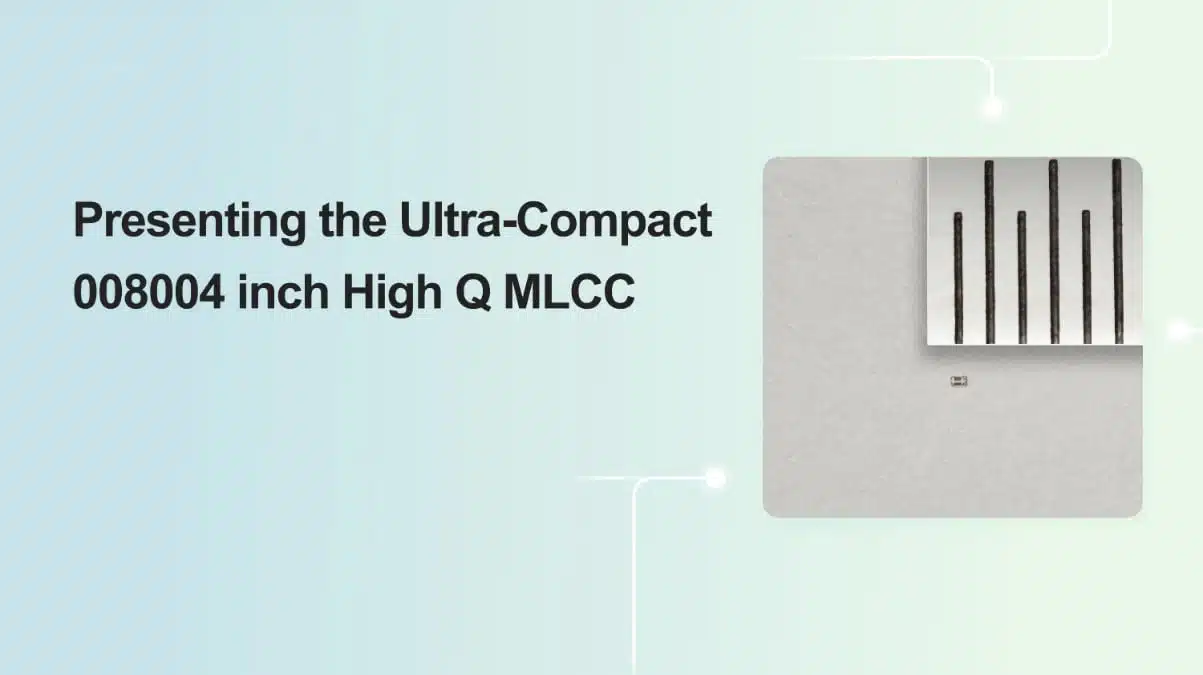
Samsung Electro-Mechanics has announced the release of a full lineup of 008004 inch High Q C0G multilayer ceramic capacitors, scheduled for mass production in October 2026.

These Samsung ultra-compact high Q value MLCC capacitors are designed to meet the demands of millimeter-wave RF front-end modules where both signal integrity in high-frequency bands and board space optimization are critical design constraints.

RelatedPosts

Samsung Introduces Ultra-High-Voltage 1500 V MLCCs for xEV Powertrains

Samsung Presents MLCC Selection Guide for Humanoids and Robotic Applications

Samsung Introduces 35V MLCCs Flying Capacitors for USB PD Fast Charging

Key features and benefits

  • Ultra-miniaturized footprint: The 008004 size measures just 0.25 × 0.125 mm, reducing mounting area by approximately 50% compared to the conventional 01005 inch format, freeing valuable PCB real estate in densely packed RF modules
  • High Q performance: Optimized quality factor minimizes signal loss in high-frequency circuits above 5 GHz, directly improving link efficiency in mmWave bands
  • Reduced parasitic elements: Smaller physical dimensions inherently lower parasitic inductance and resistance, crucial for maintaining circuit performance at frequencies where even sub-nanohenry differences matter
  • Wide capacitance range: Available from 0.2 pF to 10 pF, covering matching networks, resonant circuits, and DC blocking applications
  • Tight tolerance options: Precision matching with tolerances down to ±0.05 pF and ±0.1 pF, enabling predictable tuning in filters and impedance-matching stages
  • C0G/NP0 temperature coefficient: Stable capacitance across the full operating temperature range with virtually zero drift, essential for maintaining filter center frequencies and matching network precision
  • Maximum thickness: 0.138 mm allows compatibility with high-density pick-and-place processes

Typical applications

The 008004 High Q MLCC family is primarily intended for RF front-end modules in communication infrastructure and mobile devices operating in millimeter-wave frequency bands.
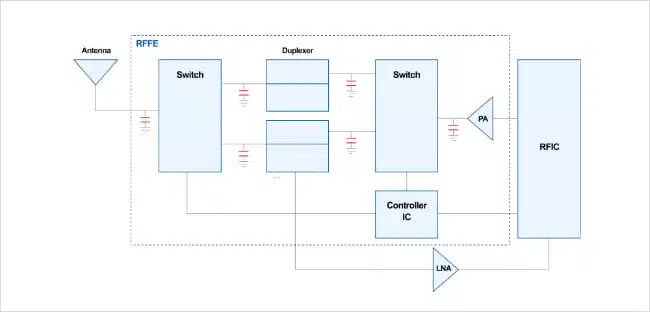
Specific circuit functions include:

  • Impedance matching networks in power amplifier output stages
  • DC blocking capacitors in RF signal paths
  • Resonant elements and tuning capacitors in bandpass filters
  • Coupling capacitors in low-noise amplifier input circuits
  • Parasitic suppression in antenna switch modules
  • High-frequency bypass and decoupling near RF integrated circuits

As 5G networks expand into the 24–71 GHz range and early 6G research targets even higher bands, RFFE modules must accommodate additional antennas, filters, and power amplifiers within the same or smaller footprint. Migrating from 01005 to 008004 capacitors enables engineers to maintain or increase filter order and matching section complexity without enlarging the module outline.

Technical highlights

Samsung Electro-Mechanics offers the 008004 High Q MLCC in two Q-value grades. The High Q variant operates at 25 V rated voltage, while the standard Q version is available at both 16 V and 25 V ratings, giving designers flexibility to trade quality factor against voltage headroom depending on circuit requirements.
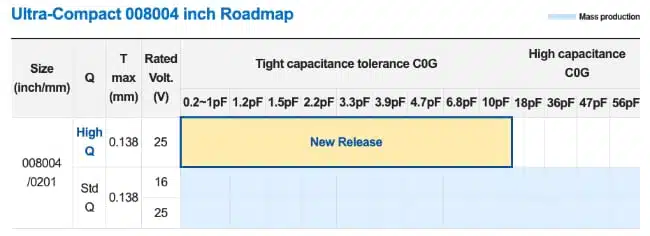
Part NumberCapacitanceRated VoltageTCCMax ThicknessQ Grade
CLR1C010BA1GNN#1 pF25 VdcC0G0.138 mmHigh Q
CLR1C050BA1GNN#5 pF25 VdcC0G0.138 mmHigh Q
CLR1C100JA1GNN#10 pF25 VdcC0G0.138 mmHigh Q

The C0G dielectric ensures that capacitance remains essentially constant from -55 °C to +125 °C, a critical property for RF circuits where even small capacitance shifts translate directly into filter passband drift or matching network detuning. This temperature stability makes C0G the preferred dielectric class for precision analog and RF applications, despite its lower volumetric efficiency compared to X7R or Y5V formulations.

Design-in notes for engineers

  • Placement and soldering: The 008004 package pushes the limits of standard SMT assembly. Verify that your pick-and-place equipment supports sub-0.3 mm component handling and that solder paste stencil apertures are optimized for such small pads. Tomb-stoning and component loss during reflow are common failure modes with ultra-miniature parts.
  • Parasitics and layout: At mmWave frequencies, pad geometry, trace width, and via placement near the capacitor can introduce parasitic inductance comparable to the component’s own reactance. Use electromagnetic simulation to model the complete structure, not just the ideal capacitor value.
  • Quality factor trade-offs: High Q means low equivalent series resistance, but ESR also provides useful damping in some matching networks. Review whether your circuit benefits from maximizing Q or whether a standard Q part offers sufficient performance with broader supply availability.
  • Mechanical stress sensitivity: Ceramic capacitors are brittle. The smaller the package, the more vulnerable it becomes to board flexure during assembly, testing, and field use. Ensure adequate underfill or conformal coating if the module will experience mechanical shock or thermal cycling.
  • Tight tolerances and cost: ±0.05 pF precision is achieved through screening and binning, which increases unit cost. Evaluate whether your filter or matching network design truly requires this level of matching, or whether a wider tolerance with tuning elements offers a more economical solution.

Source

This article is based on the official press release published by Samsung Electro-Mechanics on May 20, 2026, announcing the introduction of the 008004 inch High Q MLCC product family for RF front-end applications.

  1. Samsung Electro-Mechanics – Presenting the Ultra-Compact 008004 inch High Q MLCC
  2. Samsung Electro-Mechanics MLCC Product Search

Related

Recent Posts

Nichicon Extends Rechargeable Batteries Temperature to Rival Supercapacitors

19.5.2026
20

Two‑capacitor paradox explained for engineers

18.5.2026
46

ESA SPCD 26 Registration Open

15.5.2026
24

Capacitances of Nonlinear MLCCs: What Datasheets Don’t Tell You

14.5.2026
86

How a Digital Structural Twin Can Predict Tantalum Capacitor Reliability

14.5.2026
61

Researchers Propose Next‑Gen Compact Memory Using Ultra-thin Ferroelectric Capacitors

11.5.2026
51

Nichicon ADN Automotive Hybrid Aluminum Capacitors Now Available in EMEA

11.5.2026
45

Electrocaloric Multilayer Capacitors: Towards Quiet, Solid‑State Cooling Around Room Temperature

7.5.2026
231

KYOCERA 10 µF 0201 MLCC Brings High‑Capacitance into Mobile Designs

6.5.2026
67

Upcoming Events

Jun 2
16:00 - 17:00 CEST

Calculation, Simulation and Measurement of 800V EMC Filters

Jun 16
16:00 - 17:00 CEST

EMC with EMC – EMC‑compliant design with electromechanical connectors

View Calendar

Popular Posts

  • Buck Converter Design and Calculation

    0 shares
    Share 0 Tweet 0
  • Boost Converter Design and Calculation

    0 shares
    Share 0 Tweet 0
  • Flyback Converter Design and Calculation

    0 shares
    Share 0 Tweet 0
  • LLC Resonant Converter Design and Calculation

    0 shares
    Share 0 Tweet 0
  • MLCC and Ceramic Capacitors

    0 shares
    Share 0 Tweet 0
  • Capacitor Charging and Discharging

    0 shares
    Share 0 Tweet 0
  • What Electronics Engineer Needs to Know About Passive Low Pass Filters

    0 shares
    Share 0 Tweet 0
  • Dual Active Bridge (DAB) Topology

    0 shares
    Share 0 Tweet 0
  • Ripple Current and its Effects on the Performance of Capacitors

    3 shares
    Share 3 Tweet 0
  • Samsung Electro-Mechanics Releases High-Capacitance MLCCs for AI Server Applications

    0 shares
    Share 0 Tweet 0

Newsletter Subscription


Passive Components Blog

© EPCI - Leading Passive Components Educational and Information Site

  • Home
  • Privacy Policy
  • EPCI Membership & Advertisement
  • About

No Result
View All Result
  • Home
  • Knowledge Blog
  • PCNS

© EPCI - Leading Passive Components Educational and Information Site

This website uses cookies. By continuing to use this website you are giving consent to cookies being used. Visit our Privacy and Cookie Policy.
Go to mobile version