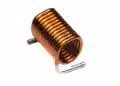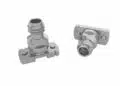





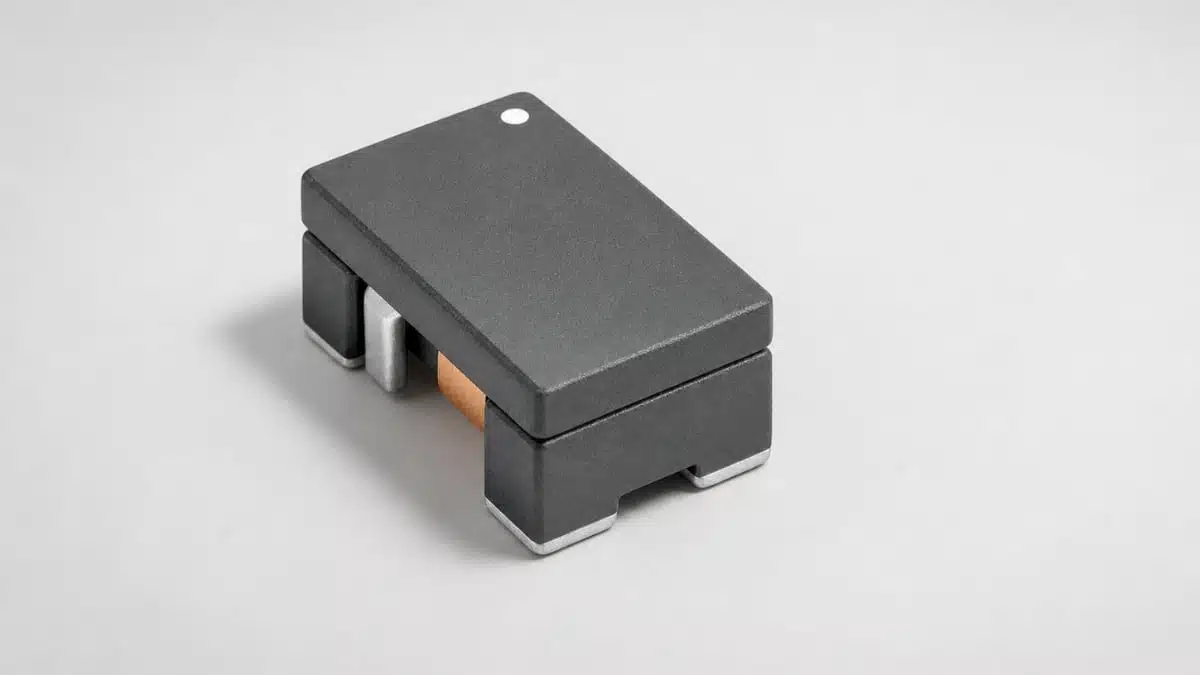
Coilcraft has introduced the CSX7030 series of SMT current sense transformers, targeting compact, high‑isolation current measurement in modern power electronics and automotive designs.
These SMT current sense transformers combine a very low-profile chip-style package with low transformer losses and wide bandwidth, making them attractive for fast-switching converters, inverters and motor drives where accurate current feedback and thermal efficiency are critical.
Key features and benefits
- Miniature SMT chip package – only 3.3 mm tall, helping designers meet height constraints in densely packed power boards and low-profile automotive modules while keeping creepage and clearance distances manageable according to layout rules.
- High isolation capability – specified 1000 Vrms, one-minute hipot between primary and secondary, supporting reinforced isolation between high-voltage power stages and low-voltage control or measurement circuits in safety-critical systems.
- Very low primary DC resistance – DCR values are in the milliohm range, which minimizes conduction losses and self-heating, improving overall efficiency and easing thermal management in high-current paths according to the manufacturer datasheet.
- Wide range of turns ratios – standard options from 1:50 up to 1:200 give flexibility to trade off sense signal amplitude, bandwidth, and burden resistor value for different controller or ADC input ranges.
- Wide operating bandwidth – effective frequency range extends from a few kilohertz into and beyond the megahertz range, enabling accurate current sensing in fast-switching topologies such as modern DC‑DC converters and resonant or hard‑switched inverters.
- AEC‑Q200 qualified – the series is qualified to AEC‑Q200 for automotive applications, which simplifies approval in automotive ECUs and other mission-critical environments that require documented stress testing.
- Automated, consistent manufacturing – the series is produced using a highly automated process, supporting tight production tolerances and cost-efficient volume deployment according to the manufacturer.
- RoHS compliant and halogen free – suitable for designs that must meet common environmental compliance and material declarations without introducing halogens into the BOM.
Typical applications
The CSX7030 series is designed for high-performance current sensing in both industrial and automotive domains.
- DC‑DC converters in telecom, server, and industrial power supplies where primary currents up to 20 A and switching frequencies into the MHz range are common.
- On-board chargers (OBC) and DC‑DC converters in electric and hybrid vehicles that require compact, AEC‑Q200 qualified current transformers for primary or secondary current monitoring.
- Inverters and motor drives, including BLDC or PMSM drives, where phase current measurement accuracy and isolation are essential for torque control and protection functions.
- Power factor correction (PFC) stages in high‑efficiency AC‑DC supplies, where precise current feedback is needed for compliance with harmonic standards and to optimize efficiency.
- General-purpose current monitoring in power management circuits that need galvanic isolation, for example feedback across high-side shunts or isolation between noisy power stages and sensitive control logic.
In many of these applications, the CSX7030 can replace larger through-hole current transformers, freeing PCB area and simplifying automated assembly.
Technical highlights
The CSX7030 series is specified as an SMT current sense transformer with high isolation and low loss characteristics suitable for up to 20 A primary current according to the manufacturer datasheet.
Electrical characteristics overview
- Inductance (secondary): specified in the millihenry range, measured at 100 kHz, 0.1 Vrms, and zero DC bias according to the datasheet.
- Primary DC resistance: from approximately 0.4 mΩ to 6.6 mΩ depending on turns ratio variant, which directly influences conduction loss for a given current level.
- Secondary DC resistance: nominally around 0.52 Ω for all listed variants, reflecting the longer secondary winding.
- Maximum primary current: 20 A primary current corresponds to less than 40 °C temperature rise from 25 °C ambient; operation beyond this current must consider higher temperature rise.
- Volt‑time product: specified per part in volt‑microseconds for the secondary, setting limits for maximum voltage and pulse width to avoid saturation.
- Frequency range: typical operating frequency spans from the low kilohertz region up to above 1 MHz depending on part number, which aligns with modern high-frequency switch-mode converters.
Part number and spec summary
The CSX7030 family includes several standard turns ratio options, all in the same 3.3 mm profile package:
| Part number | Turns ratio (Pri:Sec) | Inductance min (mH) | Primary DCR max (mΩ) | Typical RT for 1 V at 20 A (Ω) |
|---|---|---|---|---|
| CSX7030-050RC | 1 : 50 | 0.4 | 1.87 | 2.5 |
| CSX7030-100RC | 1 : 100 | 1.7 | 3.84 | 5.0 |
| CSX7030-150RC | 1 : 150 | 3.7 | 14.76 | 7.5 |
| CSX7030-175RC | 1 : 175 | 5.1 | 17.76 | 8.75 |
| CSX7030-200RC | 1 : 200 | 6.6 | 34.08 | 10.0 |
All isolation voltages are specified as 1000 Vrms, one-minute hipot between primary and secondary according to the manufacturer.
The terminating resistance values in the table are based on a design target of 1 V output at 20 A primary current and can be recalculated for other outputs using the equation given in the datasheet.
Environmental and reliability data
- Ambient operating temperature range: –40 °C to +125 °C, covering automotive under‑hood and industrial conditions when used within specified temperature rise.
- Storage temperature range: component –40 °C to +140 °C; tape-and-reel packaging –40 °C to +80 °C, important for logistics and storage planning.
- Maximum part temperature: 140 °C (ambient plus self-heating), which must not be exceeded when evaluating current, ambient, and cooling conditions.
- Environmental compliance: RoHS compliant and halogen free, with additional material and reliability information available via Coilcraft quality documentation and FIT/MTBF calculation tools.
Design‑in notes for engineers
Practical interpretation of key specs
- Turns ratio selection – higher turns ratios (such as 1:200) generate a larger secondary voltage for a given primary current, allowing use of larger terminating resistors and potentially improving signal-to-noise ratio, at the cost of higher secondary inductance and winding resistance.
- Terminating resistance and output scaling – the recommended terminating resistance values are based on 1 V output at 20 A; engineers can scale the output voltage by changing the terminating resistor using the equation provided in the datasheet to match ADC or comparator thresholds.
- Volt‑time product considerations – the specified volt‑microsecond limit on the secondary sets the allowable combination of secondary voltage and pulse width; exceeding this can push the core toward saturation, so high duty-cycle or increased pulse duration must be checked against the datasheet curves.
- Thermal design – even with very low primary DCR, 20 A continuous current leads to a specified temperature rise; thermal simulations or measurement in the actual layout are recommended when approaching this limit, especially at higher ambient temperatures.
- Bandwidth and accuracy – for accurate high-frequency current measurement (for example, in MHz-range switching), layout parasitics, stray capacitances, and terminating network design must be controlled to maintain the flatness and phase characteristics implied by the datasheet frequency range.
Layout and assembly recommendations
- Place the CSX7030 as close as practical to the current-carrying conductor or bus whose current is being sensed to minimize loop area and noise pickup.
- Respect clearance and creepage requirements consistent with the 1000 Vrms isolation rating, including solder mask openings and copper keep-outs around the device.
- Use short, wide copper traces for the primary path to minimize additional series resistance and inductance beyond the device’s specified primary DCR.
- Follow the manufacturer’s soldering guidelines: up to three reflow cycles at 260 °C with cooling between cycles, and observe PCB washing recommendations, especially for automotive and high‑reliability assemblies.
- Verify the orientation of the primary and secondary pins relative to the schematic symbol to ensure correct polarity and consistent current direction sense across phases or channels.
Source
This article is based on information from the Coilcraft CSX7030 series product page and associated official documentation and datasheet, adapted and extended for design engineers and component purchasers.