





Passive Components Blog
No Result
View All Result
  • Home
  • NewsFilter
    • All
    • Aerospace & Defence
    • Antenna
    • Applications
    • Automotive
    • Capacitors
    • Circuit Protection Devices
    • electro-mechanical news
    • Filters
    • Fuses
    • Inductors
    • Industrial
    • Integrated Passives
    • inter-connect news
    • Market & Supply Chain
    • Market Insights
    • Medical
    • Modelling and Simulation
    • New Materials & Supply
    • New Technologies
    • Non-linear Passives
    • Oscillators
    • Passive Sensors News
    • Resistors
    • RF & Microwave
    • Telecommunication
    • Weekly Digest

    Würth Elektronik Present in IEEE APEC

    Samsung Three Pillars MLCC Strategy for AI Hardware Topology

    Bourns Releases High Clearance Transformer for Isolated DC/DC Supplies

    KYOCERA AVX Extends Ultra‑Broadband RF Capacitor Series

    Earthing Systems and IEC Classification Explained

    Smiths Interconnect invests £2m in Costa Rica electronics plant

    Kyocera Offers Small SAW Filters for IoT RF Modules

    Bourns Unveils High Volt GDT for High‑Energy Surge Protection

    TDK Releases DC Link Aluminum Capacitors for EV On‑Board Chargers

    Trending Tags

    • Ripple Current
    • RF
    • Leakage Current
    • Tantalum vs Ceramic
    • Snubber
    • Low ESR
    • Feedthrough
    • Derating
    • Dielectric Constant
    • New Products
    • Market Reports
  • VideoFilter
    • All
    • Antenna videos
    • Capacitor videos
    • Circuit Protection Video
    • Filter videos
    • Fuse videos
    • Inductor videos
    • Inter-Connect Video
    • Non-linear passives videos
    • Oscillator videos
    • Passive sensors videos
    • Resistor videos

    2026 Power Magnetics Design Trends: Flyback, DAB and Planar

    Enabling Software‑Defined Vehicle Architectures: Automotive Ethernet and Zonal Smart Power

    Calculating Resistance Value of a Flyback RC Snubber 

    One‑Pulse Characterization of Nonlinear Power Inductors

    Thermistor Linearization Challenges

    Coaxial Connectors and How to Connect with PCB

    PCB Manufacturing, Test Methods, Quality and Reliability

    Transformer Behavior – Current Transfer and Hidden Feedback

    Choosing the Right Capacitor: The Importance of Accurate Measurements

    Trending Tags

    • Capacitors explained
    • Inductors explained
    • Resistors explained
    • Filters explained
    • Application Video Guidelines
    • EMC
    • New Products
    • Ripple Current
    • Simulation
    • Tantalum vs Ceramic
  • Knowledge Blog
  • DossiersNew
  • Suppliers
    • Who is Who
  • PCNS
    • PCNS 2025
    • PCNS 2023
    • PCNS 2021
    • PCNS 2019
    • PCNS 2017
  • Events
  • Home
  • NewsFilter
    • All
    • Aerospace & Defence
    • Antenna
    • Applications
    • Automotive
    • Capacitors
    • Circuit Protection Devices
    • electro-mechanical news
    • Filters
    • Fuses
    • Inductors
    • Industrial
    • Integrated Passives
    • inter-connect news
    • Market & Supply Chain
    • Market Insights
    • Medical
    • Modelling and Simulation
    • New Materials & Supply
    • New Technologies
    • Non-linear Passives
    • Oscillators
    • Passive Sensors News
    • Resistors
    • RF & Microwave
    • Telecommunication
    • Weekly Digest

    Würth Elektronik Present in IEEE APEC

    Samsung Three Pillars MLCC Strategy for AI Hardware Topology

    Bourns Releases High Clearance Transformer for Isolated DC/DC Supplies

    KYOCERA AVX Extends Ultra‑Broadband RF Capacitor Series

    Earthing Systems and IEC Classification Explained

    Smiths Interconnect invests £2m in Costa Rica electronics plant

    Kyocera Offers Small SAW Filters for IoT RF Modules

    Bourns Unveils High Volt GDT for High‑Energy Surge Protection

    TDK Releases DC Link Aluminum Capacitors for EV On‑Board Chargers

    Trending Tags

    • Ripple Current
    • RF
    • Leakage Current
    • Tantalum vs Ceramic
    • Snubber
    • Low ESR
    • Feedthrough
    • Derating
    • Dielectric Constant
    • New Products
    • Market Reports
  • VideoFilter
    • All
    • Antenna videos
    • Capacitor videos
    • Circuit Protection Video
    • Filter videos
    • Fuse videos
    • Inductor videos
    • Inter-Connect Video
    • Non-linear passives videos
    • Oscillator videos
    • Passive sensors videos
    • Resistor videos

    2026 Power Magnetics Design Trends: Flyback, DAB and Planar

    Enabling Software‑Defined Vehicle Architectures: Automotive Ethernet and Zonal Smart Power

    Calculating Resistance Value of a Flyback RC Snubber 

    One‑Pulse Characterization of Nonlinear Power Inductors

    Thermistor Linearization Challenges

    Coaxial Connectors and How to Connect with PCB

    PCB Manufacturing, Test Methods, Quality and Reliability

    Transformer Behavior – Current Transfer and Hidden Feedback

    Choosing the Right Capacitor: The Importance of Accurate Measurements

    Trending Tags

    • Capacitors explained
    • Inductors explained
    • Resistors explained
    • Filters explained
    • Application Video Guidelines
    • EMC
    • New Products
    • Ripple Current
    • Simulation
    • Tantalum vs Ceramic
  • Knowledge Blog
  • DossiersNew
  • Suppliers
    • Who is Who
  • PCNS
    • PCNS 2025
    • PCNS 2023
    • PCNS 2021
    • PCNS 2019
    • PCNS 2017
  • Events
No Result
View All Result
Passive Components Blog
No Result
View All Result

Samsung Three Pillars MLCC Strategy for AI Hardware Topology

24.2.2026
Reading Time: 7 mins read
A A

Samsung Electro‑Mechanics is aligning its multilayer ceramic capacitor (MLCC) roadmap with the specific bottlenecks of AI hardware rather than general‑purpose servers.

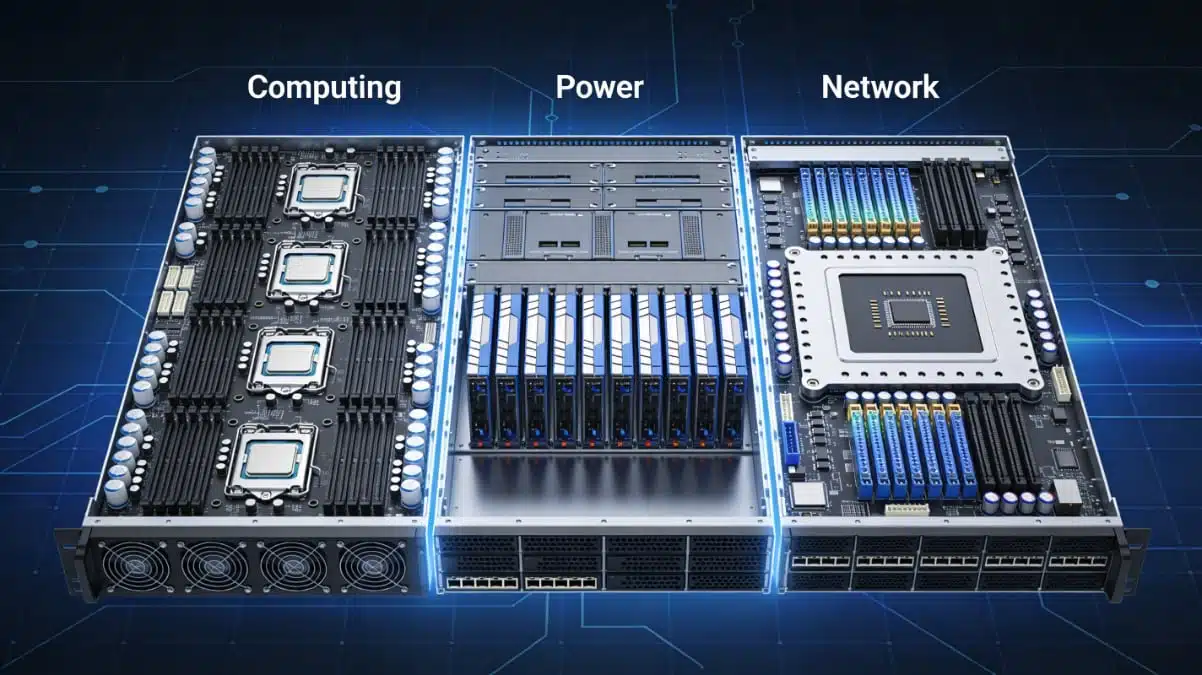
The company’s strategy is organized around three focused parts of the AI hardware topology: high‑density computing boards, high‑power delivery, and ultra‑fast networking. This three‑part approach clarifies where MLCC technology must advance to support next‑generation AI data centers.

RelatedPosts

Samsung Q4 2025 Results: MLCC focus for AI, Server and Automotive

Samsung Unveils World First CLLC Resonant 1kV 33nF C0G MLCC in 1210 Size

Samsung MLCC Replacing Aluminum Polymer Capacitors in AI Systems

Three-part strategy overview

Samsung Electro‑Mechanics structures its AI response into three tightly connected domains:

  • Computing: MLCCs for GPU/CPU boards handling massive currents at very low voltages.
  • Power: MLCCs for new 48 V and 800 V power architectures and vertical power delivery.
  • Network: MLCCs for high‑speed switches and co‑packaged optics in 800G–1.6T systems.

Across these domains, the strategy emphasizes ultra‑high capacitance in small footprints, higher voltage ratings, and higher temperature operation to match AI server conditions according to manufacturer datasheets.

Computing: MLCCs for dense AI accelerator boards

On the computing side, Samsung targets MLCC solutions for GPUs and CPUs that draw hundreds to thousands of amperes at core voltages around 0.8 V. AI accelerators require many more decoupling capacitors than conventional servers while offering less PCB area near the package.
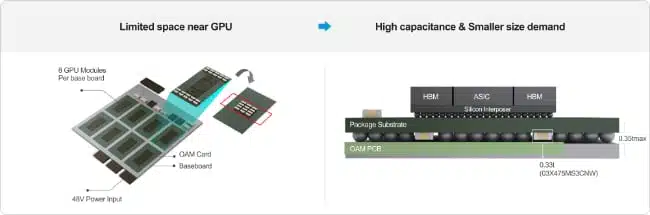
Key strategy elements for the computing segment:

  • Push capacitance density:
    • Develop ultra‑high‑capacitance MLCCs in very small case sizes (e.g., ≥47 µF in 0402, ≥100 µF in 0603, values according to manufacturer datasheet) for close‑in decoupling.
  • Move capacitance closer to the die:
    • Promote embedded MLCCs integrated into substrates or packages to reduce parasitic inductance.
    • Use landside MLCCs mounted under GPU/CPU packages to exploit the back side of the PCB area.
  • Support power integrity at AI transient speeds:
    • Shape impedance over a wide frequency range to handle rapid load steps typical of AI workloads.

In practice, this part of the strategy is about turning MLCCs into a tightly co‑designed part of the package–board–VRM system, not just a standard BOM item on the PCB.

Power: MLCCs for 48 V and 800 V architectures and Vertical Power Delivery (VPD)

For the power segment, Samsung’s strategy follows the shift from legacy 12/48 V conversion schemes to architectures that rectify mains AC to an 800 V DC bus and then convert down inside the rack. As rack power climbs towards the 120 kW class, both efficiency and reliability become critical.
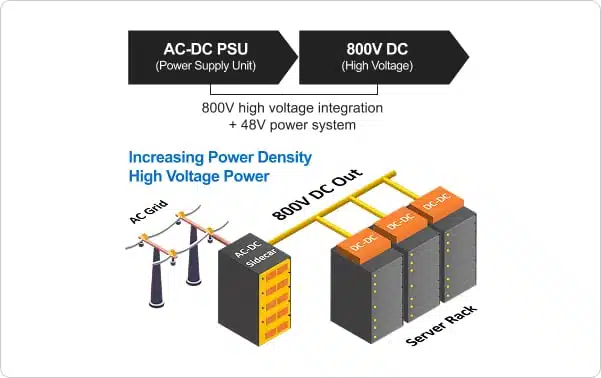
800V AI Power System

Core strategic directions in power delivery:

  • Support higher system voltages:
    • Expand 100 V MLCC offerings for 48 V distribution rails to provide robust derating and surge margin.
    • Develop large‑size 1 kV–2 kV MLCCs for 800 V DC systems, covering DC link, filtering and snubber roles.
  • Enable vertical power delivery (VPD):
    • Align MLCCs with VPD modules that shorten the path from VRMs to GPUs, increasing power density.
    • Promote high‑capacitance, low‑voltage parts such as X7T 0402 22 µF and X6S 2.5 V 47 µF (under evaluation) as building blocks for VPD decoupling.
  • Address thermal and reliability constraints:
    • Optimize MLCCs for elevated temperatures and ripple conditions in compact, high‑power PSUs and point‑of‑load converters.

This power‑focused strategy positions MLCCs as enablers of next‑generation rack architectures where efficiency gains at 48 V and 800 V directly impact operating cost and deployment density.
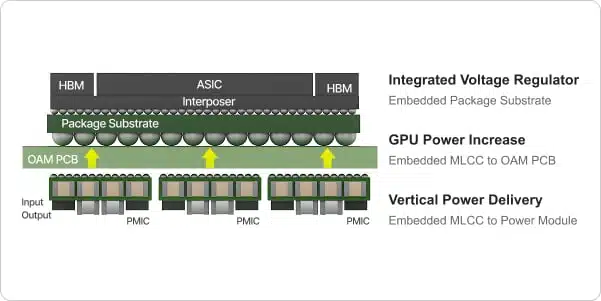
Embedded MLCC

Network: MLCCs for 1.6T switches and co‑packaged optics

On the network side, Samsung’s strategy recognizes that AI clusters are moving to 800G and 1.6T links with co‑packaged optics (CPO), which bring optics and switch ASICs into a single highly integrated module. These network trays have very high power densities and strict signal‑integrity requirements.
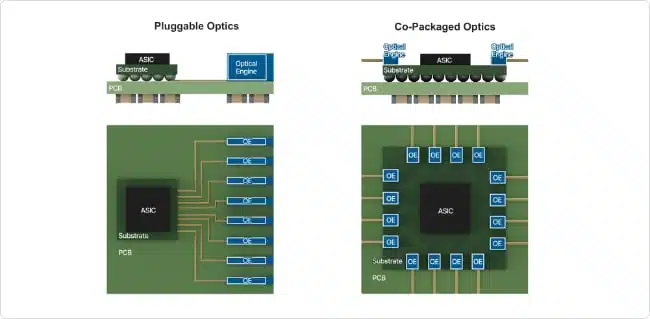
Key strategic points for networking MLCCs:

  • Address high‑power switch ASICs:
    • Design MLCCs for network chipsets consuming more than 500 W in concentrated areas.
    • Provide stable capacitance and low loss at elevated local temperatures near the switch and optics.
  • Enable co‑packaged optics:
    • Support power rails for CPO modules where space, thermal headroom and EMI margins are all tight.
    • Tailor MLCCs for placement around high‑speed SerDes and optical engines to maintain power integrity.
  • Elevate temperature capability:
    • Shift dielectric usage from X5R towards X6S and X7T to support higher operating temperatures in dense network equipment.
    • Focus on high‑temperature MLCC product lines for long‑term reliability under sustained load.

In this segment, the strategy connects MLCC development directly to the roadmap of high‑speed networking and optical integration for AI clusters.

Cross-cutting technical themes

Across computing, power and network, several technical themes are common to Samsung’s AI strategy:

  • Ultra‑high capacitance density:
    • Roadmap targets for tens of microfarads in 0402 and hundreds of microfarads in 0603 sizes for proximity decoupling.
  • Higher voltage classes:
    • Strengthening 100 V MLCC lines for 48 V racks and expanding 1 kV–2 kV MLCCs for 800 V buses and converters.
  • Higher temperature operation:
    • Increased reliance on X6S and X7T dielectrics to maintain performance in thermally stressed AI hardware.
  • Integration and form factor:
    • Embedded and landside MLCC concepts to shorten electrical distances and free top‑side PCB space.

For design engineers and buyers, this means MLCC selection in AI projects will increasingly be tied to system‑level roadmaps for GPUs, power architectures and network fabrics.

Source

This article interprets a Samsung Electro‑Mechanics product news release as a three‑part MLCC strategy for AI hardware, covering computing, power and network segments, and adds system‑level context for engineers and component purchasers.
References

  1. Samsung Electro‑Mechanics – Strategy for Responding to the AI Industry: Expanding a Three‑Part Series on Computing, Power, and Network
  2. Samsung Electro‑Mechanics – Component Center / Product Search
  3. Samsung Electro‑Mechanics – Component Library

Related

Recent Posts

Würth Elektronik Present in IEEE APEC

24.2.2026
0

Bourns Releases High Clearance Transformer for Isolated DC/DC Supplies

24.2.2026
0

KYOCERA AVX Extends Ultra‑Broadband RF Capacitor Series

24.2.2026
2

Bourns Unveils High Volt GDT for High‑Energy Surge Protection

23.2.2026
1

TDK Releases DC Link Aluminum Capacitors for EV On‑Board Chargers

23.2.2026
7

Capacitech C-Link Supercapacitors for AI Data Center Voltage Spikes Mitigation

23.2.2026
15
Researchers developed a polymer capacitor by combining two cheap, commercially available plastics. The new polymer capacitor makes use of the transparent material — pictured here, with vintage Penn State athletic marks visible through it — to store four times the energy and withstand significantly more heat.  Credit: Penn State

Penn State Demonstrated Polymer Alloy Capacitor Film with 4× Energy Density up to 250C

19.2.2026
30

Vishay Unveils Ultra-Compact 0201 Thick Film Chip Resistors

19.2.2026
15

Würth Elektronik Component Data Live in Accuris

19.2.2026
16

Upcoming Events

Feb 24
16:00 - 17:00 CET

Mastering Galvanic Isolation: Ensuring Safety in Power Electronics

Feb 25
16:00 - 17:00 CET

Magnetic Modeling – How Frenetic Models Magnetics

Mar 3
16:00 - 17:00 CET

Cybersecurity at the Eleventh Hour – from RED to CRA – Information and Discussion

View Calendar

Popular Posts

  • Buck Converter Design and Calculation

    0 shares
    Share 0 Tweet 0
  • Boost Converter Design and Calculation

    0 shares
    Share 0 Tweet 0
  • LLC Resonant Converter Design and Calculation

    0 shares
    Share 0 Tweet 0
  • Flyback Converter Design and Calculation

    0 shares
    Share 0 Tweet 0
  • Ripple Current and its Effects on the Performance of Capacitors

    3 shares
    Share 3 Tweet 0
  • Dual Active Bridge (DAB) Topology

    0 shares
    Share 0 Tweet 0
  • What is a Dielectric Constant and DF of Plastic Materials?

    4 shares
    Share 4 Tweet 0
  • MLCC and Ceramic Capacitors

    0 shares
    Share 0 Tweet 0
  • MLCC Manufacturers Consider Price Increase as AI Demand Outpaces Supply

    0 shares
    Share 0 Tweet 0
  • MLCC Case Sizes Standards Explained

    0 shares
    Share 0 Tweet 0

Newsletter Subscription


Passive Components Blog

© EPCI - Leading Passive Components Educational and Information Site

  • Home
  • Privacy Policy
  • EPCI Membership & Advertisement
  • About

No Result
View All Result
  • Home
  • Knowledge Blog
  • PCNS

© EPCI - Leading Passive Components Educational and Information Site

This website uses cookies. By continuing to use this website you are giving consent to cookies being used. Visit our Privacy and Cookie Policy.
Go to mobile version