







Passive Components Blog
No Result
View All Result
  • Home
  • NewsFilter
    • All
    • Aerospace & Defence
    • Antenna
    • Applications
    • Automotive
    • Capacitors
    • Circuit Protection Devices
    • electro-mechanical news
    • Filters
    • Fuses
    • Inductors
    • Industrial
    • Integrated Passives
    • inter-connect news
    • Market & Supply Chain
    • Market Insights
    • Medical
    • Modelling and Simulation
    • New Materials & Supply
    • New Technologies
    • Non-linear Passives
    • Oscillators
    • Passive Sensors News
    • Resistors
    • RF & Microwave
    • Telecommunication
    • Weekly Digest

    Binder Hybrid Connector Simplifies One Cable Automation

    Tapped Inductor Buck Converter Fundamentals

    TAIYO YUDEN Releases Mini Metal Power Inductors

    Molecular Memristor Shows Record 145 kH Emergent Inductance

    Planar vs Conventional Transformer: When it Make Sense

    Researchers Propose Next‑Gen Compact Memory Using Ultra-thin Ferroelectric Capacitors

    Nichicon ADN Automotive Hybrid Aluminum Capacitors Now Available in EMEA

    Wk 19 Electronics Supply Chain Digest

    Electrocaloric Multilayer Capacitors: Towards Quiet, Solid‑State Cooling Around Room Temperature

    Trending Tags

    • Ripple Current
    • RF
    • Leakage Current
    • Tantalum vs Ceramic
    • Snubber
    • Low ESR
    • Feedthrough
    • Derating
    • Dielectric Constant
    • New Products
    • Market Reports
  • VideoFilter
    • All
    • Antenna videos
    • Capacitor videos
    • Circuit Protection Video
    • Filter videos
    • Fuse videos
    • Inductor videos
    • Inter-Connect Video
    • Non-linear passives videos
    • Oscillator videos
    • Passive sensors videos
    • Resistor videos

    Tapped Inductor Buck Converter Fundamentals

    Planar vs Conventional Transformer: When it Make Sense

    Modeling Fringing Field Losses in Inductors & Transformers

    Why Power Inductors Use a Ferrite Core With an Air Gap

    Transformer-Based Power-Line Harvester Magnetic Design

    Thermal Modeling of Magnetics

    Standard vs Planar LLC transformers Comparison for Battery Chargers

    How Modern Tools Model Magnetic Components for Power Electronics

    Advanced Loss Modeling for Planar Magnetics in the Frenetic Planar Tool

    Trending Tags

    • Capacitors explained
    • Inductors explained
    • Resistors explained
    • Filters explained
    • Application Video Guidelines
    • EMC
    • New Products
    • Ripple Current
    • Simulation
    • Tantalum vs Ceramic
  • Knowledge Blog
  • DossiersNew
  • Suppliers
    • Who is Who
  • PCNS
    • PCNS 2025
    • PCNS 2023
    • PCNS 2021
    • PCNS 2019
    • PCNS 2017
  • Events
  • Home
  • NewsFilter
    • All
    • Aerospace & Defence
    • Antenna
    • Applications
    • Automotive
    • Capacitors
    • Circuit Protection Devices
    • electro-mechanical news
    • Filters
    • Fuses
    • Inductors
    • Industrial
    • Integrated Passives
    • inter-connect news
    • Market & Supply Chain
    • Market Insights
    • Medical
    • Modelling and Simulation
    • New Materials & Supply
    • New Technologies
    • Non-linear Passives
    • Oscillators
    • Passive Sensors News
    • Resistors
    • RF & Microwave
    • Telecommunication
    • Weekly Digest

    Binder Hybrid Connector Simplifies One Cable Automation

    Tapped Inductor Buck Converter Fundamentals

    TAIYO YUDEN Releases Mini Metal Power Inductors

    Molecular Memristor Shows Record 145 kH Emergent Inductance

    Planar vs Conventional Transformer: When it Make Sense

    Researchers Propose Next‑Gen Compact Memory Using Ultra-thin Ferroelectric Capacitors

    Nichicon ADN Automotive Hybrid Aluminum Capacitors Now Available in EMEA

    Wk 19 Electronics Supply Chain Digest

    Electrocaloric Multilayer Capacitors: Towards Quiet, Solid‑State Cooling Around Room Temperature

    Trending Tags

    • Ripple Current
    • RF
    • Leakage Current
    • Tantalum vs Ceramic
    • Snubber
    • Low ESR
    • Feedthrough
    • Derating
    • Dielectric Constant
    • New Products
    • Market Reports
  • VideoFilter
    • All
    • Antenna videos
    • Capacitor videos
    • Circuit Protection Video
    • Filter videos
    • Fuse videos
    • Inductor videos
    • Inter-Connect Video
    • Non-linear passives videos
    • Oscillator videos
    • Passive sensors videos
    • Resistor videos

    Tapped Inductor Buck Converter Fundamentals

    Planar vs Conventional Transformer: When it Make Sense

    Modeling Fringing Field Losses in Inductors & Transformers

    Why Power Inductors Use a Ferrite Core With an Air Gap

    Transformer-Based Power-Line Harvester Magnetic Design

    Thermal Modeling of Magnetics

    Standard vs Planar LLC transformers Comparison for Battery Chargers

    How Modern Tools Model Magnetic Components for Power Electronics

    Advanced Loss Modeling for Planar Magnetics in the Frenetic Planar Tool

    Trending Tags

    • Capacitors explained
    • Inductors explained
    • Resistors explained
    • Filters explained
    • Application Video Guidelines
    • EMC
    • New Products
    • Ripple Current
    • Simulation
    • Tantalum vs Ceramic
  • Knowledge Blog
  • DossiersNew
  • Suppliers
    • Who is Who
  • PCNS
    • PCNS 2025
    • PCNS 2023
    • PCNS 2021
    • PCNS 2019
    • PCNS 2017
  • Events
No Result
View All Result
Passive Components Blog
No Result
View All Result

February 2026 Interconnect, Passives and Electromechanical Components Market Insights

9.3.2026
Reading Time: 4 mins read
A A

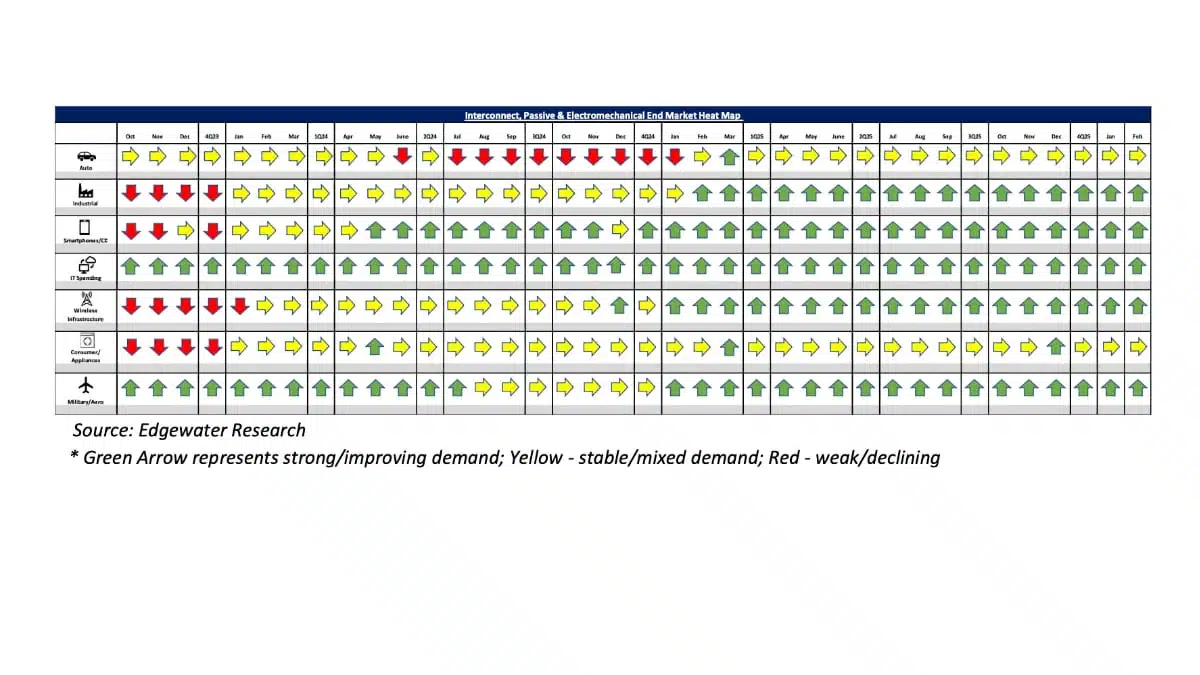
Edgewater researchers report IP&E demand and pricing are strengthening on the back of AI and industrial recovery, with tight passive component supply and a likely shift to hybrid copper‑plus‑optical datacenter architectures that keep intra‑rack copper dominant through 2030.

This February 2026 collection of news summaries, survey results, and channel market insights, covers Interconnect, Passives, and Electromechanical Components from Edgewater Research. 

RelatedPosts

Wk 19 Electronics Supply Chain Digest

Wk 18 Electronics Supply Chain Digest

Wk 17 Electronics Supply Chain Digest

What’s Changed/What’s New?

  1. Broader 1Q demand tracking better. Bookings momentum accelerating in Jan/Feb, B2B ~1.15-1.2x, driving backlog rebuild.
  2. TE/Amphenol leading second round of channel price increase YTD (+7-8% effective 3/2), impacting new orders and backlog, other
    suppliers expected to follow.
  3. AWS Trainium CY26 forecast raised 30–40% to 2.3-2.4M ASICs; now estimating ~2x connector TAM growth Y/Y vs ~+50% prior.
  4. First-wave CPO more likely to expand scale-up across racks/pods rather than displace intra-rack copper. CPO-based GPUs and
    optical backplanes likely to move into focus, but deployment timing and scope are noted as key variables.
  5. Hybrid copper/optics scale-up approach appears more likely over the next 3–5 years, with copper retaining intra-rack dominance.
  6. Kyber midplane + CPC on NVSwitches viewed as marginally more likely for Rubin Ultra; Oberon-style 72×2 with cabled backplane
    and CPO for rack-to-rack connection noted as a backup. Scenarios suggest copper content flat at worst, meaningfully higher at
    best.

Top 4 Channel Comments:

  • We believe Nvidia’s messaging will shift from “copper-only” toward a hybrid copper/optics scale-up model. CPO is likely to be
    featured prominently at GTC, but we do not see copper being displaced inside the rack anytime soon. The more probable path is
    optics for rack-to-rack links, while copper remains dominant intra-rack due to cost and practicality.
  • Despite growing CPO push from large silicon suppliers, CSPs remain conservative. We expect adoption to ramp gradually from low
    single-digit penetration (5–10%) and do not see in-rack optics reaching 30–40% until 2030 or later. For example, we have a hard time
    envisioning Amazon to adopt CPO/optics inside the rack aggressively given its historically cautious stance on architectural shifts.
  • Nvidia may push CPO aggressively over the next year or two, but we question how much will materialize. We don’t see an immediate
    need over the next 3–4 years as 1) copper can still meet density and speed requirements, and 2) even a 2% yield loss from integrating
    CPO onto a ~$60K AI ASIC implies ~$1,200 of scrap per chip. For those reasons, we don’t see CPO on AI ASICs until 2030.
  • Recent Coherent and Lumentum commentary on 2H27 CPO platforms likely tied to AMD’s next-gen rack. At Nvidia, meaningful scaleup adoption appears aligned with Feynman. Even for AMD, the initial CPO config is likely test platforms, not mass deployment.

Other Key Takeaways:

  1. CPC emerging as copper multiplier; full-stack architectures (switch + AI ASIC + backplane) imply ~2–3x content.
  2. Trn4 has a full-stack CPC + backplane configuration, likely based on TE, though final volume architecture remains undecided.
  3. Nvidia CY26 rack forecast unchanged at 60–80K. TE backplane ramp for GB300 seen as progressing through March.
    10.VR72 compute tray midplane connectors now 100% Amphenol; VR72 content estimates little changed.
    11.Passive lead times extending, pricing firming; Tantalum capacitors tightest, resistor pricing firming on silver exposure.
    12.Industrial recovery broadening beyond energy; bookings strength increasingly diversified across automation, semicap and HVAC.
    13.Auto CY26 base case unchanged at mid-single-digit growth, with pricing doing more heavy lifting than production.

Conclusion:

  1. IP&E fundamentals continue to improve through 1Q with demand and pricing firming, supporting stronger bookings and improving
    B2B ratios. Encouragingly, strength is broadening beyond AD&M and IT Datacom, while OEM/EMS customers appear to be shifting
    from inventory drawdown toward supply sufficiency. At the same time, hyperscale AI spending remains a major driver, with datacenter
    demand continuing to strengthen. Overall, we are increasingly constructive, projecting double-digit growth for the IP&E industry in
    2026 absent macro disruption. On the copper vs optics debate, supply-chain feedback suggests the near-term risk to intra-rack copper
    is overstated. While CPO development will continue, deployment is likely to be phased. The most likely outcome over the next several
    years is a hybrid copper-plus-optics architecture, with optics used for rack-to-rack links while copper remains dominant inside the
    rack, particularly as CPC architecture helps extend copper’s performance and content in next-generation systems.

Full report available from: Dennis Reed, Sr. Research Analyst, Edgewater Research

Related

Source: Edgewater Research

Recent Posts

Tapped Inductor Buck Converter Fundamentals

13.5.2026
9

TAIYO YUDEN Releases Mini Metal Power Inductors

13.5.2026
6

Molecular Memristor Shows Record 145 kH Emergent Inductance

12.5.2026
11

Planar vs Conventional Transformer: When it Make Sense

11.5.2026
35

Researchers Propose Next‑Gen Compact Memory Using Ultra-thin Ferroelectric Capacitors

11.5.2026
28

Nichicon ADN Automotive Hybrid Aluminum Capacitors Now Available in EMEA

11.5.2026
22

Electrocaloric Multilayer Capacitors: Towards Quiet, Solid‑State Cooling Around Room Temperature

7.5.2026
184

High-Crystallinity Nanocrystalline Composites for MHz Chip Inductors

7.5.2026
63

European Components Distribution Shows Strong Q1 2026 Growth Amid Geopolitical Uncertainty

7.5.2026
70

Upcoming Events

May 13
17:00 - 17:30 CEST

Winding Loss Modeling for Toroidal Magnetics – Including Gapped Cores

May 19
16:00 - 17:00 CEST

Designing Qi2 Wireless Power Systems: Practical Development and EMC Optimization

Jun 2
16:00 - 17:00 CEST

Calculation, Simulation and Measurement of 800V EMC Filters

View Calendar

Popular Posts

  • Buck Converter Design and Calculation

    0 shares
    Share 0 Tweet 0
  • Boost Converter Design and Calculation

    0 shares
    Share 0 Tweet 0
  • Flyback Converter Design and Calculation

    0 shares
    Share 0 Tweet 0
  • LLC Resonant Converter Design and Calculation

    0 shares
    Share 0 Tweet 0
  • MLCC and Ceramic Capacitors

    0 shares
    Share 0 Tweet 0
  • Dual Active Bridge (DAB) Topology

    0 shares
    Share 0 Tweet 0
  • What Electronics Engineer Needs to Know About Passive Low Pass Filters

    0 shares
    Share 0 Tweet 0
  • Capacitor Charging and Discharging

    0 shares
    Share 0 Tweet 0
  • Ripple Current and its Effects on the Performance of Capacitors

    3 shares
    Share 3 Tweet 0
  • MLCC Case Sizes Standards Explained

    0 shares
    Share 0 Tweet 0

Newsletter Subscription


Passive Components Blog

© EPCI - Leading Passive Components Educational and Information Site

  • Home
  • Privacy Policy
  • EPCI Membership & Advertisement
  • About

No Result
View All Result
  • Home
  • Knowledge Blog
  • PCNS

© EPCI - Leading Passive Components Educational and Information Site

This website uses cookies. By continuing to use this website you are giving consent to cookies being used. Visit our Privacy and Cookie Policy.
Go to mobile version