













Passive Components Blog
No Result
View All Result
  • Home
  • NewsFilter
    • All
    • Aerospace & Defence
    • Antenna
    • Applications
    • Automotive
    • Capacitors
    • Circuit Protection Devices
    • electro-mechanical news
    • Filters
    • Fuses
    • Inductors
    • Industrial
    • Integrated Passives
    • inter-connect news
    • Market & Supply Chain
    • Market Insights
    • Medical
    • Modelling and Simulation
    • New Materials & Supply
    • New Technologies
    • Non-linear Passives
    • Oscillators
    • Passive Sensors News
    • Resistors
    • RF & Microwave
    • Telecommunication
    • Weekly Digest

    CMSE 2026 Announces Call for Presentations on High-Reliability Military and Space Electronics

    ESA Call for Papers 6th Space Passive Component Days – SPCD 2026

    Würth Elektronik Offers Halogen‑Free EMC Gaskets for Displays and Housings

    Component Distribution Supply Chain January 2026

    Binder Unveils M8 Flange Solder Connectors for Flexible Cabling

    Power Electronics Tools for Passives and Magnetic Designs

    Modelithics Releases Component Model Library for SIMULIA CST Studio Suite

    Exxelia Publishes Micropen White Papers for Printed Electronics

    Stackpole Releases AlN High‑Power Thick Film Chip Resistors

    Trending Tags

    • Ripple Current
    • RF
    • Leakage Current
    • Tantalum vs Ceramic
    • Snubber
    • Low ESR
    • Feedthrough
    • Derating
    • Dielectric Constant
    • New Products
    • Market Reports
  • VideoFilter
    • All
    • Antenna videos
    • Capacitor videos
    • Circuit Protection Video
    • Filter videos
    • Fuse videos
    • Inductor videos
    • Inter-Connect Video
    • Non-linear passives videos
    • Oscillator videos
    • Passive sensors videos
    • Resistor videos

    One‑Pulse Characterization of Nonlinear Power Inductors

    Thermistor Linearization Challenges

    Coaxial Connectors and How to Connect with PCB

    PCB Manufacturing, Test Methods, Quality and Reliability

    Transformer Behavior – Current Transfer and Hidden Feedback

    Choosing the Right Capacitor: The Importance of Accurate Measurements

    RF Inductors: Selection and Design Challenges for High-Frequency Circuits

    Transformer Safety IEC 61558 Standard

    3-Phase EMI Filter Design, Simulation, Calculation and Test

    Trending Tags

    • Capacitors explained
    • Inductors explained
    • Resistors explained
    • Filters explained
    • Application Video Guidelines
    • EMC
    • New Products
    • Ripple Current
    • Simulation
    • Tantalum vs Ceramic
  • Knowledge Blog
  • DossiersNew
  • Suppliers
    • Who is Who
  • PCNS
    • PCNS 2025
    • PCNS 2023
    • PCNS 2021
    • PCNS 2019
    • PCNS 2017
  • Events
  • Home
  • NewsFilter
    • All
    • Aerospace & Defence
    • Antenna
    • Applications
    • Automotive
    • Capacitors
    • Circuit Protection Devices
    • electro-mechanical news
    • Filters
    • Fuses
    • Inductors
    • Industrial
    • Integrated Passives
    • inter-connect news
    • Market & Supply Chain
    • Market Insights
    • Medical
    • Modelling and Simulation
    • New Materials & Supply
    • New Technologies
    • Non-linear Passives
    • Oscillators
    • Passive Sensors News
    • Resistors
    • RF & Microwave
    • Telecommunication
    • Weekly Digest

    CMSE 2026 Announces Call for Presentations on High-Reliability Military and Space Electronics

    ESA Call for Papers 6th Space Passive Component Days – SPCD 2026

    Würth Elektronik Offers Halogen‑Free EMC Gaskets for Displays and Housings

    Component Distribution Supply Chain January 2026

    Binder Unveils M8 Flange Solder Connectors for Flexible Cabling

    Power Electronics Tools for Passives and Magnetic Designs

    Modelithics Releases Component Model Library for SIMULIA CST Studio Suite

    Exxelia Publishes Micropen White Papers for Printed Electronics

    Stackpole Releases AlN High‑Power Thick Film Chip Resistors

    Trending Tags

    • Ripple Current
    • RF
    • Leakage Current
    • Tantalum vs Ceramic
    • Snubber
    • Low ESR
    • Feedthrough
    • Derating
    • Dielectric Constant
    • New Products
    • Market Reports
  • VideoFilter
    • All
    • Antenna videos
    • Capacitor videos
    • Circuit Protection Video
    • Filter videos
    • Fuse videos
    • Inductor videos
    • Inter-Connect Video
    • Non-linear passives videos
    • Oscillator videos
    • Passive sensors videos
    • Resistor videos

    One‑Pulse Characterization of Nonlinear Power Inductors

    Thermistor Linearization Challenges

    Coaxial Connectors and How to Connect with PCB

    PCB Manufacturing, Test Methods, Quality and Reliability

    Transformer Behavior – Current Transfer and Hidden Feedback

    Choosing the Right Capacitor: The Importance of Accurate Measurements

    RF Inductors: Selection and Design Challenges for High-Frequency Circuits

    Transformer Safety IEC 61558 Standard

    3-Phase EMI Filter Design, Simulation, Calculation and Test

    Trending Tags

    • Capacitors explained
    • Inductors explained
    • Resistors explained
    • Filters explained
    • Application Video Guidelines
    • EMC
    • New Products
    • Ripple Current
    • Simulation
    • Tantalum vs Ceramic
  • Knowledge Blog
  • DossiersNew
  • Suppliers
    • Who is Who
  • PCNS
    • PCNS 2025
    • PCNS 2023
    • PCNS 2021
    • PCNS 2019
    • PCNS 2017
  • Events
No Result
View All Result
Passive Components Blog
No Result
View All Result

TDK World’s smallest Point-Of-Load DC-DC converter

18.3.2019
Reading Time: 2 mins read
A A

Source: TDK news

TDK introduces a new series of µPOL™ power solutions as ‘a new era of power management solutions’ with increased performance, smallest available size, ease of use and simplified integration.

RelatedPosts

CMSE 2026 Announces Call for Presentations on High-Reliability Military and Space Electronics

ESA Call for Papers 6th Space Passive Component Days – SPCD 2026

Würth Elektronik Offers Halogen‑Free EMC Gaskets for Displays and Housings

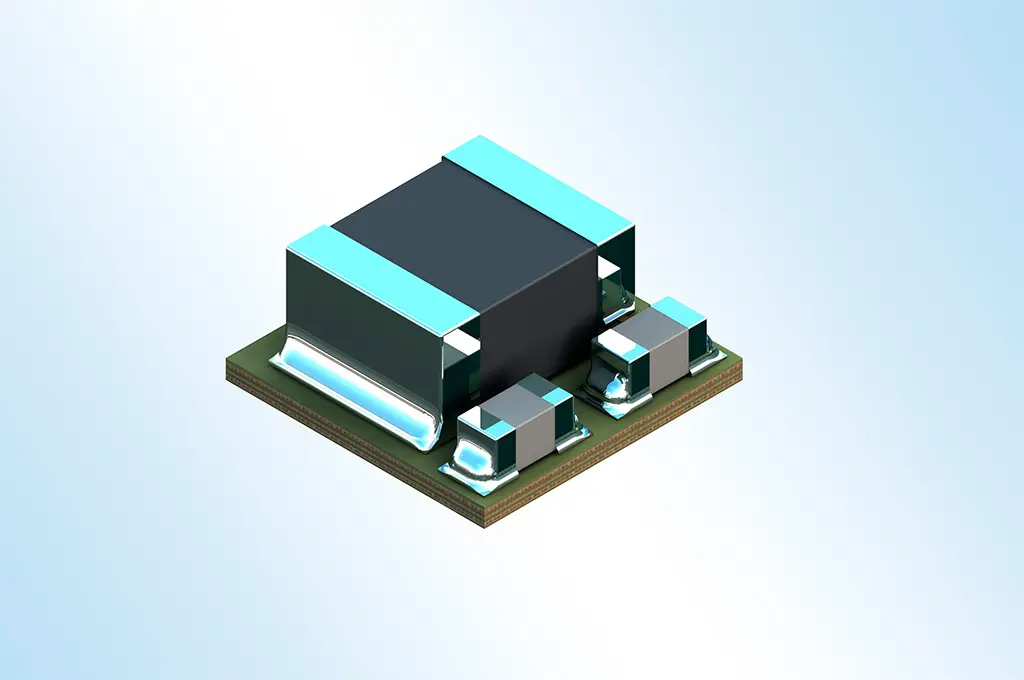
TDK Corporation (TSE:6762) announces the new series of µPOL™ DC-DC converters, the industry’s most compact and highest power density point-of-load solutions for applications such as big data, machine learning, artificial intelligence (AI), 5G cells, IoT and computing enterprise.

Rather than using side by side discrete integrated circuit (IC) and discrete inductor (L) the new FS series integrates the IC and inductor in a compact configuration which offers a high-density solution for space-constrained applications requiring a low-profile power source.

At 3.3 x 3.3 x 1.5 mm, they minimize the required external components, retaining the highest possible performance while offering a simplified design for ease of integration. This family can deliver a high density solution of 1 watt per mm3, up to 6A rated current while offering 50% less solution size than the other products available in its class. As a result, this minimizes system solution cost, reduces board size and assembly costs, as well as BOM and PCB costs. It operates at a broad junction temperature range, from -40 °C to 125 °C. Mass production of FS1406 is expected to begin in Q3 2019.

TDK has been developing patents related to these innovations (US 9,729,059 and US 10,193,442) over several years. µPOL™ were developed by TDK’s group company Faraday Semi. These new solutions incorporate high-performance semiconductors in advanced packaging technologies such as semiconductor embedded in substrate (SESUB) and advanced electronic components to achieve unique system integration in a smaller size and lower profile by 3D integration. This integration allows TDK to deliver higher efficiency and ease of use at a lower total system cost to what is currently available today.

μPOL™ technology includes a DC-DC converter placed in the vicinity of complex chipsets such as ASICs, FPGAs and others. By minimizing the distance between the converter and the chipset, the resistance and the inductance components are minimized, allowing fast response and accurate regulation with dynamic load currents.

The product family is rated for industrial application, is lead free and has ROHS compliance.

TDK will be showcasing its µPOL™ technology at APEC 2019 from March 18 to 20 at the Anaheim Convention Center in Anaheim, CA at booth 811.

Glossary
μPOL™ and nPOL™ are integrated DC-DC converters placed in the vicinity of complex ICs such as ASICs, FPGAs, and others.

Main applications

  • Network Storage: Enterprise SSD / Storage Area Network
  • Servers: Main Stream Server, Rack and Blade Server, Micro Server
  • Netcoms and Telecoms: Ethernet Switch and Router and 5G Small Cells and 5G Base Stations
  • Automotive (Future)

Main features and benefits

  • Footprint of 3.3 x 3.3 x 1.5 mm
  • Output of 1 watt per mm3, up to 6A rated current with 50% less required capacitance than existing products
  • Suitable for a junction temperature range from -40°C to 125°C
  • μPOL™, nPOL™ and The Future of Integrated Technology™ are registered trademarks of Faraday Semi.

Related

Recent Posts

CMSE 2026 Announces Call for Presentations on High-Reliability Military and Space Electronics

28.1.2026
13

ESA Call for Papers 6th Space Passive Component Days – SPCD 2026

28.1.2026
14

Binder Unveils M8 Flange Solder Connectors for Flexible Cabling

28.1.2026
11

Stackpole Releases AlN High‑Power Thick Film Chip Resistors

26.1.2026
17

Samsung Q4 2025 Results: MLCC focus for AI, Server and Automotive

26.1.2026
45

Würth Elektronik Developed a Custom Transformer for Active Hand Orthosis

26.1.2026
34

Capacitor Technology Dossier

26.1.2026
68

ROHM Extends 2012 Shunt Resistors Power Rating up to 1.25 W

23.1.2026
23

Passive Components in Quantum Computing

22.1.2026
118

Upcoming Events

Feb 24
16:00 - 17:00 CET

Designing Qi2 Wireless Power Systems: Practical Development and EMC Optimization

Mar 3
16:00 - 17:00 CET

Cybersecurity at the Eleventh Hour – from RED to CRA – Information and Discussion

Mar 21
All day

PSMA Capacitor Workshop 2026

View Calendar

Popular Posts

  • Buck Converter Design and Calculation

    0 shares
    Share 0 Tweet 0
  • Boost Converter Design and Calculation

    0 shares
    Share 0 Tweet 0
  • LLC Resonant Converter Design and Calculation

    0 shares
    Share 0 Tweet 0
  • Flyback Converter Design and Calculation

    0 shares
    Share 0 Tweet 0
  • Ripple Current and its Effects on the Performance of Capacitors

    3 shares
    Share 3 Tweet 0
  • How Metal Prices Are Driving Passive Component Price Hikes

    0 shares
    Share 0 Tweet 0
  • MLCC and Ceramic Capacitors

    0 shares
    Share 0 Tweet 0
  • Dual Active Bridge (DAB) Topology

    0 shares
    Share 0 Tweet 0
  • Degradation of Capacitors and its Failure Mechanisms

    0 shares
    Share 0 Tweet 0
  • What is a Dielectric Constant and DF of Plastic Materials?

    4 shares
    Share 4 Tweet 0

Newsletter Subscription


Passive Components Blog

© EPCI - Leading Passive Components Educational and Information Site

  • Home
  • Privacy Policy
  • EPCI Membership & Advertisement
  • About

No Result
View All Result
  • Home
  • Knowledge Blog
  • PCNS

© EPCI - Leading Passive Components Educational and Information Site

This website uses cookies. By continuing to use this website you are giving consent to cookies being used. Visit our Privacy and Cookie Policy.
Go to mobile version