





Passive Components Blog
No Result
View All Result
  • Home
  • NewsFilter
    • All
    • Aerospace & Defence
    • Antenna
    • Applications
    • Automotive
    • Capacitors
    • Circuit Protection Devices
    • electro-mechanical news
    • Filters
    • Fuses
    • Inductors
    • Industrial
    • Integrated Passives
    • inter-connect news
    • Market & Supply Chain
    • Market Insights
    • Medical
    • Modelling and Simulation
    • New Materials & Supply
    • New Technologies
    • Non-linear Passives
    • Oscillators
    • Passive Sensors News
    • Resistors
    • RF & Microwave
    • Telecommunication
    • Weekly Digest

    November 2025 Interconnect, Passives and Electromechanical Components Market Insights

    DigiKey Launches 2025 DigiWish Holiday Giveaway for Global Engineering Community

    Samtec Releases Rugged Multi-Port SMPM Interconnects with Threaded Coupling

    Stackpole Expands Anti-Corrosive Anti-Sulfur Thin Film Chip Resistors

    Skeleton Opens €220M Supercapacitor Leipzig Factory

    TAIYO YUDEN Extends Polymer Hybrid Aluminum Capacitors with Higher Ripple Current and Lower Profile

    Würth Elektronik Extends its Safety Film Capacitors

    Researchers Present Novel Graphene-Based Material for Supercapacitors

    TDK Releases 35A 750J Current Limiters for High-Power Applications

    Trending Tags

    • Ripple Current
    • RF
    • Leakage Current
    • Tantalum vs Ceramic
    • Snubber
    • Low ESR
    • Feedthrough
    • Derating
    • Dielectric Constant
    • New Products
    • Market Reports
  • VideoFilter
    • All
    • Antenna videos
    • Capacitor videos
    • Circuit Protection Video
    • Filter videos
    • Fuse videos
    • Inductor videos
    • Inter-Connect Video
    • Non-linear passives videos
    • Oscillator videos
    • Passive sensors videos
    • Resistor videos

    Choosing the Right Capacitor: The Importance of Accurate Measurements

    RF Inductors: Selection and Design Challenges for High-Frequency Circuits

    Transformer Safety IEC 61558 Standard

    3-Phase EMI Filter Design, Simulation, Calculation and Test

    Transformer Design Optimization for Power Electronics Applications

    Common Mode Chokes Selection for RF Circuits in Next-Generation Communication Systems

    Capacitor Self-balancing in a Flying-Capacitor Buck Converter

    How to Select Ferrite Bead for Filtering in Buck Boost Converter

    Power Inductors Future: Minimal Losses and Compact Designs

    Trending Tags

    • Capacitors explained
    • Inductors explained
    • Resistors explained
    • Filters explained
    • Application Video Guidelines
    • EMC
    • New Products
    • Ripple Current
    • Simulation
    • Tantalum vs Ceramic
  • Knowledge Blog
  • Suppliers
    • Who is Who
  • PCNS
    • PCNS 2025
    • PCNS 2023
    • PCNS 2021
    • PCNS 2019
    • PCNS 2017
  • Events
  • Home
  • NewsFilter
    • All
    • Aerospace & Defence
    • Antenna
    • Applications
    • Automotive
    • Capacitors
    • Circuit Protection Devices
    • electro-mechanical news
    • Filters
    • Fuses
    • Inductors
    • Industrial
    • Integrated Passives
    • inter-connect news
    • Market & Supply Chain
    • Market Insights
    • Medical
    • Modelling and Simulation
    • New Materials & Supply
    • New Technologies
    • Non-linear Passives
    • Oscillators
    • Passive Sensors News
    • Resistors
    • RF & Microwave
    • Telecommunication
    • Weekly Digest

    November 2025 Interconnect, Passives and Electromechanical Components Market Insights

    DigiKey Launches 2025 DigiWish Holiday Giveaway for Global Engineering Community

    Samtec Releases Rugged Multi-Port SMPM Interconnects with Threaded Coupling

    Stackpole Expands Anti-Corrosive Anti-Sulfur Thin Film Chip Resistors

    Skeleton Opens €220M Supercapacitor Leipzig Factory

    TAIYO YUDEN Extends Polymer Hybrid Aluminum Capacitors with Higher Ripple Current and Lower Profile

    Würth Elektronik Extends its Safety Film Capacitors

    Researchers Present Novel Graphene-Based Material for Supercapacitors

    TDK Releases 35A 750J Current Limiters for High-Power Applications

    Trending Tags

    • Ripple Current
    • RF
    • Leakage Current
    • Tantalum vs Ceramic
    • Snubber
    • Low ESR
    • Feedthrough
    • Derating
    • Dielectric Constant
    • New Products
    • Market Reports
  • VideoFilter
    • All
    • Antenna videos
    • Capacitor videos
    • Circuit Protection Video
    • Filter videos
    • Fuse videos
    • Inductor videos
    • Inter-Connect Video
    • Non-linear passives videos
    • Oscillator videos
    • Passive sensors videos
    • Resistor videos

    Choosing the Right Capacitor: The Importance of Accurate Measurements

    RF Inductors: Selection and Design Challenges for High-Frequency Circuits

    Transformer Safety IEC 61558 Standard

    3-Phase EMI Filter Design, Simulation, Calculation and Test

    Transformer Design Optimization for Power Electronics Applications

    Common Mode Chokes Selection for RF Circuits in Next-Generation Communication Systems

    Capacitor Self-balancing in a Flying-Capacitor Buck Converter

    How to Select Ferrite Bead for Filtering in Buck Boost Converter

    Power Inductors Future: Minimal Losses and Compact Designs

    Trending Tags

    • Capacitors explained
    • Inductors explained
    • Resistors explained
    • Filters explained
    • Application Video Guidelines
    • EMC
    • New Products
    • Ripple Current
    • Simulation
    • Tantalum vs Ceramic
  • Knowledge Blog
  • Suppliers
    • Who is Who
  • PCNS
    • PCNS 2025
    • PCNS 2023
    • PCNS 2021
    • PCNS 2019
    • PCNS 2017
  • Events
No Result
View All Result
Passive Components Blog
No Result
View All Result

Capacitor Lead Times: October 2025

6.11.2025
Reading Time: 4 mins read
A A

This article written by Dennis Zogbi, Paumanok Inc. published by TTI Market Eye provides a quick update on capacitor lead-times in October 2025.

Current Status of Capacitor Lead Times

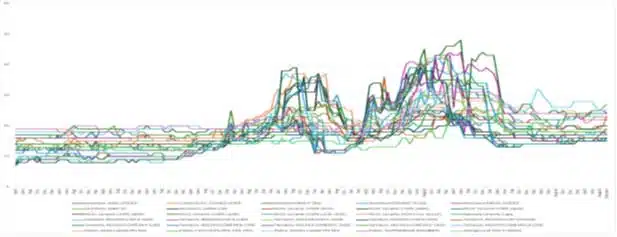
If you are procuring capacitors in 2025, you are facing one of the toughest situations in the history of the electronics industry. The average lead time across all capacitor technologies has reached 19.07 weeks (October 2025), marking a 46% increase compared to the pre-pandemic era.

RelatedPosts

Paumanok Unveils Aluminum Capacitor Foils World Markets Study 2025-2030

Paumanok Releases Capacitor Foils Market Report 2025-2030

2025 Thick and Thin Film Resistor Networks Environment Overview

Overview by Dielectric

  • Most active trends: Aluminum electrolytic and plastic film capacitors.
  • Stable segments: Tantalum capacitors and ceramic MLCC.
MetricOctober 2025Pre-pandemic (2012–2019)Change
Average lead time19 weeks13 weeks+46%

Lead Time Severity Breakdown

  • Most distressed (25–27 weeks):
    • Aluminum Snap-In: 27 weeks (rapid rise)
    • Plastic PET radial: 25 weeks (consistent)
  • High activity (20–24 weeks):
    • Al SMD V-Chip: 24 weeks
    • Al Organic H-Chip: 23 weeks
    • Film chips (PEN, PET, PPS): 23 weeks
    • Plastic snubber (X/Y): 23 weeks
    • Al axial: 22 weeks
    • Al radial: 22 weeks
  • Higher, but manageable (<20 weeks):
    • All MLCC sizes: 15–17 weeks
    • All tantalum sizes: 15–17 weeks

Key Factors Affecting Lead Times

  1. Artificial Intelligence & Data Centers:
    Every AI server uses 5,000–10,000 MLCC and 300–600 aluminum polymer capacitors. Hyperscale data centers (AWS, Azure, Google) drive demand.
  2. Electric Vehicle Revolution:
    EVs use 10,000–22,000 capacitors versus 2,000–3,000 in standard vehicles. EV production: 18M units in 2025, projected 45M units by 2030.
  3. Renewable Energy:
    Growth in solar and wind installations (annual growth 20–30%). EV charging stations contain capacitors worth $400–800 per station.
  4. Industrialization & Electrification:
    Motors, automation, robotics, electric drives are replacing hydraulics. Demand for film and MLCC capacitors is rising.

Why Manufacturing Capacity Is Insufficient

  • Long investment cycles: New MLCC/tantalum factory needs 18–36 months from decision to production.
  • Technological barriers: Advanced capacitors (polymer aluminum, high-CV MLCC, low-ESR tantalum) are limited to few manufacturers.
  • Raw material constraints: Tantalum: legislation/conflict minerals; MLCC ceramics: rare elements; aluminum/plastics: new market requirements.

Outlook for 2026–2027 (Paumanok Base Case, 50% probability)

  • AI/HPC and EV demand will continue to grow.
  • Added manufacturing capacity will be deployed in 2026–2027.
  • Lead times are expected to stabilize at around 19 weeks (Q4 2025 – Q2 2026), rising slightly to 20 weeks in Q4 2026, up to 22 weeks by 2027.
  • Lead times will remain 45–50% above pre-pandemic levels through 2027.

Source: Paumanok Publications, Inc., TTI, Inc., Dennis M. Zogbi

Related

Source: Paumanok, TTI Market Eye
Recent Posts

November 2025 Interconnect, Passives and Electromechanical Components Market Insights

4.12.2025
15

DigiKey Launches 2025 DigiWish Holiday Giveaway for Global Engineering Community

3.12.2025
12

Samtec Releases Rugged Multi-Port SMPM Interconnects with Threaded Coupling

3.12.2025
3

Stackpole Expands Anti-Corrosive Anti-Sulfur Thin Film Chip Resistors

3.12.2025
5

Skeleton Opens €220M Supercapacitor Leipzig Factory

3.12.2025
8

TAIYO YUDEN Extends Polymer Hybrid Aluminum Capacitors with Higher Ripple Current and Lower Profile

3.12.2025
15

Würth Elektronik Extends its Safety Film Capacitors

3.12.2025
14

Researchers Present Novel Graphene-Based Material for Supercapacitors

3.12.2025
11

TDK Releases 35A 750J Current Limiters for High-Power Applications

3.12.2025
10

Upcoming Events

Dec 9
December 9 @ 12:00 - December 11 @ 14:15 EST

Space and Military Standards for Hybrids and RF Microwave Modules

Dec 10
16:00 - 17:00 CET

Designing Qi2 Wireless Power Systems: Practical Development and EMC Optimization

Dec 15
December 15 @ 13:00 - December 18 @ 15:15 EST

Pre Cap Visual Inspection per Mil-Std-883 (TM 2017)

View Calendar

Popular Posts

  • Buck Converter Design and Calculation

    0 shares
    Share 0 Tweet 0
  • Boost Converter Design and Calculation

    0 shares
    Share 0 Tweet 0
  • Flyback Converter Design and Calculation

    0 shares
    Share 0 Tweet 0
  • LLC Resonant Converter Design and Calculation

    0 shares
    Share 0 Tweet 0
  • Ripple Current and its Effects on the Performance of Capacitors

    3 shares
    Share 3 Tweet 0
  • Dual Active Bridge (DAB) Topology

    0 shares
    Share 0 Tweet 0
  • MLCC and Ceramic Capacitors

    0 shares
    Share 0 Tweet 0
  • What Electronics Engineer Needs to Know About Passive Low Pass Filters

    0 shares
    Share 0 Tweet 0
  • What is a Dielectric Constant and DF of Plastic Materials?

    4 shares
    Share 4 Tweet 0
  • SEPIC Converter Design and Calculation

    0 shares
    Share 0 Tweet 0

Newsletter Subscription


Passive Components Blog

© EPCI - Leading Passive Components Educational and Information Site

  • Home
  • Privacy Policy
  • EPCI Membership & Advertisement
  • About

No Result
View All Result
  • Home
  • Knowledge Blog
  • PCNS

© EPCI - Leading Passive Components Educational and Information Site

This website uses cookies. By continuing to use this website you are giving consent to cookies being used. Visit our Privacy and Cookie Policy.
Go to mobile version