





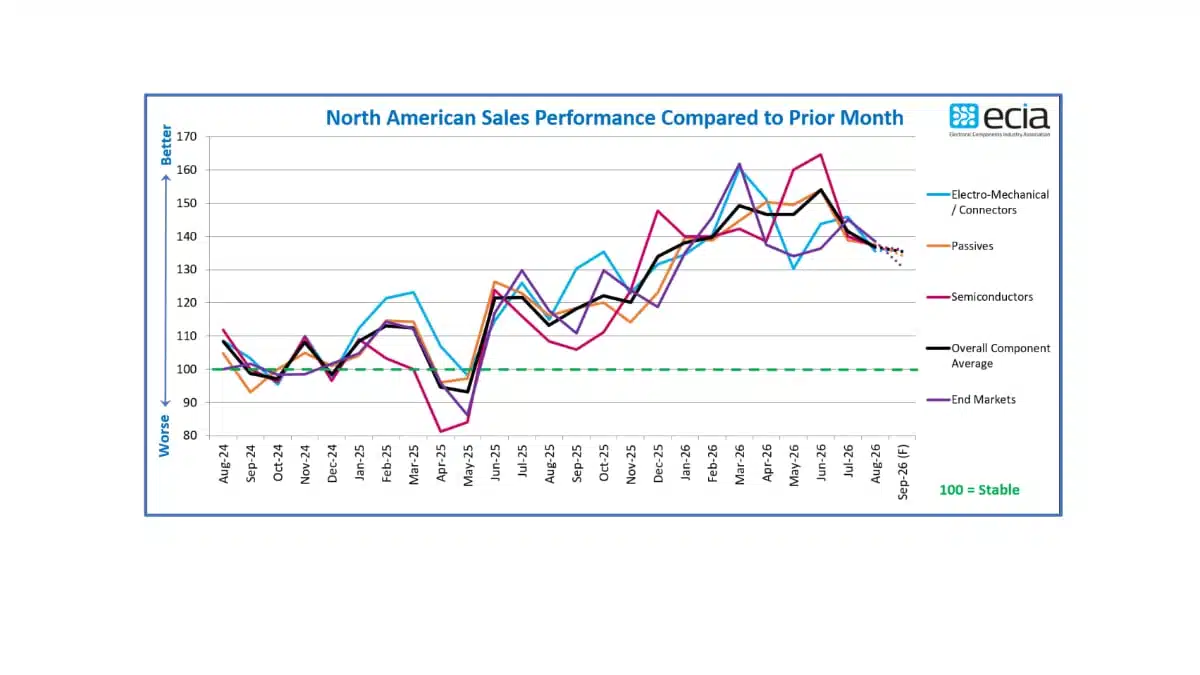
ECIA’s August and Q3 2026 Industry Pulse shows that electronics-component market sentiment is cooling from its June peak, but remains firmly in expansion territory.
Passive components continue to show positive sales expectations, while broadening lead-time pressure makes closer supply-chain monitoring increasingly important.
August Index Retreats From June Peak
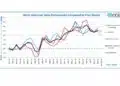
The overall ECIA component sentiment index declined by 4.9 points month over month to 136.7 in August, down 17.4 points from its June peak of 154.1. Despite this moderation, the reading remains well above the scores recorded during the four-and-a-half years preceding the recent market upswing.
Survey respondents expect the overall index to stay broadly stable in September at 135.4. ECIA’s index uses 100 as the neutral threshold, meaning that readings above 100 indicate improving market conditions and sales sentiment.
Q3 Sales Outlook Stays Positive
The Q3 survey confirms a strong near-term sales outlook across the authorized electronics supply chain. Eighty percent of participants reported growth expectations for Q3 compared with Q2, up from 70 percent in the previous quarterly survey, while only 2 to 3 percent expected declining sentiment.
Among respondents, 31 percent anticipated quarter-to-quarter growth above 5 percent and a further 27 percent expected growth between 3 and 5 percent. Expectations are softer for Q4, but 65 percent of participants still projected quarter-to-quarter growth from Q3 into Q4.
Passive Components Close to Semiconductors
The three major component groups—semiconductors, passive components and electro-mechanical/connectors—showed closely aligned monthly sentiment scores in August and in the September forecast, ranging from 134.2 to 137.5.
On a quarterly basis, 83 percent of respondents expected semiconductor growth, while 76 percent expected growth in passive components. The relatively narrow gap indicates that demand strength is extending beyond semiconductors into capacitors, resistors, inductors, magnetics and other critical bill-of-materials categories.
For designers and sourcing teams, the result reinforces the need to manage strategic components as design parameters rather than purely interchangeable commodities. This is particularly important for application-specific or difficult-to-substitute families such as high-capacitance MLCCs, automotive-qualified components and specialized magnetics; see this passive components in 2026 supply-chain analysis.
Lead-Time Pressure Broadens
Lead-time pressure remained exceptionally high across all three main component categories. Between 70 and 75 percent of survey participants reported increasing lead times, and no respondents reported falling lead times in any product category or sub-category during August.
Although DRAM and data-flash memory availability has received much of the industry’s attention, ECIA noted that the pressure is not limited to memory ICs. The survey indicates a wider supply-chain issue affecting semiconductors, passive components and electro-mechanical products.
This environment calls for a component-family-level sourcing strategy rather than reliance on aggregate market averages. Procurement teams should identify critical components with limited second-source options, validate approved alternates early, review distributor commitments and apply targeted buffers where the operational impact of a shortage exceeds inventory carrying costs. Practical context is available in the Passive Electronic Components Lead-times Update.
End Markets Remain Resilient
End-market sentiment also moderated, falling from 145.0 in July to 138.5 in August, with a further decline to 130.8 projected for September. Nevertheless, all surveyed end markets except mobile phones remained above the 100-point growth threshold in August.
ECIA expects mobile phones to reach the neutral-to-growth threshold in September, which would leave every surveyed end market in positive territory. The broad-based nature of the growth outlook supports continued demand for components across industrial, automotive, computing, communications and consumer-electronics supply chains.
Different Views Across the Channel
Manufacturers reported the strongest sales sentiment in August and also held the most positive view for September. Distributors were considerably more cautious in August but expected to align with the overall market average in September.
Manufacturer representatives were slightly more positive than the market average in August, before slipping modestly below the average in the September outlook. The differences underline the value of cross-checking manufacturer allocation signals, channel inventory and customer demand forecasts before making purchasing commitments.
Further reading
- ECIA Industry Pulse Index Cools After Five-Year High
- ECIA Industry Pulse April 2026: Sentiment Cools but Stays Strong
- Commodity to Design Parameter – Passive Components in 2026
- Passive Electronic Components Lead-times Update
Source
This article is based on the ECIA Industry Pulse: Electronic Component Trends and Sentiment executive summary for August and Q3 2026, prepared by ECIA Chief Analyst Dale Ford. The survey provides monthly and quarterly visibility into sales expectations, outlook, cancellations, decommits and lead-time conditions across the authorized electronics-component supply chain.