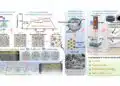












Accurate thermal prediction in magnetics is critical to avoid overheating, improve loss estimation and shorten design cycles. The Frenetic magnetic simulator implements a dedicated thermal model that transforms physical heat transfer in inductors and transformers into an equivalent network, enabling engineers to iterate designs virtually before committing to hardware.
Key Takeaways
- The magnetic thermal model is crucial for avoiding overheating and improving design efficiency.
- It uses a lumped thermal network to simulate heat transfer, mimicking electrical circuits for accuracy.
- Key heat transfer mechanisms include conduction, convection, and radiation, each mapped to thermal resistances.
- The model iterates losses and temperatures, providing accurate predictions validated against real hardware.
- Engineers can use the model to avoid late design surprises and achieve reliable performance in magnetic applications.
Why thermal modeling is essential in magnetics
Thermal behavior directly impacts the reliability and performance of magnetic components such as inductors and transformers. If the thermal model is too optimistic, prototypes may run hotter than expected, forcing redesigns, schedule slips and extra material cost.
A consistent thermal model also feeds back into loss calculations, since both core and winding losses depend on temperature. This closed loop between electrical and thermal domains allows the simulator to converge toward realistic steady‑state temperatures for both core and windings.
Core concept: lumped thermal network
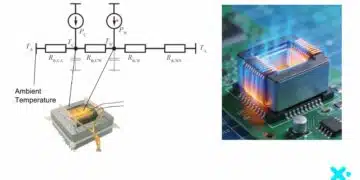
The Frenetic thermal model is built as a lumped thermal network that mirrors an electrical circuit. The main idea is to represent each relevant region of the magnetic (core, inner winding, outer winding, ambient) as nodes connected by thermal resistances.
In this analogy, thermal resistance is the counterpart of electrical resistance, temperature corresponds to voltage, and power flow corresponds to current. For example, a winding node receives the winding losses as “injected current” and dissipates heat toward ambient, the core or other parts of the structure through several thermal paths.
Thermal–electrical analogy
The model uses the following mappings:
- Temperature difference ↔ voltage difference.
- Heat flow (power) ↔ current.
- Thermal resistance ↔ electrical resistance.
- Ambient temperature ↔ circuit ground reference.
This abstraction allows the simulator to assemble complex thermal paths as a network and solve them with methods similar to those used in electrical circuit analysis.
Key heat transfer mechanisms considered
The model explicitly includes three primary heat transfer mechanisms between the magnetic component and its environment.
- Conduction: Heat flow through solid materials such as the core, bobbin and copper windings.
- Convection: Heat transfer from surfaces to surrounding air (natural or forced).
- Radiation: Thermal radiation from the component surfaces to ambient, increasingly important at higher temperatures.
Each mechanism is mapped to one or more thermal resistances in the network. Conduction is typically simpler to model; convection and radiation are more nonlinear and temperature‑dependent, so these receive special attention in the Frenetic implementation.
Key features and benefits
The thermal model in the Frenetic magnetic simulator offers several practical advantages for design and verification workflows.
- Lumped thermal network representation of core and winding with explicit paths to ambient and between internal nodes.
- Support for conduction, convection and radiation, including nonlinear temperature dependence where relevant.
- Iterative coupling between loss model and thermal model to account for temperature‑dependent losses.
- Focused refinement of the most critical resistances: winding‑to‑ambient and core‑to‑ambient, which typically dominate temperature rise.
- Empirically validated accuracy under natural and forced convection using thermocouples on real inductors.
From a user perspective, the result is that the simulator outputs winding and core temperatures as two key numbers, but these numbers come from a physically grounded, validated model rather than simple heuristics.
Typical applications
Although the webinar focuses on the model itself rather than specific applications, the approach is directly applicable to many magnetics use cases where thermal constraints are tight.
- Power inductors in DC‑DC converters (buck, boost, LLC and similar topologies).
- Inductors and transformers in on‑board chargers and off‑line power supplies.
- Magnetics in automotive, industrial and aerospace environments where reliability and derating are critical.
- Designs where potting, constrained airflow or forced convection must be evaluated quantitatively.
In all these cases, being able to predict core and winding temperatures without multiple prototype spins helps shorten time‑to‑market and reduces the risk of thermal‑related field failures.
Technical highlights
Basic formulation of thermal resistance
For conduction, the model uses the classical one‑dimensional thermal resistance formulationwhere is the heat flow path length, is thermal conductivity of the material and is the cross‑sectional area perpendicular to the heat flow. A larger cross‑section reduces the thermal resistance, while a longer path increases it.
For convection, the resistance between a surface and the surrounding fluid is expressed aswhere is the heat transfer coefficient and is the effective surface area. Doubling the surface area halves the thermal resistance if remains constant.
Radiation is modeled with a nonlinear relationship, where the radiated heat depends strongly on the fourth power of absolute temperature difference between the body and ambient. Its contribution becomes more important at elevated temperatures and for surfaces with high emissivity.
Convection modeling with empirical correlations
The most challenging part of the model is the convection path from the outer surfaces of the core and winding to ambient. To handle this, the simulator uses classical empirical correlations based on dimensionless numbers.
- Nusselt number : ratio of convective to conductive heat transfer at a surface.
- Grashof number : ratio of buoyancy forces to viscous forces in the fluid.
- Prandtl number : ratio of momentum diffusivity (viscosity) to thermal diffusivity.
- Rayleigh number Ra: product , describing flow regime (laminar vs turbulent).
For a given geometry and orientation (for example, a vertical plane, horizontal top surface or bottom surface), empirical formulas express the Nusselt number as a function of Rayleigh and Prandtl numbers. Once Nu is known, the heat transfer coefficient is obtained viawhere is the thermal conductivity of the fluid (air in most magnetics cases) and is a characteristic length such as the plate height. This then gives the convection thermal resistance.
These correlations are drawn from standard thermal design references (such as engineering heat atlases) and selected for geometries typical of magnetic components. The implementation distinguishes between laminar and turbulent regimes and uses appropriate formulas depending on Rayleigh number.
Effective surface area considerations
For real magnetic components, winding surfaces are not flat plates but bundles of round wires. The model accounts for this by using an effective surface area higher than the simple rectangular projection, reflecting the increased area due to wire curvature.
This correction improves the match between model and measurements for windings, especially when the winding‑to‑ambient path is significant in the overall thermal budget.
Iterative coupling of losses and temperature
Losses consume electrical power and generate heat, which raises the temperature. In turn, many loss mechanisms depend on temperature (for example, core losses and copper resistance). To capture this interaction, the simulator uses an iterative loop.
- Start with an initial temperature assumption (often equal to ambient).
- Compute losses in core and winding at this temperature.
- Inject these losses into the thermal network to compute an updated temperature distribution.
- Recompute losses at the new temperature and update temperatures again.
- Repeat until both losses and temperatures converge within a defined tolerance.
This coupling improves the realism of both electrical and thermal predictions, reducing the risk of underestimating losses at elevated temperatures.
Validation and accuracy
The Frenetic team validated the thermal model on real inductors equipped with thermocouples on core and winding surfaces. Measurements were taken under both natural convection and forced convection (small wind tunnel) conditions.
- Under natural convection, average error in predicted winding and core temperatures was approximately ±7%. Some operating points were more accurate; others deviated more, but the overall accuracy is considered high for a practical thermal model.
- Under forced convection, the model also showed good agreement with measured values, confirming the validity of the convection correlations and the overall network approach.
A published “thermal fact sheet” summarizes test setups, operating points (ambient temperature, winding losses) and measured versus simulated temperatures for the validation campaign.
Design‑in notes for engineers
From a practical standpoint, the Frenetic thermal model influences several design decisions for engineers using the simulator.
- Prioritise accurate loss input: The thermal model uses winding and core losses as sources. Ensure your electrical model, materials and operating points are realistically defined so that loss predictions are meaningful.
- Pay attention to ambient and airflow conditions: Thermal paths to ambient are highly sensitive to whether convection is natural or forced, and to the orientation of the component. When possible, model the intended mounting orientation and airflow scenario.
- Understand dominant bottlenecks: In many designs, the dominant thermal resistances are winding‑to‑ambient and core‑to‑ambient. Improvements such as larger exposed surface area, better airflow or higher conductivity materials often give the largest temperature reductions.
- Consider the winding window: In practical examples shown, thermal resistance within the winding window (from inner winding to outer winding) can be relatively small and sometimes negligible compared with the external path to ambient. This can influence how aggressively you can pack copper before further increases stop improving thermal performance.
- Use simulation to avoid late surprises: The main business benefit highlighted by the presenters is reduced risk of discovering overheating only at the prototype stage. By performing thermal and electrical iterations early, you can reduce redesign loops, accelerate go‑to‑market and save material cost.
For purchasing and project managers, the presence of a documented, validated thermal model in the toolchain reduces uncertainty and supports more confident commitments on performance and derating.
Practical limitations and outlook
The webinar also mentions limitations and ongoing work. For example, potting compounds and fully potted cores are not yet covered in the present thermal model, and a separate finite‑element‑based approach is under development to address such cases.
Future validation will again be done against real hardware, not just finite‑element simulations, to ensure that extended models preserve the same level of correlation with measurements. For engineers dealing with potted magnetics, the recommendation is to refer to the latest Frenetic documentation and updates as new models become available.
Source
This article is based on a technical webinar by Frenetic’s CTO and colleagues, in which they explain the thermal model of the Frenetic magnetic simulator, its underlying physics, empirical correlations and validation measurements. For exact numerical limits and component‑specific ratings, refer to the manufacturer documentation and datasheets.
References
FAQ: Thermal model of magnetic simulator
The thermal model in the Frenetic magnetic simulator is a lumped thermal network that represents core, windings and ambient as interconnected nodes with thermal resistances. It mirrors an electrical circuit where temperature corresponds to voltage, heat flow to current and thermal resistance to electrical resistance, enabling realistic prediction of core and winding temperatures based on calculated losses.
An accurate thermal model helps prevent overheating of inductors and transformers and avoids discovering thermal issues only at the prototype stage. It also improves loss prediction, because both core and winding losses depend on temperature and must be calculated iteratively together with the thermal behavior.
The model includes conduction through solid materials, convection from component surfaces to surrounding air and thermal radiation from the component surfaces to ambient. These mechanisms are represented as thermal resistances or nonlinear elements in the network so their combined effect on temperature rise can be evaluated.
Convection is modeled using empirical correlations based on dimensionless numbers such as Nusselt, Grashof, Prandtl and Rayleigh. For each geometry and orientation (vertical plane, horizontal top or bottom, gaps), specific equations are used to compute the Nusselt number, heat transfer coefficient and finally the convection thermal resistance.
The simulator performs an iterative loop in which initial temperatures are assumed, core and winding losses are calculated, and these losses are injected into the thermal network to compute updated temperatures. Losses are then recalculated at the new temperatures and the process repeats until both losses and temperatures converge.
Frenetic validated the thermal model on real inductors with thermocouples under natural and forced convection, comparing measured and simulated core and winding temperatures. Under natural convection the average error was about ±7%, and results under forced convection also showed good agreement with measurements.
The current lumped thermal model does not yet fully cover potted cores and certain complex encapsulated structures. Frenetic is working on a finite‑element‑based thermal model to address these cases and plans to validate it again against real measurements rather than only simulations.
How to use thermal modeling in magnetics design with the Frenetic simulator
- Step 1: Define electrical operating conditions and losses
Start by entering realistic electrical operating conditions for your magnetic component, including currents, voltages, switching frequency and waveforms. The simulator uses these inputs to compute core and winding losses, which are the heat sources injected into the thermal network.
- Step 2: Set ambient temperature and convection conditions
Specify the ambient temperature that reflects your application environment, for example 25 °C for lab conditions or higher for under‑hood automotive. Choose whether the component is cooled by natural convection or forced convection and define any relevant airflow assumptions, as these strongly affect the convection thermal resistance.
- Step 3: Confirm geometry and material properties
Ensure that the core geometry, bobbin, winding arrangement and materials (thermal conductivities, emissivities) are correctly defined in the simulator library or your custom model. These parameters control conduction paths through core, copper and bobbin, as well as the effective radiating and convecting surface areas.
- Step 4: Run the coupled loss–thermal simulation
Run the simulation so that the tool iteratively calculates losses and temperatures until convergence. The thermal model will update core and winding temperatures based on the heat sources and thermal resistances, then feed those temperatures back into the loss calculations in several iterations.
- Step 5: Interpret core and winding temperatures
Once the simulation converges, read the resulting core and winding temperatures reported by the simulator, typically as two main values. Compare these temperatures with material limits, insulation classes and your design derating rules to determine whether the design is thermally safe.
- Step 6: Identify dominant thermal bottlenecks
Use the model insight that the dominant resistances are often core‑to‑ambient and winding‑to‑ambient to guide optimization. If temperatures are too high, consider increasing exposed surface area, improving airflow, changing mounting orientation or adjusting materials rather than focusing only on internal conduction paths.
- Step 7: Iterate design to reduce temperature rise
Modify the design parameters such as core size, number of turns, wire gauge or cooling conditions and rerun the simulation. Use the updated temperature and loss results to converge toward a configuration that meets both thermal and electrical requirements before building hardware prototypes.
- Step 8: Be aware of current model limits
If your design includes potted cores or complex encapsulation, check the latest Frenetic documentation because these cases are not yet fully covered by the present lumped model. For such designs, combine simulator results with conservative margins or future FEM‑based extensions once they become available.