








Passive Components Blog
No Result
View All Result
  • Home
  • NewsFilter
    • All
    • Aerospace & Defence
    • Antenna
    • Applications
    • Automotive
    • Capacitors
    • Circuit Protection Devices
    • electro-mechanical news
    • Filters
    • Fuses
    • Inductors
    • Industrial
    • Integrated Passives
    • inter-connect news
    • Market & Supply Chain
    • Market Insights
    • Medical
    • Modelling and Simulation
    • New Materials & Supply
    • New Technologies
    • Non-linear Passives
    • Oscillators
    • Passive Sensors News
    • Resistors
    • RF & Microwave
    • Telecommunication
    • Weekly Digest

    YMIN Introduces Polymer Tantalum Capacitors for AI Server SSDs

    Littelfuse Expands High-Voltage TVS Diodes

    DigiKey Adds 31k New In‑Stock Parts in Q1 2026

    Miniaturization of Tantalum Capacitors: Structural Limit Under Constant Rating

    Heatsink Design and Thermal Interface Materials for Reliable Electronics

    Murata New MLCC Bulk Case Packaging Cuts Packaging Material by 99%

    Wk 17 Electronics Supply Chain Digest

    Exxelia Introduces SMD High‑Voltage Mica Capacitors

    Modelithics Releases COMPLETE v26.1 for Keysight ADS

    Trending Tags

    • Ripple Current
    • RF
    • Leakage Current
    • Tantalum vs Ceramic
    • Snubber
    • Low ESR
    • Feedthrough
    • Derating
    • Dielectric Constant
    • New Products
    • Market Reports
  • VideoFilter
    • All
    • Antenna videos
    • Capacitor videos
    • Circuit Protection Video
    • Filter videos
    • Fuse videos
    • Inductor videos
    • Inter-Connect Video
    • Non-linear passives videos
    • Oscillator videos
    • Passive sensors videos
    • Resistor videos

    Why Power Inductors Use a Ferrite Core With an Air Gap

    Transformer-Based Power-Line Harvester Magnetic Design

    Thermal Modeling of Magnetics

    Standard vs Planar LLC transformers Comparison for Battery Chargers

    How Modern Tools Model Magnetic Components for Power Electronics

    Advanced Loss Modeling for Planar Magnetics in the Frenetic Planar Tool

    2026 Power Magnetics Design Trends: Flyback, DAB and Planar

    Enabling Software‑Defined Vehicle Architectures: Automotive Ethernet and Zonal Smart Power

    Calculating Resistance Value of a Flyback RC Snubber 

    Trending Tags

    • Capacitors explained
    • Inductors explained
    • Resistors explained
    • Filters explained
    • Application Video Guidelines
    • EMC
    • New Products
    • Ripple Current
    • Simulation
    • Tantalum vs Ceramic
  • Knowledge Blog
  • DossiersNew
  • Suppliers
    • Who is Who
  • PCNS
    • PCNS 2025
    • PCNS 2023
    • PCNS 2021
    • PCNS 2019
    • PCNS 2017
  • Events
  • Home
  • NewsFilter
    • All
    • Aerospace & Defence
    • Antenna
    • Applications
    • Automotive
    • Capacitors
    • Circuit Protection Devices
    • electro-mechanical news
    • Filters
    • Fuses
    • Inductors
    • Industrial
    • Integrated Passives
    • inter-connect news
    • Market & Supply Chain
    • Market Insights
    • Medical
    • Modelling and Simulation
    • New Materials & Supply
    • New Technologies
    • Non-linear Passives
    • Oscillators
    • Passive Sensors News
    • Resistors
    • RF & Microwave
    • Telecommunication
    • Weekly Digest

    YMIN Introduces Polymer Tantalum Capacitors for AI Server SSDs

    Littelfuse Expands High-Voltage TVS Diodes

    DigiKey Adds 31k New In‑Stock Parts in Q1 2026

    Miniaturization of Tantalum Capacitors: Structural Limit Under Constant Rating

    Heatsink Design and Thermal Interface Materials for Reliable Electronics

    Murata New MLCC Bulk Case Packaging Cuts Packaging Material by 99%

    Wk 17 Electronics Supply Chain Digest

    Exxelia Introduces SMD High‑Voltage Mica Capacitors

    Modelithics Releases COMPLETE v26.1 for Keysight ADS

    Trending Tags

    • Ripple Current
    • RF
    • Leakage Current
    • Tantalum vs Ceramic
    • Snubber
    • Low ESR
    • Feedthrough
    • Derating
    • Dielectric Constant
    • New Products
    • Market Reports
  • VideoFilter
    • All
    • Antenna videos
    • Capacitor videos
    • Circuit Protection Video
    • Filter videos
    • Fuse videos
    • Inductor videos
    • Inter-Connect Video
    • Non-linear passives videos
    • Oscillator videos
    • Passive sensors videos
    • Resistor videos

    Why Power Inductors Use a Ferrite Core With an Air Gap

    Transformer-Based Power-Line Harvester Magnetic Design

    Thermal Modeling of Magnetics

    Standard vs Planar LLC transformers Comparison for Battery Chargers

    How Modern Tools Model Magnetic Components for Power Electronics

    Advanced Loss Modeling for Planar Magnetics in the Frenetic Planar Tool

    2026 Power Magnetics Design Trends: Flyback, DAB and Planar

    Enabling Software‑Defined Vehicle Architectures: Automotive Ethernet and Zonal Smart Power

    Calculating Resistance Value of a Flyback RC Snubber 

    Trending Tags

    • Capacitors explained
    • Inductors explained
    • Resistors explained
    • Filters explained
    • Application Video Guidelines
    • EMC
    • New Products
    • Ripple Current
    • Simulation
    • Tantalum vs Ceramic
  • Knowledge Blog
  • DossiersNew
  • Suppliers
    • Who is Who
  • PCNS
    • PCNS 2025
    • PCNS 2023
    • PCNS 2021
    • PCNS 2019
    • PCNS 2017
  • Events
No Result
View All Result
Passive Components Blog
No Result
View All Result

Thermocouple physics – How it works

4.10.2016
Reading Time: 3 mins read
A A

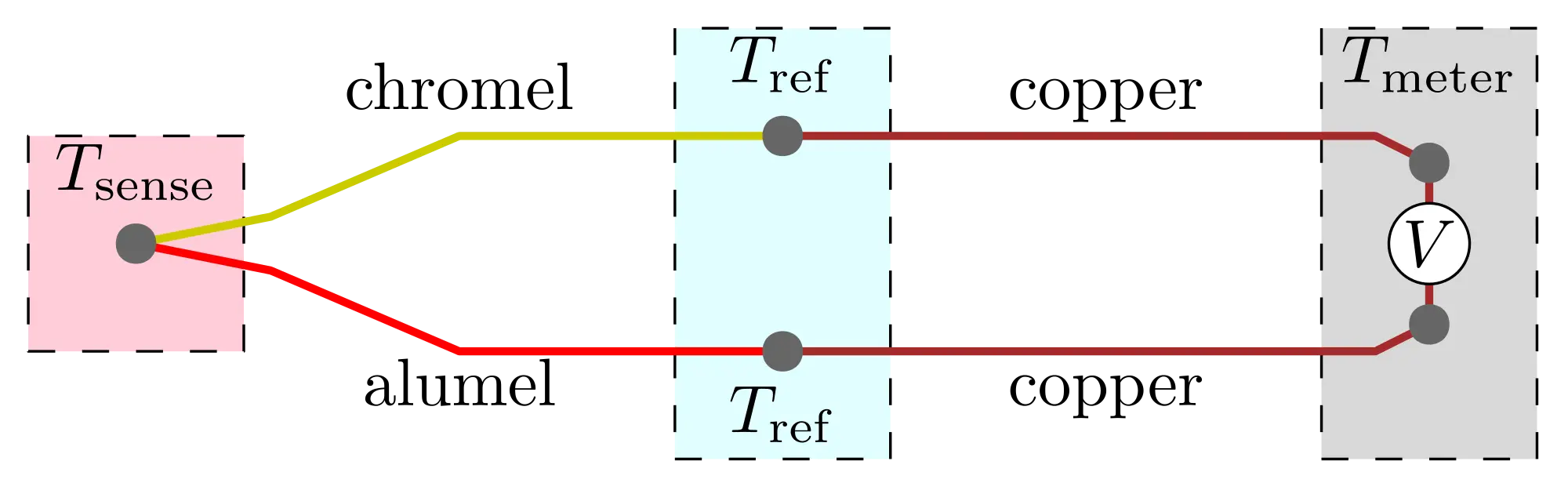
source: EDN article

Martin Rowe -October 02, 2016
Early in my editorial career, I wrote an article about thermocouples in Test & Measurement World where I incorrectly said that a voltage proportional to the junction temperature develops across the junction of two dissimilar metals. A reader wrote me a detailed letter (on paper, no e-mail then) explaining the Seebeck effect. Ever since, whenever I see anything about thermocouples using the incorrect description, I realize that yet another author is perpetuating the same old error.

RelatedPosts

YMIN Introduces Polymer Tantalum Capacitors for AI Server SSDs

Littelfuse Expands High-Voltage TVS Diodes

DigiKey Adds 31k New In‑Stock Parts in Q1 2026

When Gordon Lee sent me his article Thermocouples: Basic principles and design essentials, I immediately looked for how he described thermocouple physics. He got it right. Jim Williams, however, made the same mistake I made.

While skimming through some EDN print issues, I ran across a letter to the editor written by Bill Dubé in the September 1, 1988 issue (Signals and noise, p.32). Dubé pointed out that Jim Williams made the same mistake in an article on thermocouple circuits from the May 26, 1988 issue, Clever techniques improve thermocouple measurements. EDN’s editors notified Williams of the letter. Jim did his homework and replied that he indeed got it wrong. See the text of the letter below, reprinted from the September 1 issue.

Some 20+ years after I made the same mistake, I feel exonerated, even though two wrongs don’t make a right (except in digital logic).

Thermocouple misconceptions are common

Jim Williams’s fine article “Clever techniques improve thermocouple measurements” (EDN, May 26, 1988, pg 145) is sadly flawed by a basic misunderstanding of the physics of thermocouples. It is a common misconception that the voltage of a thermocouple is generated across the junction. This is simply not true. The voltage is generated along the wires and is driven by the temperature difference between the sensing junction and the reference (“cold”) junction. For a given temperature difference, the two dissimilar wires generate unequal voltages. The voltage appearing across the thermocouple circuit at the reference junction is the difference between these unequal voltages.

The more technical explanation is that for a given temperature gradient dT/dx, an electric field dV/dx is generated. This electric field is a function of both dT/dx and absolute temperature. The local value of the difference dV/dT for a given alloy pair at a particular temperature is called the Seebeck coefficient. If the integral of the Seebeck coefficient is evaluated between-the sensing junction and the reference junction, the thermoelectric voltage results.

Thermal voltages in thermocouple circuits are always the result of thermal gradients. If a section of a thermocouple circuit has an unknown or undesirable Seebeck coefficient, then its influence can be diminished by suppressing thermal gradients in that section. For example, when you make a connection in a thermocouple circuit, it’s best to thermally anchor each of the wires to a common temperature before they reach the electrical connection point. The connection point should also be thermally anchored to this temperature. This procedure tends to suppress thermal gradients across the oxides, unknown alloys, etc, that make up the connection. If the thermal gradients are sup pressed, spurious thermal voltages will be reduced.

I hope this explanation will help clear up some of the misconceptions about the physics of thermocouples. Jim Williams is not alone in his misunderstanding—I have seen a remarkably similar treatment of thermocouples in a high-school physics text that is currently being used by the Denver School Dept.

Bill Dubé
Mechanical Engineer Denver, CO


Jim Williams responds:
Some friends and I have reviewed Bill Dubé’s comments and found them to be quite correct. As such, I find myself corrected, educated, and apologizing for any confusion I may have caused EDN’s readers. Although Bill’s distinctions are subtle, they are still the more correct interpretation, and I appreciate his remarks.
Related

Recent Posts

DigiKey Launches “Engineering Unlocked” Video Series

26.3.2026
21

Nanocrystalline Cores for Low‑Loss MHz Chip Inductors

25.3.2026
71
Schematic illustration of the electric double layer of porous carbon electrodes at elevated potentials in a a conventional electrolyte and b a weakly solvating electrolyte; source: authors

Researchers Presented Lignin-based Electrolyte for 4V Supercapacitors with Low Self‑Discharge

19.3.2026
37

Würth Elektronik and Grinn Launch Edge AI Cooperation

13.3.2026
31
Researchers developed a polymer capacitor by combining two cheap, commercially available plastics. The new polymer capacitor makes use of the transparent material — pictured here, with vintage Penn State athletic marks visible through it — to store four times the energy and withstand significantly more heat.  Credit: Penn State

Penn State Demonstrated Polymer Alloy Capacitor Film with 4× Energy Density up to 250C

19.2.2026
81

TU Wien Sets New Benchmark in Superconducting Vacuum Gap nanoCapacitors

16.2.2026
27

Murata Publishes Power Delivery Guide for AI Servers

4.2.2026
203

Researchers Demonstrated 32nm Aluminum Vacuum Gap Capacitor

20.1.2026
59
Credit: Institute of Science Tokyo

Researchers Demonstrated 30nm Ferroelectric Capacitor for Compact Memory

2.1.2026
58

Upcoming Events

Apr 30
10:00 - 11:00 CDT

Programming Embedded Systems

May 5
16:00 - 17:00 CEST

Understanding and Selecting Capacitors – Fundamentals, Technologies and Latest Trends

May 7
17:00 - 18:00 CEST

From Grid to Motion: How Industrial Electrification is Redefining Power System Design

View Calendar

Popular Posts

  • Buck Converter Design and Calculation

    0 shares
    Share 0 Tweet 0
  • Boost Converter Design and Calculation

    0 shares
    Share 0 Tweet 0
  • Flyback Converter Design and Calculation

    0 shares
    Share 0 Tweet 0
  • LLC Resonant Converter Design and Calculation

    0 shares
    Share 0 Tweet 0
  • MLCC and Ceramic Capacitors

    0 shares
    Share 0 Tweet 0
  • Dual Active Bridge (DAB) Topology

    0 shares
    Share 0 Tweet 0
  • What Electronics Engineer Needs to Know About Passive Low Pass Filters

    0 shares
    Share 0 Tweet 0
  • Capacitor Charging and Discharging

    0 shares
    Share 0 Tweet 0
  • MLCC Case Sizes Standards Explained

    0 shares
    Share 0 Tweet 0
  • Ripple Current and its Effects on the Performance of Capacitors

    3 shares
    Share 3 Tweet 0

Newsletter Subscription


Passive Components Blog

© EPCI - Leading Passive Components Educational and Information Site

  • Home
  • Privacy Policy
  • EPCI Membership & Advertisement
  • About

No Result
View All Result
  • Home
  • Knowledge Blog
  • PCNS

© EPCI - Leading Passive Components Educational and Information Site

This website uses cookies. By continuing to use this website you are giving consent to cookies being used. Visit our Privacy and Cookie Policy.
Go to mobile version