



Passive Components Blog
No Result
View All Result
  • Home
  • NewsFilter
    • All
    • Aerospace & Defence
    • Antenna
    • Applications
    • Automotive
    • Capacitors
    • Circuit Protection Devices
    • electro-mechanical news
    • Filters
    • Fuses
    • Inductors
    • Industrial
    • Integrated Passives
    • inter-connect news
    • Market & Supply Chain
    • Market Insights
    • Medical
    • Modelling and Simulation
    • New Materials & Supply
    • New Technologies
    • Non-linear Passives
    • Oscillators
    • Passive Sensors News
    • Resistors
    • RF & Microwave
    • Telecommunication
    • Weekly Digest

    RF Inductors: Selection and Design Challenges for High-Frequency Circuits

    Wk 45 Electronics Supply Chain Digest

    Transformer Safety IEC 61558 Standard

    ESR of Capacitors, Measurements and Applications

    Murata Christophe Pottier Appointed President of EPCIA

    3-Phase EMI Filter Design, Simulation, Calculation and Test

    YAGEO Unveils Compact 2.4 GHz SMD Antenna

    KYOCERA AVX Releases Antenna for Iridium Satellite IoT Applications

    Molex Releases Industry-First Quad-Row Board-to-Board Connectors with EMI Shields

    Trending Tags

    • Ripple Current
    • RF
    • Leakage Current
    • Tantalum vs Ceramic
    • Snubber
    • Low ESR
    • Feedthrough
    • Derating
    • Dielectric Constant
    • New Products
    • Market Reports
  • VideoFilter
    • All
    • Antenna videos
    • Capacitor videos
    • Circuit Protection Video
    • Filter videos
    • Fuse videos
    • Inductor videos
    • Inter-Connect Video
    • Non-linear passives videos
    • Oscillator videos
    • Passive sensors videos
    • Resistor videos

    RF Inductors: Selection and Design Challenges for High-Frequency Circuits

    Transformer Safety IEC 61558 Standard

    3-Phase EMI Filter Design, Simulation, Calculation and Test

    Transformer Design Optimization for Power Electronics Applications

    Common Mode Chokes Selection for RF Circuits in Next-Generation Communication Systems

    Capacitor Self-balancing in a Flying-Capacitor Buck Converter

    How to Select Ferrite Bead for Filtering in Buck Boost Converter

    Power Inductors Future: Minimal Losses and Compact Designs

    Percolation Phenomenon: Degradation of Molded Power Inductors in DC/DC Converters

    Trending Tags

    • Capacitors explained
    • Inductors explained
    • Resistors explained
    • Filters explained
    • Application Video Guidelines
    • EMC
    • New Products
    • Ripple Current
    • Simulation
    • Tantalum vs Ceramic
  • Knowledge Blog
  • Suppliers
    • Who is Who
  • PCNS
    • PCNS 2025
    • PCNS 2023
    • PCNS 2021
    • PCNS 2019
    • PCNS 2017
  • Events
  • Home
  • NewsFilter
    • All
    • Aerospace & Defence
    • Antenna
    • Applications
    • Automotive
    • Capacitors
    • Circuit Protection Devices
    • electro-mechanical news
    • Filters
    • Fuses
    • Inductors
    • Industrial
    • Integrated Passives
    • inter-connect news
    • Market & Supply Chain
    • Market Insights
    • Medical
    • Modelling and Simulation
    • New Materials & Supply
    • New Technologies
    • Non-linear Passives
    • Oscillators
    • Passive Sensors News
    • Resistors
    • RF & Microwave
    • Telecommunication
    • Weekly Digest

    RF Inductors: Selection and Design Challenges for High-Frequency Circuits

    Wk 45 Electronics Supply Chain Digest

    Transformer Safety IEC 61558 Standard

    ESR of Capacitors, Measurements and Applications

    Murata Christophe Pottier Appointed President of EPCIA

    3-Phase EMI Filter Design, Simulation, Calculation and Test

    YAGEO Unveils Compact 2.4 GHz SMD Antenna

    KYOCERA AVX Releases Antenna for Iridium Satellite IoT Applications

    Molex Releases Industry-First Quad-Row Board-to-Board Connectors with EMI Shields

    Trending Tags

    • Ripple Current
    • RF
    • Leakage Current
    • Tantalum vs Ceramic
    • Snubber
    • Low ESR
    • Feedthrough
    • Derating
    • Dielectric Constant
    • New Products
    • Market Reports
  • VideoFilter
    • All
    • Antenna videos
    • Capacitor videos
    • Circuit Protection Video
    • Filter videos
    • Fuse videos
    • Inductor videos
    • Inter-Connect Video
    • Non-linear passives videos
    • Oscillator videos
    • Passive sensors videos
    • Resistor videos

    RF Inductors: Selection and Design Challenges for High-Frequency Circuits

    Transformer Safety IEC 61558 Standard

    3-Phase EMI Filter Design, Simulation, Calculation and Test

    Transformer Design Optimization for Power Electronics Applications

    Common Mode Chokes Selection for RF Circuits in Next-Generation Communication Systems

    Capacitor Self-balancing in a Flying-Capacitor Buck Converter

    How to Select Ferrite Bead for Filtering in Buck Boost Converter

    Power Inductors Future: Minimal Losses and Compact Designs

    Percolation Phenomenon: Degradation of Molded Power Inductors in DC/DC Converters

    Trending Tags

    • Capacitors explained
    • Inductors explained
    • Resistors explained
    • Filters explained
    • Application Video Guidelines
    • EMC
    • New Products
    • Ripple Current
    • Simulation
    • Tantalum vs Ceramic
  • Knowledge Blog
  • Suppliers
    • Who is Who
  • PCNS
    • PCNS 2025
    • PCNS 2023
    • PCNS 2021
    • PCNS 2019
    • PCNS 2017
  • Events
No Result
View All Result
Passive Components Blog
No Result
View All Result

Enhancing Energy Density in Nanocomposite Dielectric Capacitors

9.10.2025
Reading Time: 4 mins read
A A


Bartosz Gackowski at col from SDU University in Denmark published their paper “Enhancing energy density in thin-film nanocomposite dielectric capacitors through surface functionalization of nanoparticles” in Energy Conversion and Management: X Journal.

Introduction

Thin-film dielectric capacitors are essential components in modern power electronics, offering high-frequency stability and rapid charge-discharge capabilities. However, their energy density remains constrained by the intrinsic properties of polymer dielectrics such as polypropylene (PP) used in film capacitors.

RelatedPosts

RF Inductors: Selection and Design Challenges for High-Frequency Circuits

Wk 45 Electronics Supply Chain Digest

Transformer Safety IEC 61558 Standard

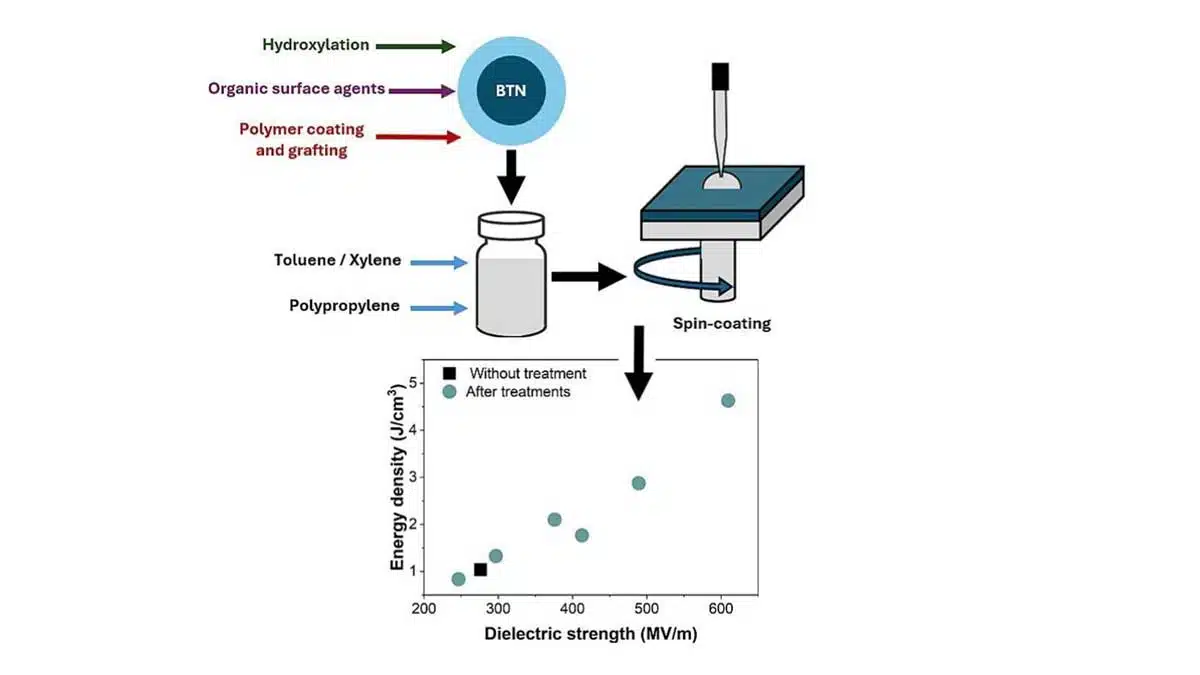
This article explores a novel approach to enhancing energy density through surface functionalization of barium titanate nanoparticles (BTNs), integrated into PP matrices using a gel-based spin-coating method. Barium titanate is a common ferroelectric dielectric material used by class II MLCC ceramic capacitors.

Key Points

  • Functionalization of BTNs significantly improves dielectric constant and breakdown strength.
  • Surface treatments include hydroxylation, organic modifiers, polymer coating, and grafting.
  • Energy density increased by up to 308% compared to untreated BTN composites.
  • Polymer coating and grafting yielded the highest dielectric strength and energy density.
  • Applications span electric vehicles, grid storage, and high-voltage converters.

Extended Summary

Chapter 1: Materials and Functionalization Techniques

BTNs were treated using four distinct methods: hydroxylation (H2O2 or HNO3), organic surface agents (dopamine, silane, phosphorous acid, etc.), polymer coating with PP, and grafting with PPgMA. These treatments aimed to improve nanoparticle dispersion, reduce agglomeration, and tailor interfacial properties for enhanced dielectric performance.

Chapter 2: Fabrication of Nanocomposite Capacitors

Functionalized BTNs were dispersed in a PP gel and spin-coated onto silver-coated glass substrates. A layered structure was employed to mitigate short-circuit risks from agglomerates. Aluminium top electrodes were deposited to complete the capacitor structure. Dielectric thicknesses remained below 1 µm, ensuring compact device profiles.

Chapter 3: Chemical and Structural Analysis

XPS and EDX analyses confirmed successful surface modification, with increased oxygen and carbon content correlating to improved dispersion and interfacial bonding. Dopamine-treated BTNs exhibited the highest carbon concentration, indicating robust surface coverage. FTIR spectra revealed functional group incorporation, supporting the chemical bonding hypotheses.

Chapter 4: Dispersion and Agglomeration Control

Dynamic Light Scattering (DLS) showed that hydroxylation reduced particle size and agglomeration. Polymer-coated and grafted nanoparticles exhibited increased hydrodynamic diameters, suggesting shell formation. Proper dispersion was critical for maintaining high breakdown strength and uniform electric field distribution.

Chapter 5: Dielectric Performance Metrics

Capacitance, dielectric constant, and breakdown strength were measured across all samples. Devices with maleic anhydride and dopamine-modified BTNs showed up to 47% increase in capacitance. Polymer-coated BTNs achieved the highest breakdown strength (108% improvement), resulting in energy densities up to 5.2 J/cm3.

SampleDielectric Constant (εr)Breakdown Strength (MV/m)Energy Density (J/cm3)
Neat PP2.07001.3
BTN + Maleic Anhydride3.813772.4
BTN + Dopamine3.54122.0
BTN + PP Coating3.16085.2
BTN + PPgMA Grafting2.94803.1

Chapter 6: Applications in Power Electronics

Enhanced nanocomposite capacitors are ideal for high-voltage converters, electric vehicles, and grid storage systems. Their compact size and high energy density support integration with wide-bandgap semiconductors (SiC, GaN), enabling efficient, lightweight designs. Hybrid capacitor systems combining electrolytic and film capacitors benefit from improved ripple current handling and extended lifespan.

Conclusion

This study demonstrates that surface functionalization of BTNs is a critical strategy for improving the energy density of PP-based nanocomposite capacitors. Among the tested methods, polymer coating and grafting yielded the most significant performance gains. These findings pave the way for next-generation capacitors in high-efficiency power electronics, offering reduced size, weight, and enhanced reliability.

Read the full article at the link:

Bartosz Mikolaj Gackowski, Mohit Sharma, Alexandru Valuta, Thomas Ebel, William Greenbank,
Enhancing energy density in thin-film nanocomposite dielectric capacitors through surface functionalization of nanoparticles,
Energy Conversion and Management: X, Volume 28, 2025, 101260, ISSN 2590-1745,
https://doi.org/10.1016/j.ecmx.2025.101260.
(https://www.sciencedirect.com/science/article/pii/S2590174525003927)

Related

Source: ScienceDirect

Recent Posts

RF Inductors: Selection and Design Challenges for High-Frequency Circuits

10.11.2025
22

Transformer Safety IEC 61558 Standard

7.11.2025
7

ESR of Capacitors, Measurements and Applications

7.11.2025
29

3-Phase EMI Filter Design, Simulation, Calculation and Test

6.11.2025
39

Molex Releases Industry-First Quad-Row Board-to-Board Connectors with EMI Shields

6.11.2025
8
Image credit: Samtec

How to Match the Right Connector with Protocol Requirements

6.11.2025
13

Smoltek CNF-MIM Capacitors Pass 1,000h Reliability Test

6.11.2025
11

Capacitor Lead Times: October 2025

6.11.2025
64

Paumanok Unveils Aluminum Capacitor Foils World Markets Study 2025-2030

6.11.2025
14

Upcoming Events

Nov 11
17:00 - 18:00 CET

Industrial Applications Demand More from Interconnects in Next-Gen Designs

Nov 12
11:00 - 12:00 CET

PCB Design: Impedance is for everyone!

Nov 12
November 12 @ 12:00 - November 13 @ 14:15 EST

Microelectronic Packaging Failure Modes and Analysis

View Calendar

Popular Posts

  • Buck Converter Design and Calculation

    0 shares
    Share 0 Tweet 0
  • Boost Converter Design and Calculation

    0 shares
    Share 0 Tweet 0
  • LLC Resonant Converter Design and Calculation

    0 shares
    Share 0 Tweet 0
  • Flyback Converter Design and Calculation

    0 shares
    Share 0 Tweet 0
  • Ripple Current and its Effects on the Performance of Capacitors

    3 shares
    Share 3 Tweet 0
  • MLCC and Ceramic Capacitors

    0 shares
    Share 0 Tweet 0
  • Dual Active Bridge (DAB) Topology

    0 shares
    Share 0 Tweet 0
  • SEPIC Converter Design and Calculation

    0 shares
    Share 0 Tweet 0
  • What is a Dielectric Constant and DF of Plastic Materials?

    4 shares
    Share 4 Tweet 0
  • Flying Capacitors

    0 shares
    Share 0 Tweet 0

Newsletter Subscription


Passive Components Blog

© EPCI - Leading Passive Components Educational and Information Site

  • Home
  • Privacy Policy
  • EPCI Membership & Advertisement
  • About

No Result
View All Result
  • Home
  • Knowledge Blog
  • PCNS

© EPCI - Leading Passive Components Educational and Information Site

This website uses cookies. By continuing to use this website you are giving consent to cookies being used. Visit our Privacy and Cookie Policy.
Go to mobile version