

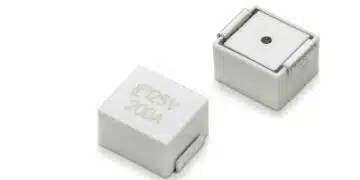








YAGEO Group’s new PTLA / PTLC 3.6 kW LLC transformer platform targets high‑power, high‑density converters where efficiency, isolation and board space are critical.
The design integrates the resonant inductance into the transformer itself, allowing engineers to simplify LLC stages, reduce magnetic count and optimize cost in applications such as EV chargers, AI power shelves and server power supplies.
Key features and benefits
The YAGEO PTLA / PTLC series is a 3.6 kW LLC transformer platform in a compact, high‑power package aimed at next‑generation power architectures.
Key characteristics include:
- Power handling up to 3.6 kW in a 53 × 52 × 43 mm max form factor
- Integrated primary‑side leakage inductance of 6.4 µH dedicated to the LLC resonant tank
- Open‑circuit inductance of 42.4 µH
- Isolation rating of 4.2 kVrms with basic insulation
- Minimum 5 mm creepage and clearance distance
- Designed according to IATF requirements and compatible with AEC‑Q200 qualification
- RoHS, REACH and halogen‑free compliant construction
From a practical perspective, concentrating and controlling the leakage inductance inside the transformer means the designer can rely on the magnetics vendor for tight inductance tolerance instead of tuning a separate resonant inductor on the PCB. This reduces design risk in high‑volume builds where repeatable resonant frequency and soft‑switching behavior are key to meeting efficiency and thermal targets.
Integrated resonant inductance in LLC topologies
In a typical LLC half‑bridge or full‑bridge converter, the resonant tank uses a series inductance and capacitance to shape the converter’s gain curve and enable soft switching. In many designs, the series inductance is partly or fully implemented as a discrete resonant inductor plus the transformer’s leakage inductance.
With the PTLA / PTLC series, YAGEO concentrates approximately 6.4 µH of controlled leakage inductance on the primary side so that essentially all of this leakage inductance participates in the resonant circuit. This has several practical consequences:
- The external resonant inductor can often be eliminated entirely.
- The magnetic component count is reduced to a single transformer for the main power stage.
- PCB area dedicated to magnetics shrinks, which is valuable in dense server or charger designs.
- Bill of materials cost can be lowered by removing a large power inductor and its associated footprint, clearance and assembly steps.
For LLC designers, this approach simplifies magnetics selection: instead of co‑optimizing a transformer plus a separate resonant inductor, the resonant parameters are tied directly to a standard transformer platform. This is especially attractive where standardized power stages or reference designs are reused across multiple products.
Typical applications
The PTLA / PTLC platform targets high‑power conversion stages where kilowatt‑level density and isolation are required:
- EV charging
Suitable for on‑board chargers and off‑board DC chargers that use LLC stages in the isolated DC/DC section, where high efficiency and compact magnetics help meet volume and thermal constraints. - AI computing and data servers
Fits high‑power server and AI accelerator power shelves using intermediate bus or isolated DC/DC stages, where 3.6 kW per transformer aligns with multi‑kW PSU ratings and enables high power per rack unit. - Telecom infrastructure
Addresses isolated power modules and rectifiers in telecom base stations and central office equipment, where high power density and standardized magnetics streamline platform designs. - Intermediate bus converters and power supplies
Applicable to high‑power intermediate bus converters or bulk power supplies in industrial and ICT equipment, particularly where LLC topology is used for its efficiency and EMI behavior.
By standardizing on a first‑to‑market kW‑class LLC transformer platform, OEMs can reuse the same magnetic building block across EV, data center and telecom projects, simplifying qualification and supply chain management.
Technical highlights
Electrical and safety parameters
- Power rating: up to 3.6 kW
Supports high‑power LLC stages in the multi‑kilowatt class, reducing the number of parallel transformers required in many designs. - Open‑circuit inductance: 42.4 µH
Defines the magnetizing inductance relevant for LLC gain and no‑load behavior; designers should cross‑check detailed values and tolerances in the manufacturer datasheet for accurate simulation and loss estimation. - Controlled leakage inductance: 6.4 µH on primary
Provides the main series inductance for the resonant tank, allowing the LLC resonant inductance Lr to be derived primarily from the transformer design instead of an external choke. - Isolation: 4.2 kVrms with basic insulation
Supports reinforced isolation requirements in many industrial and ICT applications when combined with appropriate PCB layout and system creepage design, but exact safety ratings should be verified against the applicable standards in the datasheet. - Creepage and clearance: ≥ 5 mm
Helps meet typical system‑level insulation and clearance requirements for mains‑connected equipment; designers must still verify against the target system voltage and pollution degree.
Mechanical and platform aspects
- Mechanical envelope: 53 × 52 × 43 mm max
Offers a compact footprint for a 3.6 kW transformer, enabling high power density layouts and easier placement near power switches to minimize loop inductance. - Modular and scalable platform
The PTLA / PTLC family is designed as a platform that can be extended to higher power levels and adapted to evolving architectures (for example, higher output current variants or different secondary configurations), according to information available from the manufacturer. - Full winding automation
Automated winding improves consistency of inductance values, leakage control and insulation distances, which is important for maintaining LLC performance and safety margins across large production volumes.
Design‑in notes for engineers
When designing an LLC stage around the PTLA / PTLC transformer, consider the following practical points:
- Resonant tank design
Use the specified 6.4 µH leakage inductance as the primary contribution to Lr in the LLC tank and verify the effective resonant frequency against the desired operating range. If small external inductance is still required for fine tuning, keep it minimal to preserve the integration benefits. - Magnetizing inductance and gain curve
The ratio of magnetizing inductance Lm to resonant inductance Lr is crucial for shaping the converter gain and achieving soft switching over the intended load and input range. Base calculations on the open‑circuit inductance value and tolerances from the datasheet, and validate using circuit simulation and bench measurements. - Thermal management
At 3.6 kW levels, transformer copper and core losses can be significant. Plan for adequate airflow or conduction paths, and pay attention to placement relative to switching devices to avoid hot spots. The compact 53 × 52 × 43 mm housing simplifies mechanical design but increases the importance of good system‑level cooling. - Layout and EMI
By eliminating a separate resonant inductor, loop areas around the primary switching path can often be shortened, which helps reduce stray inductance and EMI. Place the PTLA / PTLC transformer close to the primary MOSFETs or IGBTs, and use careful routing of primary and secondary current paths to minimize parasitic coupling. - Safety and compliance
Even though the transformer offers 4.2 kVrms isolation, basic insulation, and 5 mm creepage and clearance, the final equipment must be assessed against applicable safety standards (such as IEC 62368‑1 or related EV/industrial norms). Treat the transformer data as one part of the insulation coordination design and confirm all values “according to manufacturer datasheet.” - Automotive and industrial platforms
The automotive‑ready, IATF‑aligned design and compatibility with AEC‑Q200 make this platform attractive for EV and other transportation power electronics. For such projects, it is advisable to align component selection with the OEM’s existing AEC‑Q and PPAP requirements early in the design cycle.
By leveraging a standardized kW‑class LLC transformer platform with integrated resonant inductance, engineers can reduce time‑to‑market, shrink BOM complexity, and rely on a repeatable magnetic design that has been tuned specifically for LLC operation at multi‑kilowatt levels.
Source
This article is based on information provided by YAGEO Group in their official product communication for the PTLA / PTLC 3.6 kW LLC transformer platform, complemented with general application context and design‑in considerations that engineers should verify against the official datasheet for their specific design.