











Passive Components Blog
No Result
View All Result
  • Home
  • NewsFilter
    • All
    • Aerospace & Defence
    • Antenna
    • Applications
    • Automotive
    • Capacitors
    • Circuit Protection Devices
    • electro-mechanical news
    • Filters
    • Fuses
    • Inductors
    • Industrial
    • Integrated Passives
    • inter-connect news
    • Market & Supply Chain
    • Market Insights
    • Medical
    • Modelling and Simulation
    • New Materials & Supply
    • New Technologies
    • Non-linear Passives
    • Oscillators
    • Passive Sensors News
    • Resistors
    • RF & Microwave
    • Telecommunication
    • Weekly Digest

    Enabling Software‑Defined Vehicle Architectures: Automotive Ethernet and Zonal Smart Power

    Calculating Resistance Value of a Flyback RC Snubber 

    Wk 5 Electronics Supply Chain Digest

    Top 10 Connector Vendors by Product Type

    Bourns Releases High‑Q Air Coil Inductors for RF Aplications

    CMSE 2026 Announces Call for Presentations on High-Reliability Military and Space Electronics

    ESA Call for Papers 6th Space Passive Component Days – SPCD 2026

    Würth Elektronik Offers Halogen‑Free EMC Gaskets for Displays and Housings

    Component Distribution Supply Chain January 2026

    Trending Tags

    • Ripple Current
    • RF
    • Leakage Current
    • Tantalum vs Ceramic
    • Snubber
    • Low ESR
    • Feedthrough
    • Derating
    • Dielectric Constant
    • New Products
    • Market Reports
  • VideoFilter
    • All
    • Antenna videos
    • Capacitor videos
    • Circuit Protection Video
    • Filter videos
    • Fuse videos
    • Inductor videos
    • Inter-Connect Video
    • Non-linear passives videos
    • Oscillator videos
    • Passive sensors videos
    • Resistor videos

    Enabling Software‑Defined Vehicle Architectures: Automotive Ethernet and Zonal Smart Power

    Calculating Resistance Value of a Flyback RC Snubber 

    One‑Pulse Characterization of Nonlinear Power Inductors

    Thermistor Linearization Challenges

    Coaxial Connectors and How to Connect with PCB

    PCB Manufacturing, Test Methods, Quality and Reliability

    Transformer Behavior – Current Transfer and Hidden Feedback

    Choosing the Right Capacitor: The Importance of Accurate Measurements

    RF Inductors: Selection and Design Challenges for High-Frequency Circuits

    Trending Tags

    • Capacitors explained
    • Inductors explained
    • Resistors explained
    • Filters explained
    • Application Video Guidelines
    • EMC
    • New Products
    • Ripple Current
    • Simulation
    • Tantalum vs Ceramic
  • Knowledge Blog
  • DossiersNew
  • Suppliers
    • Who is Who
  • PCNS
    • PCNS 2025
    • PCNS 2023
    • PCNS 2021
    • PCNS 2019
    • PCNS 2017
  • Events
  • Home
  • NewsFilter
    • All
    • Aerospace & Defence
    • Antenna
    • Applications
    • Automotive
    • Capacitors
    • Circuit Protection Devices
    • electro-mechanical news
    • Filters
    • Fuses
    • Inductors
    • Industrial
    • Integrated Passives
    • inter-connect news
    • Market & Supply Chain
    • Market Insights
    • Medical
    • Modelling and Simulation
    • New Materials & Supply
    • New Technologies
    • Non-linear Passives
    • Oscillators
    • Passive Sensors News
    • Resistors
    • RF & Microwave
    • Telecommunication
    • Weekly Digest

    Enabling Software‑Defined Vehicle Architectures: Automotive Ethernet and Zonal Smart Power

    Calculating Resistance Value of a Flyback RC Snubber 

    Wk 5 Electronics Supply Chain Digest

    Top 10 Connector Vendors by Product Type

    Bourns Releases High‑Q Air Coil Inductors for RF Aplications

    CMSE 2026 Announces Call for Presentations on High-Reliability Military and Space Electronics

    ESA Call for Papers 6th Space Passive Component Days – SPCD 2026

    Würth Elektronik Offers Halogen‑Free EMC Gaskets for Displays and Housings

    Component Distribution Supply Chain January 2026

    Trending Tags

    • Ripple Current
    • RF
    • Leakage Current
    • Tantalum vs Ceramic
    • Snubber
    • Low ESR
    • Feedthrough
    • Derating
    • Dielectric Constant
    • New Products
    • Market Reports
  • VideoFilter
    • All
    • Antenna videos
    • Capacitor videos
    • Circuit Protection Video
    • Filter videos
    • Fuse videos
    • Inductor videos
    • Inter-Connect Video
    • Non-linear passives videos
    • Oscillator videos
    • Passive sensors videos
    • Resistor videos

    Enabling Software‑Defined Vehicle Architectures: Automotive Ethernet and Zonal Smart Power

    Calculating Resistance Value of a Flyback RC Snubber 

    One‑Pulse Characterization of Nonlinear Power Inductors

    Thermistor Linearization Challenges

    Coaxial Connectors and How to Connect with PCB

    PCB Manufacturing, Test Methods, Quality and Reliability

    Transformer Behavior – Current Transfer and Hidden Feedback

    Choosing the Right Capacitor: The Importance of Accurate Measurements

    RF Inductors: Selection and Design Challenges for High-Frequency Circuits

    Trending Tags

    • Capacitors explained
    • Inductors explained
    • Resistors explained
    • Filters explained
    • Application Video Guidelines
    • EMC
    • New Products
    • Ripple Current
    • Simulation
    • Tantalum vs Ceramic
  • Knowledge Blog
  • DossiersNew
  • Suppliers
    • Who is Who
  • PCNS
    • PCNS 2025
    • PCNS 2023
    • PCNS 2021
    • PCNS 2019
    • PCNS 2017
  • Events
No Result
View All Result
Passive Components Blog
No Result
View All Result

3D Bundle-like Carbon Nanotubes Provide Fast Charge Supercapacitor Electrodes

14.1.2022
Reading Time: 3 mins read
A A

Research undertaken by Hsu Hao-Lin et. al. from Green Energy Technology Research Center, Kun Shan University, Taiwan propose environmentally friendly and low-cost synthesis route of active composite electrode materials for supercapacitor application comprising of 3D bundle-type carbon nanotubes (BCNTs) with metallic alloys.

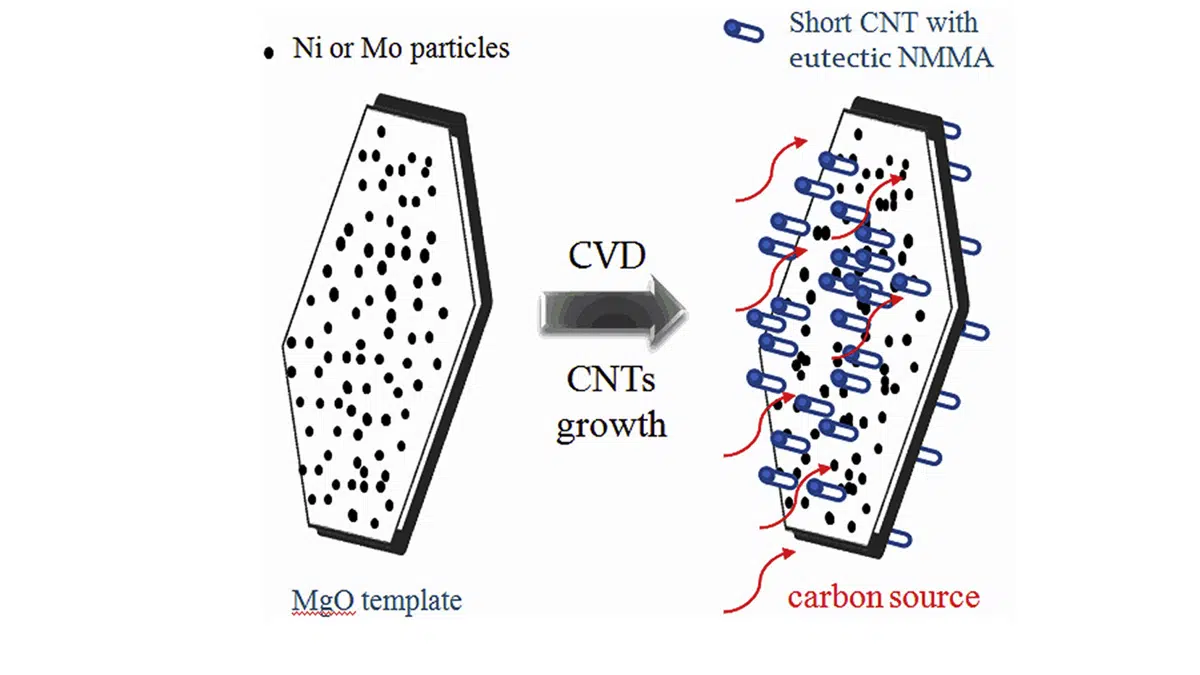
They are re-proposing the synthesized BCNTs growth mechanisms in preparing working electrodes using a two stage process with a two-component intermetallic alloy of Ni and Mg (NMA). First, the metals are mixed at a low temperature with a liquid ethylene glycol (EG) medium, followed by the BCNTs being synthesized by catalytic thermal chemical vapor deposition (CVD) which decomposes and drives off the hydrocarbons. In the second processing step, an additional precursor, in the form of molybdenum chloride, is introduced to blend with the NMAs resulting in fast charge transfer between electrode and electrolyte.

RelatedPosts

Electroninks Releases Gold and Platinum Particle-Free Conductive Inks

Peak Nano Installs Production Line for Innovative Capacitor Films

Electrical Properties Study of SMD Resistor Integrated Metallic Yarn for Smart Textiles

The resulting BCNT structures were observed using a field-emission scanning electron microscope (FESEM) and high-resolution transmission electron microscopy (HRTEM) to reveal their structural and surface morphologies, allowing their SSA to be ascertained.

Highlights

  • Three-dimensional BCNT composite is the first study of supercapacitor electrode application for publication.
  • BCNT electrodes achieve a maximum capacitance of 1,560 F/g
  • BCNT electrodes exhibit an energy density of 195 Wh/kg at a power density of 0.21 kW/kg
  • BCNT electrodes perform specific capacitance retention (128.2%) after 2,000 continuous cyclic voltammetry cycles

Abstract

Bundle-type mutil-walled carbon nanotubes (MWCNTs) composite electrode is the first investigation and publication for the supercapacitor application. According to the thermogravimetric analysis results, as-synthesized BCNTs are considered as the electrode materials for supercapacitors and electrochemical double-layer capacitor in this study. The Brunauer–Emmett–Teller specific surface area of as-prepared bundled carbon nanotubes (BCNTs) is 95.29 m2/g given to a type III isotherm and H3 hysteresis loops.

Slow scanning rates promote and enhance to achieve high Cb because of the superior conductivity of CNT bundles and one side close-layered Ni/Mg/Mo alloy inside the BCNT-based electrode and facile electron diffusivity between electrolyte and electrode. The specific capacitance Cs (1,560 F/g) is nearly equal to the maximum specific capacitance, which the BCNT-based composite electrode can actually be able to charge or fill in. The maximum energy density value is 195 Wh/kg with corresponding power density values of 0.21 kW/kg. Furthermore, the active 3D BCNTs material fabricated electrode enhances to contact the electrolyte directly and decreases the ion diffusion limitation.

Electrochemical impedance spectroscopy spectrum summarized as the low-frequency area controls by mass transfer limitation, and the high-frequency area dominates by charge transfer of kinetic control. After 2,000 consecutive cyclic voltammetry sacnings and galvanostatic charge-discharge cycles at a current density of 1.67 A/g performs, the specific capacitance retentions of 3D BCNTs electrodes achieved 128.2 and 77.3%, respectively. Three-dimensional BCNT composite electrodes exhibit good conductivity and low charge transfer resistance, which is beneficial to fast charge transfer between the BCNTs electrode materials and electrolytes.
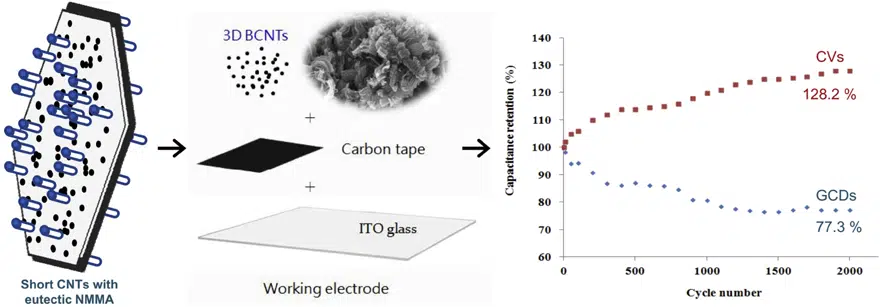
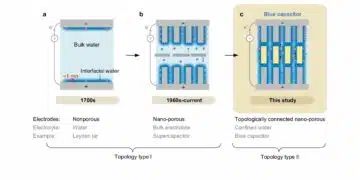
Approximate manufacturing and electrochemical experimental processes.; source: Hao-Lin et. al.

Reference

Hsu Hao-Lin et. al. (2021) Three-dimensional bundle-like multiwalled carbon nanotubes composite for supercapacitor electrode application Materials Today Chemistry 22 100569 https://doi.org/10.1016/j.mtchem.2021.100569

Related

Recent Posts

Enabling Software‑Defined Vehicle Architectures: Automotive Ethernet and Zonal Smart Power

2.2.2026
5

Calculating Resistance Value of a Flyback RC Snubber 

2.2.2026
4

CMSE 2026 Announces Call for Presentations on High-Reliability Military and Space Electronics

28.1.2026
41

ESA Call for Papers 6th Space Passive Component Days – SPCD 2026

28.1.2026
33

Power Electronics Tools for Passives and Magnetic Designs

27.1.2026
70

Samsung Q4 2025 Results: MLCC focus for AI, Server and Automotive

26.1.2026
91

Capacitor Technology Dossier

26.1.2026
117

Passive Components in Quantum Computing

22.1.2026
142

Miniaturization of MLCCs and Electrolytics, KAVX Tech Chat

21.1.2026
76

Upcoming Events

Feb 24
16:00 - 17:00 CET

Designing Qi2 Wireless Power Systems: Practical Development and EMC Optimization

Mar 3
16:00 - 17:00 CET

Cybersecurity at the Eleventh Hour – from RED to CRA – Information and Discussion

Mar 21
All day

PSMA Capacitor Workshop 2026

View Calendar

Popular Posts

  • Buck Converter Design and Calculation

    0 shares
    Share 0 Tweet 0
  • Boost Converter Design and Calculation

    0 shares
    Share 0 Tweet 0
  • LLC Resonant Converter Design and Calculation

    0 shares
    Share 0 Tweet 0
  • Flyback Converter Design and Calculation

    0 shares
    Share 0 Tweet 0
  • Ripple Current and its Effects on the Performance of Capacitors

    3 shares
    Share 3 Tweet 0
  • How Metal Prices Are Driving Passive Component Price Hikes

    0 shares
    Share 0 Tweet 0
  • MLCC and Ceramic Capacitors

    0 shares
    Share 0 Tweet 0
  • Dual Active Bridge (DAB) Topology

    0 shares
    Share 0 Tweet 0
  • What is a Dielectric Constant and DF of Plastic Materials?

    4 shares
    Share 4 Tweet 0
  • Degradation of Capacitors and its Failure Mechanisms

    0 shares
    Share 0 Tweet 0

Newsletter Subscription


Passive Components Blog

© EPCI - Leading Passive Components Educational and Information Site

  • Home
  • Privacy Policy
  • EPCI Membership & Advertisement
  • About

No Result
View All Result
  • Home
  • Knowledge Blog
  • PCNS

© EPCI - Leading Passive Components Educational and Information Site

This website uses cookies. By continuing to use this website you are giving consent to cookies being used. Visit our Privacy and Cookie Policy.
Go to mobile version