





Passive Components Blog
No Result
View All Result
  • Home
  • NewsFilter
    • All
    • Aerospace & Defence
    • Antenna
    • Applications
    • Automotive
    • Capacitors
    • Circuit Protection Devices
    • electro-mechanical news
    • Filters
    • Fuses
    • Inductors
    • Industrial
    • Integrated Passives
    • inter-connect news
    • Market & Supply Chain
    • Market Insights
    • Medical
    • Modelling and Simulation
    • New Materials & Supply
    • New Technologies
    • Non-linear Passives
    • Oscillators
    • Passive Sensors News
    • Resistors
    • RF & Microwave
    • Telecommunication
    • Weekly Digest

    Molecular Memristor Shows Record 145 kH Emergent Inductance

    Planar vs Conventional Transformer: When it Make Sense

    Researchers Propose Next‑Gen Compact Memory Using Ultra-thin Ferroelectric Capacitors

    Nichicon ADN Automotive Hybrid Aluminum Capacitors Now Available in EMEA

    Wk 19 Electronics Supply Chain Digest

    Electrocaloric Multilayer Capacitors: Towards Quiet, Solid‑State Cooling Around Room Temperature

    High-Crystallinity Nanocrystalline Composites for MHz Chip Inductors

    European Components Distribution Shows Strong Q1 2026 Growth Amid Geopolitical Uncertainty

    Stackpole Expanded its AlN Thick Film Chip Resistors

    Trending Tags

    • Ripple Current
    • RF
    • Leakage Current
    • Tantalum vs Ceramic
    • Snubber
    • Low ESR
    • Feedthrough
    • Derating
    • Dielectric Constant
    • New Products
    • Market Reports
  • VideoFilter
    • All
    • Antenna videos
    • Capacitor videos
    • Circuit Protection Video
    • Filter videos
    • Fuse videos
    • Inductor videos
    • Inter-Connect Video
    • Non-linear passives videos
    • Oscillator videos
    • Passive sensors videos
    • Resistor videos

    Planar vs Conventional Transformer: When it Make Sense

    Modeling Fringing Field Losses in Inductors & Transformers

    Why Power Inductors Use a Ferrite Core With an Air Gap

    Transformer-Based Power-Line Harvester Magnetic Design

    Thermal Modeling of Magnetics

    Standard vs Planar LLC transformers Comparison for Battery Chargers

    How Modern Tools Model Magnetic Components for Power Electronics

    Advanced Loss Modeling for Planar Magnetics in the Frenetic Planar Tool

    2026 Power Magnetics Design Trends: Flyback, DAB and Planar

    Trending Tags

    • Capacitors explained
    • Inductors explained
    • Resistors explained
    • Filters explained
    • Application Video Guidelines
    • EMC
    • New Products
    • Ripple Current
    • Simulation
    • Tantalum vs Ceramic
  • Knowledge Blog
  • DossiersNew
  • Suppliers
    • Who is Who
  • PCNS
    • PCNS 2025
    • PCNS 2023
    • PCNS 2021
    • PCNS 2019
    • PCNS 2017
  • Events
  • Home
  • NewsFilter
    • All
    • Aerospace & Defence
    • Antenna
    • Applications
    • Automotive
    • Capacitors
    • Circuit Protection Devices
    • electro-mechanical news
    • Filters
    • Fuses
    • Inductors
    • Industrial
    • Integrated Passives
    • inter-connect news
    • Market & Supply Chain
    • Market Insights
    • Medical
    • Modelling and Simulation
    • New Materials & Supply
    • New Technologies
    • Non-linear Passives
    • Oscillators
    • Passive Sensors News
    • Resistors
    • RF & Microwave
    • Telecommunication
    • Weekly Digest

    Molecular Memristor Shows Record 145 kH Emergent Inductance

    Planar vs Conventional Transformer: When it Make Sense

    Researchers Propose Next‑Gen Compact Memory Using Ultra-thin Ferroelectric Capacitors

    Nichicon ADN Automotive Hybrid Aluminum Capacitors Now Available in EMEA

    Wk 19 Electronics Supply Chain Digest

    Electrocaloric Multilayer Capacitors: Towards Quiet, Solid‑State Cooling Around Room Temperature

    High-Crystallinity Nanocrystalline Composites for MHz Chip Inductors

    European Components Distribution Shows Strong Q1 2026 Growth Amid Geopolitical Uncertainty

    Stackpole Expanded its AlN Thick Film Chip Resistors

    Trending Tags

    • Ripple Current
    • RF
    • Leakage Current
    • Tantalum vs Ceramic
    • Snubber
    • Low ESR
    • Feedthrough
    • Derating
    • Dielectric Constant
    • New Products
    • Market Reports
  • VideoFilter
    • All
    • Antenna videos
    • Capacitor videos
    • Circuit Protection Video
    • Filter videos
    • Fuse videos
    • Inductor videos
    • Inter-Connect Video
    • Non-linear passives videos
    • Oscillator videos
    • Passive sensors videos
    • Resistor videos

    Planar vs Conventional Transformer: When it Make Sense

    Modeling Fringing Field Losses in Inductors & Transformers

    Why Power Inductors Use a Ferrite Core With an Air Gap

    Transformer-Based Power-Line Harvester Magnetic Design

    Thermal Modeling of Magnetics

    Standard vs Planar LLC transformers Comparison for Battery Chargers

    How Modern Tools Model Magnetic Components for Power Electronics

    Advanced Loss Modeling for Planar Magnetics in the Frenetic Planar Tool

    2026 Power Magnetics Design Trends: Flyback, DAB and Planar

    Trending Tags

    • Capacitors explained
    • Inductors explained
    • Resistors explained
    • Filters explained
    • Application Video Guidelines
    • EMC
    • New Products
    • Ripple Current
    • Simulation
    • Tantalum vs Ceramic
  • Knowledge Blog
  • DossiersNew
  • Suppliers
    • Who is Who
  • PCNS
    • PCNS 2025
    • PCNS 2023
    • PCNS 2021
    • PCNS 2019
    • PCNS 2017
  • Events
No Result
View All Result
Passive Components Blog
No Result
View All Result

Electrical Properties Study of SMD Resistor Integrated Metallic Yarn for Smart Textiles

14.1.2022
Reading Time: 5 mins read
A A
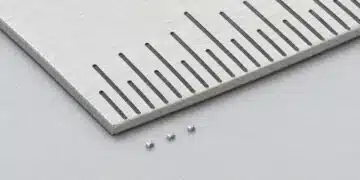
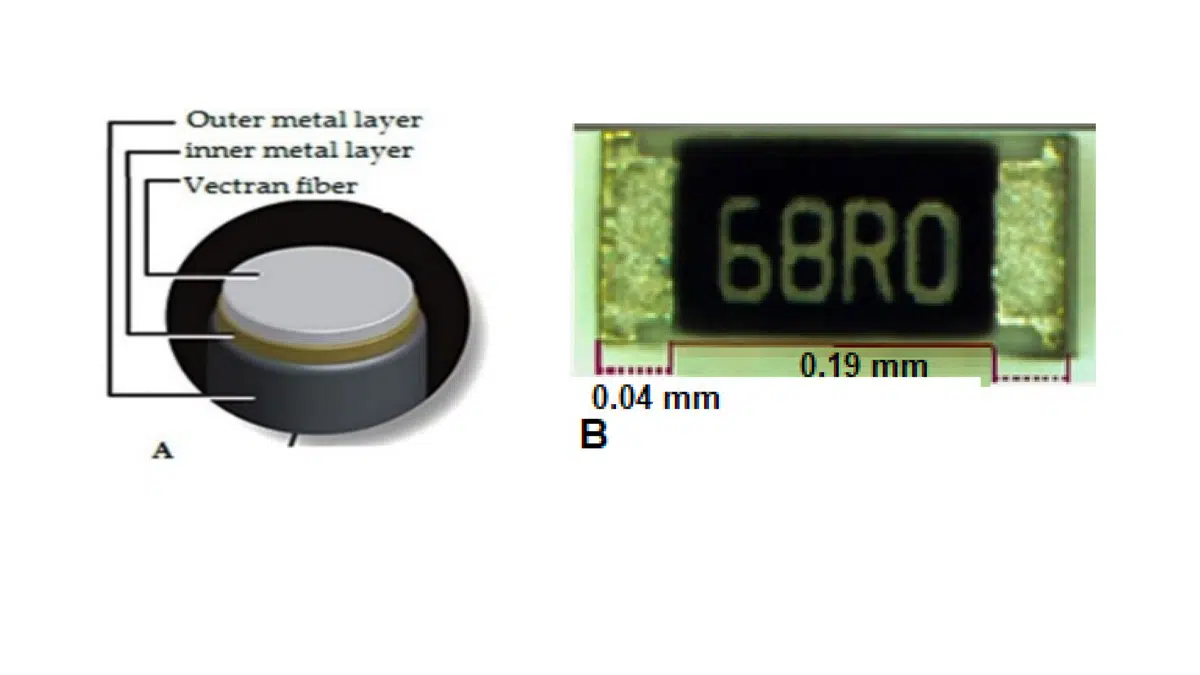
Silver coated Vectran (Liberator® 40) (A), 68 Ω Cermet resistor SMD (B)

Silver coated Vectran (Liberator® 40) (A), 68 Ω Cermet resistor SMD (B)

Researchers in study published by the journal Materials, evaluated the effects of different external factors such as strain, temperature, abrasion, washing, and solder pad size on the electrical resistance of surface-mounted resistor with integrated silver-coated Vectran (SCV) yarn.

Smart textiles have attracted huge attention due to their potential applications for ease of life. Recently, smart textiles have been produced by means of incorporation of electronic components onto/into conductive metallic yarns.

RelatedPosts

Electroninks Releases Gold and Platinum Particle-Free Conductive Inks

Peak Nano Installs Production Line for Innovative Capacitor Films

Power Paper Shows Promise of Clean High Energy Storing Capability

What is an SCV E-Yarn?

Vectran yarn is a fiber spun from aromatic polyester-based liquid-crystal polymer through the polycondensation of 4-hydroxybenzoic acid and 6-hydroxynapthalene-2-carboxylic acid. A silver coating on this fiber enables it for varieties of electronics applications as a smart textile.

Smart textiles are textiles with advanced modifications that enable them to sense and respond to external stimuli. These external stimuli are mostly electronic or photonic in nature. Electronic yarn or E-yarn are used in the healthcare sector, entertainment, fashion, on-body communication, security monitoring, sports activity tracking, and space suits.

Furthermore, microelectronics devices can be easily integrated into these smart textiles through weaving, embroidering, sewing, hybrid soldering, 2D screen printing, 3D printing, and in the form of electrically conductive inks. Also, the mechanical connectors between these smart textiles and microelectronics devices are mostly bolted buttons, socket buttons, hooks, and loops, ribbon cable connectors, crimp connectors, crimp flat-pack connectors, and snap buttons. However, the size of these electronics devices should not be large, otherwise they will damage the fabrics.

The solution to that is the incorporation of SMDs, which are very small, to smoothly embed them into any fabrics without any noticeable bulging or loading on the fabrics.
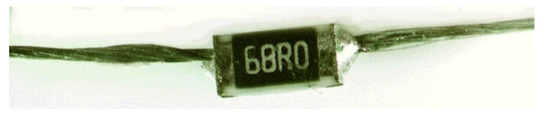
Figure 1. SMD resistor integrated E-yarn.

The development, characterizations, and electro-mechanical testing of surface mounted electronic device (SMD) integrated E-yarns is still limited. There is a vulnerability to short circuits as non-filament conductive yarns have protruding fibers. It is important to determine the best construction method and study the factors that influence the textile properties of the base yarn.

Objectives

In this study, researchers fabricated an SCV E-yarn using

  • (i) an SCV yarn with two thin layers of silver coatings to make it conductive,
  • (ii) a 68 Ω Cermet resistor with 1% tolerance, 0.27 mm length, and 0.04 mm solderable metallic terminal pads
  • (iii) a carbon conducive-based solder paste.

They used a temperature-controlled vapor phase reflow soldering method to connect the metallic terminal pads of the SMD to the conductive SCV yarn with the help of a wooden cupboard, which tightly held them together during the process of soldering.
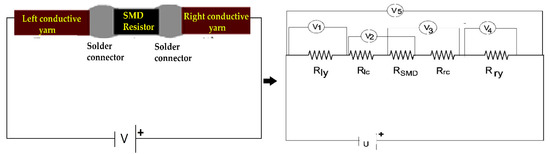
Figure 2. Schematic diagram of different resistors found in the E yarn and measurements of voltage drop down at each node.

Subsequently, the effect of the gauge length, strain, abrasion, temperature, washing, and solder pad overlap thickness on electrical resistance was measured and algebraically added, followed by measurement of total power loss using the total heat dissipation calculation method.

Observations

The electrical resistance increased linearly with an increase in clamping gauge length at a constant rate per unit length of 2.802 Ω/m. Also, the correlation coefficient of 0.994 and the positive probe factor indicated a significant influence of gauge length on the electrical resistance. Moreover, the relative electrical resistance showed a similar linear relationship with the cyclic strain with a correlation coefficient of 0.99, and the effect was more significant when the strain reached 0.05%.

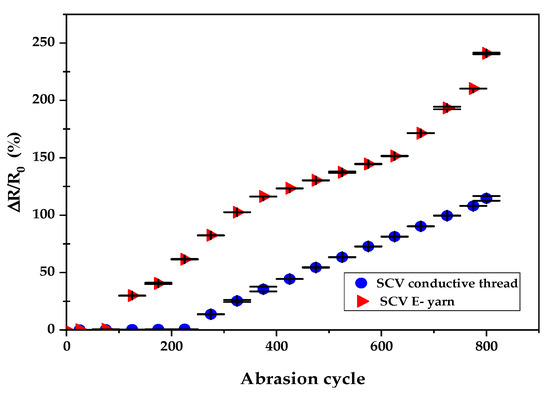
Figure 3. SCV conductive yarn before (A) and after (B) abrasion.
Materials 15 00272 g010 550
Figure 4. Effects of abrasion on electrical resistance.

Furthermore, the effect of abrasion was highly significant owing to the formation of cracks, scratches, protruding fibers, and breakage in the outer metallic layer of the SCV conductive yarn, which was evident from optical microscope observations. The noticeable change in electrical resistance started at the 150-abrasion cycle for E-yarn and at the 225-abrasion cycle for SCV. Subsequently, the effects of mechanical abrasion were increased by 240.9% and 114.6% of the SCV E-yarn and SCV conductive yarn, respectively, after the 800-abrasion cycles. A protective coating of thermoplastic polyurethane (TPU) or silicone encapsulation alleviated this issue.

The effect of temperature on electrical resistance had two phases i.e., temperatures below 50 ℃ and temperatures between 50 ℃ to 100 ℃. Up to 50 ℃, the electrical resistance increased very slowly, but after crossing this critical temperature, resistance increased rapidly. The electrical resistance of the SCV conductive yarn and E-yarn between the temperature range of 50 °C to 100 °C increased by 47.49% and 57.99%, respectively.

The electrical resistance of SCV conductive yarn and E-yarn after each washing cycle increased by a magnitude of 6% and 10%, respectively, between 0 to 10 wash cycles. Moreover, due to the formation of an amorphous region in the micro pad connector, the resistance of E-yarn slightly increased from 1.588 to 2.125 Ω when the solder joint pad overlap length increased from 0.5 to 5 mm.

Conclusions

The researchers fabricated an SCV E-yarn setup using a vapor phase reflow soldering method to integrate an SCV conductive yarn and an SMD Cermet resistor.

From all measurements, it was evident that the gauge length and strain linearly increased the electrical resistance. Moreover, after certain critical values, abrasion, temperature, and number of washing cycles had abruptly significant influence on the electrical resistance of both SCV E-yarn and SCV conductive yarn. However, the effect of solder joint pad overlap length was minor. The study suggested coating the SCV E-yarn setup with a protective coating of TPU thermoplastic polyurethane.

Reference

Simegnaw, A., Malengier, B., Tadesse, M., Rotich, G., Van Langenhove, L., Study the Electrical Properties of Surface Mount Device Integrated Silver Coated Vectran Yarn. Materials 2022, 15, 272. https://www.mdpi.com/1996-1944/15/1/272

Related

Recent Posts

Molecular Memristor Shows Record 145 kH Emergent Inductance

12.5.2026
10

Researchers Propose Next‑Gen Compact Memory Using Ultra-thin Ferroelectric Capacitors

11.5.2026
27

Electrocaloric Multilayer Capacitors: Towards Quiet, Solid‑State Cooling Around Room Temperature

7.5.2026
183

High-Crystallinity Nanocrystalline Composites for MHz Chip Inductors

7.5.2026
63

Stackpole Expanded its AlN Thick Film Chip Resistors

6.5.2026
22

Modelithics Releases COMPLETE v26.1 for Keysight ADS

23.4.2026
23

April 2026 Interconnect, Passives and Electromechanical Components Market Insights

22.4.2026
140

ECIA March 2026 Industry Pulse Points to Best Sales Climate in Five Years

13.4.2026
84

March 2026 Interconnect, Passives and Electromechanical Components Market Insights

2.4.2026
138

Upcoming Events

May 13
17:00 - 17:30 CEST

Winding Loss Modeling for Toroidal Magnetics – Including Gapped Cores

May 19
16:00 - 17:00 CEST

Designing Qi2 Wireless Power Systems: Practical Development and EMC Optimization

Jun 2
16:00 - 17:00 CEST

Calculation, Simulation and Measurement of 800V EMC Filters

View Calendar

Popular Posts

  • Buck Converter Design and Calculation

    0 shares
    Share 0 Tweet 0
  • Boost Converter Design and Calculation

    0 shares
    Share 0 Tweet 0
  • Flyback Converter Design and Calculation

    0 shares
    Share 0 Tweet 0
  • LLC Resonant Converter Design and Calculation

    0 shares
    Share 0 Tweet 0
  • MLCC and Ceramic Capacitors

    0 shares
    Share 0 Tweet 0
  • Dual Active Bridge (DAB) Topology

    0 shares
    Share 0 Tweet 0
  • Capacitor Charging and Discharging

    0 shares
    Share 0 Tweet 0
  • What Electronics Engineer Needs to Know About Passive Low Pass Filters

    0 shares
    Share 0 Tweet 0
  • Ripple Current and its Effects on the Performance of Capacitors

    3 shares
    Share 3 Tweet 0
  • MLCC Case Sizes Standards Explained

    0 shares
    Share 0 Tweet 0

Newsletter Subscription


Passive Components Blog

© EPCI - Leading Passive Components Educational and Information Site

  • Home
  • Privacy Policy
  • EPCI Membership & Advertisement
  • About

No Result
View All Result
  • Home
  • Knowledge Blog
  • PCNS

© EPCI - Leading Passive Components Educational and Information Site

This website uses cookies. By continuing to use this website you are giving consent to cookies being used. Visit our Privacy and Cookie Policy.
Go to mobile version