










Passive Components Blog
No Result
View All Result
  • Home
  • NewsFilter
    • All
    • Aerospace & Defence
    • Antenna
    • Applications
    • Automotive
    • Capacitors
    • Circuit Protection Devices
    • electro-mechanical news
    • Filters
    • Fuses
    • Inductors
    • Industrial
    • Integrated Passives
    • inter-connect news
    • Market & Supply Chain
    • Market Insights
    • Medical
    • Modelling and Simulation
    • New Materials & Supply
    • New Technologies
    • Non-linear Passives
    • Oscillators
    • Passive Sensors News
    • Resistors
    • RF & Microwave
    • Telecommunication
    • Weekly Digest

    Modelithics Releases COMPLETE v26.1 for Keysight ADS

    April 2026 Interconnect, Passives and Electromechanical Components Market Insights

    SPICE Simulation of Non-Linear Resistors: Vishay’s Thermistor and PPTC Modelling Ecosystem

    KYOCERA AVX Introduces Traction‑Grade DC Link Film Capacitors

    When More Capacitance Hurts Reliability: The Role of the Metallic Skeleton in Tantalum Anodes

    Why Power Inductors Use a Ferrite Core With an Air Gap

    Wk 16 Electronics Supply Chain Digest

    YAGEO Introduces High‑Current Y2/X1 Film Capacitors for Wide-bandgap Power Systems

    Amphenol Explanded Liquid Cooling Connectors for AI, ESS and EV Systems

    Trending Tags

    • Ripple Current
    • RF
    • Leakage Current
    • Tantalum vs Ceramic
    • Snubber
    • Low ESR
    • Feedthrough
    • Derating
    • Dielectric Constant
    • New Products
    • Market Reports
  • VideoFilter
    • All
    • Antenna videos
    • Capacitor videos
    • Circuit Protection Video
    • Filter videos
    • Fuse videos
    • Inductor videos
    • Inter-Connect Video
    • Non-linear passives videos
    • Oscillator videos
    • Passive sensors videos
    • Resistor videos

    Why Power Inductors Use a Ferrite Core With an Air Gap

    Transformer-Based Power-Line Harvester Magnetic Design

    Thermal Modeling of Magnetics

    Standard vs Planar LLC transformers Comparison for Battery Chargers

    How Modern Tools Model Magnetic Components for Power Electronics

    Advanced Loss Modeling for Planar Magnetics in the Frenetic Planar Tool

    2026 Power Magnetics Design Trends: Flyback, DAB and Planar

    Enabling Software‑Defined Vehicle Architectures: Automotive Ethernet and Zonal Smart Power

    Calculating Resistance Value of a Flyback RC Snubber 

    Trending Tags

    • Capacitors explained
    • Inductors explained
    • Resistors explained
    • Filters explained
    • Application Video Guidelines
    • EMC
    • New Products
    • Ripple Current
    • Simulation
    • Tantalum vs Ceramic
  • Knowledge Blog
  • DossiersNew
  • Suppliers
    • Who is Who
  • PCNS
    • PCNS 2025
    • PCNS 2023
    • PCNS 2021
    • PCNS 2019
    • PCNS 2017
  • Events
  • Home
  • NewsFilter
    • All
    • Aerospace & Defence
    • Antenna
    • Applications
    • Automotive
    • Capacitors
    • Circuit Protection Devices
    • electro-mechanical news
    • Filters
    • Fuses
    • Inductors
    • Industrial
    • Integrated Passives
    • inter-connect news
    • Market & Supply Chain
    • Market Insights
    • Medical
    • Modelling and Simulation
    • New Materials & Supply
    • New Technologies
    • Non-linear Passives
    • Oscillators
    • Passive Sensors News
    • Resistors
    • RF & Microwave
    • Telecommunication
    • Weekly Digest

    Modelithics Releases COMPLETE v26.1 for Keysight ADS

    April 2026 Interconnect, Passives and Electromechanical Components Market Insights

    SPICE Simulation of Non-Linear Resistors: Vishay’s Thermistor and PPTC Modelling Ecosystem

    KYOCERA AVX Introduces Traction‑Grade DC Link Film Capacitors

    When More Capacitance Hurts Reliability: The Role of the Metallic Skeleton in Tantalum Anodes

    Why Power Inductors Use a Ferrite Core With an Air Gap

    Wk 16 Electronics Supply Chain Digest

    YAGEO Introduces High‑Current Y2/X1 Film Capacitors for Wide-bandgap Power Systems

    Amphenol Explanded Liquid Cooling Connectors for AI, ESS and EV Systems

    Trending Tags

    • Ripple Current
    • RF
    • Leakage Current
    • Tantalum vs Ceramic
    • Snubber
    • Low ESR
    • Feedthrough
    • Derating
    • Dielectric Constant
    • New Products
    • Market Reports
  • VideoFilter
    • All
    • Antenna videos
    • Capacitor videos
    • Circuit Protection Video
    • Filter videos
    • Fuse videos
    • Inductor videos
    • Inter-Connect Video
    • Non-linear passives videos
    • Oscillator videos
    • Passive sensors videos
    • Resistor videos

    Why Power Inductors Use a Ferrite Core With an Air Gap

    Transformer-Based Power-Line Harvester Magnetic Design

    Thermal Modeling of Magnetics

    Standard vs Planar LLC transformers Comparison for Battery Chargers

    How Modern Tools Model Magnetic Components for Power Electronics

    Advanced Loss Modeling for Planar Magnetics in the Frenetic Planar Tool

    2026 Power Magnetics Design Trends: Flyback, DAB and Planar

    Enabling Software‑Defined Vehicle Architectures: Automotive Ethernet and Zonal Smart Power

    Calculating Resistance Value of a Flyback RC Snubber 

    Trending Tags

    • Capacitors explained
    • Inductors explained
    • Resistors explained
    • Filters explained
    • Application Video Guidelines
    • EMC
    • New Products
    • Ripple Current
    • Simulation
    • Tantalum vs Ceramic
  • Knowledge Blog
  • DossiersNew
  • Suppliers
    • Who is Who
  • PCNS
    • PCNS 2025
    • PCNS 2023
    • PCNS 2021
    • PCNS 2019
    • PCNS 2017
  • Events
No Result
View All Result
Passive Components Blog
No Result
View All Result

A Guide to Understanding Common Mode Choke

18.12.2024
Reading Time: 4 mins read
A A

This article written by Chris Hare, Coilcraft provides a guide to understanding of common mode choke.

What is a Common Mode Choke?

RelatedPosts

Coilcraft Unveils Molded Power Inductors for High‑Current VRMs

Coilcraft Releases TLVR Inductors for High Density VRMs and PoL Converters

Coilcraft Releases Automotive Common Mode Chokes

A common mode choke is an electrical filter that blocks high frequency noise common to two or more data or power lines while allowing the desired DC or low-frequency signal to pass.

Common mode (CM) noise current is typically radiated from sources such as unwanted radio signals, unshielded electronics, inverters and motors. Left unfiltered, this noise presents interference problems in electronics and electrical circuits.

How do Common Mode Chokes Work?

In normal or differential mode (single choke), current travels on one line in one direction from the source to the load, and in the opposite direction on the return line that completes the circuit.

In common mode, the noise current travels on both lines in the same direction.

common mode choke vs differential mode choke current flow

Common mode chokes have the two or more windings arranged such that the common mode current creates a magnetic field that opposes any increase in common mode current. This is similar to how single line (differential) inductors function. Inductors create magnetic fields that oppose changes in current.

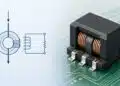
In common mode, the current in a group of lines travels in the same direction so the combined magnetic flux adds to create an opposing field to block the noise, as illustrated by the red and green arrows in the toroid core shown in Figure 1. In differential mode, the current travels in opposite directions and the flux subtracts or cancels out so that the field does not oppose the normal mode signal.

How do I Choose a Common Mode Choke?

The main criteria for selecting a common mode choke are:

  • Required impedance: How much attenuation of noise is needed?
  • Required frequency range: Over what frequency bandwidth is the noise?
  • Required current-handling: How much differential mode current must it handle?

High-Speed and Super-Speed Data Line EMI Chokes

USB, high-speed and Super-Speed data line common mode chokes effectively reduce common mode noise in high-speed interfaces like USB 2.0, USB 3.1 Gen 1, HDMI, IEEE 1394, LVDS, HDBaseTTM, MOST® bus, etc. They maintain excellent signal integrity for high-speed communications with -3 dB differential mode cutoff frequencies up to 6.5 GHz. Most provide greater than 30 dB common mode attenuation at 500 MHz and 25 dB in the GHz band.

Data Line Common Mode EMI Chokes

Surface mount data line common mode chokes are designed to attenuate common mode noise up to 100 MHz. The PDLF Series can reduce noise by a factor of 32 from 15 MHz to 300 MHz and are available in 2, 3 and 4 line versions. The PTRF Series is optimized for FCC and ITU-T (formerly CCITT) requirements. These parts provide 15 to 25 dB attenuation, greater than 1000 Ohms impedance and 1500 V isolation between windings. M2022 can suppress common mode noise up to 500 MHz in a compact 1812 package.

Data/Power Line Common Mode EMI Chokes

LPD, MSD and PFD Families are low profile, miniature footprint common mode chokes that can be used to attenuate common mode noise or differential mode noise in both data and power line applications.

Surface Mount Power Line Common Mode EMI Chokes

Low-cost, high performance surface mount power line common mode chokes come in a variety of sizes and packages. They are designed to eliminate AC line-conducted common mode noise across a broad range of frequencies, with up to 1500 Vrms isolation. These common mode chokes can operate over a wide range of current from 0.06 Amps to 15 Amps, providing attenuation where line filtering is needed, such as in switch-mode power supplies.

Through-Hole Power Line Common Mode EMI Chokes

Low-cost through-hole BU Series high efficiency choke coils are designed to eliminate line conducted common mode noise across a broad range of frequencies. The BU9S and BU9HS are ideal for signal line applications; the other BUs can be used in switching power supplies and power supply circuits. For low profile applications, the BU9 and BU9S filters are available in a horizontal configuration that reduces their height to under half an inch (12.5 mm).

CMT Common Mode EMI Chokes

CMT toroid style common mode chokes are designed to provide the highest common mode impedance over the widest frequency range. These parts are ideal for any application requiring a high DC current bias and are well suited for use in switch-mode power supplies. These common mode chokes are most effective in filtering supply and return conductors with in-phase signals of equal amplitude. Differential mode inductors are available for filtering out-ofphase or uneven amplitude signals.


Related

Source: Coilcraft

Recent Posts

Modelithics Releases COMPLETE v26.1 for Keysight ADS

23.4.2026
2

April 2026 Interconnect, Passives and Electromechanical Components Market Insights

22.4.2026
7

When More Capacitance Hurts Reliability: The Role of the Metallic Skeleton in Tantalum Anodes

20.4.2026
23

Why Power Inductors Use a Ferrite Core With an Air Gap

20.4.2026
17

TDK Introduces High‑Voltage Common‑Mode Chokes for Compact 1250 V DC Converters

16.4.2026
25

Vishay Extends Power Inductors for DC/DC with 1212 Compact Case

16.4.2026
20

Modeling Planar Magnetics Temperature: Practical Guidelines for Power Electronics Engineers

15.4.2026
20

YAGEO Releases Ferrite Shielded Power Inductors for High‑Density Designs

15.4.2026
17

AI-Assisted Structural Diagnostics and Physics-Based Reliability Interpretation of Tantalum Capacitor Anodes

14.4.2026
33

Upcoming Events

Apr 27
15:00 - 16:00 CEST

Commercial Space Screening Approach for Agile, High-Reliability Payloads

Apr 29
10:00 - 11:00 CDT

SEPIC Design Done Right

Apr 30
10:00 - 11:00 CDT

Programming Embedded Systems

View Calendar

Popular Posts

  • Buck Converter Design and Calculation

    0 shares
    Share 0 Tweet 0
  • Boost Converter Design and Calculation

    0 shares
    Share 0 Tweet 0
  • Flyback Converter Design and Calculation

    0 shares
    Share 0 Tweet 0
  • LLC Resonant Converter Design and Calculation

    0 shares
    Share 0 Tweet 0
  • MLCC and Ceramic Capacitors

    0 shares
    Share 0 Tweet 0
  • Dual Active Bridge (DAB) Topology

    0 shares
    Share 0 Tweet 0
  • Capacitor Charging and Discharging

    0 shares
    Share 0 Tweet 0
  • Ripple Current and its Effects on the Performance of Capacitors

    3 shares
    Share 3 Tweet 0
  • What Electronics Engineer Needs to Know About Passive Low Pass Filters

    0 shares
    Share 0 Tweet 0
  • MLCC Case Sizes Standards Explained

    0 shares
    Share 0 Tweet 0

Newsletter Subscription


Passive Components Blog

© EPCI - Leading Passive Components Educational and Information Site

  • Home
  • Privacy Policy
  • EPCI Membership & Advertisement
  • About

No Result
View All Result
  • Home
  • Knowledge Blog
  • PCNS

© EPCI - Leading Passive Components Educational and Information Site

This website uses cookies. By continuing to use this website you are giving consent to cookies being used. Visit our Privacy and Cookie Policy.
Go to mobile version