






Passive Components Blog
No Result
View All Result
  • Home
  • NewsFilter
    • All
    • Aerospace & Defence
    • Antenna
    • Applications
    • Automotive
    • Capacitors
    • Circuit Protection Devices
    • electro-mechanical news
    • Filters
    • Fuses
    • Inductors
    • Industrial
    • Integrated Passives
    • inter-connect news
    • Market & Supply Chain
    • Market Insights
    • Medical
    • Modelling and Simulation
    • New Materials & Supply
    • New Technologies
    • Non-linear Passives
    • Oscillators
    • Passive Sensors News
    • Resistors
    • RF & Microwave
    • Telecommunication
    • Weekly Digest

    Panasonic Releases Compact Tactile Switch with 3N Operation Force and 500K Cycles Life

    Modelithics Unveils Qorvo GaN Library v25.5.9

    Jinghai Offers Custom Bottom Cooled Screw Aluminum Capacitors

    PCB Manufacturing, Test Methods, Quality and Reliability

    TDK Unveils Vibration-Resistant Hybrid Polymer Aluminum Capacitors

    Wk 50 Electronics Supply Chain Digest

    Transformer Behavior – Current Transfer and Hidden Feedback

    Littelfuse Completes Acquisition of Basler Electric

    Isabellenhütte Releases Automotive Pulse Load Resistors

    Trending Tags

    • Ripple Current
    • RF
    • Leakage Current
    • Tantalum vs Ceramic
    • Snubber
    • Low ESR
    • Feedthrough
    • Derating
    • Dielectric Constant
    • New Products
    • Market Reports
  • VideoFilter
    • All
    • Antenna videos
    • Capacitor videos
    • Circuit Protection Video
    • Filter videos
    • Fuse videos
    • Inductor videos
    • Inter-Connect Video
    • Non-linear passives videos
    • Oscillator videos
    • Passive sensors videos
    • Resistor videos

    PCB Manufacturing, Test Methods, Quality and Reliability

    Transformer Behavior – Current Transfer and Hidden Feedback

    Choosing the Right Capacitor: The Importance of Accurate Measurements

    RF Inductors: Selection and Design Challenges for High-Frequency Circuits

    Transformer Safety IEC 61558 Standard

    3-Phase EMI Filter Design, Simulation, Calculation and Test

    Transformer Design Optimization for Power Electronics Applications

    Common Mode Chokes Selection for RF Circuits in Next-Generation Communication Systems

    Capacitor Self-balancing in a Flying-Capacitor Buck Converter

    Trending Tags

    • Capacitors explained
    • Inductors explained
    • Resistors explained
    • Filters explained
    • Application Video Guidelines
    • EMC
    • New Products
    • Ripple Current
    • Simulation
    • Tantalum vs Ceramic
  • Knowledge Blog
  • Suppliers
    • Who is Who
  • PCNS
    • PCNS 2025
    • PCNS 2023
    • PCNS 2021
    • PCNS 2019
    • PCNS 2017
  • Events
  • Home
  • NewsFilter
    • All
    • Aerospace & Defence
    • Antenna
    • Applications
    • Automotive
    • Capacitors
    • Circuit Protection Devices
    • electro-mechanical news
    • Filters
    • Fuses
    • Inductors
    • Industrial
    • Integrated Passives
    • inter-connect news
    • Market & Supply Chain
    • Market Insights
    • Medical
    • Modelling and Simulation
    • New Materials & Supply
    • New Technologies
    • Non-linear Passives
    • Oscillators
    • Passive Sensors News
    • Resistors
    • RF & Microwave
    • Telecommunication
    • Weekly Digest

    Panasonic Releases Compact Tactile Switch with 3N Operation Force and 500K Cycles Life

    Modelithics Unveils Qorvo GaN Library v25.5.9

    Jinghai Offers Custom Bottom Cooled Screw Aluminum Capacitors

    PCB Manufacturing, Test Methods, Quality and Reliability

    TDK Unveils Vibration-Resistant Hybrid Polymer Aluminum Capacitors

    Wk 50 Electronics Supply Chain Digest

    Transformer Behavior – Current Transfer and Hidden Feedback

    Littelfuse Completes Acquisition of Basler Electric

    Isabellenhütte Releases Automotive Pulse Load Resistors

    Trending Tags

    • Ripple Current
    • RF
    • Leakage Current
    • Tantalum vs Ceramic
    • Snubber
    • Low ESR
    • Feedthrough
    • Derating
    • Dielectric Constant
    • New Products
    • Market Reports
  • VideoFilter
    • All
    • Antenna videos
    • Capacitor videos
    • Circuit Protection Video
    • Filter videos
    • Fuse videos
    • Inductor videos
    • Inter-Connect Video
    • Non-linear passives videos
    • Oscillator videos
    • Passive sensors videos
    • Resistor videos

    PCB Manufacturing, Test Methods, Quality and Reliability

    Transformer Behavior – Current Transfer and Hidden Feedback

    Choosing the Right Capacitor: The Importance of Accurate Measurements

    RF Inductors: Selection and Design Challenges for High-Frequency Circuits

    Transformer Safety IEC 61558 Standard

    3-Phase EMI Filter Design, Simulation, Calculation and Test

    Transformer Design Optimization for Power Electronics Applications

    Common Mode Chokes Selection for RF Circuits in Next-Generation Communication Systems

    Capacitor Self-balancing in a Flying-Capacitor Buck Converter

    Trending Tags

    • Capacitors explained
    • Inductors explained
    • Resistors explained
    • Filters explained
    • Application Video Guidelines
    • EMC
    • New Products
    • Ripple Current
    • Simulation
    • Tantalum vs Ceramic
  • Knowledge Blog
  • Suppliers
    • Who is Who
  • PCNS
    • PCNS 2025
    • PCNS 2023
    • PCNS 2021
    • PCNS 2019
    • PCNS 2017
  • Events
No Result
View All Result
Passive Components Blog
No Result
View All Result

Circular Connectors Coding

26.11.2025
Reading Time: 8 mins read
A A

This post provides a comprehensive technical explanation of connector coding, focusing on the industry-standard M12 and its compact variant M8, complete with specifications, usage cases, and engineering context.

Key Takeaways

  • This article explains connector coding with a focus on M12 and M8 connectors, emphasizing their importance in industrial automation.
  • Connector coding prevents mismating, ensures reliability, saves time, and enhances safety during installations and maintenance.
  • M12 connectors offer various coding types for different applications, while M8 connectors are suitable for space-constrained environments.
  • Coding benefits include reliable communication in industrial networks and protection against environmental factors.
  • Selecting the correct connector involves considering voltage, signal type, mechanical constraints, and environmental requirements.

Introduction
Circular connectors like M12 and M8 are fundamental in industrial automation, robotics, and transportation. Coding systems ensure safety, compatibility, and reliability by preventing mismating and supporting quick, error-free installation.

RelatedPosts

Panasonic Releases Compact Tactile Switch with 3N Operation Force and 500K Cycles Life

Modelithics Unveils Qorvo GaN Library v25.5.9

Jinghai Offers Custom Bottom Cooled Screw Aluminum Capacitors

Why Connector Coding Matters

Connector coding is essential for daily operations involving installation, maintenance, and upgrades. Each time a connector is removed or replaced, incorrect mating can cause failures, downtime, or hazards. Coding addresses this by:

  • Preventing mismating: Unique pin/socket/keying layouts only allow correct matching.
  • Ensuring reliability: Mechanical features align connectors accurately before locking.
  • Saving time: Field technicians can connect devices safely, reducing installation errors.
  • Enhancing safety: Cross-connections, short circuits, and voltage errors are avoided.

Coding is vital in all industries that require error-free signal, data, and power transmission.

M12 Connector Coding – Technical Overview

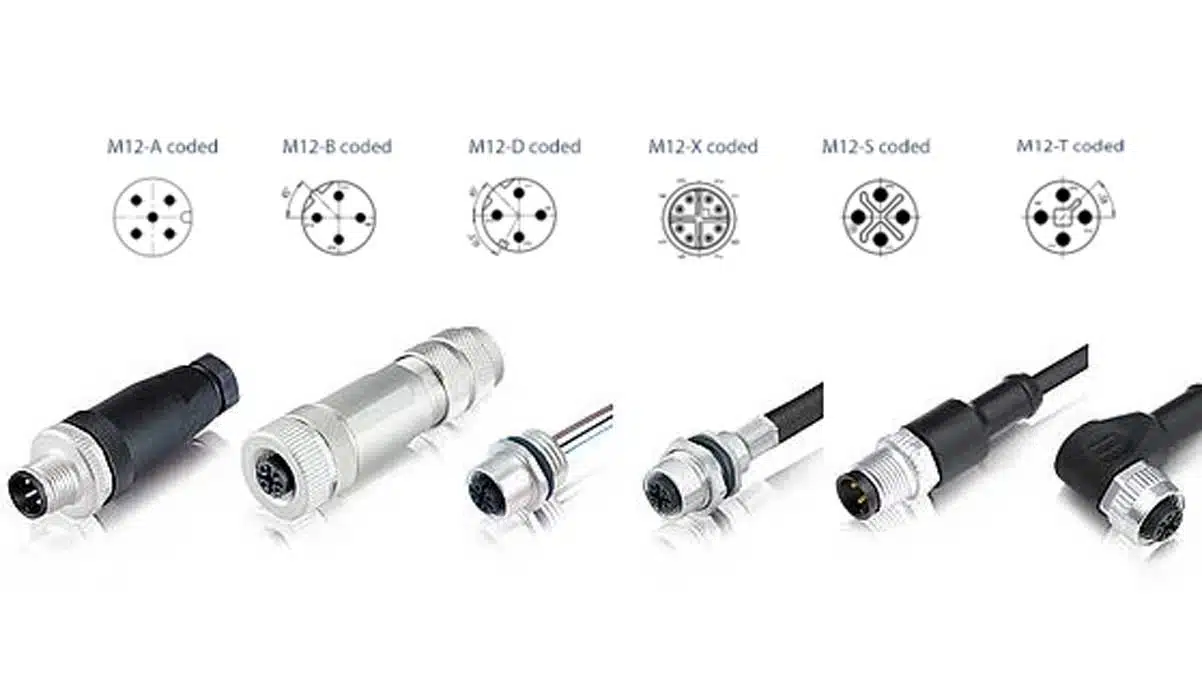
M12 connectors have become a leading choice for automation due to their compact size, durability, and broad coding selection. The key coding types and their major properties are outlined below:

TypeCurrentVoltageProtectionContactsApplications
A-coded1.5–8A30–250VACIP67/68/69K3–12Sensors, CAN, DeviceNet, DC Power
B-coded4A60–250VACIP67/684–5PROFIBUS DP
D-coded4A250VACIP674Ethernet, EtherCAT, PROFINET, Sercos
X-coded0.5A50VAC/60VDCIP678High-Speed Ethernet up to 10 Gbit/s
S-coded12A630VACIP673+PEAC Power Supply
K-coded12A630VACIP674+PEAC Power Supply (higher pole count)
L-coded16A63VDCIP674–FEDC Power Supply, PROFINET
T-coded12A60VDCIP674DC Power Supply
US-coded4A250VACIP673–5Signal

M8 Connector Coding – Technical Overview

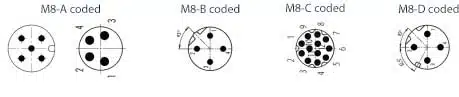
M8 connectors are ideal for space-constrained environments and miniaturized machinery. Their coding types match the diversity of industrial requirements for signal, data, and low-power applications.
TypeCurrentVoltageProtectionContactsApplications
A-coded1.5–4A30–60VACIP65/67/68/69K3–8Power, Signal, CAN, DeviceNet
B-coded3A30–60VACIP67/68/69K5PROFIBUS DP
C-coded1A30–32VACIP6712Power, Signal
D-coded1.5–4A50–63VACIP674Ethernet, PROFINET

Coding Benefits & Use Cases

  • Fieldbus and Ethernet: M12 D-coded and X-coded ensure communication reliability for PROFIBUS, PROFINET, EtherCAT, and high-speed Ethernet networks up to 10 Gbit/s.
  • Power separation: Codings like T, L, S, K in M12 and A, C in M8 ensure proper voltage levels and protect sensitive electronics.
  • Industrial sensors: M8 A-coded and M12 A-coded widely used for field device power and signal connections.
  • Harsh environments: IP67–IP69K protection maintains integrity against dust, water, and vibration.

Color coding and mechanical keying in these connectors facilitate easy, error-proof deployment by visual and tactile feedback, critical for technicians working under time constraints.

Practical Engineering Selection

When specifying a connector, engineers should reference the coding charts above and consider:

  • Voltage and current levels (match rating to application)
  • Signal/data type (fieldbus vs. power delivery)
  • Mechanical constraints (pin count, housing size)
  • Environmental requirements (IP protection, temperature)

Correct coding selection prevents device damage, system errors, and future-proofs installations for expansions or upgrades.

Conclusion

Connector coding is a subtle but crucial part of system engineering in industrial automation. By employing standardized coding schemes—especially in M12 and M8 connectors—engineers gain robust, safe, and reliable interconnect solutions. Coding ensures error-free installation, operational safety, and compatibility for applications as diverse as high-speed communication, AC/DC power distribution, and miniature sensor networks. Adhering to appropriate coding practices is essential for long-lasting, efficient operations in all automation and control systems.

FAQ – Coding in Circular Connectors

Why do circular connectors have different codings?

Circular connectors use coding systems to prevent mismatching, guarantee correct mating, and ensure safe, reliable connections in industrial and automation applications.

What is a coded connector?

A coded connector features unique pin, socket, and mechanical keying layouts to ensure that only the correct plug fits the correct socket, preventing error-prone connections.

What are the main types of coding in circular connectors?

A- and B-coding support sensor connections and data lines by ensuring correct orientation and application-specific compatibility, thus reducing the risk of signal interference or equipment damage.

Can M12 connectors be used for both power and data?

Yes, M12 connectors are available in coding types suitable for both power (e.g., S, K, L, T) and data (e.g., D, X), letting engineers safely combine different transmission needs within one robust format.

What is the difference between M8 and M12 coding?

M8 connectors are smaller and ideal for compact applications but offer fewer coding types than M12. M12 offers a broader variety of codings for high-power, data, and sensor applications.

What does A-, B-, D-, and X-coding mean for M12 connectors?

A-coding is used for sensors and DC power; B-coding for PROFIBUS; D-coding for Ethernet up to 100 Mbit/s; X-coding for high-speed Ethernet up to 10 Gbit/s.

Related

Source: binder

Recent Posts

PCB Manufacturing, Test Methods, Quality and Reliability

15.12.2025
15

Molex Introduces Modular Wire-to-Wire Automotive Connectors

11.12.2025
10

Murata Releases World’s First Inner Cavity-Structure Ultra-Low-Loss LCP Flexible Substrate

10.12.2025
37

Key Interconnect Technologies for 2025

5.12.2025
25

Bishop Reveals Top 10 Connector Manufacturers

5.12.2025
68

Samtec Releases Rugged Multi-Port SMPM Interconnects with Threaded Coupling

3.12.2025
15

binder Presents Harsh Environment Connector for Outdoor Environments

26.11.2025
9

Molex Releases Industry-First Quad-Row Board-to-Board Connectors with EMI Shields

6.11.2025
36
Image credit: Samtec

How to Match the Right Connector with Protocol Requirements

6.11.2025
30

Upcoming Events

Dec 15
December 15 @ 13:00 - December 18 @ 15:15 EST

Pre Cap Visual Inspection per Mil-Std-883 (TM 2017)

Dec 19
12:00 - 14:00 EST

External Visual Inspection per MIL-STD-883 TM 2009

Jan 27
16:00 - 17:00 CET

Simplifying Vehicle Development with Automotive Ethernet and Zonal Smart Switch Technologies

View Calendar

Popular Posts

  • Buck Converter Design and Calculation

    0 shares
    Share 0 Tweet 0
  • Boost Converter Design and Calculation

    0 shares
    Share 0 Tweet 0
  • LLC Resonant Converter Design and Calculation

    0 shares
    Share 0 Tweet 0
  • Flyback Converter Design and Calculation

    0 shares
    Share 0 Tweet 0
  • What Electronics Engineer Needs to Know About Passive Low Pass Filters

    0 shares
    Share 0 Tweet 0
  • Dual Active Bridge (DAB) Topology

    0 shares
    Share 0 Tweet 0
  • Ripple Current and its Effects on the Performance of Capacitors

    3 shares
    Share 3 Tweet 0
  • MLCC and Ceramic Capacitors

    0 shares
    Share 0 Tweet 0
  • What is a Dielectric Constant and DF of Plastic Materials?

    4 shares
    Share 4 Tweet 0
  • SEPIC Converter Design and Calculation

    0 shares
    Share 0 Tweet 0

Newsletter Subscription


Passive Components Blog

© EPCI - Leading Passive Components Educational and Information Site

  • Home
  • Privacy Policy
  • EPCI Membership & Advertisement
  • About

No Result
View All Result
  • Home
  • Knowledge Blog
  • PCNS

© EPCI - Leading Passive Components Educational and Information Site

This website uses cookies. By continuing to use this website you are giving consent to cookies being used. Visit our Privacy and Cookie Policy.
Go to mobile version