















Passive Components Blog
No Result
View All Result
  • Home
  • NewsFilter
    • All
    • Aerospace & Defence
    • Antenna
    • Applications
    • Automotive
    • Capacitors
    • Circuit Protection Devices
    • electro-mechanical news
    • Filters
    • Fuses
    • Inductors
    • Industrial
    • Integrated Passives
    • inter-connect news
    • Market & Supply Chain
    • Market Insights
    • Medical
    • Modelling and Simulation
    • New Materials & Supply
    • New Technologies
    • Non-linear Passives
    • Oscillators
    • Passive Sensors News
    • Resistors
    • RF & Microwave
    • Telecommunication
    • Weekly Digest

    Murata and Xona Partner on LEO Satellite Navigation for Industrial Applications

    Bourns Offers Custom Magnetics for 3‑Phase Flying Capacitor Inverters

    YAGEO Releases Cost Efficient Pt‑RTD Sensors with Ni wires

    Nvidia Vera Rubin: Why One AI Rack Needs So Many More MLCC Capacitors

    Stackpole Introduces 1400A Busbar Shunt Resistors

    Tecate Unveils High‑temp 105C Supercapacitors for Harsh‑Environment Designs

    Bourns Expands 1000V High‑Power Fuses for Semiconductor and Battery Protection

    Passive Components in 2026: From Invisible Commodity to Design Parameter

    Bourns Introduces High Current Chip Ferrite Beads for Dense Power Rails

    Trending Tags

    • Ripple Current
    • RF
    • Leakage Current
    • Tantalum vs Ceramic
    • Snubber
    • Low ESR
    • Feedthrough
    • Derating
    • Dielectric Constant
    • New Products
    • Market Reports
  • VideoFilter
    • All
    • Antenna videos
    • Capacitor videos
    • Circuit Protection Video
    • Filter videos
    • Fuse videos
    • Inductor videos
    • Inter-Connect Video
    • Non-linear passives videos
    • Oscillator videos
    • Passive sensors videos
    • Resistor videos

    Current Sense Transformer Datasheet and Design‑in Guide

    Designing a USB Type‑C Flyback Planar Transformer with Frenetic’s Planar Tool

    Magnetics Design in High‑Frequency GaN Converters

    Qi2 Wireless Charging: Inductors, Capacitors and EMC Filters

    Two‑capacitor paradox explained for engineers

    Capacitances of Nonlinear MLCCs: What Datasheets Don’t Tell You

    Tapped Inductor Buck Converter Fundamentals

    Planar vs Conventional Transformer: When it Make Sense

    Modeling Fringing Field Losses in Inductors & Transformers

    Trending Tags

    • Capacitors explained
    • Inductors explained
    • Resistors explained
    • Filters explained
    • Application Video Guidelines
    • EMC
    • New Products
    • Ripple Current
    • Simulation
    • Tantalum vs Ceramic
  • Knowledge Blog
  • DossiersNew
  • Suppliers
    • Who is Who
  • PCNS
    • PCNS 2025
    • PCNS 2023
    • PCNS 2021
    • PCNS 2019
    • PCNS 2017
  • Events
  • Home
  • NewsFilter
    • All
    • Aerospace & Defence
    • Antenna
    • Applications
    • Automotive
    • Capacitors
    • Circuit Protection Devices
    • electro-mechanical news
    • Filters
    • Fuses
    • Inductors
    • Industrial
    • Integrated Passives
    • inter-connect news
    • Market & Supply Chain
    • Market Insights
    • Medical
    • Modelling and Simulation
    • New Materials & Supply
    • New Technologies
    • Non-linear Passives
    • Oscillators
    • Passive Sensors News
    • Resistors
    • RF & Microwave
    • Telecommunication
    • Weekly Digest

    Murata and Xona Partner on LEO Satellite Navigation for Industrial Applications

    Bourns Offers Custom Magnetics for 3‑Phase Flying Capacitor Inverters

    YAGEO Releases Cost Efficient Pt‑RTD Sensors with Ni wires

    Nvidia Vera Rubin: Why One AI Rack Needs So Many More MLCC Capacitors

    Stackpole Introduces 1400A Busbar Shunt Resistors

    Tecate Unveils High‑temp 105C Supercapacitors for Harsh‑Environment Designs

    Bourns Expands 1000V High‑Power Fuses for Semiconductor and Battery Protection

    Passive Components in 2026: From Invisible Commodity to Design Parameter

    Bourns Introduces High Current Chip Ferrite Beads for Dense Power Rails

    Trending Tags

    • Ripple Current
    • RF
    • Leakage Current
    • Tantalum vs Ceramic
    • Snubber
    • Low ESR
    • Feedthrough
    • Derating
    • Dielectric Constant
    • New Products
    • Market Reports
  • VideoFilter
    • All
    • Antenna videos
    • Capacitor videos
    • Circuit Protection Video
    • Filter videos
    • Fuse videos
    • Inductor videos
    • Inter-Connect Video
    • Non-linear passives videos
    • Oscillator videos
    • Passive sensors videos
    • Resistor videos

    Current Sense Transformer Datasheet and Design‑in Guide

    Designing a USB Type‑C Flyback Planar Transformer with Frenetic’s Planar Tool

    Magnetics Design in High‑Frequency GaN Converters

    Qi2 Wireless Charging: Inductors, Capacitors and EMC Filters

    Two‑capacitor paradox explained for engineers

    Capacitances of Nonlinear MLCCs: What Datasheets Don’t Tell You

    Tapped Inductor Buck Converter Fundamentals

    Planar vs Conventional Transformer: When it Make Sense

    Modeling Fringing Field Losses in Inductors & Transformers

    Trending Tags

    • Capacitors explained
    • Inductors explained
    • Resistors explained
    • Filters explained
    • Application Video Guidelines
    • EMC
    • New Products
    • Ripple Current
    • Simulation
    • Tantalum vs Ceramic
  • Knowledge Blog
  • DossiersNew
  • Suppliers
    • Who is Who
  • PCNS
    • PCNS 2025
    • PCNS 2023
    • PCNS 2021
    • PCNS 2019
    • PCNS 2017
  • Events
No Result
View All Result
Passive Components Blog
No Result
View All Result

Embroidering electronics into the next generation of ‘smart’ fabrics

11.11.2019
Reading Time: 4 mins read
A A

source: The Conversation article

Asimina Kiourti, The Ohio State University

RelatedPosts

Murata and Xona Partner on LEO Satellite Navigation for Industrial Applications

Bourns Offers Custom Magnetics for 3‑Phase Flying Capacitor Inverters

YAGEO Releases Cost Efficient Pt‑RTD Sensors with Ni wires

Archaeology reveals that humans started wearing clothes some 170,000 years ago, very close to the second-to-last ice age. Even now, though, most modern humans wear clothes that are only barely different from those earliest garments. But that’s about to change as flexible electronics are increasingly woven into what are being called “smart fabrics.”

Many of these are already available for purchase, such as leggings that provide gentle vibrations for easier yoga, T-shirts that track player performance and sports bras that monitor heart rate. Smart fabrics have potentially promising uses in health care (measuring patients’ heart rate and blood pressure), defense (monitoring soldiers’ health and activity levels), cars (adjusting seat temperatures to make passengers more comfortable) and even smart cities (letting signs communicate with passersby).

Ideally, the electronic components of these garments – sensors, antennas to transmit data and batteries to supply power – will be small, flexible and largely unnoticed by their wearers. That’s true today for sensors, many of which are even machine-washable. But most antennas and batteries are rigid and not waterproof, so they need to be detached from the clothing before washing it.

My work at the ElectroScience Laboratory of the Ohio State University aims to make antennas and power sources that are equally flexible and washable. Specifically, we’re embroidering electronics directly into fabrics using conductive threads, which we call “e-threads.”

Antenna embroidery
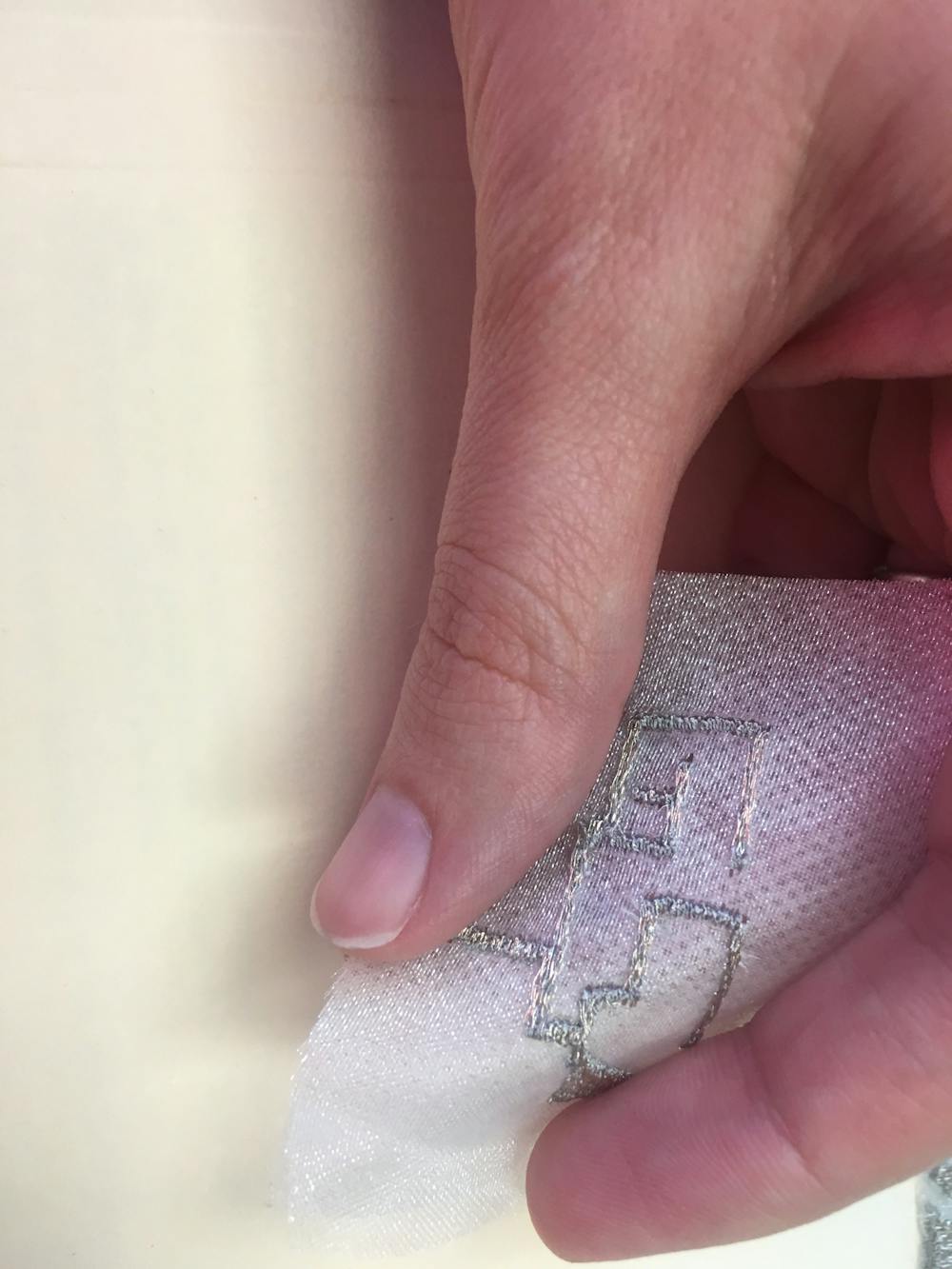
An embroidered antenna.
ElectroScience Lab, CC BY-ND

The e-threads we’re working with are bundles of twisted polymer filaments to provide strength, each with a metal-based coating to conduct electricity. The polymer core of each filament is typically made out of Kevlar or Zylon, while the surrounding coating is silver. Tens or even hundreds of these filaments are then twisted together to form a single e-thread that’s usually less than half a millimeter across.

These e-threads can be easily used with common commercial embroidery equipment – the same computer-connected stitching machines that people use every day to put their names on sports jackets and sweatshirts. The embroidered antennas are lightweight and just as good as their rigid copper counterparts, and can be as intricate as state-of-the-art printed circuit boards.

Our e-thread antennas can even be combined with regular threads in more complex designs, like integrating antennas into corporate logos or other designs. We’ve been able to embroider antennas on fabrics as thin as organza and as thick as Kevlar. Once embroidered, the wires can be connected to sensors and batteries by traditional soldering or flexible interconnections that plug components together.

So far, we’ve been able to create smart hats that read deep brain signals for patients with Parkinson’s or epilepsy. We have embroidered T-shirts with antennas that extend the range of Wi-Fi signals to the wearer’s mobile phone. We also made mats and bedsheets that monitor infants’ height to screen for a range of early childhood medical conditions. And we’ve made foldable antennas that measure how much a surface the fabric is on has bent or lifted.

Foldable antennas made with textile electronics.

Moving beyond the antenna

My lab is also working with other Ohio State researchers, including chemist Anne Co and physician Chandan Sen, to make flexible fabric-based miniature power generators.
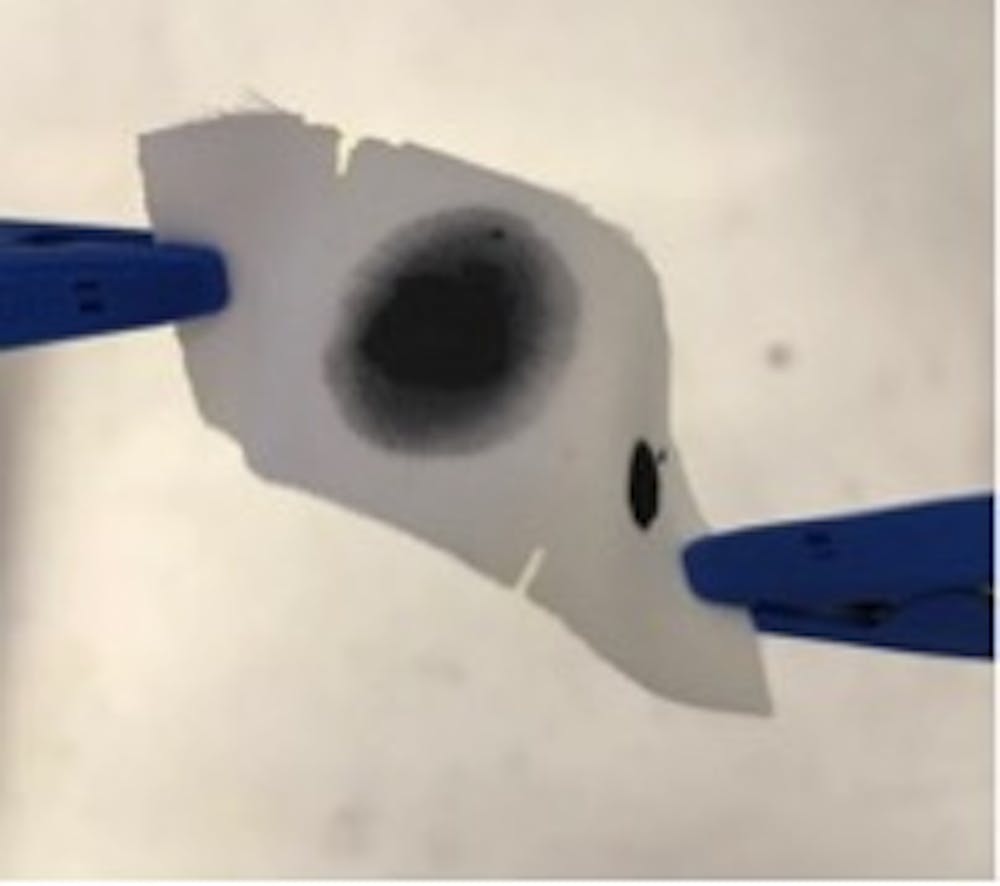
Printed on fabric, metals can generate power.
ElectroScience Lab, CC BY-ND

We use a process much like inkjet printing to place alternating regions of silver and zinc dots on the fabric. When those metals come into contact with sweat, saline or even fluid discharges from wounds, silver acts as the positive electrode and zinc serves as the negative electrode – and electricity flows between them.

We have generated small amounts of electricity just by getting the fabric damp – without the need for any additional circuits or components. It’s a fully flexible, washable power source that can connect with other wearable electronics, eliminating the need for conventional batteries.

The ConversationBoth together and individually, these flexible, wearable electronics will transform clothing into connected, sensing, communicating devices that mesh well with the fabric of the interconnected 21st century.

Asimina Kiourti, Assistant Professor of Electrical and Computer Engineering, The Ohio State University

This article was originally published on The Conversation. Read the original article.

Featured Image: Embroidery machine creating FSS structure, source: “Embroidery and Related Manufacturing Techniques for Wearable Antennas: Challenges and Opportunities”, read the full article here

Related

Recent Posts

Bourns Offers Custom Magnetics for 3‑Phase Flying Capacitor Inverters

3.6.2026
17

Nvidia Vera Rubin: Why One AI Rack Needs So Many More MLCC Capacitors

2.6.2026
66

Stackpole Introduces 1400A Busbar Shunt Resistors

2.6.2026
11

Tecate Unveils High‑temp 105C Supercapacitors for Harsh‑Environment Designs

2.6.2026
15

Passive Components in 2026: From Invisible Commodity to Design Parameter

2.6.2026
27

Bourns Introduces High Current Chip Ferrite Beads for Dense Power Rails

1.6.2026
14

Vishay Releases High‑Current Radial Inductors up to 209 A

29.5.2026
27

May 2026 Interconnect, Passives and Electromechanical Components Market Insights

29.5.2026
96

Passive Components Enable Safe and Reliable ADAS Architectures

28.5.2026
69

Upcoming Events

Jun 16
16:00 - 17:00 CEST

EMC with EMC – EMC‑compliant design with electromechanical connectors

View Calendar

Popular Posts

  • Buck Converter Design and Calculation

    0 shares
    Share 0 Tweet 0
  • Boost Converter Design and Calculation

    0 shares
    Share 0 Tweet 0
  • MLCC and Ceramic Capacitors

    0 shares
    Share 0 Tweet 0
  • Flyback Converter Design and Calculation

    0 shares
    Share 0 Tweet 0
  • LLC Resonant Converter Design and Calculation

    0 shares
    Share 0 Tweet 0
  • Capacitor Charging and Discharging

    0 shares
    Share 0 Tweet 0
  • What Electronics Engineer Needs to Know About Passive Low Pass Filters

    0 shares
    Share 0 Tweet 0
  • Dual Active Bridge (DAB) Topology

    0 shares
    Share 0 Tweet 0
  • SEPIC Converter Design and Calculation

    0 shares
    Share 0 Tweet 0
  • Ripple Current and its Effects on the Performance of Capacitors

    3 shares
    Share 3 Tweet 0

Newsletter Subscription


Passive Components Blog

© EPCI - Leading Passive Components Educational and Information Site

  • Home
  • Privacy Policy
  • EPCI Membership & Advertisement
  • About

No Result
View All Result
  • Home
  • Knowledge Blog
  • Dossiers
  • PCNS

© EPCI - Leading Passive Components Educational and Information Site

This website uses cookies. By continuing to use this website you are giving consent to cookies being used. Visit our Privacy and Cookie Policy.
Go to mobile version