















Exxelia, in collaboration with CEA‑Leti, has demonstrated a miniaturized inverted‑F antenna (IFA) operating around 400 MHz by loading it with a custom magnetodielectric material instead of relying solely on high‑permittivity dielectrics.
The work targets compact UHF antennas where space is at a premium but bandwidth and efficiency must remain within acceptable limits. The results are of particular interest for engineers involved in constrained RF platforms in defense, aviation and connected objects in the low UHF band.
Key features and benefits
The joint study focuses on an IFA operating in the low UHF band around 400 MHz and loaded with a custom‑engineered magnetodielectric material developed by Exxelia and CEA‑Leti. The approach co‑optimizes both the electromagnetic properties of the material and the antenna architecture to reduce size while maintaining usable radiation performance.
Key outcomes of the prototype include:
- Operation in the 400 MHz UHF band with magnetodielectric loading
- Antenna miniaturized to a characteristic radius of approximately λ/15
- SWR < 3 bandwidth of about 20 MHz (roughly 5% relative bandwidth)
- Measured radiation efficiency on the order of 30%
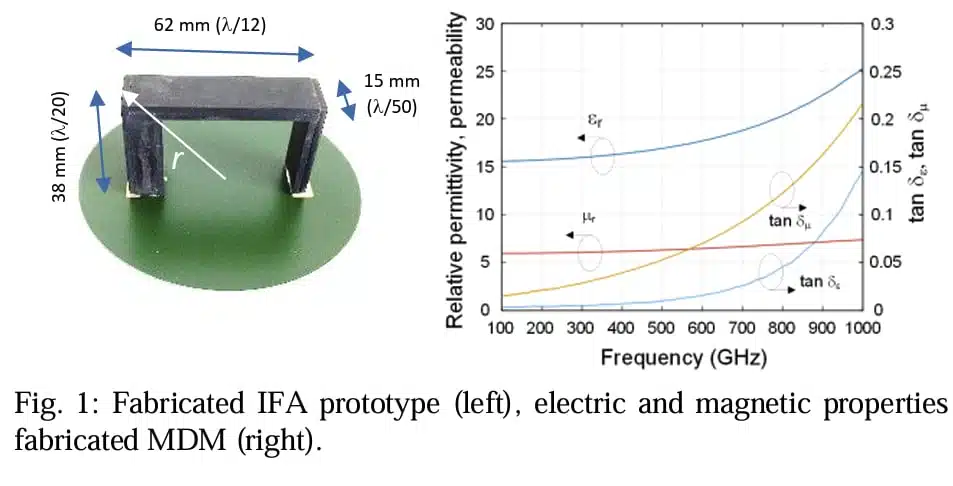
- Stable behavior of the loading material over the 300–500 MHz range and controlled magnetic losses
For practical RF design, this means engineers can reduce antenna size significantly while still retaining a workable impedance bandwidth and efficiency for many low‑data‑rate or duty‑cycled UHF applications. The trade‑off between miniaturization and efficiency is made explicit, allowing design teams to weigh footprint savings versus link budget margins.
Technical approach
Custom magnetodielectric material
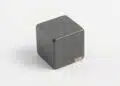
The magnetodielectric loading material is based on hard magnetic hexaferrite compositions of the type BaxCoyFe24O41, processed and tailored for the targeted UHF band. It is engineered to exhibit elevated permeability in the 300–500 MHz frequency range, combined with controlled magnetic losses and a stable temperature response according to the published paper.
In manufacturing, the ferrite components are:
- Produced via solid‑state processing
- Machined to defined geometries suitable for integration near the IFA structure
- Metallized using silver screen printing
- Assembled by epoxy bonding for mechanical integrity and RF continuity
For RF engineers, the elevated permeability enables stronger interaction with the antenna near field, effectively shortening the electrical length of the structure for a given physical size. At the same time, controlled losses and stable temperature behavior are essential to maintain predictable impedance and efficiency over operating conditions.
Antenna loading strategy
A dedicated loading strategy is used to maximize coupling between the IFA near field and the magnetodielectric blocks. The study analyzes the impact of material positioning and volume around:
- The resonant strip
- The short circuit connection
- The feed probe
Three key performance parameters are evaluated:
- Miniaturization factor (footprint reduction versus a conventional IFA)
- SWR bandwidth (defined here as SWR < 3)
- Radiation efficiency
By placing the magnetodielectric material where magnetic fields are strongest, the design achieves a characteristic radius of approximately λ/15 while keeping about 5% impedance bandwidth and around 30% radiation efficiency. In practical terms, such a configuration is attractive where board real estate is extremely constrained and an external or full‑size quarter‑wave radiator is not acceptable.
Typical applications
The demonstrated antenna targets compact UHF platforms where both volume and integration flexibility are limited. Typical use cases include:
- Defense and secure communications terminals operating near 400 MHz
- Aviation systems and subsystems in the UHF band where embedded or conformal antennas are preferred
- Compact connected objects and industrial devices in the low UHF range that require integrated rather than external antennas
- RF communication modules where antenna size conflicts with enclosure dimensions, shielding or coexistence constraints
Because the concept is based on a custom magnetodielectric block, it lends itself to application‑specific optimization. For OEMs, this can translate into tailored antenna modules or magnetodielectric loading elements co‑designed for a given housing, ground plane and RF front‑end architecture.
Technical highlights
The work presented at IEEE CAMA 2025 provides several quantitative and qualitative highlights relevant for RF and antenna engineers:
- Operating band: low UHF around 400 MHz
- Miniaturization: characteristic radius approximately λ/15, enabling a much smaller physical volume than a conventional quarter‑wave structure
- Bandwidth: SWR < 3 bandwidth of about 20 MHz (roughly 5% of the center frequency), suitable for many narrowband or channelized systems
- Radiation efficiency: measured around 30% for the magnetodielectric‑loaded IFA prototype
- Material behavior: magnetodielectric material exhibits elevated permeability and controlled losses in the 300–500 MHz range, with stable temperature performance as described by the authors
Compared with purely dielectric miniaturization, magnetodielectric loading provides an alternative route where both electric and magnetic fields are exploited to shrink the antenna. This can reduce extreme permittivity requirements and may result in more balanced Q‑factor and bandwidth trade‑offs, especially for UHF frequencies where physical size is a major challenge.
Availability and related product families
The antenna and material combination is presented in the context of a research and development project supported by the French DGA under the RAPID FAMTOMAS framework. As such, it should be viewed as a technology demonstrator and platform for future custom developments rather than a single commercial part number.
For engineers looking at practical design‑ins, Exxelia highlights several related product and material families that support RF and microwave designs:
- Ferrite and magnetodielectric components optimized for frequency‑sensitive applications in the RF and microwave range
- High‑Q ceramic and mica capacitors for RF tuning, filtering and impedance matching networks associated with antennas and front ends
- Film capacitors designed for high‑voltage operation (up to 1.5 kV) and elevated temperatures (up to 140 °C), which can be relevant for associated power or pulsed systems
- Custom magnetic components and microwave ferrites and dielectric solutions targeted at frequency‑sensitive communication and radar applications
These product families underline that the magnetodielectric IFA demonstrator is part of a broader portfolio of advanced functional materials and RF passive components. For concrete projects, the exact material grades, dimensions and electrical properties are typically defined and confirmed through the manufacturer datasheets and project‑specific specifications.
Design‑in notes for engineers
For RF and antenna engineers considering similar approaches, several practical points emerge from the published work:
- Magnetodielectric loading is most effective when placed in regions of strong magnetic fields, so careful field analysis (via full‑wave simulation or measurement) is important before fixing geometry.
- There is a clear trade‑off between miniaturization and efficiency; a characteristic radius near λ/15 with about 30% radiation efficiency will fit some link budgets but not all, so system‑level budget calculations are essential.
- The SWR < 3 criterion and 5% relative bandwidth are acceptable for many narrowband or channelized UHF systems, but broadband or multi‑standard designs may require additional matching or alternative architectures.
- Material processing, metallization (e.g. silver screen printing) and bonding methods can influence RF losses, repeatability and long‑term reliability; coordination between antenna and materials engineering teams is therefore recommended.
- Temperature stability of the magnetodielectric properties is critical in defense, aviation and industrial environments; designers should rely on detailed datasheets and, when possible, full S‑parameter models over temperature.
In procurement and project planning, it is advisable to engage with the manufacturer early to clarify:
- Availability of the specific magnetodielectric composition (such as BaxCoyFe24O41‑based materials) for volume production
- Standard versus custom shapes and metallization patterns
- Qualification levels for aerospace, defense or industrial standards
- Lead times and minimum order quantities for tailored magnetodielectric components or antenna modules
This technology positions magnetodielectric loading as a serious alternative to purely dielectric miniaturization for compact UHF antennas, particularly when integration in constrained platforms is more critical than absolute peak efficiency.
Source
This article is based on information published by Exxelia about its joint work with CEA‑Leti on a magnetodielectric‑loaded 400 MHz inverted‑F antenna, complemented by general context for RF and antenna design engineers. For precise electrical characteristics and application‑specific details, readers should consult the original technical paper and the corresponding manufacturer documentation.
References
- Exxelia – Miniaturization of IFA Antenna Using Custom Magnetodielectric Material
- Exxelia – Full technical paper (IEEE CAMA 2025 IFA magnetodielectric study, PDF)
- Exxelia – Ferrite and magnetodielectric materials overview
- Exxelia – High‑Q ceramic capacitors
- Exxelia – Mica capacitors
- Exxelia – High‑voltage film capacitors
- Exxelia – Custom magnetic components