



Passive Components Blog
No Result
View All Result
  • Home
  • NewsFilter
    • All
    • Aerospace & Defence
    • Antenna
    • Applications
    • Automotive
    • Capacitors
    • Circuit Protection Devices
    • electro-mechanical news
    • Filters
    • Fuses
    • Inductors
    • Industrial
    • Integrated Passives
    • inter-connect news
    • Market & Supply Chain
    • Market Insights
    • Medical
    • Modelling and Simulation
    • New Materials & Supply
    • New Technologies
    • Non-linear Passives
    • Oscillators
    • Passive Sensors News
    • Resistors
    • RF & Microwave
    • Telecommunication
    • Weekly Digest

    Tecate Unveils High‑temp 105C Supercapacitors for Harsh‑Environment Designs

    Bourns Expands 1000V High‑Power Fuses for Semiconductor and Battery Protection

    Passive Components in 2026: From Invisible Commodity to Design Parameter

    Bourns Introduces High Current Chip Ferrite Beads for Dense Power Rails

    Wk 22 Electronics Supply Chain Digest

    Vishay Releases High‑Current Radial Inductors up to 209 A

    May 2026 Interconnect, Passives and Electromechanical Components Market Insights

    Passive Components Enable Safe and Reliable ADAS Architectures

    Current Sense Transformer Datasheet and Design‑in Guide

    Trending Tags

    • Ripple Current
    • RF
    • Leakage Current
    • Tantalum vs Ceramic
    • Snubber
    • Low ESR
    • Feedthrough
    • Derating
    • Dielectric Constant
    • New Products
    • Market Reports
  • VideoFilter
    • All
    • Antenna videos
    • Capacitor videos
    • Circuit Protection Video
    • Filter videos
    • Fuse videos
    • Inductor videos
    • Inter-Connect Video
    • Non-linear passives videos
    • Oscillator videos
    • Passive sensors videos
    • Resistor videos

    Current Sense Transformer Datasheet and Design‑in Guide

    Designing a USB Type‑C Flyback Planar Transformer with Frenetic’s Planar Tool

    Magnetics Design in High‑Frequency GaN Converters

    Qi2 Wireless Charging: Inductors, Capacitors and EMC Filters

    Two‑capacitor paradox explained for engineers

    Capacitances of Nonlinear MLCCs: What Datasheets Don’t Tell You

    Tapped Inductor Buck Converter Fundamentals

    Planar vs Conventional Transformer: When it Make Sense

    Modeling Fringing Field Losses in Inductors & Transformers

    Trending Tags

    • Capacitors explained
    • Inductors explained
    • Resistors explained
    • Filters explained
    • Application Video Guidelines
    • EMC
    • New Products
    • Ripple Current
    • Simulation
    • Tantalum vs Ceramic
  • Knowledge Blog
  • DossiersNew
  • Suppliers
    • Who is Who
  • PCNS
    • PCNS 2025
    • PCNS 2023
    • PCNS 2021
    • PCNS 2019
    • PCNS 2017
  • Events
  • Home
  • NewsFilter
    • All
    • Aerospace & Defence
    • Antenna
    • Applications
    • Automotive
    • Capacitors
    • Circuit Protection Devices
    • electro-mechanical news
    • Filters
    • Fuses
    • Inductors
    • Industrial
    • Integrated Passives
    • inter-connect news
    • Market & Supply Chain
    • Market Insights
    • Medical
    • Modelling and Simulation
    • New Materials & Supply
    • New Technologies
    • Non-linear Passives
    • Oscillators
    • Passive Sensors News
    • Resistors
    • RF & Microwave
    • Telecommunication
    • Weekly Digest

    Tecate Unveils High‑temp 105C Supercapacitors for Harsh‑Environment Designs

    Bourns Expands 1000V High‑Power Fuses for Semiconductor and Battery Protection

    Passive Components in 2026: From Invisible Commodity to Design Parameter

    Bourns Introduces High Current Chip Ferrite Beads for Dense Power Rails

    Wk 22 Electronics Supply Chain Digest

    Vishay Releases High‑Current Radial Inductors up to 209 A

    May 2026 Interconnect, Passives and Electromechanical Components Market Insights

    Passive Components Enable Safe and Reliable ADAS Architectures

    Current Sense Transformer Datasheet and Design‑in Guide

    Trending Tags

    • Ripple Current
    • RF
    • Leakage Current
    • Tantalum vs Ceramic
    • Snubber
    • Low ESR
    • Feedthrough
    • Derating
    • Dielectric Constant
    • New Products
    • Market Reports
  • VideoFilter
    • All
    • Antenna videos
    • Capacitor videos
    • Circuit Protection Video
    • Filter videos
    • Fuse videos
    • Inductor videos
    • Inter-Connect Video
    • Non-linear passives videos
    • Oscillator videos
    • Passive sensors videos
    • Resistor videos

    Current Sense Transformer Datasheet and Design‑in Guide

    Designing a USB Type‑C Flyback Planar Transformer with Frenetic’s Planar Tool

    Magnetics Design in High‑Frequency GaN Converters

    Qi2 Wireless Charging: Inductors, Capacitors and EMC Filters

    Two‑capacitor paradox explained for engineers

    Capacitances of Nonlinear MLCCs: What Datasheets Don’t Tell You

    Tapped Inductor Buck Converter Fundamentals

    Planar vs Conventional Transformer: When it Make Sense

    Modeling Fringing Field Losses in Inductors & Transformers

    Trending Tags

    • Capacitors explained
    • Inductors explained
    • Resistors explained
    • Filters explained
    • Application Video Guidelines
    • EMC
    • New Products
    • Ripple Current
    • Simulation
    • Tantalum vs Ceramic
  • Knowledge Blog
  • DossiersNew
  • Suppliers
    • Who is Who
  • PCNS
    • PCNS 2025
    • PCNS 2023
    • PCNS 2021
    • PCNS 2019
    • PCNS 2017
  • Events
No Result
View All Result
Passive Components Blog
No Result
View All Result

Exxelia Publishes Micropen White Papers for Printed Electronics

26.1.2026
Reading Time: 8 mins read
A A

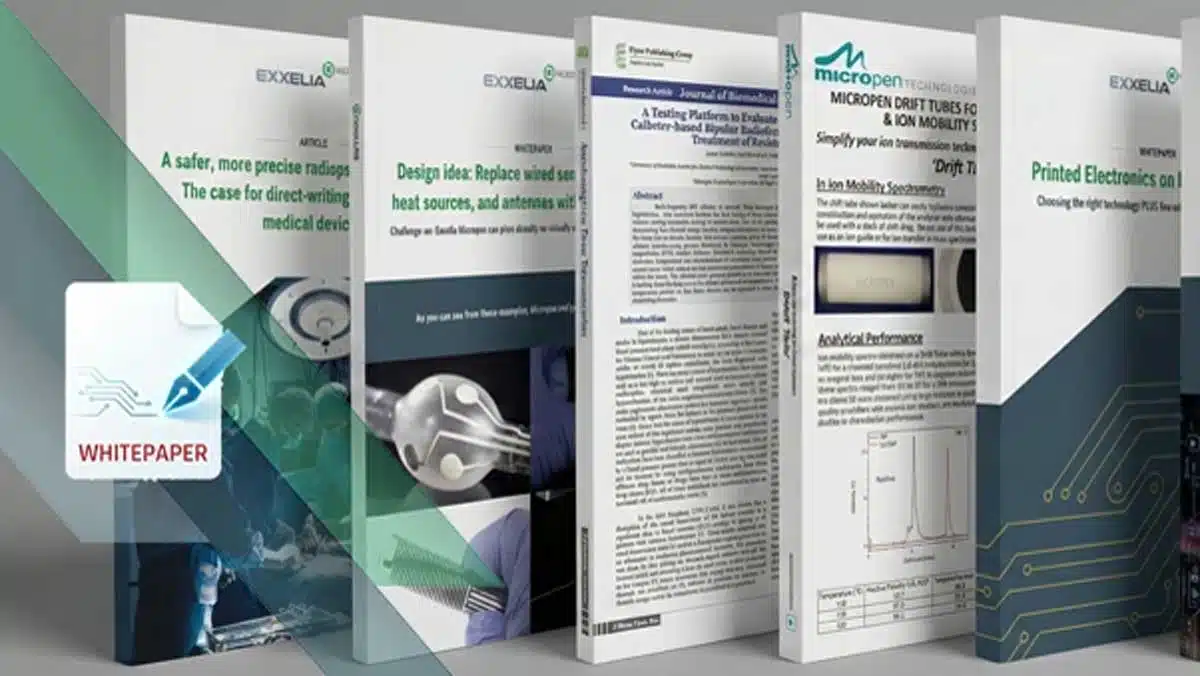
Exxelia has released a set of new Micropen white papers with practical insights for printed electronics in medical and sensor designs that go into real design details for printed electronics on medical devices, radiopaque markers, analytical instrumentation and integrated sensors.

For engineers and technical purchasers working with high‑reliability passive and sensing functions, these Exxelia documents can help clarify when Micropen direct‑write technology is a viable alternative to conventional wired components and assemblies.

RelatedPosts

Exxelia Extends Temperature Range of its PP Film Capacitors to 140C

Exxelia Introduces SMD High‑Voltage Mica Capacitors

Exxelia Releases Updated Microwave Materials and Frequency Tuning Catalogues

What Micropen technology offers to hardware designers

Micropen is a direct‑write printed electronics process that deposits functional materials (for example resistive, conductive or sensing inks) directly onto a substrate instead of using separate chips, wires or assemblies according to the manufacturer’s documentation. This enables resistors, heaters, sensors and interconnects to be formed as patterns on complex 2D or 3D geometries, including medical device surfaces and structures in analytical instruments.

For designers used to conventional thick‑film or SMD passives, the key value is the ability to “turn the substrate into the component” by integrating these functions in place, rather than routing to remote discrete parts. This can reduce interconnect count, shorten signal paths and simplify mechanical packaging in tight or dynamic spaces such as catheters, probes or compact analyzers.

Key themes of the new Micropen white papers

The new white papers from Exxelia Micropen focus on several application domains around printed electronics and sensor integration:

  • Printed electronics on medical devices, including ways to embed sensing or heating functionality directly onto device surfaces according to manufacturer documentation. Exxelia Micropen – Printed Electronics on Medical Devices white paper
  • Direct‑written radiopaque markers for medical devices, positioned as an alternative to traditional marker bands and coils. Exxelia Micropen – Radiopaque (RO) marker white paper
  • Micropen‑fabricated drift tubes for mass spectrometry and ion mobility spectrometry in analytical instruments. Exxelia Micropen – Drift tubes for mass spectrometry and ion mobility spectrometry white paper

  • A journal‑style biomedical technology and research article related to technological integration in clinical environments. Journal of Biomedical Technology and Research
  • Design concepts for replacing wired sensors, resistors, heaters and antennas with direct‑printed structures. Revolutionizing Design and Sensors; Design Idea – Replace Wired Sensors and Resistors

Together, they form a technical overview of how direct‑write printing can replace, complement or extend classical passive components and interconnects in demanding applications.

Typical applications highlighted in the Micropen material

The specific white papers linked from the Micropen technical center cover scenarios where passive or sensor functionality is directly printed onto or into a mechanical structure. Typical use cases include:

  • Medical devices
    • Printed sensors and heaters on catheters, probes or surgical instruments for temperature monitoring, ablation control or therapy delivery.
    • Conductive patterns and resistors printed on implantable or temporary devices where space and biocompatibility are critical (exact examples and limits are detailed in the white papers and datasheets).
    • Radiopaque markers printed as patterns on device surfaces, offering an alternative to metal bands or coils for X‑ray visualization while minimizing added profile and avoiding sharp transitions.
  • Analytical instrumentation
    • Drift tubes for mass spectrometry and ion mobility spectrometry with printed resistive or electrode structures along the tube wall, enabling controlled electric fields and compact assembly.
    • Integration of printed heater or sensor elements onto structural parts, reducing the need for separate heater cartridges or bolted‑on sensors.
  • General sensor and passive integration
    • Replacement of wired sensors and discrete resistors used for temperature, position, or pressure monitoring by printed resistor and sensor patterns.
    • Printed antennas or RF structures integrated on dielectric supports or housings, depending on material compatibility and frequency requirements as detailed in the relevant design documentation.

In many of these cases, Micropen functionality plays a similar role to traditional thick‑film resistors, heaters or sensor elements, but applied directly to the final substrate instead of an intermediate ceramic or PCB.

Design‑in notes for engineers

When evaluating Micropen‑based solutions as part of a passive or sensor design strategy, consider the following practical points:

  • Treat the printed function like a custom passive
    • Rather than selecting a catalog SMD resistor or thermistor, you are effectively specifying a custom printed element whose geometry, resistance, layout and location can be tuned for your application.
    • Early engagement with Exxelia’s technical team and the relevant Micropen white papers is recommended to define electrical ratings, environmental limits and mechanical constraints according to manufacturer datasheets.
  • Understand thermal paths and power density
    • For printed heaters or power resistors on thin‑wall catheters, probes or drift tubes, the thermal path into the surrounding medium (fluid, tissue, gas) is critical.
    • Use the white papers as a starting point, then perform your own simulation or testing to validate power density, temperature gradients and maximum allowable operating temperatures according to your safety case.
  • Define insulation and creepage/clearance
    • Where printed conductors or resistors are used at elevated voltages, creepage and clearance distances along the substrate surface must be designed according to IEC and UL requirements for your equipment class.
    • Surface finish, coatings, humidity exposure and pollution degree all influence how close printed features can be without risking tracking or breakdown.
  • Specify measurement and test requirements
    • For sensor applications (temperature, pressure, position, flow), define calibration strategy, drift limits and test conditions in your component or subassembly specification.
    • Micropen’s ability to produce consistent geometries should help with repeatability, but your test plan needs to confirm performance over the full lifetime and environmental range.
  • Consider supply chain and lifecycle
    • Since Micropen is a process‑driven technology, the “component” is a combination of substrate, ink and printing process carried out by Exxelia.
    • Purchasing and engineering teams should align on long‑term availability, change control, and second‑source strategies (if any) as they would with other custom or application‑specific passive components.

Availability and how to access the white papers

The new Micropen white papers are available through the Exxelia Technical Center under the Micropen‑related guides and technical documents section. From the overview page, engineers can navigate directly to individual titles such as printed electronics on medical devices, radiopaque markers, drift tubes for mass spectrometry and the design idea paper on replacing wired components with direct‑printed structures.

Source

This article is based on information published by Exxelia in its Micropen guides and technical center materials, with interpretation and context added for design and purchasing engineers. For detailed ratings, performance data and application limitations, always refer to the original white papers and associated datasheets from the manufacturer.

References

  1. New White Papers Available: Explore the Full Potential of Micropen Technology – Exxelia
  2. Exxelia Micropen – Technology overview
  3. Exxelia Technical Center – Micropen documents
  4. Exxelia Micropen – Printed Electronics on Medical Devices white paper
  5. Exxelia Micropen – Radiopaque (RO) marker white paper
  6. Exxelia Micropen – Drift tubes for mass spectrometry and ion mobility spectrometry white paper

Related

Recent Posts

Exxelia Extends Temperature Range of its PP Film Capacitors to 140C

1.6.2026
44

How Long-Term Storage Causes Aging in Electronic Components

26.5.2026
114

Stackpole Introduces High‑Voltage Low VCR Chip Resistors

25.5.2026
38

Using Stress–Strain Curves to Diagnose Tantalum Powders for Capacitors

20.5.2026
41

SCHURTER Releases SMT Micro Switch for Compact HMIs

30.4.2026
20

Vishay Introduced Thin Film Submount Platform for Optical and RF Modules

30.4.2026
50

Exxelia Introduces SMD High‑Voltage Mica Capacitors

28.4.2026
54

KYOCERA AVX Introduces Traction‑Grade DC Link Film Capacitors

21.4.2026
78

Hirose Introduced BGA connector for PCIe Gen6 for AI and Edge Computing

17.4.2026
37

Upcoming Events

Jun 2
16:00 - 17:00 CEST

Calculation, Simulation and Measurement of 800V EMC Filters

Jun 16
16:00 - 17:00 CEST

EMC with EMC – EMC‑compliant design with electromechanical connectors

View Calendar

Popular Posts

  • Buck Converter Design and Calculation

    0 shares
    Share 0 Tweet 0
  • Boost Converter Design and Calculation

    0 shares
    Share 0 Tweet 0
  • Flyback Converter Design and Calculation

    0 shares
    Share 0 Tweet 0
  • MLCC and Ceramic Capacitors

    0 shares
    Share 0 Tweet 0
  • LLC Resonant Converter Design and Calculation

    0 shares
    Share 0 Tweet 0
  • Capacitor Charging and Discharging

    0 shares
    Share 0 Tweet 0
  • What Electronics Engineer Needs to Know About Passive Low Pass Filters

    0 shares
    Share 0 Tweet 0
  • Dual Active Bridge (DAB) Topology

    0 shares
    Share 0 Tweet 0
  • Ripple Current and its Effects on the Performance of Capacitors

    3 shares
    Share 3 Tweet 0
  • SEPIC Converter Design and Calculation

    0 shares
    Share 0 Tweet 0

Newsletter Subscription


Passive Components Blog

© EPCI - Leading Passive Components Educational and Information Site

  • Home
  • Privacy Policy
  • EPCI Membership & Advertisement
  • About

No Result
View All Result
  • Home
  • Knowledge Blog
  • Dossiers
  • PCNS

© EPCI - Leading Passive Components Educational and Information Site

This website uses cookies. By continuing to use this website you are giving consent to cookies being used. Visit our Privacy and Cookie Policy.
Go to mobile version