

Passive Components Blog
No Result
View All Result
  • Home
  • News
    • All
    • Aerospace & Defence
    • Antenna
    • Applications
    • Automotive
    • Capacitors
    • Circuit Protection Devices
    • electro-mechanical news
    • Filters
    • Fuses
    • Inductors
    • Industrial
    • Integrated Passives
    • inter-connect news
    • Market & Supply Chain
    • Market Insights
    • Medical
    • Modelling and Simulation
    • New Materials & Supply
    • New Technologies
    • Non-linear Passives
    • Oscillators
    • Passive Sensors News
    • Resistors
    • RF & Microwave
    • Telecommunication
    • Weekly Digest

    Samsung MLCC Revenue Seen Above KRW 8T by 2027, Murata EOL Actions Reshape Supply

    ROHM SDR01 high anti-surge thick-film chip resistor in 1005 metric 0402 package with 0.33 W rated power

    ROHM Introduces Anti-Surge 0402 Resistors Rated at 0.33 W

    ECIA Industry Pulse Q3 2026 chart showing passive components, semiconductors and electro-mechanical component market sentiment and lead-time pressure

    ECIA Industry Pulse Moderates as Passive Lead Times Tighten

    LG Innotek Demonstrates FC-BGA Substrates With Embedded Silicon Capacitors for AI Power Delivery

    On-Chip 3D-Printed Copper Microinductors: A New Route to Compact RF Electronics

    Emerging Capacitor Markets in Fusion Energy

    Murata DLW32SH_MF 1210 surface-mount common mode choke coil with metal terminals for automotive CAN FD signal-line noise suppression

    Murata Introduces Common Mode Chokes for Automotive CAN FD up to 150°C

    onsemi solid-state transformer concept for 800 V HVDC AI data center power conversion with SiC modules, DC-link capacitors and high-frequency magnetics

    Solid-State Transformers for 800 V AI Data Centers: Passive Component Design Considerations

    Littelfuse TX00AT314AMA omnipolar TMR magnetic switch sensor in a leaded TO-92-3 through-hole package

    Littelfuse Expands Omnipolar TMR Switch with Leaded TO-92 Package Option

    Trending Tags

    • Ripple Current
    • RF
    • Leakage Current
    • Tantalum vs Ceramic
    • Snubber
    • Low ESR
    • Feedthrough
    • Derating
    • Dielectric Constant
    • New Products
    • Market Reports
  • Knowledge Blog
  • Dossiers
    • AI Hardware Dossier
    • Automotive Dossier
    • Industrial Robotics Dossier
    • Power Converter Dossier
    • Capacitor Dossier
    • Resistor Dossier
    • Inductor Dossier
    • Circuit Protection Dossier
  • Suppliers
    • Who is Who
  • PCNS
    • PCNS 2025
    • PCNS 2023
    • PCNS 2021
    • PCNS 2019
    • PCNS 2017
  • Events
  • Home
  • News
    • All
    • Aerospace & Defence
    • Antenna
    • Applications
    • Automotive
    • Capacitors
    • Circuit Protection Devices
    • electro-mechanical news
    • Filters
    • Fuses
    • Inductors
    • Industrial
    • Integrated Passives
    • inter-connect news
    • Market & Supply Chain
    • Market Insights
    • Medical
    • Modelling and Simulation
    • New Materials & Supply
    • New Technologies
    • Non-linear Passives
    • Oscillators
    • Passive Sensors News
    • Resistors
    • RF & Microwave
    • Telecommunication
    • Weekly Digest

    Samsung MLCC Revenue Seen Above KRW 8T by 2027, Murata EOL Actions Reshape Supply

    ROHM SDR01 high anti-surge thick-film chip resistor in 1005 metric 0402 package with 0.33 W rated power

    ROHM Introduces Anti-Surge 0402 Resistors Rated at 0.33 W

    ECIA Industry Pulse Q3 2026 chart showing passive components, semiconductors and electro-mechanical component market sentiment and lead-time pressure

    ECIA Industry Pulse Moderates as Passive Lead Times Tighten

    LG Innotek Demonstrates FC-BGA Substrates With Embedded Silicon Capacitors for AI Power Delivery

    On-Chip 3D-Printed Copper Microinductors: A New Route to Compact RF Electronics

    Emerging Capacitor Markets in Fusion Energy

    Murata DLW32SH_MF 1210 surface-mount common mode choke coil with metal terminals for automotive CAN FD signal-line noise suppression

    Murata Introduces Common Mode Chokes for Automotive CAN FD up to 150°C

    onsemi solid-state transformer concept for 800 V HVDC AI data center power conversion with SiC modules, DC-link capacitors and high-frequency magnetics

    Solid-State Transformers for 800 V AI Data Centers: Passive Component Design Considerations

    Littelfuse TX00AT314AMA omnipolar TMR magnetic switch sensor in a leaded TO-92-3 through-hole package

    Littelfuse Expands Omnipolar TMR Switch with Leaded TO-92 Package Option

    Trending Tags

    • Ripple Current
    • RF
    • Leakage Current
    • Tantalum vs Ceramic
    • Snubber
    • Low ESR
    • Feedthrough
    • Derating
    • Dielectric Constant
    • New Products
    • Market Reports
  • Knowledge Blog
  • Dossiers
    • AI Hardware Dossier
    • Automotive Dossier
    • Industrial Robotics Dossier
    • Power Converter Dossier
    • Capacitor Dossier
    • Resistor Dossier
    • Inductor Dossier
    • Circuit Protection Dossier
  • Suppliers
    • Who is Who
  • PCNS
    • PCNS 2025
    • PCNS 2023
    • PCNS 2021
    • PCNS 2019
    • PCNS 2017
  • Events
No Result
View All Result
Passive Components Blog
No Result
View All Result

Toroidal Inductors, Current Compensated Chokes, Common Mode Chokes and Beads

15.7.2026
Reading Time: 12 mins read
A A

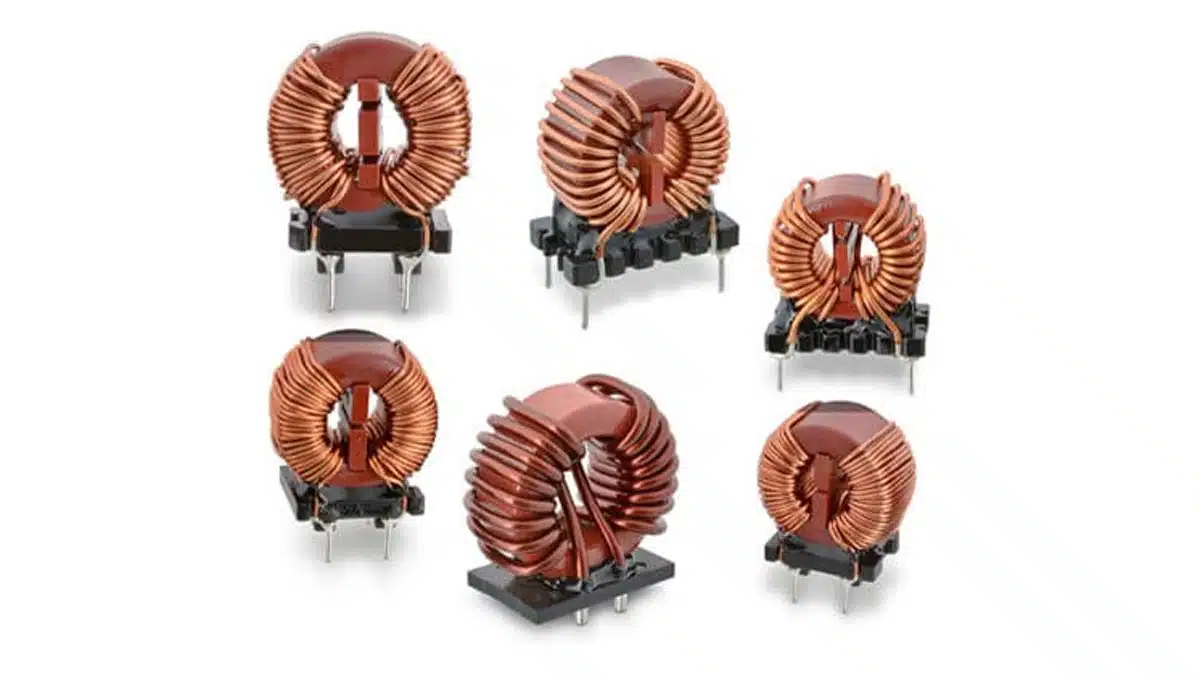
Coils wound on toroids have due to the closed magnetic circuit, a high inductance and thus a good attenuation effect. If they are connected into a mains network in order to block or suppress interference of any frequency the choice of inductor must be determined by the kind of interference that applies. This article discuss construction and its impact of toroidal inductors, current compensated chokes, common mode chokes and beads.

Interference Background

We have to deal with either common mode / asymmetrical interference or differential mode / symmetrical interference.

RelatedPosts

Current Sense Transformers: Ferrite vs Nanocrystalline Cores for Accurate Current Measurement

Planar vs Conventional Transformer: When it Make Sense

Why Power Inductors Use a Ferrite Core With an Air Gap

If we have a noise or interference source in a network that produces interference currents via short circuiting parasitic capacitance in, for example, the load, the two interference types may be illustrated with Figure 1.

The cure for this kind of interference current might be use of chokes combined with X- and Y- safety capacitors, i.e., capacitors intended for interference suppression in the mains. Asymmetrical interference is best rectified by a so called current compensated choke, where two counteracting windings cause the load current to create two opposing magnet fluxes. Those two fluxes cancel each other out. Any saturation risk is out of the question.
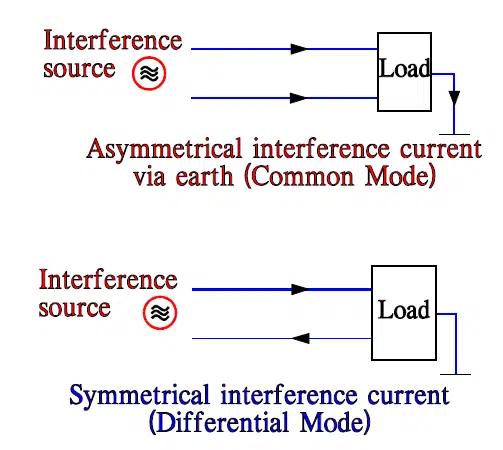
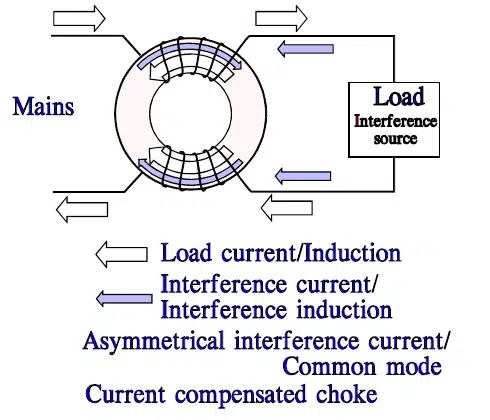
Figure 1. Asymmetrical (common mode) and symmetrical (differential) interference.
Figure 2. Asymmetrical interference on toroidal core

This method allows high permeability ferrites and subsequent high inductance. For asymmetric interference signals the inductance of the two windings co-operate and produce approximately 3.5 times higher inductance than a separate winding.

Note that the opposing fluxes from the load current create certain magnetic stray fluxes around the coils. This is illustrated in following figure 3.

Figure 3. Stray flux around a current compensated choke.
Figure 4. Symmetrical interference on toroidal core.

When there is a symmetrical interference (Figure 4.) we can’t use a current compensated choke. The fluxes of the load and interference currents will co-operate inside the toroid. In order not to come near magnetic saturation ferrites, with low to medium high permeability have to be used.

Current Compensated Chokes

Saturation effects caused by high signal currents, or DC current super imposed on the signal, reduce the effectiveness of the choke. The use of standard inductors in the signal path adversely impairs the useful signal. Current compensation circumvents these disadvantages. In current compensation, the “useful return current” must be passed through the choke. In this way, the useful current does not contribute to the magnetization of the core. See Figures 2. and 5.
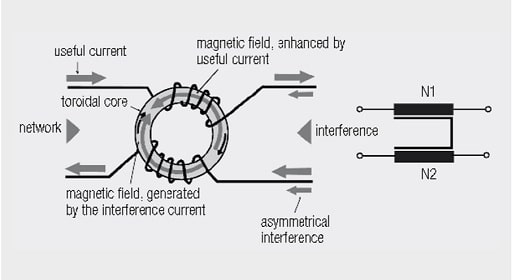
Figure 5. Construction and circuit diagram of a current compensated choke

Current-compensated chokes can be manufactured with different ferrite geometries; the best known are toroidal ring core and ribbed core. Different core materials enable their use in various frequency ranges. A very well known component, but one not designed as a common mode choke, is the snap ferrite or the split ferrite sleeve.

The effect of current-compensated chokes on coupled interference is, above all, used for data and signal lines. They are often the only option to avoid the interference suppression component affecting the useful signal.

see also webinar video: https://passive-components.eu/common-mode-choke-parameters-explained-we-webinar/

Current Compensated Choke Types

There is a wide range of current compensated choke types. Here is an overview of the most common types.

SMD Common Mode Noise Suppressor

The SMD Common Mode Noise Suppressor is usually not based on a ring core, either in size 0805 or 1206. Only for this reason it is possible to achieve such a compact current-compensated component. However, as it is a closed ferrite material system, the stray field remains negligibly small. Typical applications for the SMD common mode noise suppressors are USB, Firewire or High Speed Data Lines.
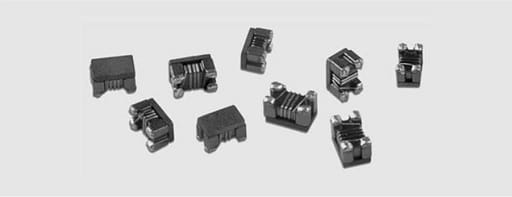
SMD Common Mode Noise Suppressor (Würth Elektronik WE-CNSW)

Current-Compensated SMD filter

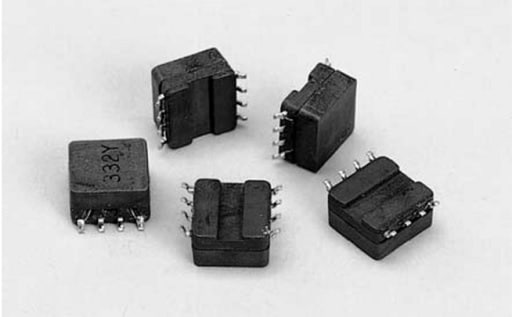
current-compensated SMD line filters (Würth Elektronik WE-SL series)

In contrast to SMD common mode noise suppressors, the current-compensated SMD line filters include ring cores. As a result, stray fields can almost be excluded. The different geometries and, above all, the very flat package heights of the various types, offer potential solutions for every application. High current ratings, as used in low-voltage applications, are also available.

Despite their compact construction, the current-compensated SMD line filters can also offers 4x current-compensated versions.

NiZn Core Current-Compensated SMD Filter

The NiZn current-compensated SMD line filters offers high in common mode impedance with a smaller footprint than MnZn types. NiZn ferrite base material provides a wider working temperature range.
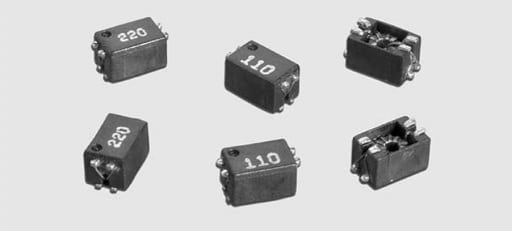
NiZn current-compensated SMD line filters (Würth Elektronik WE-SLM series)

At the same time, the leakage inductance is lower so the signal is less affected. The NiZn core current-compensated SMD line filters can therefore also be used at high signal frequencies.

MnZn Current-Compensated SMD Filter
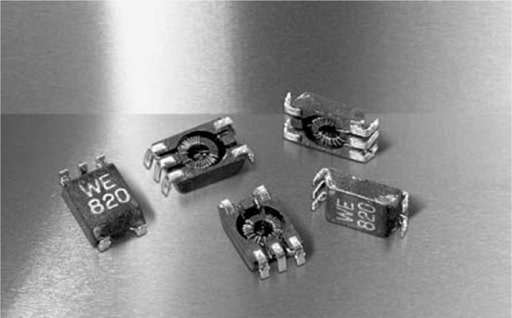
MnZn current-compensated SMD line filter (Würth Elektronik WE-SL1 series)

The MnZn current-compensated SMD line filter (such as Würth Elektronik WE-SL1 series) all excels by virtue of its low space requirement, both in terms of package height as well as footprint.

The manganese-zinc basic material provides adequate balances attenuation values.

MnZn Current-Compensated SMD Filter with Separated Construction
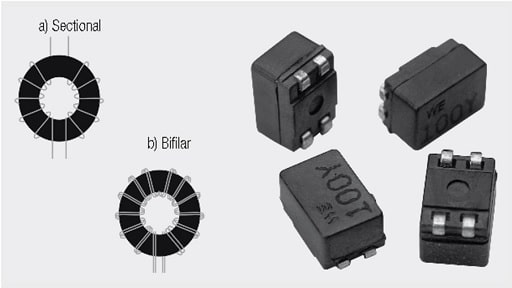
MnZn current-compensated SMD line filters with separated construction (Würth Elektronik WE-SL2 series)

The MnZn current-compensated SMD line filters can be prepared also with separated construction and both sectional and bifilar winding technology. 

The separated construction of the sectional winding allows both the attenuation of high frequency symmetrical frequency components, as well as the suppression of asymmetrical interference components. However, if the quality of the useful signal is too greatly affected, the original bifilar winding technology should be chosen.

High Density MnZn Current-Compensated SMD filter with Separated Construction
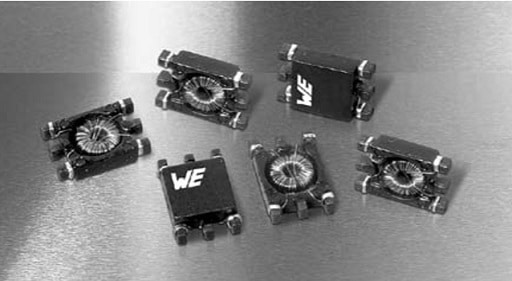
high density MnZn current-compensated SMD line filter with separated construction (Würth Elektronik WE-SL3 series)

The MnZn current-compensated SMD line filter with separated construction can be also made in high density version that represents an advancement of the MnZn current-compensated SMD line filters. Despite the halved package height, almost the same performance can be attained, at least for low inductance values. Additionally a 3x current-compensated version has been developed, which is mainly used for low voltages.

High Frequency MnZn Current-Compensated SMD Filter

A special high frequency design of manganese-zinc allows the frequency band in the single and double figure megahertz range to be covered.
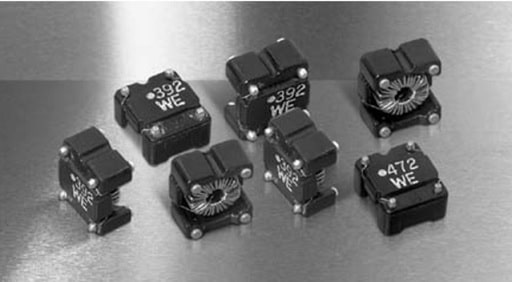
MnZn high frequency current compensated SMD filter (Würth Elektronik WE-SL3 series)

Current Compensated Choke for Mains Voltage Applications
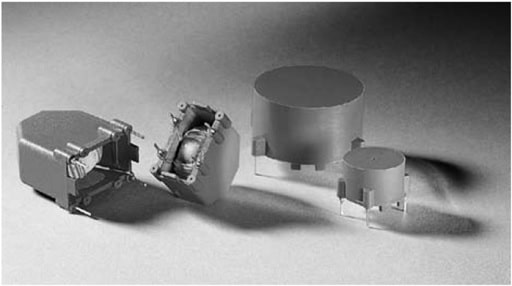
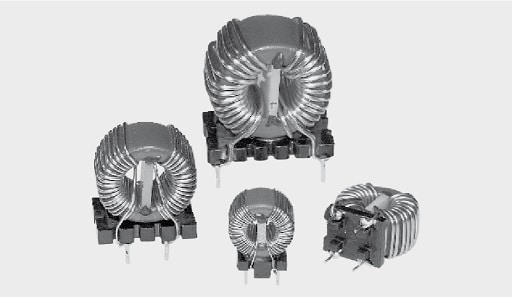
Mains voltage current compensated choke (Würth Elektronik WE-LF)
Mains voltage current compensated choke (Würth Elektronik WE-CMB)

Special construction of the current-compensated chokes allow the reduction of undesirable parasitic effects. Careful selection of core/winding relationship allows a very high current for a comparable footprint.

However, if conducting components or packaging parts are placed in the immediate vicinity, the required safety separation must be ensured on some types, as enameled wires are not considered to be insulated components. In most cases, the use of this design, however, unproblematic as insulated components, such as capacitors, provide the necessary separation.

Multi-chamber Current-Compensated Power Line Chokes
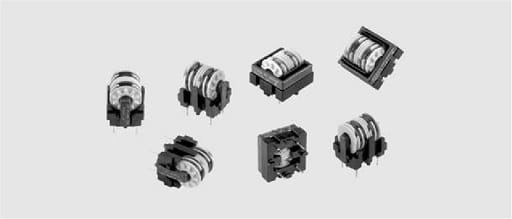
Multichamber current-compensated choke (Würth Elektronik WE-FC)

Multichamber current-compensated choke has roughly twice the leakage inductance relative to comparable toroidal chokes. The effect on symmetrical interference increases without having to use an additional inductor. Parasitic parallel capacitance is reduced as a result of the construction with a multi-chamber coil body.

The impedance profile is raised at higher frequencies. At the same time, resilience against burst and surge pulses is improved.

Attenuation Beads

A special variant of the toroidal inductor is the so called attenuation bead that becomes effective in the MHz range. It consists in its most simple form of a miniature toroid in low or high permeability ferrite or sometimes of iron powder. In alternative designs the “bead” becomes a tube or, depending on application, a double or multiaperture ferrite core. In all these variants the lead passes through the toroid. In designs where all space in the construction is consumed and we find afterwards that interference suppression measures are needed a small ferrite bead may be the solution.

It increases the inductance of the lead/wire in the RF range and functions as an energy absorber, for example, transients. A simple formula for
estimating the induction factor AL of the bead is Equation [1] below.

AL= µ x 0.4π/c » µ x 0.2 x h x ln(D/d) [1]

h is height, D is outer diameter, d is inner diameter of the toroid, The measures are expressed in mm.

Example: µ = 750, h = 2.5 mm, D = 6.3mm, d=3.8 mm gives AL = 750 x 0.2 x 2.5 x ln(6.3/3.8) = 190 nH.

Ferrite beads also are manufactured as chips. Examples of ferrite chip characteristics of two different materials are stated in the following table 1.
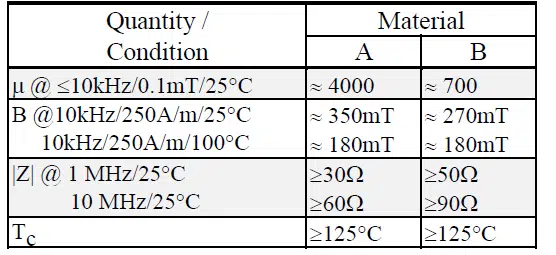
Table 1. Examples of ferrite chip material characteristics.

Note how the flux density B has been reduced considerably at 100 °C, though the Curie temperature TC is situated considerably higher.
How the different materials may depend on frequency is shown in following diagram.
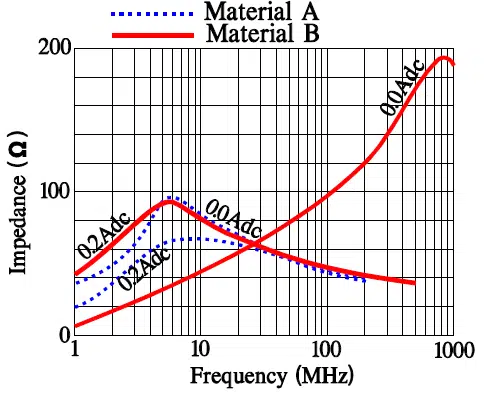
Figure 6. Examples of impedance versus frequency for several ferrite materials according to Table 1.

Note how lower permeabilities improve the impedance at higher frequencies as well as how DC load, increasing the flux density B, lowers the impedance. In order to cover a broader frequency band it might be necessary to connect in series ferrite beads with different materials.

Finally we should observe that ferrites have a certain conductance. In sensitive applications it might be necessary to use isolated/lacquered beads.

Furher Read

EMC Design Fundamentals: Safe Use of Varistors and Common Mode Chokes in Mains and Data-Line Filters

Related

Recent Posts

On-Chip 3D-Printed Copper Microinductors: A New Route to Compact RF Electronics

10.9.2026
15
Murata DLW32SH_MF 1210 surface-mount common mode choke coil with metal terminals for automotive CAN FD signal-line noise suppression

Murata Introduces Common Mode Chokes for Automotive CAN FD up to 150°C

10.9.2026
11
onsemi solid-state transformer concept for 800 V HVDC AI data center power conversion with SiC modules, DC-link capacitors and high-frequency magnetics

Solid-State Transformers for 800 V AI Data Centers: Passive Component Design Considerations

9.9.2026
66

Coilcraft Introduces Automotive Common Mode Chokes Target CISPR 25 Class 5 EMC Compliance

7.9.2026
17

Murata Expands Automotive Metal Power Inductor Range

7.9.2026
37

August 2026 Interconnect, Passives and Electromechanical Components Market Insights

4.9.2026
51

Vishay Extends High-Current Common-Mode Chokes with 30 A EMI Filtering up to 150 °C

3.9.2026
36

B–H Curve-Based Inductor Modelling in LTspice: A Current-Dependent Magnetic Model

31.8.2026
58

Vishay IFBT SMT Flyback Transformers Target PoE and Isolated DC/DC Designs up to 30 W

28.8.2026
24

Upcoming Events

Sep 16
17:00 - 18:00 CEST

Designing a 5 kW, 800 V-to-50 V PSFB Converter for Next-Generation Data Centers

Sep 29
16:00 - 17:00 CEST

Cybersecurity 2026

Nov 24
16:00 - 17:00 CET

Component selection with the WE REDEXPERT® DC-DC Converter Designer Tool

View Calendar

Popular Posts

  • Buck Converter Design and Calculation

    0 shares
    Share 0 Tweet 0
  • LLC Resonant Converter Design and Calculation

    0 shares
    Share 0 Tweet 0
  • Boost Converter Design and Calculation

    0 shares
    Share 0 Tweet 0
  • Flyback Converter Design and Calculation

    0 shares
    Share 0 Tweet 0
  • Earthing Systems and IEC Classification Explained

    0 shares
    Share 0 Tweet 0
  • MLCC and Ceramic Capacitors

    0 shares
    Share 0 Tweet 0
  • Resistor Symbols

    0 shares
    Share 0 Tweet 0
  • Capacitor Charging and Discharging

    0 shares
    Share 0 Tweet 0
  • Audio Capacitors: Choosing Capacitors for Crossover Circuits

    0 shares
    Share 0 Tweet 0
  • Capacitor Symbols

    0 shares
    Share 0 Tweet 0

Newsletter Subscription


Passive Components Blog

© 2015–2026
All rights reserved

  • Home
  • Privacy Policy
  • EPCI Membership & Advertisement
  • About

No Result
View All Result
  • Home
  • Knowledge Blog
  • Dossiers
  • PCNS

© 2015–2026
All rights reserved