

















Passive Components Blog
No Result
View All Result
  • Home
  • NewsFilter
    • All
    • Aerospace & Defence
    • Antenna
    • Applications
    • Automotive
    • Capacitors
    • Circuit Protection Devices
    • electro-mechanical news
    • Filters
    • Fuses
    • Inductors
    • Industrial
    • Integrated Passives
    • inter-connect news
    • Market & Supply Chain
    • Market Insights
    • Medical
    • Modelling and Simulation
    • New Materials & Supply
    • New Technologies
    • Non-linear Passives
    • Oscillators
    • Passive Sensors News
    • Resistors
    • RF & Microwave
    • Telecommunication
    • Weekly Digest

    KYOCERA AVX Introduces Traction‑Grade DC Link Film Capacitors

    When More Capacitance Hurts Reliability: The Role of the Metallic Skeleton in Tantalum Anodes

    Why Power Inductors Use a Ferrite Core With an Air Gap

    Wk 16 Electronics Supply Chain Digest

    YAGEO Introduces High‑Current Y2/X1 Film Capacitors for Wide-bandgap Power Systems

    Amphenol Explanded Liquid Cooling Connectors for AI, ESS and EV Systems

    Hirose Introduced BGA connector for PCIe Gen6 for AI and Edge Computing

    YAGEO Introduces High Rel MLCCs Beyond MIL-Spec Limits

    Würth Elektronik Expanded Capacity for Validation and Services in Asia

    Trending Tags

    • Ripple Current
    • RF
    • Leakage Current
    • Tantalum vs Ceramic
    • Snubber
    • Low ESR
    • Feedthrough
    • Derating
    • Dielectric Constant
    • New Products
    • Market Reports
  • VideoFilter
    • All
    • Antenna videos
    • Capacitor videos
    • Circuit Protection Video
    • Filter videos
    • Fuse videos
    • Inductor videos
    • Inter-Connect Video
    • Non-linear passives videos
    • Oscillator videos
    • Passive sensors videos
    • Resistor videos

    Why Power Inductors Use a Ferrite Core With an Air Gap

    Transformer-Based Power-Line Harvester Magnetic Design

    Thermal Modeling of Magnetics

    Standard vs Planar LLC transformers Comparison for Battery Chargers

    How Modern Tools Model Magnetic Components for Power Electronics

    Advanced Loss Modeling for Planar Magnetics in the Frenetic Planar Tool

    2026 Power Magnetics Design Trends: Flyback, DAB and Planar

    Enabling Software‑Defined Vehicle Architectures: Automotive Ethernet and Zonal Smart Power

    Calculating Resistance Value of a Flyback RC Snubber 

    Trending Tags

    • Capacitors explained
    • Inductors explained
    • Resistors explained
    • Filters explained
    • Application Video Guidelines
    • EMC
    • New Products
    • Ripple Current
    • Simulation
    • Tantalum vs Ceramic
  • Knowledge Blog
  • DossiersNew
  • Suppliers
    • Who is Who
  • PCNS
    • PCNS 2025
    • PCNS 2023
    • PCNS 2021
    • PCNS 2019
    • PCNS 2017
  • Events
  • Home
  • NewsFilter
    • All
    • Aerospace & Defence
    • Antenna
    • Applications
    • Automotive
    • Capacitors
    • Circuit Protection Devices
    • electro-mechanical news
    • Filters
    • Fuses
    • Inductors
    • Industrial
    • Integrated Passives
    • inter-connect news
    • Market & Supply Chain
    • Market Insights
    • Medical
    • Modelling and Simulation
    • New Materials & Supply
    • New Technologies
    • Non-linear Passives
    • Oscillators
    • Passive Sensors News
    • Resistors
    • RF & Microwave
    • Telecommunication
    • Weekly Digest

    KYOCERA AVX Introduces Traction‑Grade DC Link Film Capacitors

    When More Capacitance Hurts Reliability: The Role of the Metallic Skeleton in Tantalum Anodes

    Why Power Inductors Use a Ferrite Core With an Air Gap

    Wk 16 Electronics Supply Chain Digest

    YAGEO Introduces High‑Current Y2/X1 Film Capacitors for Wide-bandgap Power Systems

    Amphenol Explanded Liquid Cooling Connectors for AI, ESS and EV Systems

    Hirose Introduced BGA connector for PCIe Gen6 for AI and Edge Computing

    YAGEO Introduces High Rel MLCCs Beyond MIL-Spec Limits

    Würth Elektronik Expanded Capacity for Validation and Services in Asia

    Trending Tags

    • Ripple Current
    • RF
    • Leakage Current
    • Tantalum vs Ceramic
    • Snubber
    • Low ESR
    • Feedthrough
    • Derating
    • Dielectric Constant
    • New Products
    • Market Reports
  • VideoFilter
    • All
    • Antenna videos
    • Capacitor videos
    • Circuit Protection Video
    • Filter videos
    • Fuse videos
    • Inductor videos
    • Inter-Connect Video
    • Non-linear passives videos
    • Oscillator videos
    • Passive sensors videos
    • Resistor videos

    Why Power Inductors Use a Ferrite Core With an Air Gap

    Transformer-Based Power-Line Harvester Magnetic Design

    Thermal Modeling of Magnetics

    Standard vs Planar LLC transformers Comparison for Battery Chargers

    How Modern Tools Model Magnetic Components for Power Electronics

    Advanced Loss Modeling for Planar Magnetics in the Frenetic Planar Tool

    2026 Power Magnetics Design Trends: Flyback, DAB and Planar

    Enabling Software‑Defined Vehicle Architectures: Automotive Ethernet and Zonal Smart Power

    Calculating Resistance Value of a Flyback RC Snubber 

    Trending Tags

    • Capacitors explained
    • Inductors explained
    • Resistors explained
    • Filters explained
    • Application Video Guidelines
    • EMC
    • New Products
    • Ripple Current
    • Simulation
    • Tantalum vs Ceramic
  • Knowledge Blog
  • DossiersNew
  • Suppliers
    • Who is Who
  • PCNS
    • PCNS 2025
    • PCNS 2023
    • PCNS 2021
    • PCNS 2019
    • PCNS 2017
  • Events
No Result
View All Result
Passive Components Blog
No Result
View All Result

Flexible Displays and Sensors: Enabling a New Era of Electronics

16.2.2022
Reading Time: 3 mins read
A A

Source: TTI Market Eye article

by Murray Slovick.

RelatedPosts

Electroninks Enhanced Ultra-Fine Silver Ink Ready for Aerosol Jet Printing

Researches Developed Fast and Low Cost Prototyping Technique to Make Wearable Stretchable Sensors and Supercapacitors

High Energy Flexible Supercapacitors for IoT Applications

Flexible electronics, a technology for assembling circuits by mounting devices on plastic substrates that can bend, stretch and twist un-tethered by wires, offers important advantages over conventional electronics built on rigid substrates.

Among the products that this technology is rapidly making possible are folding smartphones with wraparound displays that can fit into a pocket but unfold into a full-sized tablet, photovoltaic sheets and wearable or implantable devices that are better able to interact with the human body; conventional rigid electronics cannot be worn comfortably and do not do well when a body moves or when a sensor is placed on the soft tissue of an internal organ.

At the Consumer Electronics show last month Chinese startup Royole showed off the world’s first commercial smartphone with a flexible display. Called FlexPai it is a combination of mobile phone and tablet (it has the portability of a smartphone plus the screen size of a tablet). Unfolded, FlexPai provides a 7.8” color display screen with 4:3 aspect ratio and a 1920 x 1440 resolution.

FlexPai can be folded from 0 to 180 degrees to easily fit into a pocket. It Includes two cameras with 20 and 16 megapixels that can be bent to capture objects at unique angles. Royole’s flexible displays are produced at the company’s mass production campus in Shenzhen, China, a 100% self-designed, R&D and manufacturing facility with a total investment of around $1.7billion.

Royole further showed how the same flexible displays could be used for automotive dashboards, wearables and for various other commercial and industrial uses.

Also at CES LG unveiled a 65-inch OLED television that that rolls into and out of a base stand. It can be furled and unfurled on demand, extend part way to display photos or act as a control screen for smart devices, or unfold completely for full viewing. The company also showcased an “LG waterfall” formed from dozens of curved displays at the entrance to its CES booth.

The Korean company announced that its scrolling screen will be available for purchase during the second half of 2019.

More to Come

The academic community is engaged in a broad range of research topics directly relevant to flexible electronics and associated production. In a paper published Feb. 1 in Science Advances, researchers from the University of Houston reported significant advances in stretchable, rubbery semiconductors, including integrated electronics, logic circuits and arrayed sensory skins, moving these applications closer to commercialization.

Carrier mobility, or the speed at which electrons can move through a material, is critical for an electronic device to work successfully because it governs the ability of the semiconductor transistors to amplify the current. The University of Houston researchers discovered that adding minute amounts of metallic carbon nanotubes to the rubbery semiconductor P3HT (polydimethylsiloxane composite) leads to improved carrier mobility by providing what they described as “a highway” to speed up the carrier transport across the semiconductor.

At the University of Southampton researchers are collaborating with industrial partner PragmatIC on a Process Design Kit (PDK) that will expand the potential for the mass market uses of flexible electronics.

PragmatIC creates flexible integrated circuits (FlexICs) that can be embedded into packaging to personalize product information and present promotional offers. The prototype PDK developed through the project applies the school’s design flow expertise to PragmatIC’s flexible transistor technology.

Flexible Hybrid Electronics
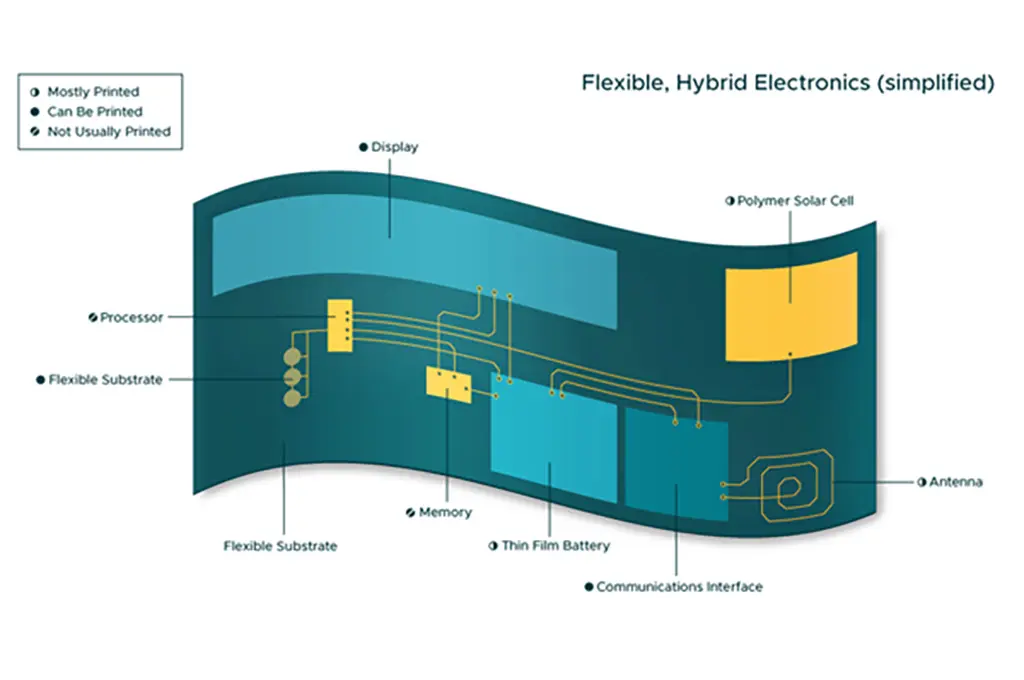
Integrating silicon components, printing with conductive inks and pasting on stretchable substrates yields so-called flexible hybrid electronics (FHE). The term refers to curved and variable form factor integrated devices with both printed components and conventional (although slimmed down) CMOS-based devices. FHE’s advantage is that it preserves the full operation of traditional electronic circuits but in conformable architectures.

Over the past few years and in recognition that it is important to share information as well as collaborate with multiple entities on FHE projects, major U.S. and international companies have formed public/private consortiums to launch targeted, large-scale programs with significant government funding to develop these new technologies.

For example, to advance the growth of the FHE ecosystem, the public/private partnership SEMI-FlexTech recently issued a Request for Proposal (RFP) for a demonstrable, modular multi-disciplinary FHE sensing system applicable to flexible, lightweight mobile and/or curved constructions. Another RFP asks for renewable, sustainable power systems employing flexible hybrid electronic components.

The SEMI-Flextech proposal process consists of two stages starting with a white paper review. White papers will be accepted until March 1, 2019, at 5:00 p.m. PST. Full proposals will be due by April 15, 2019, and award notifications will be issued on or about June 1, 2019.

Approximately $5 million is allocated for these projects. Primary funding will be provided by the U.S. Army Research Laboratory (ARL) through SEMI-FlexTech.

NextFlex is another consortium of companies, academic institutions, non-profits and state, local and federal governments with a shared goal of advancing U.S. manufacturing of FHE. Formed in 2015 through a cooperative agreement between the US Department of Defense (DoD) and the FlexTech Alliance, the consortium is currently developing an FHE PDK and a Modeling and Design Roadmap.

featured image: A simplified example of a curved FHE (Source: NextFlex)

Related

Recent Posts

KYOCERA AVX Introduces Traction‑Grade DC Link Film Capacitors

21.4.2026
3

When More Capacitance Hurts Reliability: The Role of the Metallic Skeleton in Tantalum Anodes

20.4.2026
16

Why Power Inductors Use a Ferrite Core With an Air Gap

20.4.2026
9

YAGEO Introduces High‑Current Y2/X1 Film Capacitors for Wide-bandgap Power Systems

17.4.2026
15

YAGEO Introduces High Rel MLCCs Beyond MIL-Spec Limits

16.4.2026
42

Samsung Introduces Ultra-High-Voltage 1500 V MLCCs for xEV Powertrains

16.4.2026
21

YAGEO Q1 2026 Results: AI Servers and Pricing Power Behind a Moderate Q2 Outlook

16.4.2026
61

TDK Introduces High‑Voltage Common‑Mode Chokes for Compact 1250 V DC Converters

16.4.2026
21

Vishay Extends Power Inductors for DC/DC with 1212 Compact Case

16.4.2026
16

Upcoming Events

Apr 21
16:00 - 17:00 CEST

Heatsink Solutions: Thermal Management in electronic devices

Apr 22
17:00 - 17:30 CEST

Magnetics in a high frequency GaN era

Apr 22
17:00 - 18:00 CEST

Derating Tantalum, Film, and Ceramic Capacitors

View Calendar

Popular Posts

  • Buck Converter Design and Calculation

    0 shares
    Share 0 Tweet 0
  • Boost Converter Design and Calculation

    0 shares
    Share 0 Tweet 0
  • Flyback Converter Design and Calculation

    0 shares
    Share 0 Tweet 0
  • LLC Resonant Converter Design and Calculation

    0 shares
    Share 0 Tweet 0
  • Dual Active Bridge (DAB) Topology

    0 shares
    Share 0 Tweet 0
  • MLCC and Ceramic Capacitors

    0 shares
    Share 0 Tweet 0
  • Capacitor Charging and Discharging

    0 shares
    Share 0 Tweet 0
  • Ripple Current and its Effects on the Performance of Capacitors

    3 shares
    Share 3 Tweet 0
  • MLCC Case Sizes Standards Explained

    0 shares
    Share 0 Tweet 0
  • Plastic Materials Dielectric Constant and DF

    4 shares
    Share 4 Tweet 0

Newsletter Subscription


Passive Components Blog

© EPCI - Leading Passive Components Educational and Information Site

  • Home
  • Privacy Policy
  • EPCI Membership & Advertisement
  • About

No Result
View All Result
  • Home
  • Knowledge Blog
  • PCNS

© EPCI - Leading Passive Components Educational and Information Site

This website uses cookies. By continuing to use this website you are giving consent to cookies being used. Visit our Privacy and Cookie Policy.
Go to mobile version