







Passive Components Blog
No Result
View All Result
  • Home
  • News
    • All
    • Aerospace & Defence
    • Antenna
    • Applications
    • Automotive
    • Capacitors
    • Circuit Protection Devices
    • electro-mechanical news
    • Filters
    • Fuses
    • Inductors
    • Industrial
    • Integrated Passives
    • inter-connect news
    • Market & Supply Chain
    • Market Insights
    • Medical
    • Modelling and Simulation
    • New Materials & Supply
    • New Technologies
    • Non-linear Passives
    • Optoelectronics and Isolation
    • Oscillators
    • Passive Sensors News
    • Resistors
    • RF & Microwave
    • Telecommunication
    • Weekly Digest
    SCHURTER TCS6F IP67 sealed SMD tactile switch with white silicone actuator on dark background

    SCHURTER Unveils IP67 Tactile Switch in 6.2 × 6.2 mm Package

    YAGEO SMD 0603 ST Pt1000 chip sensor shown in front of rooftop HVAC equipment

    YAGEO SMD 0603 ST Pt1000 Sensor with Standard SMD Termination

    Power line EMI filter on a copper ground-plane fixture connected to a vector network analyzer with a toroidal balun

    How to Measure Filter Performance: Insertion Loss, VNA Fixtures and CM/DM Separation

    Assorted EMI and RF filter components: common mode choke, ferrite beads, feedthrough filter, X2 capacitor, cavity filter, ceramic coaxial resonators, thin-film filter and SAW/BAW packages

    Passive Filter Technologies Compared: LC, Ferrite, Feedthrough, Ceramic, Cavity, Microstrip, SAW and BAW

    Illustration of a thin-film capacitor stack with TiN electrodes and an ultrathin hafnium zirconium oxide ferroelectric layer on silicon

    Sub-Volt Ferroelectric HZO Capacitor Pairs Speed and Endurance

    Cut-open lithium-ion capacitor pouch cell showing stacked carbon electrodes and separators, with vials of carbon powder

    Lithium-Ion Capacitor Review Backs Hard Carbon//AC Pairing

    Rack power shelf in an AI data center with film DC-link capacitors, a supercapacitor bank and a converter board

    800 VDC AI Data Centers Reshape Capacitor Demand for 2027

    Schematic of a titanium nitride thin-film inductor within a CMOS poly-resistor stack beside its integrated resonator circuit.

    TiN Superinductors Bring Compact Cryogenic Inductance to CMOS

    Close-up of reddish-brown metallic rocks illustrating TTI MarketEYE’s connector raw material cost analysis

    Connector Raw Material Costs Rise 20.9% in Q2 2026

    Trending Tags

    • Ripple Current
    • RF
    • Leakage Current
    • Tantalum vs Ceramic
    • Snubber
    • Low ESR
    • Feedthrough
    • Derating
    • Dielectric Constant
    • New Products
    • Market Reports
  • Knowledge Blog
  • Dossiers
    • Aerospace and Defense Passive Components Dossier
    • AI Hardware Dossier
    • Automotive Dossier
    • Industrial Robotics Dossier
    • Power Converter Dossier
    • Capacitor Dossier
    • Circuit Protection Dossier
    • Inductor Dossier
    • Resistor Dossier
    • Silicon Capacitors and Integrated Passives Dossier
  • Suppliers
    • Who is Who
  • PCNS
    • PCNS 2025
    • PCNS 2023
    • PCNS 2021
    • PCNS 2019
    • PCNS 2017
  • Events
No Result
View All Result
Passive Components Blog
No Result
View All Result

Flexible Displays and Sensors: Enabling a New Era of Electronics

16.2.2022
Reading Time: 3 mins read
A A

Source: TTI Market Eye article

by Murray Slovick.

RelatedPosts

Electroninks Enhanced Ultra-Fine Silver Ink Ready for Aerosol Jet Printing

Researches Developed Fast and Low Cost Prototyping Technique to Make Wearable Stretchable Sensors and Supercapacitors

High Energy Flexible Supercapacitors for IoT Applications

Flexible electronics, a technology for assembling circuits by mounting devices on plastic substrates that can bend, stretch and twist un-tethered by wires, offers important advantages over conventional electronics built on rigid substrates.

Among the products that this technology is rapidly making possible are folding smartphones with wraparound displays that can fit into a pocket but unfold into a full-sized tablet, photovoltaic sheets and wearable or implantable devices that are better able to interact with the human body; conventional rigid electronics cannot be worn comfortably and do not do well when a body moves or when a sensor is placed on the soft tissue of an internal organ.

At the Consumer Electronics show last month Chinese startup Royole showed off the world’s first commercial smartphone with a flexible display. Called FlexPai it is a combination of mobile phone and tablet (it has the portability of a smartphone plus the screen size of a tablet). Unfolded, FlexPai provides a 7.8” color display screen with 4:3 aspect ratio and a 1920 x 1440 resolution.

FlexPai can be folded from 0 to 180 degrees to easily fit into a pocket. It Includes two cameras with 20 and 16 megapixels that can be bent to capture objects at unique angles. Royole’s flexible displays are produced at the company’s mass production campus in Shenzhen, China, a 100% self-designed, R&D and manufacturing facility with a total investment of around $1.7billion.

Royole further showed how the same flexible displays could be used for automotive dashboards, wearables and for various other commercial and industrial uses.

Also at CES LG unveiled a 65-inch OLED television that that rolls into and out of a base stand. It can be furled and unfurled on demand, extend part way to display photos or act as a control screen for smart devices, or unfold completely for full viewing. The company also showcased an “LG waterfall” formed from dozens of curved displays at the entrance to its CES booth.

The Korean company announced that its scrolling screen will be available for purchase during the second half of 2019.

More to Come

The academic community is engaged in a broad range of research topics directly relevant to flexible electronics and associated production. In a paper published Feb. 1 in Science Advances, researchers from the University of Houston reported significant advances in stretchable, rubbery semiconductors, including integrated electronics, logic circuits and arrayed sensory skins, moving these applications closer to commercialization.

Carrier mobility, or the speed at which electrons can move through a material, is critical for an electronic device to work successfully because it governs the ability of the semiconductor transistors to amplify the current. The University of Houston researchers discovered that adding minute amounts of metallic carbon nanotubes to the rubbery semiconductor P3HT (polydimethylsiloxane composite) leads to improved carrier mobility by providing what they described as “a highway” to speed up the carrier transport across the semiconductor.

At the University of Southampton researchers are collaborating with industrial partner PragmatIC on a Process Design Kit (PDK) that will expand the potential for the mass market uses of flexible electronics.

PragmatIC creates flexible integrated circuits (FlexICs) that can be embedded into packaging to personalize product information and present promotional offers. The prototype PDK developed through the project applies the school’s design flow expertise to PragmatIC’s flexible transistor technology.

Flexible Hybrid Electronics
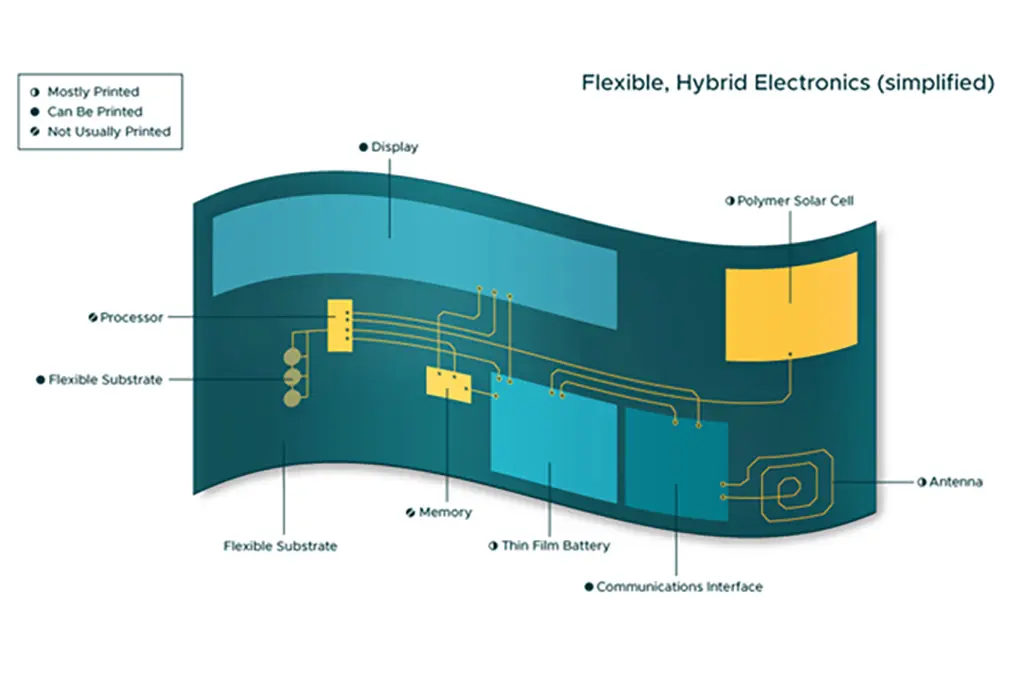
Integrating silicon components, printing with conductive inks and pasting on stretchable substrates yields so-called flexible hybrid electronics (FHE). The term refers to curved and variable form factor integrated devices with both printed components and conventional (although slimmed down) CMOS-based devices. FHE’s advantage is that it preserves the full operation of traditional electronic circuits but in conformable architectures.

Over the past few years and in recognition that it is important to share information as well as collaborate with multiple entities on FHE projects, major U.S. and international companies have formed public/private consortiums to launch targeted, large-scale programs with significant government funding to develop these new technologies.

For example, to advance the growth of the FHE ecosystem, the public/private partnership SEMI-FlexTech recently issued a Request for Proposal (RFP) for a demonstrable, modular multi-disciplinary FHE sensing system applicable to flexible, lightweight mobile and/or curved constructions. Another RFP asks for renewable, sustainable power systems employing flexible hybrid electronic components.

The SEMI-Flextech proposal process consists of two stages starting with a white paper review. White papers will be accepted until March 1, 2019, at 5:00 p.m. PST. Full proposals will be due by April 15, 2019, and award notifications will be issued on or about June 1, 2019.

Approximately $5 million is allocated for these projects. Primary funding will be provided by the U.S. Army Research Laboratory (ARL) through SEMI-FlexTech.

NextFlex is another consortium of companies, academic institutions, non-profits and state, local and federal governments with a shared goal of advancing U.S. manufacturing of FHE. Formed in 2015 through a cooperative agreement between the US Department of Defense (DoD) and the FlexTech Alliance, the consortium is currently developing an FHE PDK and a Modeling and Design Roadmap.

featured image: A simplified example of a curved FHE (Source: NextFlex)

Related

Recent Posts

Illustration of a thin-film capacitor stack with TiN electrodes and an ultrathin hafnium zirconium oxide ferroelectric layer on silicon

Sub-Volt Ferroelectric HZO Capacitor Pairs Speed and Endurance

6.11.2026
6
Cut-open lithium-ion capacitor pouch cell showing stacked carbon electrodes and separators, with vials of carbon powder

Lithium-Ion Capacitor Review Backs Hard Carbon//AC Pairing

6.11.2026
5
Rack power shelf in an AI data center with film DC-link capacitors, a supercapacitor bank and a converter board

800 VDC AI Data Centers Reshape Capacitor Demand for 2027

6.11.2026
11
Schematic of a titanium nitride thin-film inductor within a CMOS poly-resistor stack beside its integrated resonator circuit.

TiN Superinductors Bring Compact Cryogenic Inductance to CMOS

5.11.2026
18
YAGEO PMT6397 push-pull transformer with a segmented toroidal winding and surface-mount terminals

YAGEO Releases Push-Pull Transformers for Isolated 3 W Supplies

5.11.2026
8

Transformer Losses and Thermal Design: Modelling and Validation

4.11.2026
20
Bourns MSF series four-terminal current-sense shunt resistor with radial PCB terminals

Bourns Introduces Four-Terminal Shunt Resistors for Current Sensing

4.11.2026
21
Würth Elektronik WE-SLSP SMT common-mode choke with a square package and four terminals.

Würth Elektronik Releases Common-Mode Chokes for 100 V Data and Power Lines

4.11.2026
26
Schematic diagrams illustrating the physical model of the stripline microinductor.

Stripline Microinductors with Nickel–Iron Oxide Cores

4.11.2026
10

Upcoming Events

Nov 24
16:00 - 17:00 CET

Select the Correct Components for Your DC/DC Converter

Dec 1
16:00 - 17:00 CET

Developing low-noise mixed-signal systems

Dec 8
16:00 - 17:00 CET

WE-CCMF: Design Principles, Layout Guidelines and Measurement Results for High-Speed EMI Filtering

View Calendar

Popular Posts

  • Buck Converter Design and Calculation

    0 shares
    Share 0 Tweet 0
  • September 2026 Interconnect, Passives and Electromechanical Components Market Insights

    0 shares
    Share 0 Tweet 0
  • Boost Converter Design and Calculation

    0 shares
    Share 0 Tweet 0
  • Capacitor Charging and Discharging

    0 shares
    Share 0 Tweet 0
  • LLC Resonant Converter Design and Calculation

    0 shares
    Share 0 Tweet 0
  • RF Connector Types: How To Choose the Right One

    0 shares
    Share 0 Tweet 0
  • Passive Low Pass Filters: Fundamentals and EMI Design

    0 shares
    Share 0 Tweet 0
  • Flyback Converter Design and Calculation

    0 shares
    Share 0 Tweet 0
  • Audio Capacitors: Choosing Capacitors for Crossover Circuits

    0 shares
    Share 0 Tweet 0
  • MLCC and Ceramic Capacitors

    0 shares
    Share 0 Tweet 0

Newsletter Subscription


Passive Components Blog

© 2015–2026
All rights reserved

  • Home
  • Privacy Policy
  • EPCI Membership & Advertisement
  • About

No Result
View All Result
  • Home
  • Knowledge Blog
  • Dossiers
  • PCNS

© 2015–2026
All rights reserved